
15 Best AI Medical Scribes in 2026
Updated July 2026 · By Dr. Giri Rajtosh Purohit, Product Owner, OmniMD
| S.No. | Tool | Best For | Starting Price | Practice Size |
|---|---|---|---|---|
| 1 | DeepScribe | Complex specialty visits | Quote (~$750/mo) | Oncology, cardiology, high-acuity specialties |
| 2 | Abridge | Enterprise ambient scribing, now expanding into pre-bill revenue cycle review (CDI and coding) | ~$208/provider/mo (scribing); revenue cycle product pricing not disclosed | Hospitals, large health systems, and VA medical centers nationwide |
| 3 | Ambience Healthcare | Documentation plus real-time coding | Quote | Large health systems, EDs, inpatient |
| 4 | Dragon Copilot (formerly DAX) | Enterprise compliance and Epic governance | $444 to $600/provider/mo | Health systems, hospitals |
| 5 | IKS Health (Scribble Live) | Human-reviewed accuracy, now with per-visit flexibility (Scribble Select) | Enterprise contract | Large specialty groups and hospitals |
| 6 | OmniMD AI Scribe | Integrated documentation, billing, scheduling | Custom, free 7-day trial | Independent and multi-specialty practices |
| 7 | Glass Health | Scribing plus clinical decision support | Free to $200/mo | Solo to mid-size practices |
| 8 | Suki AI | Ambient scribing plus native in-EHR voice dictation, proven at enterprise scale | ~$299 to $399/provider/mo (ambient); Suki Dictation also sold standalone via API/SDK | Multi-specialty, primary care, and large health systems |
| 9 | Nabla Copilot | Telehealth, multilingual care, and native on-device EHR dictation | Free to ~$119/mo | Virtual, hybrid, international, and health-system practices |
| 10 | Freed | Simple solo practice scribing | From $39/mo | Solo clinicians, small practices |
| 11 | Heidi Health | Agentic AI: ambient scribe plus supervised agents that complete visit admin (draft referrals, prep charts, arrange follow-ups, read/write appointments and clinical mail) | Free tier; paid plans from ~$99/mo (Scribe tiers). Heidi II: no firm price yet (reported Oct 1: first month of agentic access free for clinician-tier subscribers, then a credit-based add-on; token-based pricing, Heidi absorbing compute costs for now) | Was: small practices / international clinicians. Now: health systems and large practices (Beth Israel Lahey Health, NHS Midlands named as customers) |
| 12 | Twofold Health | Lowest price, privacy-first | $49 to $69/mo | Solo and small practices |
| 13 | Sunoh.ai | High-volume passive ambient scribing | ~$149/user/mo | Urgent care, walk-in clinics |
| 14 | SPRY AI Medical Scribe | Therapy and rehab documentation | Tiered by visits | PT, OT, rehab practices |
| 15 | S10.AI | Works with any EHR including legacy systems | ~$99/provider/mo | Independent practices on older EHRs |
Update (2026): Heidi launches agentic admin
Heidi II (launched September 28, 2026) adds supervised agents on top of the ambient scribe: it can review a day’s visits, draft referral letters and reminders, and run that as a recurring “Routine” a clinician approves before it completes, while also surfacing citation-backed research from partners like NEJM and Cochrane at the point of care.
Why it matters for buyers: Heidi is now pitching health systems, not just small clinics, backed by a $340M financing package at a $900M valuation announced September 22, 2026. If you’re a midsize or large practice evaluating AI scribes, Heidi belongs in the enterprise set alongside Abridge, Dragon Copilot, and Ambience. Heidi II pricing isn’t firm yet; reported terms are a free first month of agentic access for clinician-tier subscribers, then a credit-based add-on.
OmniMD AI Scribe is #6 on this list. We built our own AI medical scribe with HIPAA BAA included at no extra cost, 98.65% accuracy, and active deployments across 600+ clinics. See how OmniMD AI Scribe works for your practice.
Why We Wrote This
We have spent over 20 years working directly with independent physicians, growing group practices, and multi-specialty clinics. We know where documentation workflows break down and what actually helps.
The problem is real and well-documented. Here is what the data says about a typical physician’s week in 2024, based on AMA Organizational Biopsy data from nearly 18,000 physicians across 100-plus health systems:
- Only 27.2 of the average 57.8-hour workweek goes to direct patient care
- 13 more hours per week go to tasks like documentation, order entry, and reviewing test results
- Over 20% of physicians spend more than 8 hours per week on EHR work after normal hours
- For every 8 hours of scheduled patient time, physicians spend more than 5 hours in the EHR
This is not just a time problem. Spending too much time on paperwork leads to more medical errors, less time with patients, and doctors leaving practice earlier. A 2025 survey by Tebra found that documentation was the top cause of burnout for 16% of all providers, and 26% of primary care physicians.
The good news is that AI scribing work. The research now proves it:
- A Yale-led study published in JAMA Network Open in October 2025 tracked 263 doctors and advanced practice providers across six U.S. health systems for 30 days. Burnout dropped from 51.9% to 38.8%. Doctors also spent less time charting after hours and felt more focused on patients during visits.
- A separate JAMA Network Open study of more than 1,400 clinicians at Mass General Brigham and Emory Healthcare found a 21.2% drop in burnout at Mass General Brigham after 84 days, and a 30.7% improvement in documentation-related wellbeing at Emory after 60 days.
- A 2025 UCSF study in JAMA Network Open found that doctors using AI scribes earned about $3,044 more per year and saw 0.8 more patients per week, with no rise in claim denials.
- The Permanente Medical Group found in NEJM Catalyst in 2025 that AI scribes saved their physicians 15,791 hours of documentation time in a single year.
These results come from multiple health systems, not one vendor’s marketing page. The question in 2026 is not whether to use an AI scribe. It is which one fits your practice, your EHR, and your day-to-day workflow.
What Vendor Marketing Usually Gets Wrong
After 20 years of helping providers implement health IT tools, we have seen the same gaps show up over and over in vendor content. Here is what most product comparisons miss.
#1 ‘Compatible with Epic’ can mean very different things.
Some tools write notes directly into discrete EHR fields, read your patient’s prior chart before the visit, and map to billing codes automatically. Others just copy text into a blank note field. These are completely different workflows with very different outcomes for billing, documentation quality, and staff time.
#2 Accuracy on simple visits does not equal accuracy on complex ones.
A tool may do well on a 15-minute primary care visit and struggle badly on a 45-minute oncology consultation with multiple active problems and HCC-relevant diagnoses. A July 2025 competitive analysis in JAMA Open tested six AI scribes in primary care and found that none were consistently error-free, and all performed worse as visits got longer and more complex.
Expert Advise: Ask vendors to demo using your actual visit types before you commit.
#3 AI scribes can help revenue, but payers are pushing back.
Better documentation from AI tools can improve coding completeness and reduce claim denials. A 2025 Trilliant Health study of national claims data across six health systems found clear upward shifts in E/M billing codes after AI scribe adoption. That is a real benefit when it reflects legitimately better documentation. However, Cigna began in October 2025 applying automated review to many level 4 and 5 E/M claims.
Expert Advise: Do not project revenue gains without understanding how your payer mix will respond.
#4. The real cost is higher than the subscription price.
Implementation labor, EHR integration fees, provider learning time, per-note overage charges, and legal review of the Business Associate Agreement can together exceed the subscription cost in year one, especially for enterprise tools.
#5. HIPAA compliance claims are not all equal.
In November 2025, a proposed class action was filed against Sharp HealthCare alleging that an ambient AI scribe recorded about 100,000 patient visits without proper consent. Legal analysis from Foley and Lardner LLP found real vendor contracts with missing BAA terms, vague indemnity language, and provisions allowing vendors to train AI on patient data.
Expert Advise: Always review the actual BAA, not just the marketing language.
How We Evaluated Each Tool
We used five criteria for every tool in this review:
- Ambient accuracy and specialty fit: Does it capture clinical language naturally, across the specialties that matter to your practice, without needing structured dictation?
- EHR integration quality: Does it write notes directly into chart fields? Does it read prior chart data before the visit? Does it connect to billing codes?
- Compliance and data governance: Does it include a HIPAA BAA by default? What happens to audio after the visit? Does the vendor train AI on your patient data? Is there SOC 2 Type 2 certification?
- Pricing transparency and true cost: Is pricing public? What does the first year actually cost when you add implementation, integration, and overages?
- Third-party proof: Is there a KLAS score, a peer-reviewed study, or a named health system deployment on record?
To make this comparison genuinely useful, we applied these criteria consistently across every tool, focusing on real-world clinical performance, integration depth, and long-term value rather than surface-level features. Let’s get started.
1. DeepScribe
Best for: Specialty practices in oncology, cardiology, orthopedics, urology, and similar fields where visit notes are long, complex, and closely tied to billing accuracy.
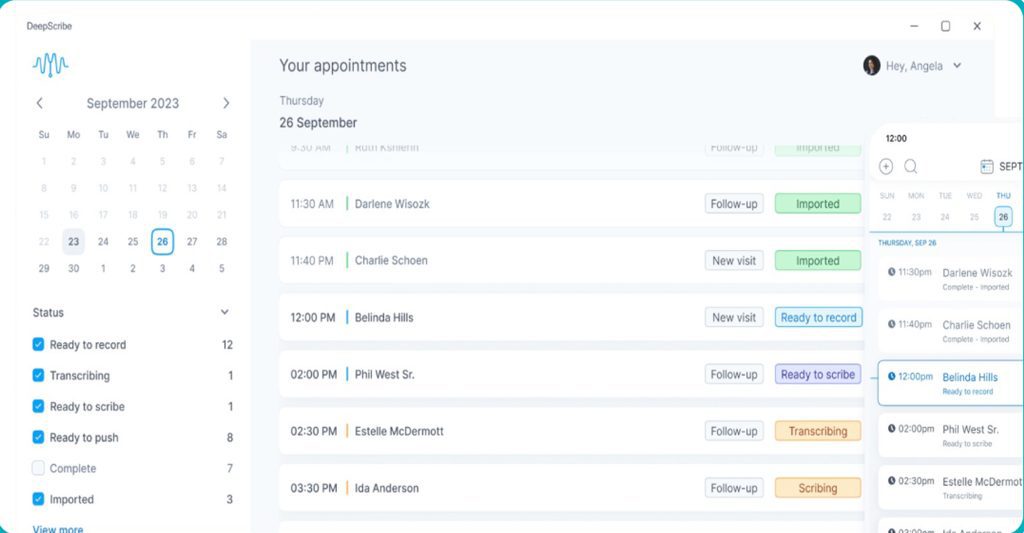
DeepScribe scored 98.8 out of 100 in the January 2025 KLAS Research Emerging Company Spotlight. It received A+ grades in all six measured categories: Product, Value, Operations, Relationship, Loyalty, and Culture. That score is 5.5 points higher than the average 2024 Best in KLAS ambient speech vendor.
In October 2025, KLAS ranked DeepScribe in its Top 5 for three categories in the Emerging Solutions Top 20: Improving Outcomes, Improving Patient Experience, and Improving Clinician Experience.
What makes DeepScribe different from general scribing tools is that its AI models are trained per specialty. It does not treat a 45-minute oncology consultation the same way it treats a 15-minute acute visit.
An August 2025 study in the Journal of Clinical Pathways measuring DeepScribe in oncology found meaningful improvements in diagnosis capture and note quality. Organizations using DeepScribe now see roughly 40% of all cancer care visits in the U.S. documented through their platform.
Key strengths:
- 98.8 KLAS score with A+ in all six categories, the highest score of any ambient AI tool in this review
- Specialty-trained AI models for oncology, cardiology, orthopedics, urology, gastroenterology, and neurology
- Two-way EHR integration with Epic, athenahealth, NextGen, and eClinicalWorks, reads chart data before the visit, writes structured notes back after
- HCC, CPT, and ICD-10 coding built into the note, not added as a separate step
- Learns each provider’s individual documentation style over time
Limitations:
- Pricing is quote-based at roughly $750/provider/month, which is hard to justify for simple primary care workflows
- Works best for specialists seeing complex patients, not short low-acuity visits
- No self-serve option; all sign-ups go through a sales process
Pricing: Quote-based, estimated at roughly $750/provider/month. KLAS Score: 98.8 out of 100, January 2025 KLAS Emerging Company Spotlight.
2. Abridge
Best for: Hospitals and large health systems that want the most research-backed ambient scribing tool available at enterprise scale.
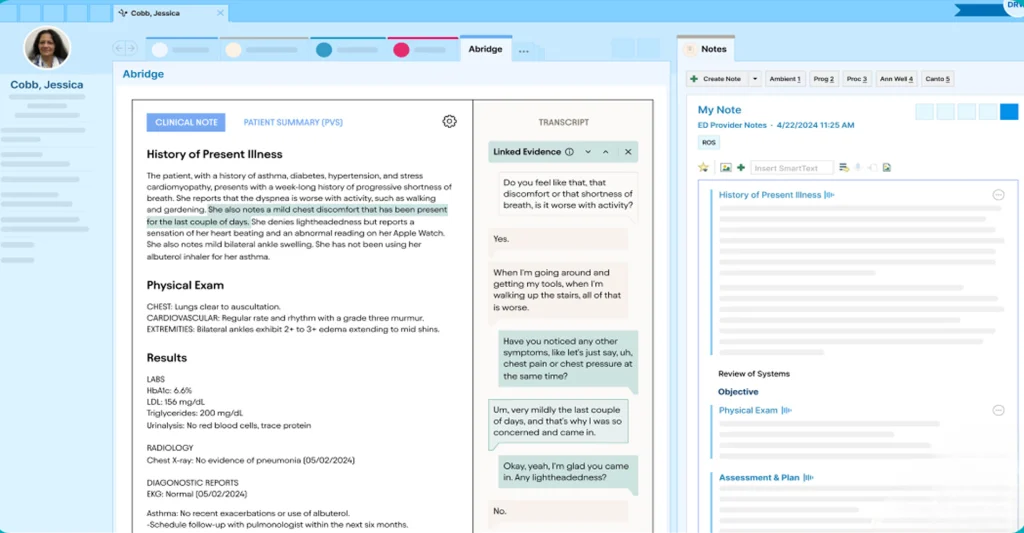
Abridge earned Best in KLAS for Ambient AI in both 2025 and 2026. Fast Company named it the most innovative healthcare company of 2025. It also appeared on TIME’s Best Inventions list and CNBC’s Disruptor list. The company raised $550 million in 2025 across two funding rounds, with its June Series E led by Andreessen Horowitz valuing it at approximately $5.3 billion.
A Yale-led study published in JAMA Network Open, involving 263 clinicians across six health systems, evaluated Abridge. Burnout dropped from 51.9% to 38.8% within 30 days.
At UChicago Medicine, a pilot with about 200 physicians found:
- 90% of clinicians reported giving patients more undivided attention, up from 49% before using Abridge
- 90% said Abridge made them feel more valued by their organization
At Corewell Health, a 90-day pilot with about 100 providers found:
- 85% reported higher job satisfaction
- More than half said they felt less burned out
- After-hours charting fell 48%, from 4.3 hours to 2.2 hours per week
What differentiates Abridge from most scribing tools is its ability to generate structured summaries from conversations rather than simply transcribing them. It also produces patient-facing summaries at an eighth-grade reading level, addressing the well-documented issue that patients retain only about 15% of what is discussed during a visit.
Update (2026): Abridge moves into revenue cycle
In September 2026, Abridge launched a pre-bill review product for CDI and coding teams, using the same clinical data captured during the visit to check coded diagnoses and DRGs against the documentation before a claim is ever submitted. That same month, Abridge was also selected for the VA’s enterprise ambient AI contract (a multi-award IDIQ with a $775.7 million ceiling), building on a pilot already running at more than 75 VA medical centers.
Why it matters for buyers: Abridge is no longer just a scribing vendor. A pre-bill CDI and coding product is squarely in the same category as OmniMD’s AI RCM, not an adjacent feature. If you’re comparing scribes for a midsize or large practice, factor in whether you want your documentation vendor also auditing your claims, versus a single platform like OmniMD that was built end to end for documentation, coding, and billing together.
Key strengths:
- Best in KLAS for Ambient AI in 2025 and 2026, the most consistent independent recognition in this review
- The only tool with burnout outcomes published across two separate peer-reviewed JAMA Network Open multi-site studies
- Patient-facing visit summaries created automatically from the same recording as the clinical note
- Native Epic integration via Haiku and Hyperdrive with no extra switching between apps
- Broad multilingual support for diverse patient populations
Limitations:
- Enterprise pricing only; no option for solo clinicians or small practices
- Onboarding typically takes six or more weeks of IT and clinical workflow coordination
- Not a fit for solo practitioners or small groups
Pricing: About $2,500/user/year (~$208/month) for enterprise deployments.
3. Ambience Healthcare
Best for: Large health systems that need documentation, real-time coding, and clinical documentation integrity in one platform, working across outpatient clinics, emergency departments, and hospital floors at the same time.
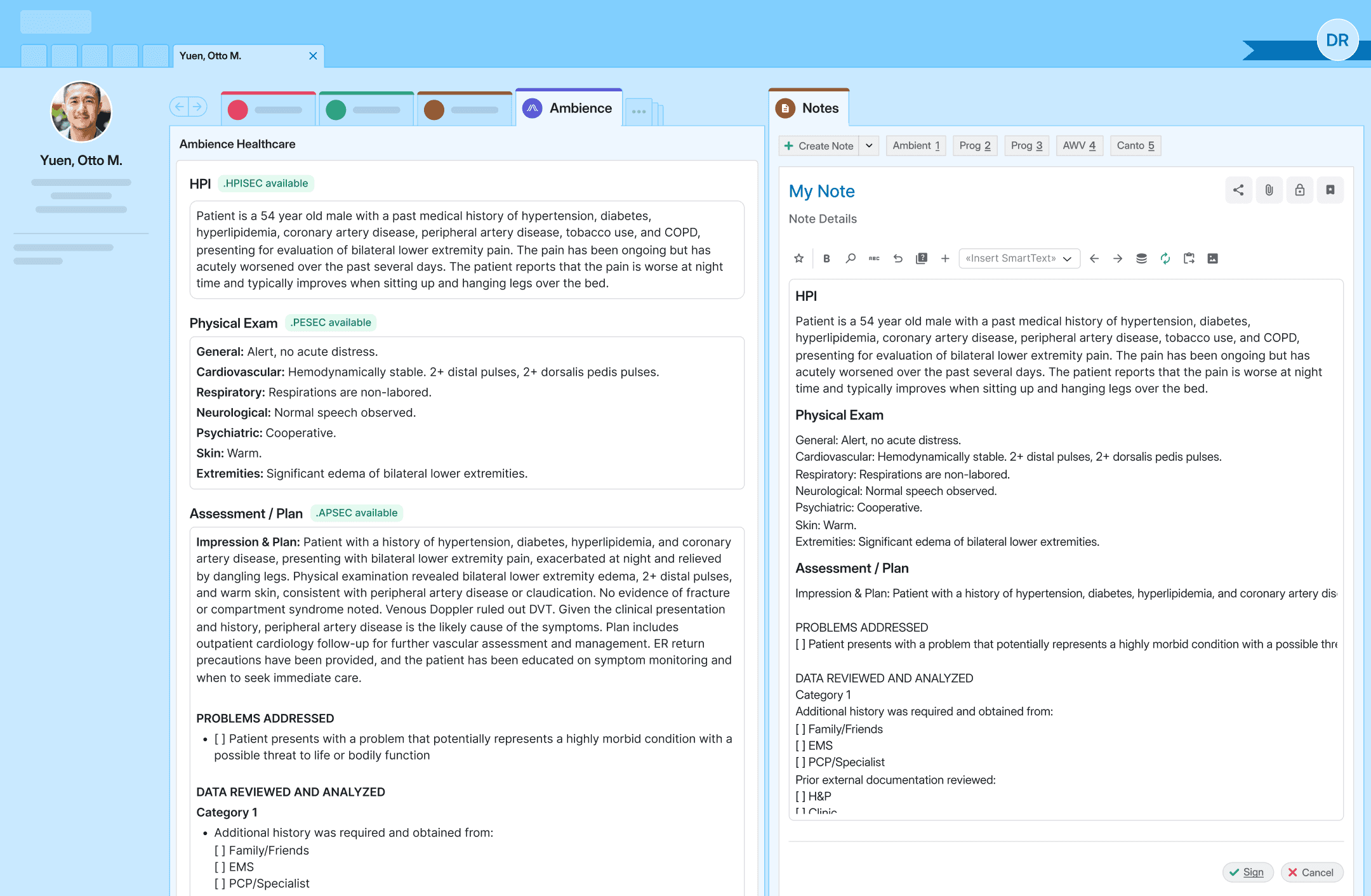
Ambience raised $243 million in Series C funding in July 2025, co-led by Andreessen Horowitz and Oak HC/FT, reaching a $1.25 billion valuation. Investors include the OpenAI Startup Fund, Kleiner Perkins, and Optum Ventures.
More than 40 U.S. health systems use it, including Cleveland Clinic, UCSF Health, Houston Methodist, and Memorial Hermann. Ardent Health announced a full enterprise rollout of Ambience in 2025.
At Cleveland Clinic, the deployment saved clinicians 14 minutes per day on note writing and chart review. Ambience reports about 45% less charting time overall across its deployments.
What sets Ambience apart is that all of its core features run from the same ambient recording:
- AutoScribe creates the clinical note
- AutoCDI applies real-time ICD-10 coding and CDI
- AutoAVS creates a plain-language patient summary
- AutoRefer drafts the referral letter
This means revenue cycle work happens at the point of care, not as a separate workflow after the visit. All integrations with Epic, Oracle Cerner, and athenahealth use native APIs, not screen scraping or clipboard workarounds.
Key strengths:
- Deployed at 40-plus major U.S. health systems with named clients and published outcomes
- Real-time ICD-10 coding and CDI happens during the visit, not after
- Native API integration with Epic, Oracle Cerner, and athenahealth
- Covers 100-plus specialties across outpatient, ED, and inpatient settings in one platform
Limitations:
- Enterprise-only; no solo or individual clinician option
- Full implementation is a large IT project, not a quick setup
- Pricing is not public; requires direct contact with the vendor
Pricing: Enterprise contract.
4. Dragon Copilot, formerly Nuance DAX Copilot (Microsoft)
Best for: Large health systems that need the strongest compliance architecture, data residency controls, and the deepest native EHR integration built on Microsoft infrastructure.
Nuance DAX Copilot runs inside Microsoft’s healthcare cloud and connects natively with Epic and Oracle Health. Of all the tools in this review, it has the most mature compliance setup, including data residency controls, full audit trails, and enterprise security architecture. Note: Microsoft folded DAX Copilot into its unified Dragon Copilot brand back in March 2025. Existing DAX Copilot customers keep their current contracts, but new buyers now purchase under the Dragon Copilot name. In August 2026, Microsoft also opened a Dragon Copilot app and agent marketplace, letting partners like Optum and Regard publish add-ons directly into the clinician workflow.
A 2024 survey of thousands of DAX users found:
- 70% reported less burnout and fatigue
- 50% less time spent on clinical documentation
- 7 minutes saved per patient visit on average
- 5 more appointments managed per clinic day on average
A 2025 JAMA Network Open study of 46 clinicians using DAX Copilot in Epic found greater efficiency, less mental burden from documentation, and better patient engagement during visits. DAX also won the VA’s 120-Day AI Tech Sprint in 2024 as the top ambient documentation tool among 150-plus competing companies. At Stanford Medicine, a preliminary clinician survey found 96% said it was easy to use and 78% said it made notetaking faster.
Key strengths:
- Deepest native Epic and Oracle Health alignment of any tool in this review
- Strongest data residency, audit trail, and compliance governance architecture
- Won the VA’s 2024 AI Tech Sprint across 150-plus competing tools
- Tested head-to-head against Nabla in a published randomized clinical trial
- Built on Microsoft Azure with end-to-end enterprise security
Limitations:
- Most expensive tool in this review at $444 to $600/provider/month plus setup fees
- Implementation takes 2 to 6 weeks of active IT involvement, which does not show up in the subscription price
- Deep Microsoft dependency creates real vendor lock-in risk
Pricing: $444 to $600/provider/month plus setup fees. Confirm with the vendor.
5. IKS Health (Scribble Live)
Best for: Clinical settings where a human reviews and verifies every note before it goes into the chart, because contract requirements, payer standards, or organizational policy demand it.

IKS Health won the 2026 Best in KLAS award for Virtual Scribing Services for the second year in a row, scoring 91.9 out of 100 with A-grades in four of five customer experience categories. This is confirmed in the 2026 Best in KLAS Awards Software and Services Report. IKS Health has now earned Best in KLAS recognition eight years in a row.
IKS’s Scribble Live works by combining AI transcription with a human quality review step before notes enter the chart. Notes are usually ready 30 to 60 minutes after a visit rather than immediately. That lag is the tradeoff for a level of accuracy that fully automated AI tools cannot guarantee in every clinical situation.
Scribble Live is listed in Epic’s Connection Hub. IKS Health also scored 91.8 in revenue cycle management and 89.9 in transcription in the same KLAS report, making it a broader partner beyond just scribing.
Update (2026): In August 2026, IKS Health launched Scribble Select at Western Washington Medical Group (100-plus providers across 20-plus specialties), letting clinicians pick AI-only, AI-with-human-validation, or fully clinician-reviewed notes on a per-visit basis instead of one fixed review level for every encounter.
Key strengths:
- 91.9 KLAS score, Best in KLAS 2026 for Virtual Scribing Services, two years running
- Human review step provides a reliability floor that fully automated AI tools cannot currently match in every case
- Listed in Epic’s Connection Hub, which validates Epic compatibility at an independent review level
- Also recognized with 91.8 KLAS in revenue cycle management and 89.9 in transcription
- Eight consecutive years of Best in KLAS recognition across its service lines
Limitations:
- Notes take 30 to 60 minutes to arrive because of the human review step; this does not work for practices that need the chart updated immediately after the visit
- Enterprise contract only; no option for small practices
- Higher cost per note than AI-only tools at scale
Pricing: Enterprise contract. Contact the vendor directly. KLAS Score: 91.9 out of 100, Best in KLAS 2026, Virtual Scribing Services.
6. OmniMD AI Scribe
Best for: Independent and multi-specialty practices that want documentation, billing, scheduling, and analytics to work together in one system, not as separate tools that need to be reconciled.
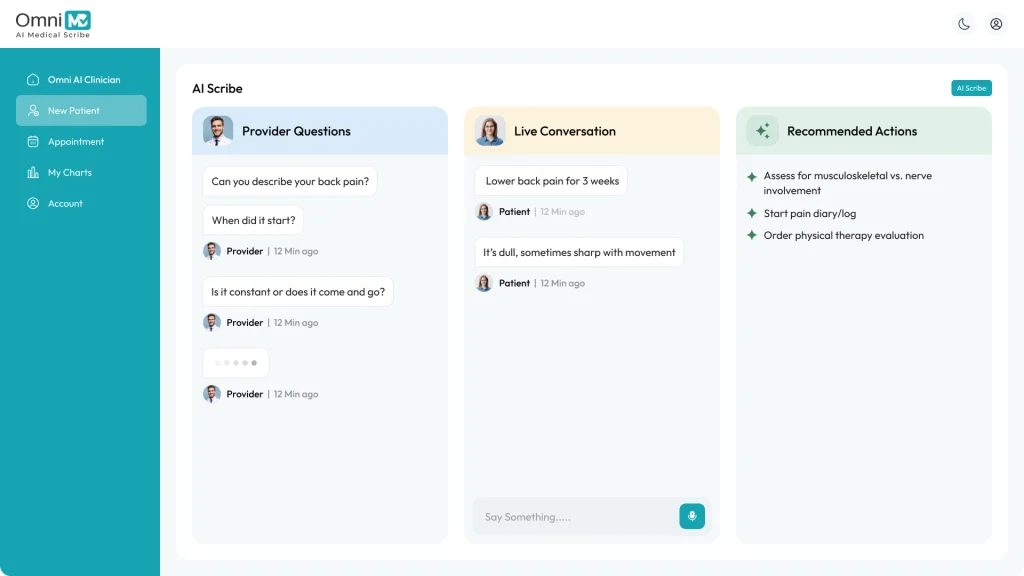
OmniMD has served more than 12,000 providers for over 20 years. That operational depth shaped how the AI Scribe was built: around the real friction points where documentation errors become billing errors, not just around the documentation step in isolation.
The biggest difference between OmniMD AI Scribe and every other tool in this review is that it lives inside OmniMD’s EHR, Practice Management, and Revenue Cycle platform. Notes flow directly into billing and scheduling without any handoff, API bridging, or manual reconciliation. For multi-specialty practices where a coding error in one department affects billing across the whole practice, eliminating that handoff matters.
Our key features include, but are not limited to:
- Multi-speaker separation that keeps track of who said what, including patients, providers, nurses, and care team members in the same room
- Built-in multilingual support for diverse patient populations
- Native SMART-on-FHIR connectivity plus HL7 and secure API bridges to other leading EHRs
- Notes, scheduling, billing, and analytics update in real time in the same system
- Supports 20-plus specialties with specialty-specific templates
- ONC-certified EHR foundation
- 7-day free trial with no credit card required
For practices not currently on OmniMD’s EHR: getting the full integration benefit means using OmniMD as your EHR platform, not just adding a standalone scribing tool. For practices already on OmniMD, or those evaluating a full platform switch, the unified workflow removes overhead that all other scribing tools in this review still carry.
Key strengths:
- Notes flow directly into billing, scheduling, and analytics with no third-party handoff
- Multi-speaker separation preserves clinical context from every person in the room
- Multilingual ambient capture with speaker identification
- ONC-certified EHR with SMART-on-FHIR, HL7, and API interoperability
- Free 7-day trial available before any financial commitment
- Built by a team with 20-plus years of hands-on experience serving 12,000-plus providers
Limitations:
- Pricing is custom; no public tier structure, requires direct contact
- Third-party clinical outcomes evidence is less extensive than Abridge or Nuance DAX
Pricing: Custom pricing based on provider count and modules selected. Start a 7-day free trial or contact us directly.
7. Glass Health
Best for: Physicians who want AI scribing and clinical decision support in the same tool, especially those managing complex or diagnostically unclear cases where both note writing and clinical reasoning support are needed.
Glass Health is the only tool in this review that combines ambient scribing with a built-in clinical decision support layer. While every other tool in this list focuses on documentation, Glass Health also helps with the thinking step: it generates structured differential diagnoses across three tiers (Most Likely, Expanded, and Can’t Miss), creates evidence-backed assessment and plan drafts, and answers clinical questions with citations to guidelines and medical literature.
Pricing is publicly listed at four tiers:
- Lite: Free, no credit card required; limited scribing and limited CDS included
- Starter: $20/month
- Pro: $90/month; unlimited scribing plus the full clinical decision support platform
- Max: $200/month; includes direct Epic, eClinicalWorks, and athenahealth integration via SMART on FHIR
The Pro plan at $90/month delivers both documentation and clinical reasoning for less than most documentation-only tools charge at their standard paid tier.
Key strengths:
- The only tool in this review combining ambient scribing with structured differential diagnosis, evidence-backed A&P generation, and clinical Q&A
- Fully public pricing from free to $200/month; no sales call needed to start
- Free Lite tier includes both scribing and CDS features with no credit card
- Epic, eClinicalWorks, and athenahealth integration available at the Max tier
Limitations:
- English only; not suitable for multilingual clinical settings
- The CDS features require the clinician to review and act on the outputs; it is not passive automation
- Newer to the market with less enterprise track record than Abridge, Nuance DAX, or OmniMD
Pricing: Free to $200/month.
8. Suki AI
Best for: Clinicians who prefer using their voice to navigate documentation rather than relying on passive ambient listening, and who need coding support alongside note generation.
Suki has been in continuous clinical use since 2017, making it the longest-running ambient scribing tool in this review. It offers two-way integration with Epic, Oracle Health, athenahealth, and MEDITECH, confirmed on the vendor’s own integration page.
Unlike passive ambient tools that just listen and transcribe, Suki lets providers issue voice commands mid-visit. You can pull up patient history, stage orders, and trigger documentation steps without touching a screen. Suki also connects to UpToDate via a Wolters Kluwer partnership, adds ambient order staging, and supports ICD-10 and HCC coding alignment built into the documentation workflow.
Update (2026): Suki expanded its enterprise-wide rollout at Austin Regional Clinic, a 40-location, 700,000-plus patient multispecialty group in Texas, reporting an 18.5% cut in documentation time per encounter and an average $1,452 annual gain per provider from more accurate E/M coding. In August 2026, Suki also launched Suki Dictation, a standalone dictation tool built natively into Epic and MEDITECH that clinics can deploy on its own or alongside Suki’s ambient listening, instead of being locked into an all-or-nothing documentation bundle. The company is also making it available through APIs and SDKs for other health-tech vendors to build on.
Key strengths:
- Longest active deployment track record in this review at seven years
- Two-way integration with Epic, Oracle Health, athenahealth, and MEDITECH, confirmed on the vendor’s integration page
- ICD-10 and HCC coding built into the documentation workflow
- Ambient order staging reduces post-visit work for high-volume primary care and internal medicine
- UpToDate reference surfacing during visits via Wolters Kluwer
- SOC 2 Type 2 certified and HIPAA compliant
Limitations:
- Pricing is not public; requires a sales conversation; estimated at roughly $299 to $399/provider/month
- Voice-command workflow takes one to two weeks for providers used to typing; not ideal for those who prefer fully passive ambient capture
Pricing: Roughly $299 to $399/provider/month, not publicly listed.
9. Nabla Copilot
Best for: Clinicians working across telehealth and in-person visits who need consistent cross-device performance and the strongest privacy setup of any tool in this review, especially in multilingual or international practice settings.
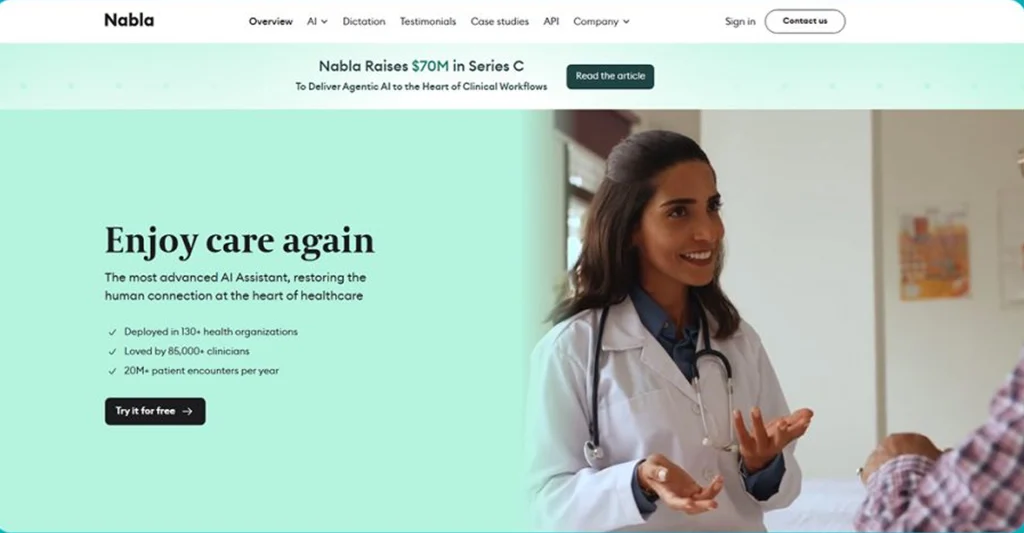
Nabla was founded in Paris in 2018 and now serves 85,000-plus clinicians at 130-plus healthcare organizations, handling more than 20 million patient encounters per year. It raised a $70 million Series C in 2025 and supports 55-plus specialties across 35-plus languages.
Update (2026): In July 2026, Nabla named Brian Manning, former president of Bamboo Health, as CEO to lead its next phase of enterprise growth. Around the same time, Nabla launched a fully on-device clinical dictation app built for Apple hardware with native Epic integration, a clear move beyond its original telehealth and multilingual positioning and into health-system deals.
Nabla’s privacy setup is the most thoroughly documented of any tool in this review:
- HIPAA compliant
- GDPR compliant
- SOC 2 Type 2 certified
- ISO 27001 certified
- Does not store audio by default
- Does not train its AI models on customer data
For practices in behavioral health, practices serving international patients, or practices where recording sensitivity is especially high, this level of specificity matters in ways that a general “HIPAA compliant” claim does not cover.
A UCLA randomized clinical trial published in 2025, covering 238 outpatient physicians across 14 specialties, directly compared Nabla against DAX Copilot in an Epic setting.
Key strengths:
- HIPAA, GDPR, SOC 2 Type 2, and ISO 27001 certified, the strongest multi-framework privacy posture in this review
- Does not store audio and does not train its models on patient data by default
- 55-plus specialty support across 35-plus languages, the broadest multilingual coverage among mid-market tools
- Works consistently across web, iOS, and Android with no friction when switching between devices
Limitations:
- Fewer native EHR integrations than enterprise tools; copy-paste is still common in some EHR environments
- Less specialty customization at the high end compared to DeepScribe or Suki
Pricing: Free tier available; paid plans at roughly $119/month.
10. Freed
Best for: Solo clinicians who want a clean, simple, affordable paid scribe that they can set up and start using the same day without IT help.
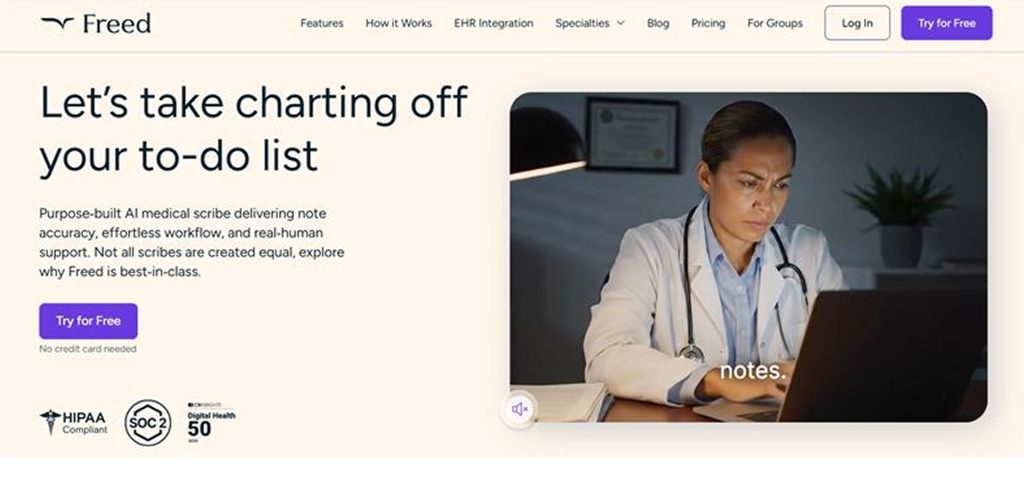
Freed was built by physicians for physicians. The whole product is focused on one task: record a visit, get a structured note, sign it.
Current pricing tiers as of May 2026:
- Starter: $39/month billed annually for up to 40 notes per month
- Core: $79/month for unlimited notes with an AI editing assistant
- Group and Enterprise: Custom pricing for two or more providers
- Student and Resident discount: 50% off the individual plan
- 7-day free trial with no credit card required
Freed holds SOC 2 Type II certification, includes a HIPAA BAA by default, and lets users auto-delete recordings and opt out of model training on their data.
Update (2026): Freed added Clinical Evidence, a built-in feature on Core plans and above that lets clinicians ask a clinical question mid-visit and get a cited answer pulled from 50-plus vetted medical sources. It is a useful add, but Freed is still built and priced for solo and small-practice use, not the enterprise deployments other tools on this list are chasing.
Key strengths:
- Clear, public pricing starting at $39/month
- Sets up in under one hour with no IT team needed
- SOC 2 Type II certified with HIPAA BAA included and audio auto-deletion available
- Unlimited notes on Core and higher plans with no throttling
- 7-day free trial, no credit card required
Limitations:
- Limited native EHR integration; most users copy and paste notes into the chart
- Not designed for complex specialty visits, high-acuity multi-problem encounters, or coding alignment
- Less clinical outcomes evidence than enterprise tools
Pricing: From $39/month. Please confirm current tiers with the vendor.
11. Heidi Health
Best for: Clinicians and small practices anywhere in the world who need fast setup, a real free tier, and support for many languages.
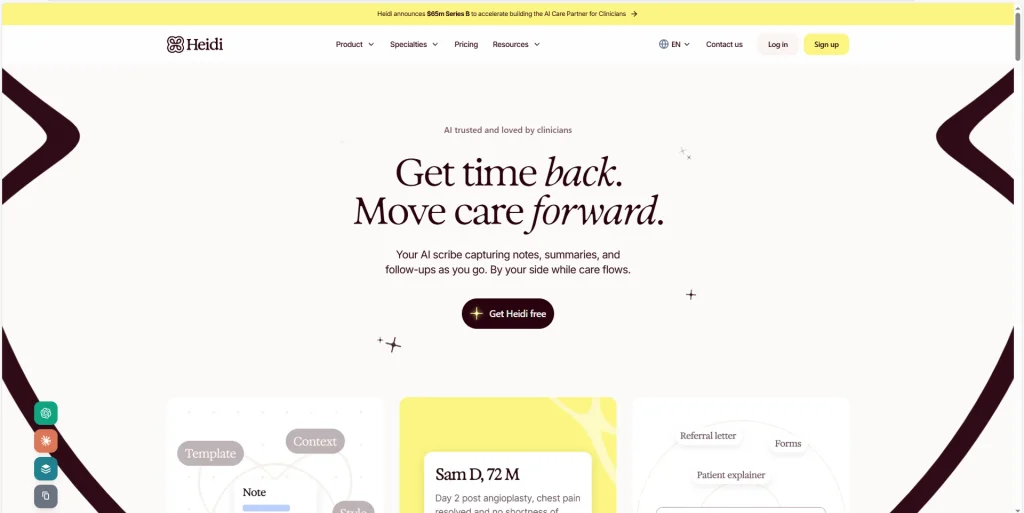
Heidi Health started as one of the fastest-to-deploy ambient scribes (free tier, 110+ languages, same-day setup) and was easy to file under “small-practice tool.” That filing is now wrong. With Heidi II (September 2026), Heidi’s product completes the administrative work around the visit (referrals, chart prep, follow-up scheduling) through supervised agents, while new EHR connectors and citation-backed clinical evidence aim squarely at health-system workflows. Scale is real: 2.8M patient visits/week, 175M+ visits documented to date, 67M clinical hours. The free tier still exists, which keeps Heidi accessible to small clinics, but its roadmap and funding ($340M at a $900M valuation) point at enterprise. Choose Heidi if: you want the fastest path from scribe to agentic admin and your team is comfortable with clinician-supervised automation. Choose OmniMD AI Scribe instead if: you need documentation, billing, and scheduling in one platform rather than stitching a scribe to your existing EHR, and want a single vendor accountable for the whole workflow.
Key strengths:
- Free tier with no expiration and no credit card needed for basic notes
- More than 2 million visits per week across 116 countries and 110 languages, the broadest global reach of any tool in this review
- Sets up in under an hour with no IT involvement
- 300-plus specialty coverage
- Founded by clinicians; requires human review of all AI outputs
Limitations:
- Free tier limits advanced Pro Actions to ten per month; busy practices will need a paid plan
- Pro plan at $99/month is more expensive than Twofold Health for similar core functionality
- Direct EHR write-back requires team or enterprise plan; not available on free or entry-level paid tiers
Pricing: Free tier available; Pro at $99/month or about $66/month billed annually.
12. Twofold Health
Best for: Solo clinicians and small practices who want the lowest verified annual price for unlimited scribing and the strongest audio deletion privacy setup.
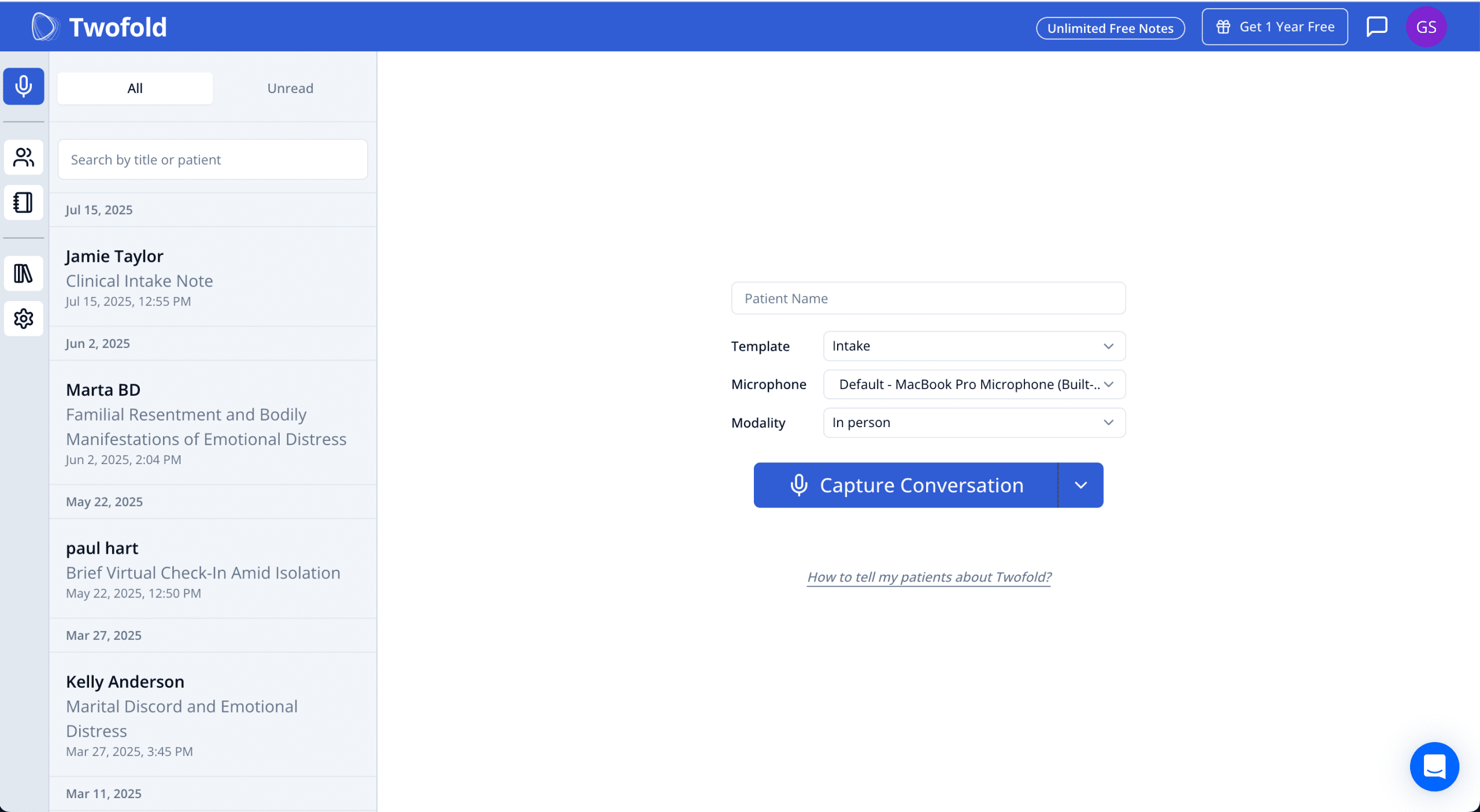
Twofold Health lists its pricing publicly: $49/month billed annually or $69/month billed monthly, with unlimited notes and no throttling. Independent price comparisons from Q4 2025 confirm this is the lowest publicly listed price for unlimited notes among AI scribing tools with published individual pricing.
Twofold’s defining privacy feature is that audio is automatically deleted after processing. Nothing is stored. The platform is HIPAA and HITECH compliant with a BAA included as standard. It earns 4.9 out of 5 on both G2 and Capterra from verified clinician reviewers, with reviewers consistently noting note drafts in under 30 seconds.
Key strengths:
- Lowest verified public price among unlimited-note AI scribes at $49/month billed annually
- Audio deleted automatically after processing; nothing stored
- 4.9 out of 5 on both G2 and Capterra from verified clinician reviewers
- Notes generated in under 30 seconds based on consistent user reports
- Works across iOS, Android, and desktop with the same features on every device
Limitations:
- Fewer clinical research studies than tools with longer track records
- Less depth for high-complexity specialty encounters
- Newer product with a shorter market history than Freed or Heidi
Pricing: $49/month billed annually or $69/month billed monthly.
13. Sunoh.ai
Best for: Urgent care clinics, walk-in centers, and high-volume outpatient settings that need reliable passive ambient scribing with zero learning curve for providers.
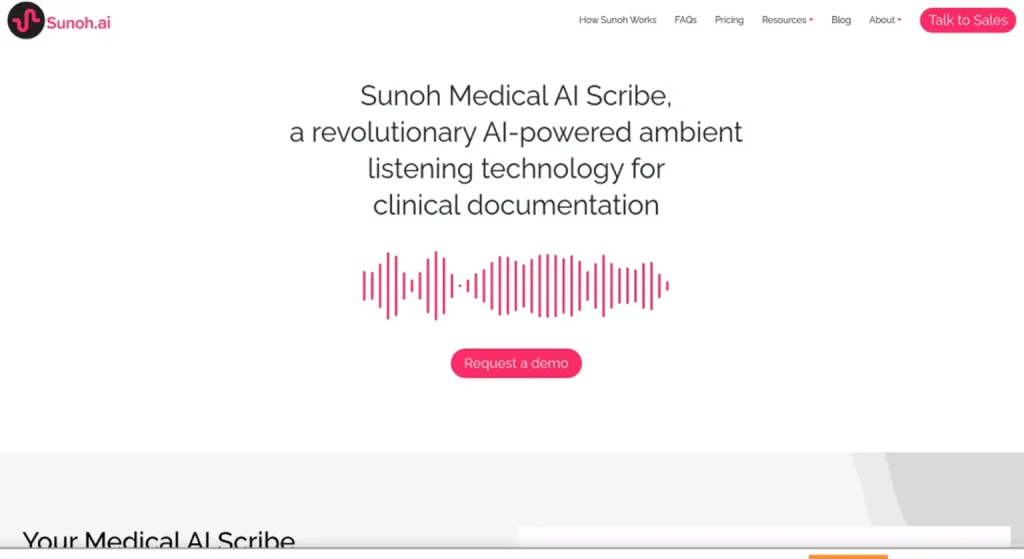
Sunoh.ai is designed for fast-moving clinical environments where asking providers to change how they talk or document is not realistic. It uses fully passive ambient listening: no voice commands, no trigger phrases, no change at all to how providers speak or examine patients.
Key strengths:
- Fully passive ambient listening with no training or commands needed
- Works on mobile, tablet, and desktop
- About $149/user/month, competitive for the outpatient segment
Limitations:
- Less reliable on complex, multi-problem visits compared to specialty-trained tools
- Fewer third-party clinical outcome studies than established vendors
Pricing: About $149/user/month.
14. SPRY AI Medical Scribe
Best for: Physical therapy, occupational therapy, and rehabilitation practices that need SOAP note generation built specifically for therapy workflows.
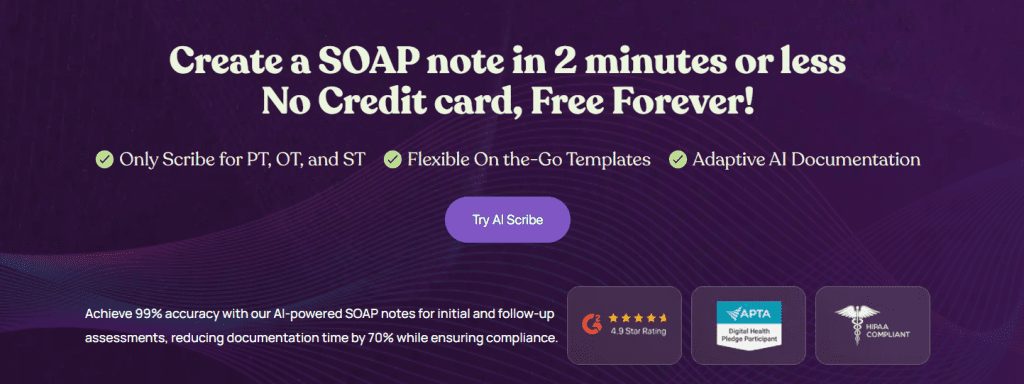
SPRY’s AI Medical Scribe is built into a clinical and practice management platform designed for therapy settings. Its note engine is trained on SOAP-format documentation, the standard structure for PT and OT visits. It also learns each provider’s individual style over time, so the notes need less editing the longer you use it.
One important point for anyone evaluating SPRY: adopting the AI Scribe means adopting the full SPRY EMR platform. It is not a standalone scribing tool. This is a platform selection decision, not just a documentation tool purchase.
Key strengths:
- Generates real-time SOAP notes trained specifically on therapy and rehab documentation
- Learns each provider’s individual documentation style over time
- Fully integrated with SPRY’s clinical and practice management platform
Limitations:
- Requires adopting the full SPRY EMR platform; no standalone deployment option
- Not suited for medical specialties outside therapy and rehabilitation
- Pricing is not publicly listed
Pricing: Tiered by visit volume.
15. S10.AI
Best for: Independent and small group practices on older or non-standard EHR platforms where the major vendors’ native integrations simply do not exist.
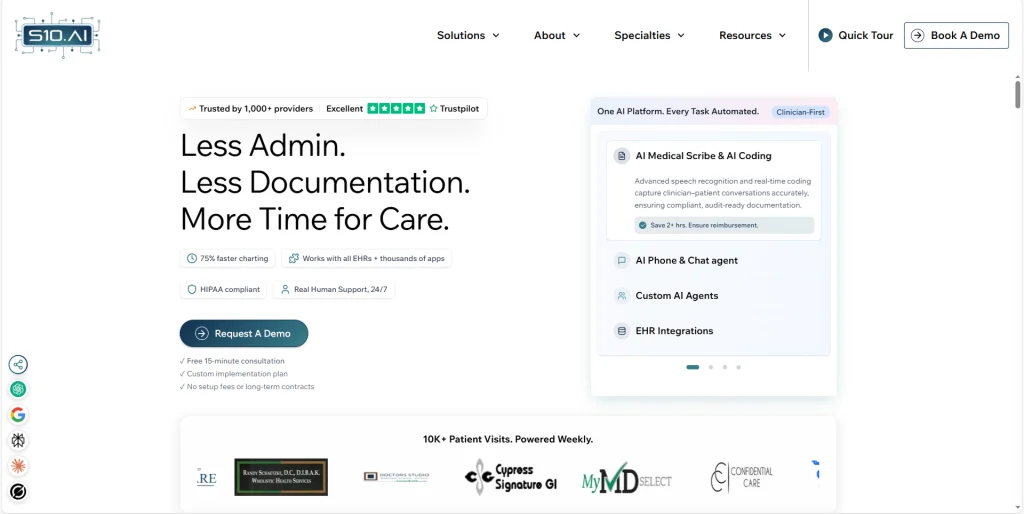
S10.AI is built for broad EHR compatibility rather than deep native integration with a handful of major platforms. It works alongside virtually any EHR, including legacy systems, using specialty-aware templates and clipboard-friendly output.
Key strengths:
- Works with non-standard and legacy EHR platforms that most other tools cannot connect to
- About $99/provider/month, competitive for a standalone scribing tool
- Fast setup with specialty-aware templates
Limitations:
- Copy-paste workflow adds a step that native-integration tools eliminate
- Less third-party validation than established vendors
- Non-native integration requires more configuration and handoff steps
Pricing: About $99/provider/month.
How AI Medical Scribes Actually Work: 5 Real Workflow Models
Most AI scribe comparisons group tools by features or pricing tiers. That approach looks neat on paper, but it does not reflect how these systems actually behave in clinical environments.
In practice, AI medical scribes fall into five distinct workflow architectures. These architectures matter far more than brand names because they determine:
- How much clinicians interact with the tool during a visit
- How deeply it integrates with the EHR
- How documentation and coding are generated
- What kind of practice it actually fits
Below is a clearer way to understand the market.
1. Enterprise Ambient Intelligence Platforms (System-Level Automation Layer)
Includes:
- Abridge
- Ambience Healthcare
- Nuance
How the workflow works
These platforms operate as a passive ambient layer inside the clinical system.
- The visit conversation is continuously captured in the background
- AI models process the entire encounter into multiple outputs simultaneously
- Clinical note
- Structured summary
- Coding signals (varies by platform)
- Patient-facing summaries (in some systems)
- Outputs are pushed into the EHR environment
- The clinician performs a final review and signs off
There is minimal interaction during the visit itself.
Deployment model
These are enterprise infrastructure systems, not standalone tools:
- Integrated into Epic or Oracle environments
- Deployed across entire health systems
- Require IT-led rollout and governance alignment
Where they work best
- Hospital systems
- Academic medical centers
- Multi-specialty health networks
- High documentation + high compliance environments
What makes this model different
This category does not ‘assist documentation.’
It replaces large parts of the documentation workflow inside the health system itself.
Operational tradeoffs
- Long implementation cycles (often multiple weeks)
- High cost and IT dependency
- Not viable for small or independent practices
- Strong dependency on EHR ecosystem alignment
2. Specialty-First Clinical Intelligence Platforms (Adaptive Documentation Systems)
Includes:
- DeepScribe
- Suki AI
How the workflow works
These systems are built around the idea that not all clinical encounters are structurally the same.
- The system captures the encounter (ambient or voice-driven)
- DeepScribe uses passive ambient capture
- Suki uses voice-command + assisted capture
- The encounter is processed using specialty-aware models
- Documentation is structured according to specialty context
- oncology visits are not treated like primary care visits
- The clinician reviews and finalizes the note
- The final output is pushed into the EHR
Deployment model
- Standalone AI layer
- Integrates with major EHRs (Epic, athenahealth, etc.)
- Configured per specialty rather than per enterprise system
Where they work best
- Oncology
- Cardiology
- Neurology
- Gastroenterology
- Orthopedics
- Other high-complexity outpatient specialties
What makes this model different
These platforms do not just transcribe conversations.
They adapt documentation structure based on clinical specialty logic.
Operational tradeoffs
- Higher cost than lightweight tools
- Less efficient for low-acuity or short visits
- Requires configuration and onboarding per specialty
- Not designed for rapid self-serve deployment
3. Integrated Healthcare Ecosystem Platforms (EHR + Scribing + Revenue Cycle Unified)
Includes:
- OmniMD
- SPRY
How the workflow works
These systems operate differently from every other category because the AI scribe is not separate from the EHR.
- Patient visit is documented directly inside the platform
- AI generates notes within the same system database
- Billing, scheduling, and documentation update simultaneously
- No export, no integration bridge, and no external sync layer is required
Deployment model
- Full-stack healthcare IT platform
- EHR + practice management + revenue cycle system
- AI scribing embedded as a native feature
Where they work best
- Practices planning long-term system consolidation
- Therapy and rehabilitation networks (SPRY)
- Multi-specialty practices wanting unified operations
- Organizations reducing vendor fragmentation
What makes this model different
Instead of integrating with an EHR, these platforms are the EHR environment itself.
Operational tradeoffs
- High switching cost once adopted
- Requires commitment to ecosystem
- Less flexibility if practice wants best-of-breed tools
- Migration away from system is complex
4. Lightweight Standalone AI Scribes (Fast Adoption, Low Friction Tools)
Includes:
- Freed
- Heidi Health
- Twofold Health
- Sunoh.ai
- Nabla
How the workflow works
This category is built around speed and simplicity rather than deep system integration.
- Visit is recorded or captured via ambient listening
- AI generates a structured clinical note almost immediately
- Clinician performs light editing
- Note is copied or exported into the EHR
Deployment model
- Standalone SaaS tools
- Minimal IT involvement
- Designed for individual clinicians or small practices
Where they work best
- Solo physicians
- Small group practices
- Telehealth-heavy workflows
- Clinics prioritizing speed of adoption
What makes this model different
These tools optimize for:
‘Start using it today without changing anything else in your workflow.’
Operational tradeoffs
- Weaker EHR-native integration
- Manual copy-paste still common in many setups
- Limited enterprise governance features
- Less suitable for high-acuity specialty environments
5. Clinical Reasoning + Documentation Hybrid Model (Outlier Category)
Includes:
- Glass Health
How the workflow works
This system extends beyond documentation.
- Clinical context is captured
- AI generates:
- Structured differential diagnosis
- Evidence-backed assessment & plan
- Clinical documentation draft
- Clinician reviews outputs and applies clinical judgment
Deployment model
- Standalone clinical intelligence platform
- Integrates with EHRs via export (not deep embedding)
- Designed for clinician decision support rather than system automation
Where it works best
- Diagnostically complex cases
- Clinicians managing uncertainty-heavy workflows
- Providers who want reasoning support alongside documentation
What makes this model different
Unlike all other categories, this system does not only document care.
It also supports clinical thinking during documentation.
Operational tradeoffs
- Not purely passive automation
- Requires clinician engagement with outputs
- Newer category with less enterprise adoption history
- Limited to English workflows
How to Pick the Right Tool for Your Practice
There is no single best AI scribe. The right choice depends on your practice type, your EHR, and your day-to-day workflow. Here is a straightforward guide:
#1. Solo primary care or family medicine physician
Freed ($99/month) or Heidi Health (free tier to $99/month). Both set up in under an hour with no IT team required and produce SOAP notes in standard primary care format from the first visit. Heidi Health has a usable free tier for low-volume clinicians; Freed is the better paid option for a physician who wants a tool built specifically by and for primary care doctors.
#2. Small specialty practice (2 to 5 providers) in cardiology, orthopedics, GI, or dermatology
Suki AI (~$299 to $399/provider/month) handles specialty documentation and CPT code mapping across multi-provider environments with solid specialty note coverage and voice-command flexibility. Nabla Copilot (free to ~$119/month) is the lower-cost alternative with multilingual support and strong note formats for diverse patient populations.
#3. Multi-specialty ambulatory practice that needs documentation, billing, and scheduling unified in one platform
OmniMD AI Scribe is the only tool in this review where the scribe runs inside the same platform as billing, practice management, scheduling, patient portal, and remote patient monitoring. Notes flow directly into the revenue cycle without API bridging or manual reconciliation. A 7-day free trial is available with no credit card required.
#4. Behavioral health, therapy, or mental health practice
Freed (from $99/month) for primary care and mental health note formats including DAP notes and therapy SOAP. Nabla Copilot (free to $119/month) for multilingual behavioral health patient populations and practices running a significant share of visits via telehealth.
#5. Hospital-affiliated or enterprise outpatient practice on Epic or Oracle Cerner
Nuance DAX Copilot ($444 to $600/provider/month) or Abridge (~$208/provider/month). Both have published KLAS scores, peer-reviewed clinical outcomes data, and native Epic integrations. Expect 2 to 6 weeks of IT-supported setup. Both require an active IT team to manage the integration and are not suited for independent practices without infrastructure support.
#6. High-volume emergency medicine or hospital medicine
DeepScribe (custom pricing, approximately $750/month) for the highest-acuity environments. DeepScribe has the most published clinical outcomes data in emergency and specialty settings of any tool in this review, including the highest KLAS score of any ambient AI documentation tool in 2025.
#7. Small practice prioritizing low cost and strong data privacy
Twofold Health ($49 to $69/month) or Heidi Health (free to $99/month). Both sign BAAs as standard, require no IT team, and can be set up the same day. Twofold Health has the strongest privacy-first architecture of the tools in this review, with a model that does not retain audio or transcripts after note generation.
Questions to Ask Every Vendor Before You Sign
Based on 20-plus years helping more than 12,000 providers choose and implement health IT tools, here are the questions that matter most:
On HIPAA and data privacy:
- Do you sign a HIPAA Business Associate Agreement as standard, and does it cover audio recordings specifically?
- Who on your team can access patient audio or transcripts?
- Does your BAA allow you to train AI models on our patient data?
- If we serve behavioral health patients, does your BAA explicitly cover therapy session recordings?
On EHR integration:
- Do notes write directly into discrete chart fields, or do clinicians copy and paste?
- Does the integration read prior chart data, medications, and problems before the visit starts?
- Does the integration map to billing codes, or only create documentation?
- Who handles integration failures, and what is the resolution process?
On accuracy:
- Is there a KLAS score or peer-reviewed study for our specific specialty and visit type?
- Can we run a trial using our own real patient encounters, not a standardized demo, before committing?
On pricing:
- What is the total first-year cost including implementation, EHR integration fees, and any per-note overages?
- Do lower-tier plans cap monthly note volume in a way that would require upgrading based on our patient load?
What AI Scribes Actually Cost: The Full Picture
The subscription price is only part of what you will spend. Here is what to budget for before you sign:
Implementation labor:
Enterprise tools like Nuance DAX and Ambience take 2 to 6 weeks of IT-supported setup. At $150 to $200 per hour for clinical IT staff, a six-week implementation can add $10,000 to $15,000 before the first note is written. This cost does not appear in any vendor’s pricing page.
Provider learning time:
Simple tools like Freed, Heidi Health, and Sunoh.ai take about a week for most providers to get up to speed. Voice-command tools like Suki AI take one to two weeks of deliberate practice. Expect 20 to 30% reduced throughput during that adjustment period.
EHR integration fees:
Some EHR vendors charge activation fees for third-party API connections. Ask both the scribe vendor and your EHR vendor about this before signing.
Per-note overages:
Some lower-tier plans cap monthly note volume. A primary care doctor seeing 20 patients per day creates 400 to 440 notes per month. Make sure your plan covers your real volume.
Legal review of the BAA:
Having a healthcare attorney review a Business Associate Agreement typically costs $500 to $2,000. Include this in your timeline.
Payer audit risk:
A 2025 Trilliant Health analysis of national claims data across six health systems found that E/M billing codes shifted upward consistently after AI scribe adoption. Cigna began automatically reviewing many level 4 and 5 E/M claims in October 2025. Before projecting revenue gains, confirm that your tool’s documentation output will hold up under payer review.
Frequently Asked Questions
Which AI medical scribe has the best KLAS score?
DeepScribe scored 98.8 out of 100 in the 2025 KLAS Emerging Company Spotlight for specialty ambulatory, the highest of any ambient AI tool in this review. IKS Health scored 91.9 and won Best in KLAS in 2026 for Virtual Scribing Services for the second consecutive year. Abridge won Best in KLAS for Ambient AI in both 2025 and 2026. KLAS scores are specialty- and setting-specific, so compare them only within the same category.
Which AI medical scribe works with Epic?
DeepScribe, Abridge, Nuance DAX Copilot, Suki AI, and Ambience Healthcare all have documented native Epic integrations. IKS Health Scribble Live is listed in Epic’s Connection Hub. Glass Health connects via SMART on FHIR at the Max tier. Always confirm current integration status directly with the vendor before purchase.
What is the cheapest AI medical scribe?
Heidi Health and Glass Health both have genuinely usable free tiers. Twofold Health at $49/month billed annually is the lowest publicly verified price for unlimited notes on a paid plan. Freed starts at $39/month for up to 40 notes per month.
Is an AI medical scribe HIPAA compliant?
All 15 tools in this review claim HIPAA compliance, but the quality of BAA terms varies a lot. Foley and Lardner LLP has documented real vendor contracts with missing BAA terms, vague indemnity language, and provisions that let vendors train AI on patient data. Always read the actual BAA, not just the marketing language.
Can AI medical scribes work without the internet?
No. Every tool in this review requires an internet connection for audio processing. If your clinic has unreliable connectivity, ask vendors about minimum bandwidth requirements before purchasing.
How long does setup take?
Simple tools like Heidi Health, Freed, and Twofold Health take under an hour. Mid-market tools like Nabla and Sunoh.ai go live in 1 to 3 days. Enterprise platforms like Nuance DAX and Ambience require 2 to 6 weeks for full EHR configuration and IT sign-off.
What is the difference between ambient scribing and dictation?
With dictation, you narrate the note using structured phrasing while you work. With ambient scribing, the tool listens to your natural conversation with the patient and creates the note automatically. You do not change how you speak, examine, or interact with the patient at all.
Do AI scribes work for telehealth visits?
Yes. Nabla Copilot, Abridge, Heidi Health, and OmniMD AI Scribe all support telehealth documentation. For practices focused on telehealth, Nabla Copilot’s cross-device performance and dual GDPR and HIPAA compliance are the strongest fit.
What Is Coming Next in AI Scribing
Today’s ambient AI tools mainly convert speech to structured notes. Here is what is developing that will affect purchasing decisions soon:
Epic building its own native scribe:
Epic announced its own ambient AI scribe in 2025, built on Microsoft Dragon AI and the Cosmos patient data platform. Wider release is expected through 2026. Health systems fully standardized on Epic will have a single-vendor governance option to evaluate alongside third-party tools.
Ordering and referral automation:
Vendors including Ambience are testing modules that suggest orders and draft referral letters from the same ambient recording, reducing admin work beyond just the note.
Documentation meeting clinical reasoning:
Tools like Glass Health are showing that the line between documenting what happened and thinking through what to do next is starting to disappear. Future platforms will increasingly do both.
Payer scrutiny getting tighter:
As AI scribing improves documentation completeness and shifts coding intensity upward, payer responses are already happening. Practices need to stay current on payer policy changes and make sure their tool’s output holds up under audit, not just internal clinical review.
Editorial note: This review was prepared by Dr. Giri Rajtosh Purohit, Product Owner at OmniMD with nearly 10 years of direct experience in EHR implementation, clinical documentation, and healthcare compliance across independent and group physician practices. OmniMD AI Scribe is included as tool #6 and was evaluated using the same criteria applied to all 15 tools reviewed. Pricing data was verified against vendor pricing pages and product documentation in May through July 2026. Verify current pricing, features, and BAA terms directly with each vendor before purchasing.

Dr. Giriraj Tosh Purohit is an experienced Product Manager and Security officer with a strong background in healthcare technology and management consulting. With expertise spanning clinical workflows, EHR, RCM, Digital Health, and AI-driven products, he has been instrumental in shaping innovative healthcare solutions.