
Medical Billing Software for Clinics
OmniMD medical billing software achieves 97% clean claim rates with AI claim scrubbing and predictive denial scoring. Prior authorization turnaround drops from 10 days to 2 hours. Days in AR falls below 30 days for most practice types within two billing cycles.
Redefining Medical Billing Software Excellence
Accounts Receivable
A focused, time-bound initiative to recover aging receivables and accelerate medical AR recovery. We segment and prioritize portfolios, apply proven AR follow-up workflows, and align with write-off governance to improve cash flow, reduce days in AR, close legacy balances, and strengthen financial hygiene across the healthcare revenue cycle.

Staffing Backfill
Rapid deployment of skilled revenue cycle management staffing and certified medical billing talent to stabilize operations during workforce gaps. Our resources integrate efficiently into your existing RCM workflows, sustaining productivity and minimizing disruption across billing, coding, and AR functions.

Analytics & Insights
A full-spectrum RCM analytics and reporting layer that turns raw data into actionable intelligence. We track core revenue cycle KPIs, AR Days, Denial Rate, Net Collection Rate, Clean Claim Rate, and DNFB (Discharged, Not Final Billed), enabling smarter decisions that improve cash flow, operational efficiency, and financial performance.

Medical Billing Software for Small Clinics
A fully integrated and accountable end-to-end medical billing solution for small practices. We manage registration through final payment using standardized RCM processes, automation tools, and compliance-first workflows. Our outcomes focus on cash acceleration, denial prevention, clean claim submission, and sustainable collection efficiency, purpose-built for small medical practices.
Financial Clearance Services
Pre-service rigor powered by automated insurance eligibility verification, benefits confirmation, prior authorization management, and accurate patient cost estimates. This front-end financial clearance model reduces downstream denials, enhances patient financial transparency, and maximizes point-of-service collections.
Coding Support Services
Certified medical coders and reliable QA protocols ensure compliant medical coding services, accurate clinical abstraction, and payer-compliant documentation. We strengthen audit readiness, reduce coding-related denials, support HCC, E/M, CPT, ICD-10 accuracy, and optimize reimbursement integrity.

Accounts Receivable Follow-Up
Strategic AR follow-up services customized by payer patterns and account age. Our targeted workflows improve aging metrics, increase recovery, and reinforce upstream documentation and claim submission practices, reducing rework and preventing recurring AR issues.

Denials Management
A proactive denial prevention and resolution framework that addresses root causes, strengthens clean claim submission, and accelerates appeals. We reduce denial rates, improve overturn ratios, and implement denial management automation and corrective controls that prevent recurrence, ensuring faster reimbursement and predictable revenue.

MIPS & MACRA
A solution that makes monitoring, tracking, and reporting performance easier, helping healthcare organizations stay compliant and optimize their outcomes in value-based care programs. It turns complex requirements into simple, actionable insights for every team member. learn more


Get 98% Claim Accuracy with Cloud-Based Medical Billing Software
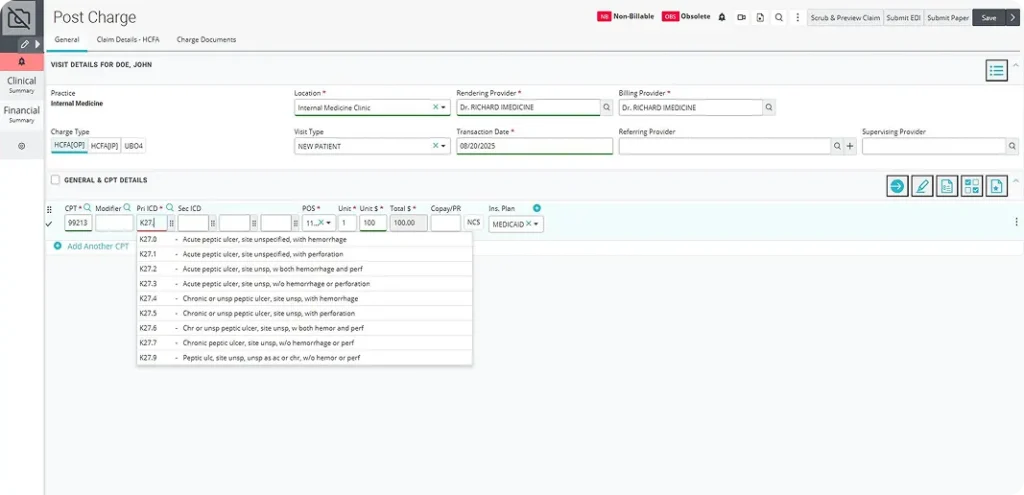
Gain line-level clarity, predictive denials intelligence, and optimized work queues that prioritize action by impact with our cloud-based RCM software that delivers consistently high clean claim rates without compromising cycle speed or compliance. By unifying payer rules, charge integrity checks, and clinical documentation alignment into one adaptive ecosystem, it eliminates fragmented workflows that lead to denials.
Embedded AI continuously learns from remittance trends and payer behavior to fix revenue leakage. The system dynamically tunes edits and scrubbing protocols based on specialty, locality, and regulatory shifts with no manual rule-setting needed.
Experience the OmniMD Advantage
Real Stories From Medical Practices Thriving With OmniMD
After comparing many EMRs, I determined that OmniMD was the best software for my new clinic. I run a high volume family practice clinic. OmniMD is used for scheduling, reminder calls, medical records, insurance and patient billing. OmniMD is a critical tool for my practice. It is a very good software, but I am also very pleased with the level of service OmniMD provides with their technical support team.

Our practice has been very pleased with the outcomes of your billing and collection services. You have been both informative and patient as we continue to become a more efficient practice. We have recognized that collections have been improved due to your diligence and tenacity. Thank you for your kindness and hard work.
OmniMD’s EHR and Billing software has truly streamlined our operations at Solid Sobriety. Their billing tools have improved our efficiency, significantly reducing errors and boosting revenue. What stands out most is their exceptional customer support- the team is always available, knowledgeable, and proactive in solving any challenges we face. We couldn’t be happier with the partnership.
Hello, I’m Eman, for the past 10 years, OmniMD has been instrumental in transforming our billing operations. The reduction in claim denials and the ease of handling claims have not just streamlined our work but have also allowed us to focus more on patient care. The efficiency and reliability that OmniMD offers are unparalleled, and it has been a vital component of our practice’s success.

OmniMD has proven to be reputable and reliable. Although it was not a smooth start with the initial billing and claims process. They were readily available to quickly worked with me and rectified any issues that may arise. I was quickly assigned to one of the best billers, and it has made big difference in my practice revenue. OmniMD values customer satisfaction and will go above and beyond to maintain a positive and productive relationship. They have my trust!




Frequently Asked Questions
Medical Billing Software: Resources and Guides
OmniMD’s medical billing software automates the complete revenue cycle across 20+ specialties, from eligibility verification and prior authorization through claims submission, denial management, and AR recovery. The guides below cover the billing software decisions, workflows, and benchmarks that practice owners, billing managers, and healthcare CFOs use to improve first-pass rates, reduce denials, and increase collections.
Claim Denials and Revenue Recovery
- How to Reduce Claim Denials by 50% in 90 Days – A step-by-step protocol for identifying and closing the root causes behind your top denial codes, with timelines for each intervention stage.
- The 7 Most Common Claim Denials and How to Appeal Each One – Denial-by-denial breakdown of the most frequent payer rejections, including the documentation and appeal language that works for each type.
- Average Claim Denial Rates by Medical Specialty: Industry Report – Specialty-by-specialty benchmarks so you know whether your denial rate signals a process problem or reflects industry norms.
- Payer Underpayment Recovery: The Hidden 15% Revenue Gap – How to identify systematic underpayments your billing software may be accepting and posting without flagging for review.
- Medical AR Cleanup: How to Recover Aged Receivables Over 120 Days – Recovery strategies and prioritization frameworks for AR that has aged past the point most practices write off as uncollectable.
AI and Automation in Medical Billing
- AI in Medical Billing: Top 5 Platforms Compared (2026) – Feature-by-feature comparison of the leading AI billing tools by coding accuracy, specialty coverage, EHR integration, and denial prevention capability.
- How AI Medical Coders Catch $150K in Missed Revenue Per Year – The specific coding errors and undercoding patterns AI catches consistently that human coders routinely miss across high-volume specialties.
- Prior Authorization Automation: Cutting Approval Time from 10 Days to 2 Hours – How automated prior auth workflows eliminate the single biggest source of claim delays and front-desk staff time waste.
- AI vs Traditional Medical Billing: Which Saves More? – Cost-per-claim and ROI comparison across automated and manual billing models at different practice sizes and specialties.
- Why 2026 Will Be the Year of Fully Automated Revenue Cycle Management – The workflow changes and technology shifts making full RCM automation viable for mid-size practices that previously relied on manual billing teams.
Specialty Billing Guides
- Mental Health Billing 2026: CPT 90837 vs 90834 Explained – The coding rules and payer-specific requirements that determine reimbursement for your highest-volume therapy sessions, including modifier and place-of-service considerations.
- Physical Therapy Billing: The 8-Minute Rule Explained – How to apply the 8-minute rule correctly across timed service codes and avoid the underbilling and overbilling errors that trigger payer audits.
- OB/GYN Billing Cheat Sheet: Global Maternity and E/M Coding – CPT codes, modifiers, and global period rules for the most commonly billed OB/GYN procedures, with unbundling risk flags for each.
- Podiatry Billing: Routine Foot Care and Medicare LCDs – How Medicare Local Coverage Determinations affect routine podiatry billing and the specific documentation requirements needed to get paid for each service category.
- Prior Authorization in Radiology Billing: How to Reduce Denials – Payer-specific prior auth requirements for high-volume radiology procedures and how to manage them at scale without expanding your administrative team.
Revenue Cycle Management and Practice Operations
- Healthcare CFO Buyer Guide to Medical Billing Software – Evaluation criteria, vendor contract questions, and revenue integrity benchmarks for billing software purchasing decisions at the practice and health system level.
- Best Revenue Cycle Management Software of 2026 – Ranked comparison of RCM platforms by specialty fit, automation depth, reporting capability, and total cost of ownership.
- 5 Medical Billing KPIs Every Clinic Must Track – The metrics that reveal whether your billing software is performing or quietly leaking revenue, with industry benchmarks for each KPI by specialty.
- How to Read an EOB and Catch Underpayments in 10 Minutes – A field-by-field guide to Explanation of Benefits documents and the systematic underpayment patterns most practice billing teams miss during posting.
- How to Improve Medical Practice Revenue: 9 Proven Strategies – Billing, coding, and workflow improvements with documented revenue impact across multiple specialties and practice sizes, ranked by implementation difficulty.