

Meet The AI Medical Scribe For Cardiology
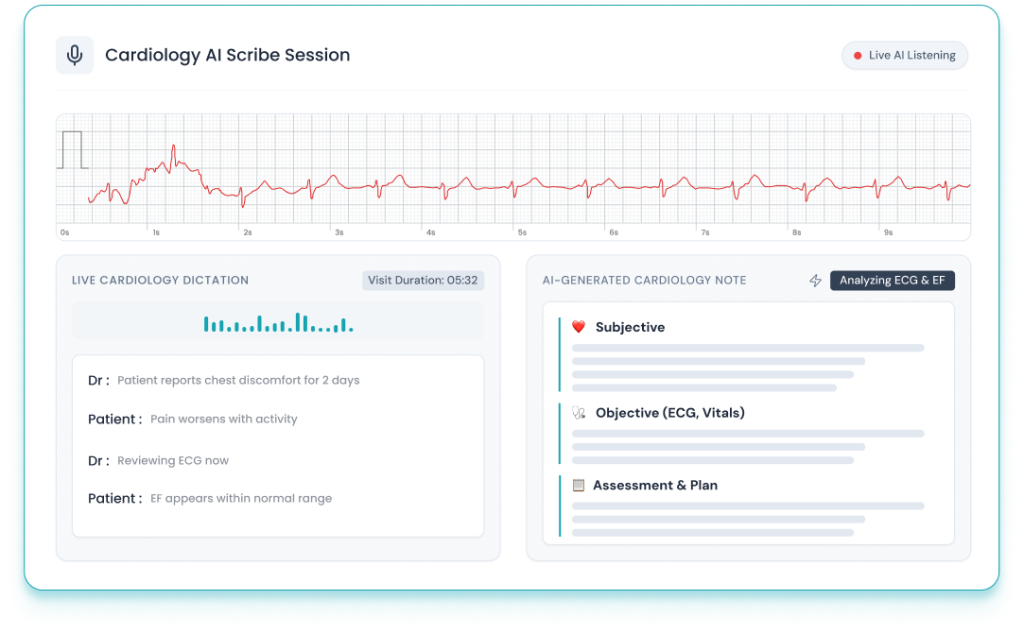
Automatically captures ECGs, ejection fraction (EF), and procedure details so your cardiology notes are clinically relevant and easy to reference later.
Simplifying Billing Workflows for Modern Primary Care Practices

Suggests accurate ICD-10 and CPT codes specific to cardiology

Distinguishes cardiac vs non-cardiac symptoms automatically

Tracks changes in ECG findings compared to prior ECGs

Understands cardiology abbreviations natively

Flags anticoagulation indications and bleeding risks
Designed for Cardiologists, Fellows, NPs, PAs, and Cardiology Teams
Automated Cardiology Note Builder
Automatically structures cardiology notes from your spoken or typed inputs, including EF, ECG, and procedural data. This ensures consistent, error-free documentation without manual formatting.
Real-Time Cardiac Speech Transcription
Transforms your spoken cardiology assessments into real-time, accurate text. The AI recognizes clinical terminology, abbreviations, and cardiology-specific measurements seamlessly.

Cardiology
EHR Sync
Works directly with your electronic health record to pull patient history and push structured notes. This ensures all cardiac metrics and procedures are updated without double entry.

Cardiology Conversation Mapping
Distinguishes between the cardiologist, patient, and staff during visits. Each comment is accurately attributed, so your notes reflect the full conversation context.

Multilingual Cardiac
Visit Capture
Understands and transcribes cardiology visits in multiple languages. This ensures accurate documentation even with patients or staff who speak different languages.

AI Cardiology
Summary Generator
Generates concise, structured summaries of patient history, cardiac findings, and ongoing treatments. This saves review time and highlights critical EF, ECG, or procedural changes.
Cardiology Chart
Trend Analyzer
Automatically compares current and prior cardiology charts, highlighting EF trends, ECG changes, and procedural updates. This enables quick longitudinal insight without manual chart review.
Why AI Medical Scribe For Cardiology Matters
Cardiac metrics captured automatically
Cardiac metrics captured automatically
Reduction in coding errors
Accuracy in longitudinal tracking
Faster chart review
Boost in team satisfaction
Trusted by 12,000+ Providers in 600+ Clinics
After comparing many EMRs, I determined that OmniMD was the best software for my new clinic. I run a high volume family practice clinic. OmniMD is used for scheduling, reminder calls, medical records, insurance and patient billing. OmniMD is a critical tool for my practice. It is a very good software, but I am also very pleased with the level of service OmniMD provides with their technical support team.

Our practice has been very pleased with the outcomes of your billing and collection services. You have been both informative and patient as we continue to become a more efficient practice. We have recognized that collections have been improved due to your diligence and tenacity. Thank you for your kindness and hard work.

OmniMD’s EHR and Billing software has truly streamlined our operations at Solid Sobriety. Their billing tools have improved our efficiency, significantly reducing errors and boosting revenue. What stands out most is their exceptional customer support- the team is always available, knowledgeable, and proactive in solving any challenges we face. We couldn’t be happier with the partnership.

I have been a practitioner for over a decade and worked various EMR programs in the past by far OmniMD surpasses all my expectations. It’s easy to navigate and your entire note in one page with only a few clicks to complete. I own a family medical practice/ spa and I am very happy that I chose OmniMD. Their support staff is amazing they are always available to assist you.

The team at OmniMD website developer are absolutely awesome! They developed my website exactly how I envisioned it—clean, precise, and professional. They are highly knowledgeable, incredibly patient, and truly committed to working closely with the customer to ensure everything is just right. I’m so pleased I chose them, and I’m thrilled with the final result. My website is now complete, and it looks fantastic!
