
Occupational Therapy EMR
Simplify OT’s toughest tasks, adaptive planning, caregiver training logs, and progress benchmarks, while staying fully compliant.

All-in-One Occupational Therapy Clinic Software
Transform the way you deliver therapy with Cloud OT software systems engineered for the complexity of occupational performance.
Customized evaluation workflows capture fine motor, sensory processing, and ADL performance with the depth OTs need, without the paperwork drag. Dynamic goal-setting tools translate therapy plans into measurable functional outcomes, whether it’s handwriting fluency, self-feeding, or safe community mobility.
Flawless HEP modules let you prescribe graded activities that fit naturally into a patient’s home, school, or workplace environment.
Adaptive scheduling accounts for specialized equipment, sensory rooms, and caregiver participation because OT sessions aren’t one-size-fits-all.


Occupational Therapy EHR Software Interface
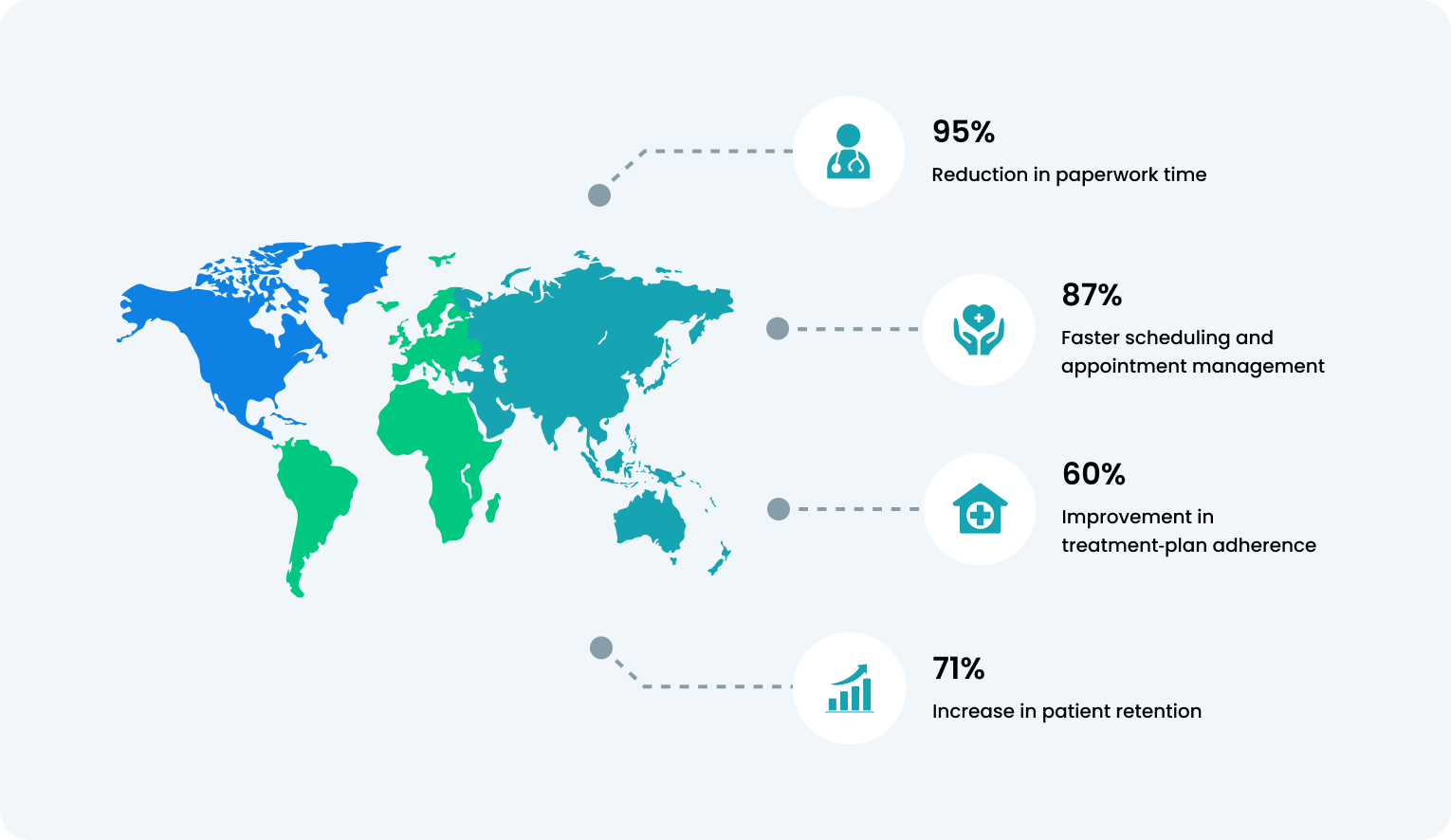
Harnessing AI for Real-World Clinical Impact

Interoperable OT EHR (referrals, EMR)
Purpose-built for OT with templates for sensory integration, motor retraining, executive function, and environmental adaptation. Supports stroke recovery, pediatrics, hand therapy, and mental health, authored in OT’s own language.

OT Scheduling & Billing Software
Codes align with OT care, from neuromuscular re-education to ADL and cognitive retraining. Logic validates therapy minutes, modifiers, and units. Automated claims simplify multipayer submissions, reducing denials and admin pain points.

Home-Based OT Workflow Integration
Teletherapy designed for OT, with tools for home audits, ergonomic checks, and activity coaching. Screen-share supports real-time adaptations. Documentation captures strategies, therapeutic activity, and environmental modifications in care.

Patient Engagement for OT (exercises, reminders)
Tracks progress through independence in self-care, work, and participation, not just strength. Dashboards show gains in daily tasks like cooking, writing, or dressing, making therapy outcomes visible, patient-centered, and defensible.

AI-Assisted OT Notes
Smart prompts guide therapists with phrasing rooted in occupational performance rather than generic medical jargon. Adaptive algorithms learn each therapist’s unique style, reducing redundancy while capturing clinical nuance. Notes highlight functional gains, compensatory techniques, and task adaptations with clarity and precision. Review time shrinks, accuracy expands, and clinical reasoning shines through every line.

Multi-Site OT Practice Software
Centralized scheduling, documentation, and billing flow seamlessly across clinics, schools, and community programs. Therapists log in once and move between sites without losing context. Shared data supports coordinated care plans, while site-level reports reveal productivity, payer trends, and referral patterns. Growth doesn’t fracture workflows, it scales them.
Real Stories From Medical Practices Thriving With OmniMD
After comparing many EMRs, I determined that OmniMD was the best software for my new clinic. I run a high volume family practice clinic. OmniMD is used for scheduling, reminder calls, medical records, insurance and patient billing. OmniMD is a critical tool for my practice. It is a very good software, but I am also very pleased with the level of service OmniMD provides with their technical support team.

Our practice has been very pleased with the outcomes of your billing and collection services. You have been both informative and patient as we continue to become a more efficient practice. We have recognized that collections have been improved due to your diligence and tenacity. Thank you for your kindness and hard work.
OmniMD’s EHR and Billing software has truly streamlined our operations at Solid Sobriety. Their billing tools have improved our efficiency, significantly reducing errors and boosting revenue. What stands out most is their exceptional customer support- the team is always available, knowledgeable, and proactive in solving any challenges we face. We couldn’t be happier with the partnership.
I have been a practitioner for over a decade and worked various EMR programs in the past by far OmniMD surpasses all my expectations. It’s easy to navigate and your entire note in one page with only a few clicks to complete. I own a family medical practice/ spa and I am very happy that I chose OmniMD. Their support staff is amazing they are always available to assist you.


Who Should Use Occupational Therapy EHR Software?
Occupational therapy EHR software is the right fit for practices that document time-based therapeutic procedures as a routine part of every visit and need billing tools that go well beyond standard physician E&M codes:
- Outpatient OT clinics: Practices managing stroke, TBI, orthopedic post-surgical, and neurological conditions need time-based billing tools, functional outcome measure tracking, and goal documentation that payers accept as medical necessity evidence across the care episode.
- Pediatric OT practices: Practices treating autism spectrum disorder, ADHD, developmental coordination disorder, and sensory processing diagnoses need age-specific evaluation templates, sensory integration documentation, and goal formats compatible with IEP and IFSP reporting requirements for school-based services.
- Hand therapy clinics: Certified hand therapists managing post-surgical upper extremity cases, fractures, and repetitive strain injuries need grip strength, ROM, and edema measurement fields alongside CPT 97760 orthotic fabrication and management documentation.
- Hospital-based OT departments: Acute and post-acute OT teams need documentation that interfaces with inpatient records, supports functional status reporting for CMS quality programs, and tracks therapy minutes for Medicare Part A skilled care requirements.
- Multi-specialty rehabilitation clinics: Clinics combining OT, physical therapy, and speech therapy need a platform that shares the patient record across disciplines and handles discipline-specific billing rules without requiring separate EHR systems for each therapy type.
- Mental health OT practices: Practitioners providing OT for anxiety, depression, and psychiatric rehabilitation need coping strategy, routine planning, and sensory modulation documentation alongside SOAP notes that support behavioral health payer billing.
- Home health and community OT: Practitioners delivering OT in patients’ homes or community settings need mobile-accessible documentation with home safety assessment templates, caregiver instruction records, and RPM integration for ongoing functional monitoring between visits.
Occupational Therapy EHR Software Evaluation Checklist
Before selecting an occupational therapy EHR or OT EMR, verify that it meets the clinical and billing requirements specific to OT practice. Use this checklist when comparing platforms:
- ONC-certified under 2015 Edition Cures Update with HL7 FHIR 4.0.1 for interoperability with referring physicians, hospitals, and payers
- AOTA Framework-aligned evaluation templates covering occupational profile, performance skills, performance patterns, context and environment, and activity demands
- Structured evaluation codes (97165, 97166, 97167) with complexity level selection and re-evaluation (97168) documentation
- 8-minute rule compliance: automatic billable unit calculation for per-15-minute timed codes with threshold alerts
- Functional outcome measure fields: FIM, COPM, DASH, Barthel Index, Lawton IADL Scale with longitudinal tracking and goal linkage
- KX modifier support and therapy cap tracking for Medicare patients
- GP modifier application for OT claims (distinguishes OT from PT and SLP in payer systems)
- Sensory integration documentation templates for pediatric OT (autism, developmental coordination disorder, sensory processing)
- Upper extremity measurement fields: grip dynamometry, pinch strength, ROM, edema circumference, two-point discrimination
- Cognitive rehabilitation documentation: MMSE, MoCA, executive function, attention intervention notes (CPT 97129, 97130)
- Orthotic management documentation (97760) with splint type, fabrication date, fit check, and training records
- Assistive technology assessment (97755) with DME funding justification fields
- Prior authorization tracking with approved-visit countdown and expiration alerts
- Home exercise program generation with patient portal delivery or printable handouts
- Billing software with OT-specific claim editing: modifier validation, unit calculation, therapy cap rules
- Scheduling with time-block settings for 30-, 45-, and 60-minute OT evaluation slots versus 15-minute add-on procedure units
- AI-assisted front desk for insurance eligibility verification, therapy authorization status checks, and patient intake for OT appointments
- AI RCM software for OT claim scrubbing, denial management, and therapy-specific payer rule updates
Frequently Asked Questions
Brands That Trust Us