
Top 10+ Revenue Cycle Management Platforms: A Buyer-Centric Evaluation for 2026
| Rank | Platform | Buyer Profile | Deployment Model | Key Strengths | Best For | Limitations | G2 & Recognition |
|---|---|---|---|---|---|---|---|
| #1 | Waystar | Organizations wanting strong claims, clearinghouse, denial, and payment workflows | Software only (cloud) |
|
Orgs with an existing EHR needing a best-of-breed RCM layer | Not an EHR; contract and pricing complaints in public reviews | 4.4/5 (119 reviews) Best in KLAS Claims since 2010 |
| #2 | athenahealth | Practices wanting a cloud platform with EHR, practice management, and RCM support | Cloud EHR + RCM (all-in-one) |
|
Small to mid-sized practices wanting one connected environment | Mixed support reviews; specialty workflow depth can be limited | 3.6/5 (129 reviews) Best in KLAS 2025 ambulatory |
| #3 | OmniMDDigital Healthcare Innovators | Buyers wanting a unified EHR and RCM platform with AI-led automation and specialty workflows | Unified EHR + RCM (cloud) |
|
Specialty clinics wanting EHR and RCM in one platform with AI-driven insights | Steeper onboarding; less suitable for billing-only buyers | 4.2/5 (11 reviews) Consistent 2026 RCM roundup presence |
| #4 | NextGen Healthcare | Ambulatory practices wanting integrated clinical and financial workflows | Software + managed services |
|
Ambulatory and multi-specialty practices wanting guided RCM support plus software | Hybrid model requires active vendor relationship management | 3.7/5 (163 reviews) KLAS Ambulatory RCM top performance |
| #5 | AdvancedMD | Independent practices wanting a flexible cloud billing and practice management platform | Cloud EHR + RCM (all-in-one) |
|
Cloud-first independent and ambulatory practices wanting scheduling, EHR, and billing in one stack | Moderate G2 satisfaction; complex initial setup for new users | 3.6/5 (62 reviews) |
| #6 | CureMD | Practices needing configurable billing workflows and integrated practice software | Software + managed services (outsource) |
|
Small to mid-sized practices wanting to outsource billing with AI-backed managed support | Less direct billing control; pricing available via direct contact only | Black Book top pick 2026 Consistent 2026 RCM roundup presence |
| #7 | eClinicalWorks | Buyers wanting a broad EHR platform with strong RCM relevance | Unified EHR + RCM (cloud) |
|
Ambulatory and FQHC-style practices wanting EHR-native RCM workflows | Best evaluated as part of a broader EHR decision, not standalone | Broad ambulatory presence Consistent industry roundup visibility |
| #8 | Epic | Large health systems needing deeply integrated enterprise revenue cycle capabilities | Enterprise EHR + RCM (multi-year program) |
|
Large hospitals and multi-site health systems wanting full clinical-financial integration | Multi-year implementation; very high cost; steep learning curve for staff | 37%+ U.S. acute care market share Consistent KLAS enterprise recognition |
| #9 | Oracle Health | Large organizations needing enterprise-scale finance and clinical workflow depth | Enterprise EHR + RCM (enterprise contract) |
|
Large integrated delivery networks wanting a single intelligent infrastructure | Requires significant implementation planning; not suited for small practices | KLAS enterprise recognition Major global health system deployments |
| #10 | R1 RCM | Organizations wanting software-backed managed revenue cycle operations | Tech-enabled outsourcing (performance-based) |
|
Hospitals and health systems wanting to outsource all or part of the revenue cycle | Loss of direct billing control; complex multi-year contracts | Best in KLAS 2026 (multiple categories) 7 consecutive years of KLAS recognition |
| #11 | SPRY RCMsprypt.com | PT, OT, SLP, and rehab therapy clinics wanting RCM embedded directly within their EMR workflow | Cloud EHR + RCM (all-in-one, therapy-native) |
|
Outpatient rehab therapy practices (PT/OT/SLP) wanting fully integrated AI billing without switching platforms | Primarily built for therapy specialties; limited fit for general medical or hospital RCM | 4.8/5 (127 reviews) 12 G2 Badges — Fall 2024 Fastest-growing rehab RCM 2025 |
Data sourced from G2, KLAS Research, Capterra, and public vendor information as of 2026. For informational purposes only — rankings reflect editorial assessment.
Why the Buyer-Centric View Matters
Healthcare organizations come in many shapes.
- Small independent practices.
- Multi-specialty groups.
- Large ambulatory networks.
- Academic medical centers and integrated health systems.
Each of these needs a different mix of automation, integration, configurability, and support. A platform that is excellent for an enterprise may be overbuilt for a small practice, and a claims-focused engine may feel too narrow for a team that wants one connected EHR-plus-billing environment.
That is why this blog is structured to help buyers answer questions like:
- What does this platform actually do well?
- What are its meaningful limitations?
- How much setup and change will it require?
- Who is it really best for?
Let’s begin.
1. Waystar: Strong, End-to-End RCM Engine
Waystar is a cloud-based, end-to-end revenue cycle management platform that focuses on simplifying claim submission, payment workflows, and denial management for healthcare organizations of all sizes. Public G2 data shows it enjoys a score of about 4.4 out of 5.0 based on more than 100 reviews, which signals both real adoption and meaningful user feedback.
Waystar is especially relevant for organizations that:
- Need a strong claims and clearinghouse layer.
- Deal with many different payers and complex remits.
- Want better visibility and control over denials, underpayments, and patient responsibility.
Because of its narrow, purpose-built focus, Waystar is often treated as a leading ‘pure’ RCM software option in 2026 industry roundups.
What Waystar does
Waystar’s platform is designed around the full revenue cycle, not just claim submission. According to its public materials and independent reviews, its core modules typically include:
Claims management
- End-to-end claim submission, scrubbing, and editing before claims leave the system.
- Real-time status tracking so billers can see where each claim is with each payer.
- Pre-submission edits that flag common errors before they trigger denials.
Eligibility and benefits verification
- Real-time and batch eligibility checks across commercial, Medicare, and Medicaid plans.
- Integration with most major practice management and EHR systems so front-desk staff can check eligibility without leaving the workflow.
Prior authorization
- Automated PA submission and status tracking using payer portal connections where available.
- Partially manual handling for more complex clinical cases.
Denial management
- Automated denial categorization and root-cause analysis across payers, codes, and providers.
- Workflow routing for appeals and rejected claims, with rules that can be tailored by practice.
Patient payments
- Digital billing and patient statements.
- Payment plans, financial assistance screening, and point-of-service collection tools.
AI-driven CDI and analytics
- Clinical documentation improvement (CDI) powered by Waystar’s Iodine acquisition, which adds AI-driven clinical documentation analysis and physician querying.
- Smart analytics for revenue performance, underpayment detection, and payer behavior.
All of this is built on a cloud architecture that supports large volumes of claims and many different provider types, from small practices to large health systems and post-acute organizations.
Who Waystar fits best
Waystar is most attractive for buyers who:
- Already have a clinical or practice management system and want to add a strong revenue cycle layer.
- Want to reduce manual work across eligibility, prior authorizations, and payment posting.
- Need broad payer connectivity and a single place to track claims, denials, and remits.
Waystar’s value is less about replacing EHRs and more about improving how claims and payments move through the system once the care has been delivered.
Strengths
Buyers choose Waystar for several practical reasons.
Deep payer and clearinghouse focus
- Waystar connects to more than 5,000 payers, which is a strong signal of breadth in the clearinghouse and claims space.
- Pre-submission rules and editing catch many common errors before they become denials, improving first-pass rates.
End-to-end workflow coverage
The platform spans eligibility, claims, denials, remits, and patient payments, which reduces the need for many disconnected tools.
Visibility and analytics
Waystar promotes dashboards and analytics that show revenue, denials, underpayments, and payer patterns in one place.
AI-enhanced CDI and denial tools
The Iodine-based CDI engine surfaces coding opportunities, generates physician queries, and can help improve case mix index and reimbursement accuracy.
Broad integration profile
- Waystar integrates with many EHRs and practice management systems including Epic, Oracle Health, MEDITECH, athenahealth, eClinicalWorks, NextGen, and several specialty-specific platforms.
These strengths make Waystar a strong benchmark for any buyer who puts claims and payment workflows at the center of the RCM strategy.
Limitations and buyer nuances
No platform is perfect, and Waystar is no exception. Public reviews and independent reviews highlight several points that buyers should consider carefully.
Service and contract experience
- Some G2 reviewers report issues with customer service responsiveness, ticket resolution, and contract or pricing clarity.
- This does not mean the platform is weak, but it does mean buyers should read contracts closely, clarify support expectations, and understand how escalation works.
Pricing model
- Waystar often uses a per-claim pricing model, which can be volume-efficient at scale but can add up quickly for high-volume organizations.
- Buyers should model usage and ask for clear, written pricing tiers and any add-on fees.
Role in a broader ecosystem
- Waystar is not an EHR. It is strongest when paired with an existing clinical or practice system.
- Practices that want one all-in-one instead of a best-of-breed architecture may need to adjust expectations.
For a buyer, this means Waystar is powerful but not friction-free. It earns its place at the top of this list because its RCM foundation is unusually mature and broad, but it should be treated as a high-impact, real-work RCM engine, not a magic-bullet app.
Implementation and workflow impact
From a buyer’s perspective, implementing Waystar often looks like this:
- Integration with existing EHR or practice management systems.
- Mapping current workflows (eligibility, front-desk, billing, reporting) onto Waystar’s modules.
- Training staff on the new interfaces for claims, EOBs, denials, and patient payments.
- Setting up rules for pre-submission edits, denial routing, and reporting dashboards.
Because Waystar touches so many steps in the revenue cycle, the change management piece can be meaningful. Teams that engage with training, rule configuration, and regular review of denial and underpayment reports usually get the most value.
For buyers who want a strong, vendor-agnostic RCM backbone, Waystar is a logical first-stop evaluation.
2. Athenahealth: Broad, Integrated Cloud Platform
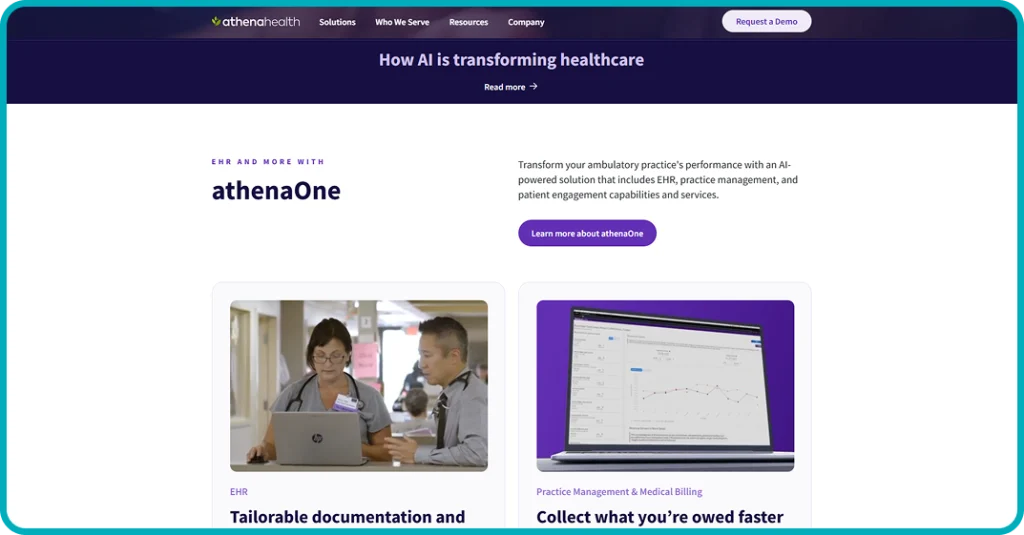
athenahealth is a well-known cloud healthcare company that offers a suite of products including EHR, practice management, and revenue cycle services. Public G2 data shows athenahealth with more than 100 reviews and a score around 3.6 out of 5.0, which signals both broad adoption and mixed user feedback. That kind of review profile is common for large, complex platforms that serve many different practice types and specialties.
athenahealth belongs on this list because it is not just a billing tool. It is a full-service environment that tightly connects clinical documentation, scheduling, billing, and analytics in one cloud ecosystem.
athenahealth is most relevant for organizations that:
- Want to minimize the number of separate systems they use.
- Need a cloud platform that can grow with them over time.
- Value integration between clinical and financial workflows rather than pure billing automation.
What athenahealth actually does
athenahealth’s revenue cycle capabilities are spread across its product family, especially its athenaIDX and athenaOne offerings. Based on public product pages and third-party analyses, the platform typically covers:
Patient registration and scheduling
Unified patient records and appointment scheduling that feed billing and documentation workflows.
Insurance verification and eligibility
Automated insurance verification and eligibility checks that reduce manual lookups at the front desk.
Medical coding and charge capture
- Tools that support charge capture and coding, including AI-assisted suggestions and payer-focused rules.
- Emphasis on reducing coding errors and improving first-pass claim accuracy.
Claim submission and payment posting
- End-to-end claim management from submission through payment posting and reconciliation.
- Integration with payers and clearinghouse-style capabilities built into the workflow.
Denial management and appeals
Automated denial tracking, categorization, and appeal routing.
Patient billing and collections
Digital statements and patient payment tools that support copay collection, deductibles, and other balances.
Analytics and financial reporting
Dashboards and reports that track revenue, denials, days in AR, and collections by payer, provider, and code.
Taken together, this makes athenahealth more of an integrated operating platform than a narrow RCM engine.
Who athenahealth fits best
athenahealth is most attractive for buyers who:
- Want fewer systems, not more.
- Need a cloud platform that can support scheduling, clinical notes, billing, and analytics in one place.
- Prefer a mature, widely used ecosystem with strong integration and support infrastructure.
Because of its size and footprint, athenahealth is often a good fit for:
- Small to mid-sized practices that want an all-in-one environment.
- Multi-specialty groups that still want to keep processes relatively unified.
- Buyers that value long-term vendor stability and a broad partner ecosystem.
athenahealth is less ideal for organizations that:
- Only want a billing-only tool.
- Need a very niche, specialty-specific engine that is not tied to a broader EHR.
- Prefer a lightweight, minimalist workflow with very simple screens.
Strengths
Buyers choose athenahealth for several concrete reasons.
Tight integration across clinical and financial workflows
Data flows from scheduling and documentation into billing, which reduces manual data entry and potential handoff errors.
Cloud-native architecture
The platform is cloud-based, which supports remote access, automatic updates, and easier scaling than many on-premise systems.
Enterprise-grade revenue cycle tools
athenaIDX is positioned as enterprise RCM software that supports low-touch workflows, intelligent automation, and interoperability.
Strong appeal to practices that want consolidation
The platform is attractive to buyers who want to avoid stitching together multiple vendors for EHR, practice management, and RCM.
These strengths make athenahealth worth serious consideration for any organization that wants a single, connected platform rather than a patchwork of point tools.
Limitations and buyer nuances
The public review data for athenahealth suggests that the platform is real and useful, but not universally loved. This is normal for systems with broad scope and many moving parts.
Key points to watch:
Learning curve and change management
- A large integrated platform can be complex to learn and configure.
- Buyers should expect to invest time in onboarding, role-based training, and workflow design.
Fit by specialty
- Some specialty workflows may not be as deeply tailored as in a niche RCM engine.
- Buyers should map specific billing rules and documentation needs against the platform’s flexibility.
Perception of support and pricing
- Mixed reviews hint at variability in support quality and pricing transparency.
- Buyers should test vendor support response during demos and ask for clear, written pricing and SLA commitments.
For many buyers, those tradeoffs are acceptable because the benefit of consolidation is large. But the decision should be made with eyes open, not with marketing language alone.
Implementation and workflow impact
athenahealth implementations usually involve:
- Data migration and setup of patient and billing data.
- Configuration of workflows for scheduling, documentation, coding, and billing.
- Staff training on new tools and dashboards.
- Ongoing process refinements based on denial and reporting data.
Organizations that commit to a structured rollout and strong internal champions often report better long-term performance.
athenahealth is a strong candidate for buyers who want a single, mature, cloud-based operating environment with strong RCM support baked in.
3. OmniMD: Unified EHR + RCM with AI-Driven Automation
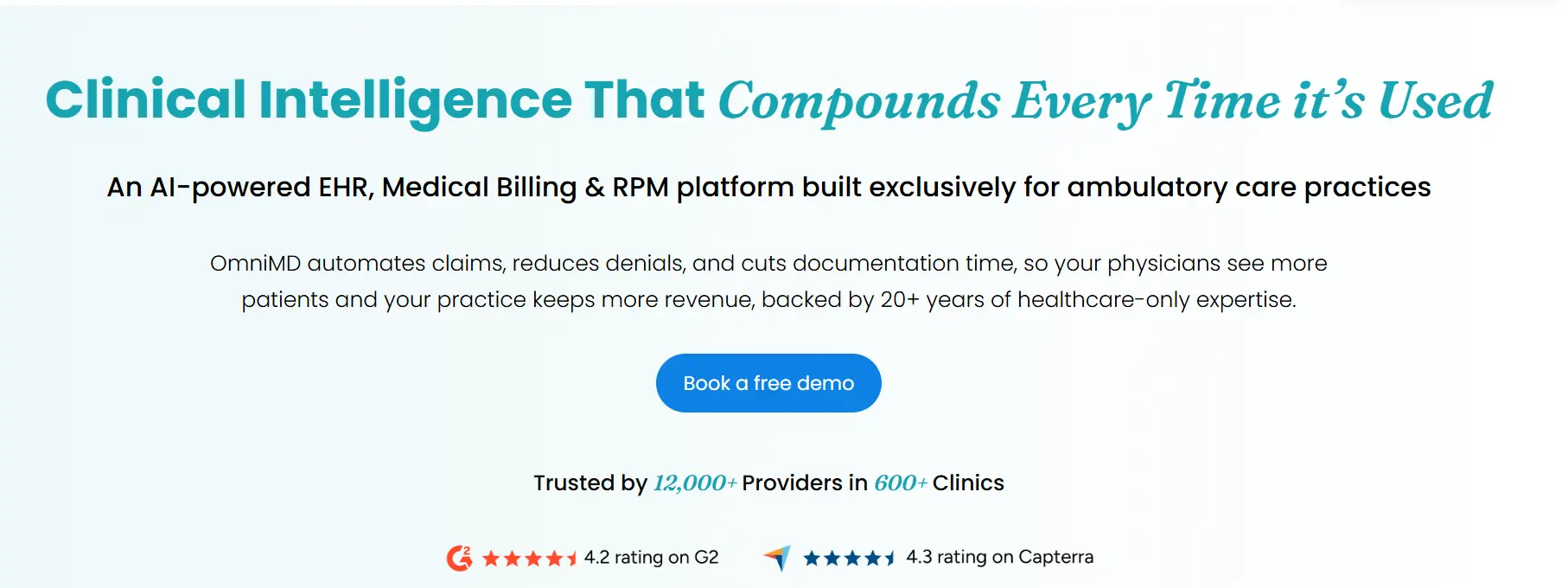
We are a cloud-based healthcare technology company that offers EHR, practice management, and revenue cycle management solutions for medical practices and clinics. Public G2 data shows we have a visible review footprint, which helps confirm that we are a real player in the market, not just a theoretical brand.
We are positioned as a platform that unifies clinical and financial workflows, with a strong emphasis on automation, AI-driven insights, and specialty-oriented billing intelligence. That makes us especially relevant for organizations that want to reduce system fragmentation and push more intelligence into the billing and approval process.
We belong on this list because we are genuinely part of the RCM conversation and are not being ranked first simply because of ownership or preference. Our position is honest and evidence-based, reflecting our role as a specialized, integrated RCM plus EHR suite.
What OmniMD actually does
Our public materials and demo content frame the platform around several core themes:
Unified EHR and RCM architecture
Clinical documentation, scheduling, and billing live in one environment, which reduces manual data entry and handoff gaps.
Specialty-focused billing intelligence
The platform includes specialty-specific workflows and rules that can be tuned to the needs of different practice types.
AI-driven revenue and financial insights
We use AI-based tools to surface claim issues, predict denials, flag underpayments, and help optimize collections.
Eligibility and authorizations
The platform includes automated eligibility and authorization workflows that reduce front-desk manual work.
Denial and appeals management
We promote automated denial tracking, root-cause analysis, and appeal routing that can be tailored by payer, provider, or code.
Patient payment automation
The platform supports digital statements, payment plans, and patient-facing tools that help reduce outstanding balances and improve cash flow.
Reporting and analytics
Dashboards and custom reports track key metrics such as first-pass rate, denial rate, days in AR, and net collection rate by specialty, payer, and provider.
Taken together, this positions us as a tightly integrated, workflow-centric RCM platform that is especially useful for organizations that want to connect clinical care to billing in a single system.
Who OmniMD fits best
We are most attractive for buyers who:
- Want one platform instead of multiple disconnected tools.
- Need a system that can handle both clinical notes and revenue cycle workflows.
- Value AI-driven analytics and predictive denial prevention rather than only basic billing automation.
We are especially strong for:
- Specialty practices that have complex coding and documentation rules.
- Clinics that want to reduce manual follow-up on denials and underpayments.
- Organizations that want stronger visibility into revenue performance without adding extra reporting tools.
We are less ideal for organizations that:
- Only want a billing-only engine.
- Prefer a very lightweight, simple-interface tool with minimal configuration.
- Need maximum flexibility without any platform-level constraints.
Strengths
Buyers choose us for several specific reasons:
Consolidation and workflow alignment
Because EHR, practice management, and RCM live in one environment, the platform reduces the risk of broken handoffs between clinical and billing teams.
AI-driven insights and denial prediction
The platform uses AI-based analysis to surface problem claims, predict denials, and recommend corrective actions.
Specialty-oriented design
We are built with an emphasis on specialty workflows and rules, which can be valuable for clinics with complex billing patterns.
Built-in reporting and analytics
The platform supports dashboards and custom reports that track common RCM KPIs and help teams spot trends early.
Strong focus on compliance and security
As a cloud healthcare platform, we emphasize HIPAA-aligned workflows, data encryption, and audit-ready reporting.
These strengths make us a strong fit for organizations that want more than a simple billing tool. It is a platform that can be part of a broader operational transformation, not just a quick plugin.
Limitations and Buyer Nuances
Because OmniMD is a unified platform, there are several tradeoffs that buyers should consider.
Implementation and onboarding effort
- A full-suite platform usually requires more setup, configuration, and training than a simple billing app.
- Buyers should ensure they have internal or external support to handle migration and workflow design.
Fit by practice size and specialty
- The platform may be more valuable for organizations that have enough staff and billing volume to justify its depth.
- Smaller practices may find the learning curve steeper than simpler tools.
Dependency on vendor support and change control
- As with any cloud platform, any changes to the underlying system depend on the vendor’s roadmap and support structure.
- Buyers should clarify upgrade schedules, support SLAs, and escalation paths during the contracting phase.
These are not weaknesses in the abstract. They are normal tradeoffs for a deeper, more integrated platform.
Typical implementation and workflow impact
An OmniMD implementation typically includes:
- Data migration and configuration of patient and billing data.
- Setup of specialty-specific workflows, coding rules, and denial management logic.
- Training for clinical and billing staff on how the platform connects documentation to billing.
- Ongoing refinement of AI-based alerts and reporting dashboards.
Organizations that invest in clear process design and regular tuning of the platform’s analytics usually see the most benefit.
We are a strong candidate for buyers who want a unified, AI-driven RCM and EHR environment that can reduce manual work, improve visibility, and support specialty-oriented workflows.
4. NextGen Healthcare: Integrated Ambulatory Revenue Cycle Stack
NextGen Healthcare is a long-standing health IT vendor whose RCM offerings are tightly tied to its ambulatory practice ecosystem. The company positions its RCM services and software as a way to help both small and mid-enterprise practices improve clean claims, reduce denials, and accelerate collections without forcing them to become in-house billing factories.
NextGen is especially relevant for:
- Independent practices that want vendor-supported RCM rather than full-stack outsourcing.
- Ambulatory and multi-specialty groups that already use or are considering NextGen practice management and EHR tools.
- Organizations that want a mix of technology and operational support bundled together.
Because of its strong ambulatory presence and frequent appearance in RCM-vendor lists, it deserves a top-10 place, but not as a claims-first engine like Waystar or a pure EHR like Epic.
What NextGen Healthcare does
NextGen Healthcare’s RCM capability is delivered both as services and as software-enabled workflows that plug into its broader practice ecosystem. Its public materials emphasize four main angles:
Claims and A/R management
- NextGen RCM supports end-to-end claims submission, payment posting, and A/R cleanup across payers.
- The platform focuses on cleaning up old accounts receivable, including bringing aged A/R back into the collection stream.
Eligibility and prior authorization
- The vendor offers eligibility verification services that integrate with its practice management tools to reduce front-desk errors and eligibility-related denials.
- Prior authorization workflows are built around practice needs, with staff and system support to help manage approvals before care is delivered.
Payment and collections optimization
- NextGen supports payment posting automation and specialized recovery teams that work on outstanding A/R, with reported returns ranging from 3x to 10x on some A/R-recovery engagements.
- The platform promotes faster collections and reduced days in A/R through tighter eligibility and claim controls.
Analytics and consultative services
- NextGen RCM provides dashboards and analytics that track more than 100 KPIs, including denials, collection rates, and days in A/R by specialty and payer.
- The vendor pairs these analytics with consultative support, where dedicated client managers help practices interpret data and refine workflows.
This combination makes NextGen attractive for practices that want more than a basic billing tool but less than a full-service external RCM agency.
Who NextGen fits best
NextGen is a strong fit for:
- Independent ambulatory practices that want to keep some control over billing but need more help than a small in-house team can provide.
- Multi-specialty groups that benefit from specialty-aware claim and eligibility rules.
- Organizations that already use or are evaluating NextGen EHR and practice management, because the integration is naturally tighter in that context.
It is less ideal for:
- Very large health systems that need a full-enterprise RCM suite rather than a vendor-augmented practice model.
- Practices that only want software without any managed-service or consultative support.
- Buyers who want a turnkey, fully outsourced RCM solution instead of a hybrid model.
NextGen’s value is in its balance: it gives practices technology plus guided support, not just a box of features.
Strengths
Buyers choose NextGen for several concrete reasons.
Specialty-aware workflows
The RCM services are tailored to common ambulatory specialties, which can reduce misaligned claim logic and payer-rule mismatches.
A/R and recovery support
The vendor’s A/R recovery teams are designed to chase down old balances, often with results that exceed the cost of the service, which is attractive for practices sitting on aged A/R.
Eligibility, credentialing, and coding add-ons
NextGen offers eligibility services, coding support, and credentialing services that can relieve internal staff of repetitive, high-burden work.
Analytics-driven consulting
The combination of KPI dashboards and subject-matter-expert guidance makes it easier for practices to spot underperforming payers, codes, or workflows and act on them.
Flexible service model
Practices can pick and choose which services they want, such as eligibility, coding, A/R recovery, and patient statements, rather than being forced into a full-stack bundle.
These strengths make NextGen a practical choice for organizations that want help improving revenue integrity without walking away from their existing clinical stack entirely.
Revenue integrity depends as much on how you buy as on what you buy. Our CFO’s guide to revenue integrity and billing software breaks down the evaluation criteria, pricing models and total cost of ownership questions worth settling before you sign.
Limitations and buyer nuances
NextGen is not a set-and-forget solution. Buyers should be aware of a few trade-offs:
Service-plus-software model
Because NextGen combines technology and human services, buyers give up some internal control and must manage a vendor relationship on top of a software relationship.
Dependence on workflow design
To get real value from A/R recovery and analytics, the practice must be willing to review and refine workflows, not just hand data over to the vendor.
Pricing and ROI expectations
Services like A/R recovery and coding support come with costs, so buyers should model the expected ROI carefully and ask for clear, written case-study-style examples.
Fit by practice size and complexity
NextGen is especially strong for independent and mid-sized ambulatory practices. Very small practices may find the service mix overbuilt, while very large systems may find it under-scaled.
For a buyer who wants vendor-supported RCM that sits between pure in-house and full-outsourced, NextGen is a strong candidate, but it should be treated as a managed-partner model, not a simple software license.
Implementation and workflow impact
A NextGen RCM engagement usually looks like this:
Scoping and service selection
The practice decides which pieces it wants: eligibility services, coding support, A/R recovery, payment posting, or analytics-only.
Data integration and mapping
The vendor connects with the practice’s practice management or EHR system, maps current workflows, and begins to ingest billing and A/R data.
Service ramp-up and optimization
A/R teams start working on existing backlog, eligibility services are tuned, and reporting dashboards are configured to highlight key metrics.
Ongoing review and refinement
Each month, practice leaders review analytics and consultative feedback, then adjust front-office and clinical workflows based on denial and payer patterns.
Organizations that treat NextGen RCM as a true partnership, not just a vendor, tend to see more improvement in clean claims, collections, and days in A/R.
For ambulatory practices that want structured support plus software, NextGen is a strong fit.
5. AdvancedMD: Cloud-First Practice and Billing Platform
AdvancedMD is a cloud-based healthcare management platform that focuses on independent and ambulatory practices, with a strong emphasis on billing and practice management. Public G2 data shows AdvancedMD with a rating around 3.6 out of 5.0 and more than 60 reviews, which signals that it is a real option in the market but not a universally loved one.
AdvancedMD is most relevant for:
- Independent practices that want a flexible, cloud-first environment for billing, scheduling, and EHR.
- Organizations that want configurability and workflow control rather than a one-size-fits-all template.
- Buyers who prefer a vendor-hosted, cloud model over on-premise deployments.
Because of this mix of public visibility, review presence, and category relevance, AdvancedMD belongs in the top 10 as a strong mid-market RCM platform.
What AdvancedMD actually does
AdvancedMD’s public materials and product pages frame it as an all-in-one practice management and EHR suite with deep billing and revenue-cycle modules.
The platform typically includes:
Practice management and scheduling
Centralized patient records, scheduling, and front-office tools that feed into billing workflows.
Cloud EHR and documentation
An EHR component that supports clinical documentation in a cloud environment, with features like AI-assisted charting in some releases.
Medical billing and RCM
- Full-cycle medical billing workflows, from charge capture to claim submission, remittance posting, and reporting.
- Built-in analytics and dashboards that let practices track AR by payer and other key metrics.
Automation and AI-assisted features
- The 2026 Winter Release notes AI-driven ambient listening and scribing to help automate clinical documentation, which can reduce the documentation burden on providers.
- The platform promotes AI-assisted claim scrubbing, eligibility checks, and payer-specific rules as part of its best medical billing software positioning.
Remote-practice enablement
The platform is built for telehealth and hybrid care models, with support for telehealth visits and cloud-based access for staff.
Taken together, this positions AdvancedMD as a cloud-first practice-management and billing stack rather than a pure RCM engine like Waystar.
Who AdvancedMD fits best
AdvancedMD is strongest for:
- Independent practices that want cloud-based scheduling, EHR, and billing in one environment.
- Ambulatory groups that need a platform that can grow with them as they add providers or locations.
- Organizations that want flexibility and workflow configurability rather than a locked-down, template-only solution.
It is less ideal for:
- Very small practices that only want a lightweight billing tool.
- Large enterprise systems that need the depth and integration of Epic or Oracle Health.
- Buyers who strongly prefer on-premise deployments and are not ready to move to a cloud-hosted model.
For the right buyer, AdvancedMD offers a balance of flexibility and completeness without the weight of a massive enterprise suite.
Strengths
Buyers choose AdvancedMD for several practical reasons:
Cloud-first design
The platform is cloud-hosted, which supports remote access, easier updates, and lower IT overhead than many legacy systems.
All-in-one practice stack
AdvancedMD combines scheduling, EHR, billing, and analytics in a single environment, which reduces the need for many separate tools.
Configurability and flexibility
The platform is designed to let practices tailor workflows, reports, and billing logic to their needs rather than forcing everyone into the same mold.
AI-enhanced documentation and billing support
Ambient listening and AI-assisted charting can reduce provider documentation time, while AI-assisted claim scrubbing and eligibility checks help reduce errors and improve first-pass rates.
Strong analytics and KPI dashboards
The platform promotes dashboards that track AR by payer and category, which helps practices identify underperforming payers and workflow bottlenecks.
These strengths make AdvancedMD attractive for organizations that want an integrated, cloud-based practice environment with strong billing depth.
Limitations and buyer nuances
The public review footprint and independent content suggest that AdvancedMD has real strengths and real friction points.
Buyers should consider these:
Learning curve and setup complexity
- A flexible, cloud-first platform with strong configurability usually requires more setup and training.
- Buyers should expect to invest time in workflow design, role-based configuration, and staff training.
Mixed satisfaction signals
- G2 data shows a moderate rating, which usually implies that the platform is powerful but not always easy to use or cheap to implement.
- Buyers should talk to current customers in similar specialties and practice sizes.
Feature depth vs pricing expectations
- AdvancedMD offers many features, but some buyers may find that certain advanced tools or add-ons come at extra cost.
- Pricing transparency and clear tiering are important to review before committing.
Scope for very small or very large practices
The platform is optimized for independent and ambulatory groups, so it may feel overbuilt for tiny practices and under-scaled for large health systems. For organizations that want a configurable, cloud-based practice and billing environment, AdvancedMD is a strong fit, but buyers should be prepared for a real implementation and change-management process.
Implementation and workflow impact
An AdvancedMD rollout typically includes:
Data migration and practice setup
Transferring patient, insurance, and billing data into the platform and configuring basic workflows.
Billing and EHR configuration
Setting up charge capture, payer rules, remittance posting, and reporting dashboards aligned with practice needs.
AI and automation enablement
Enabling AI-assisted documentation and claim-scrubbing features where the practice wants them.
Ongoing optimization
Using dashboards and KPIs to refine workflows, reduce denials, and improve days in A/R over time.
Organizations that treat AdvancedMD as a true operating system, not just a billing tool, usually see the most value in both clinical and financial workflows.
6. CureMD: AI-Driven RCM Services and Software

CureMD is a cloud-based health IT company whose RCM business is built around AI-driven automation and managed-service billing support. The vendor offers a mix of technology and service that can be attractive to practices that want to outsource billing functions while still keeping some visibility and control.
CureMD is especially relevant for:
- Practices that want to reduce in-house billing staff or complexity.
- Organizations that want AI-driven automation across claims, payments, and denials.
- Buyers who value transparency and vendor-managed RCM rather than a purely in-house model.
Because of its clear RCM-service focus, public product messaging, and client-case-study-style claims, CureMD belongs in the top 10, but as a service-plus-software vendor rather than a narrow software-only option.
What CureMD does
CureMD’s RCM services are built around automating and managing the full revenue cycle, from front-desk insurance checks through to collections and analytics. Key components typically include:
AI-powered RCM services
CureMD promotes AI algorithms that automate tasks like claims processing, payment posting, and denial management, which reduces manual effort and improves accuracy.
Insurance verification and eligibility
The platform supports real-time and batch insurance verification, including dual-eligibility and Medicaid-Medicare checks, to reduce front-desk errors and eligibility-related denials.
Prior authorization
CureMD handles prior authorization workflows, helping ensure that services are pre-approved before billing.
Payment posting and patient statements
Automated payment posting and patient statement services streamline collections and reduce manual follow-ups.
Reporting and analytics/BI tools
CureMD offers reporting and BI tools that give practices visibility into income, collections, and performance.
Managed billing and collections
Many clients outsource portions of their billing and collections to CureMD, including denials and appeals, which can free up internal staff to focus on patient care.
CureMD markets its RCM services as delivering:
- Average collection rate of up to 96%
- Denial resubmission within 48 hours
- Up to 40% reduction in A/R days
- Up to 25% increase in overall collection rates
These are marketing-level figures, but they do illustrate CureMD’s focus on measurable, outcome-oriented RCM performance rather than just feature lists.
Who CureMD fits best
CureMD is most attractive for:
- Small to mid-sized practices that want to outsource billing or significant parts of the revenue cycle.
- Organizations that want AI-driven automation but do not have the internal resources to build and maintain that automation in-house.
- Practices that value transparency and vendor-managed support over keeping everything in-house.
It is less ideal for:
- Buyers who want full control over every billing decision and do not want to share responsibility with a vendor.
- Very large health systems that already have mature, enterprise-level RCM infrastructure.
- Practices that want a low-cost basic billing tool without services or managed support.
CureMD is best treated as a managed-service partner with strong AI-driven technology, not a simple software-only product.
Strengths
Buyers choose CureMD for several reasons:
AI-driven automation
Claim processing, payment posting, and denial management are handled with AI tools that aim to reduce manual work and improve accuracy.
Transparency and reporting
The platform provides detailed reporting and analytics, so practices can see how their RCM performance changes over time.
Scalable services model
CureMD’s services are designed to scale with practice growth, so organizations can add more services as they grow without major new system investments.
Compliance and security
The vendor emphasizes HIPAA-compliant workflows and secure data handling as part of its RCM services.
Client-focused ROI examples
CureMD shares case-study-style results, including improved collection rates and reduced RCM costs, which can help buyers understand potential impact.
These strengths help explain why some practices move away from in-house billing to CureMD-managed RCM.
Limitations and buyer nuances
Because CureMD is a managed-service model, buyers should watch for several trade-offs:
Loss of internal control
Practices that hand over billing and collections to CureMD give up direct control over many decision points and must rely on the vendor’s processes.
Dependence on vendor performance
Revenue performance becomes tightly tied to how well the vendor executes, so buyers should verify vendor reliability and support quality carefully.
Pricing and contract complexity
CureMD offers pricing plans tailored to practice needs, but those details are only available via direct contact, which can create uncertainty before commitment.
Service vs software clarity
The vendor blends software and services in a way that may not be clear from marketing; buyers should ask for a breakdown of fees, responsibilities, and expectations.
For organizations that want vendor-managed RCM with AI-driven automation, CureMD is a strong fit, but it should be treated as a serious partnership decision, not just a software purchase.
Implementation and workflow impact
A typical CureMD RCM engagement looks like this:
Scoping and pricing discussion
The practice and CureMD define what services will be outsourced: billing, claims, A/R recovery, or full-cycle RCM.
Data integration and onboarding
Billing and practice data are connected to CureMD’s systems, and workflows are mapped to the vendor’s model.
Service ramp-up and automation
AI-driven tools and vendor staff begin handling claims, payments, and denials, while the practice monitors performance through dashboards.
Ongoing review and optimization
The practice and CureMD review performance reports monthly and adjust workflows, payer rules, and strategy as needed.
Organizations that treat CureMD as a true partner and not just a vendor tend to see the most benefit in collections, A/R reduction, and staff-time savings.
7. eClinicalWorks: EHR-First RCM for Ambulatory Care
eClinicalWorks is a broad EHR and practice management platform whose revenue cycle capabilities are built into its core product suite. The vendor emphasizes that a strong RCM solution can reduce manual work, improve claim accuracy, and speed up collections, which is why it builds RCM workflows directly into its EHR environment.
eClinicalWorks is most relevant for:
- Ambulatory and community-based organizations that want one integrated EHR and RCM stack.
- Practices that value vendor-consolidated workflows over multiple best-of-breed tools.
- Buyers who already use or are evaluating eClinicalWorks for clinical documentation and practice management.
Because eClinicalWorks consistently appears in healthcare software and RCM roundups, it deserves a place in the top 10 as a long-standing EHR-focused RCM platform.
What eClinicalWorks does
eClinicalWorks’ RCM features are woven into its EHR and practice management workflow rather than existing as a separate product.
Typical capabilities include:
Integrated claim management
Automated claim submission and management tools that aim to reduce manual handling and speed up billing.
Eligibility and prior authorization
Eligibility verification and prior authorization workflows integrated into the EHR so front-desk staff and clinicians can see coverage and approvals in context.
Analytics and reporting
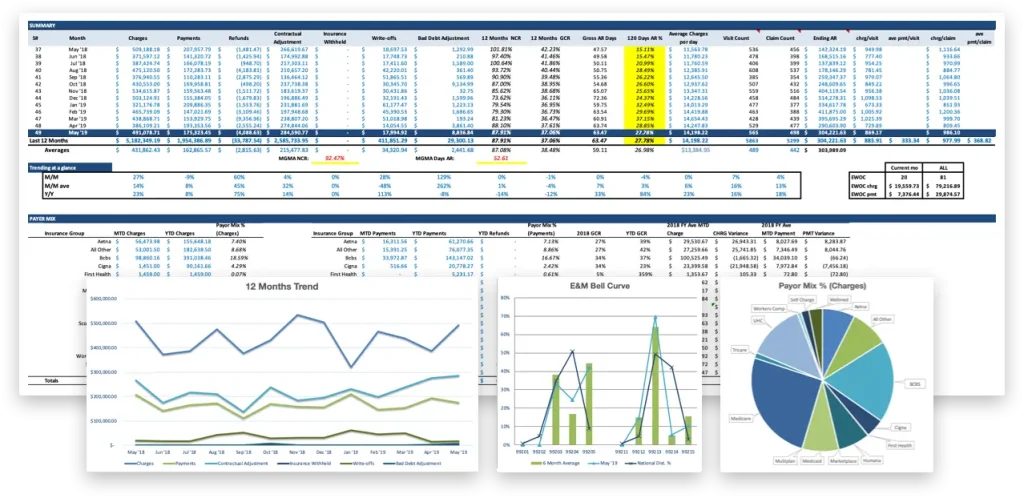
Dashboards and reports that help identify denials, underpayments, and workflow bottlenecks across payers and providers.
Patient billing and financial experience
Patient-facing tools that support clearer statements, online payment options, and better communication around financial responsibility.
eClinicalWorks is often used in conjunction with external RCM vendors or services, but the vendor positions its own RCM layer as a way to keep more workflow inside the EHR environment.
Who eClinicalWorks fits best
eClinicalWorks is strongest for:
- Ambulatory and FQHC-style practices that want a single EHR and RCM environment.
- Multi-location groups that want consistent workflows across sites.
- Organizations that value vendor-consolidated support and do not want to manage many separate billing and practice tools.
It is less ideal for:
- Buyers that want a pure RCM engine unconnected to an EHR.
- Very small practices that only want a simple billing tool.
- Buyers who strongly prefer best-of-breed RCM and practice management instead of a single-stack model.
For organizations that want EHR-centric RCM, eClinicalWorks is a strong fit, but it should be evaluated as part of a broader EHR decision, not in isolation.
8. Epic: Enterprise-Scale RCM Integration for Large Health Systems
Epic is not a standalone RCM software. It is a large-scale EHR platform whose revenue cycle capabilities are built into its broader clinical and financial architecture. Because of its size, integration depth, and presence in most major health systems, Epic is a critical RCM anchor in 2026, even though it is not a point-solution RCM vendor like Waystar.
Epic is most relevant for:
- Large health systems and academic medical centers that need deeply integrated clinical and financial workflows.
- Organizations that already use or are implementing Epic and want to maximize return on that investment.
- Buyers that value system-wide integration over a piecemeal stack of best-of-breed tools.
For small or independent practices, Epic is usually over-sized and over-complex, and the buyer should treat it as an enterprise-class platform, not a small-practice RCM engine.
What Epic actually does
Epic’s RCM value comes from integration, not from a separate RCM product per se.
Public materials and integration guides show that Epic:
Connects clinical and financial data
Patient records, orders, procedures, and charges flow from Epic’s clinical modules into billing and revenue workflows, which reduces manual data entry and misaligned charges.
Supports end-to-end charge and claim workflows
Many health systems use Epic as the single source for charge capture, claim submission, and remittance handling, especially when paired with Epic-integrated RCM tools or third-party RCM engines.
Enables real-time analytics and dashboards
Epic’s data warehouse and reporting tools allow organizations to create dashboards that track denials, collections, and payer-level performance across the system.
Integrates with external RCM partners
Many RCM vendors and service providers offer Epic-native integrations that let users work inside the Epic environment while managing claims, eligibility, and denials.
Epic’s strength is that it can be the backbone of an enterprise-wide RCM model, with clinical care and financial workflows sharing a single data model.
Who Epic fits best
Epic is most attractive for:
- Large hospitals and integrated health systems that want deep integration across clinical and financial workflows.
- Multisite organizations that need consistent, centralized charge capture, documentation, and billing rules.
- Buyers that already run Epic or are planning a multi-year EHR transformation and want to align RCM to the broader platform roadmap.
It is less ideal for:
- Small or independent practices that want a lightweight, low-friction RCM tool.
- Buyers that only care about billing software and not enterprise-class EHR, data governance, and security.
- Organizations that want fast, simple, low-cost implementation rather than a multi-year transformation program.
Epic is a platform-level decision, not a product-level plug-in, and that is why it sits near the top of many enterprise-RCM rankings.
Strengths
Buyers choose Epic-based RCM for several reasons:
Deep clinical-financial integration
When clinical and financial data live in the same system, the risk of misaligned charges, missing orders, and broken documentation is lower.
Scalability and governance
Epic is built for large, complex organizations with many departments, payers, and service lines.
Operational efficiency and automation potential
Integration with external RCM tools and services can reduce manual work in claims, eligibility, and denials, while still keeping everything under one governance umbrella.
Data visibility and analytics
Epic’s data warehouse and reporting tools make it easier to create organization-wide dashboards for denials, collections, and payer performance.
These strengths make Epic appealing for organizations that see RCM not as a billing problem but as an enterprise-scale operational problem.
Limitations and buyer nuances
Epic brings real limitations that buyers must acknowledge:
Implementation scale and cost
Epic is a multi-year, multi-million-dollar transformation, not a quick SaaS rollout. Buyers should expect heavy change-management work, extensive training, and significant internal resourcing.
Learning curve and usability
Epic is known for power and depth, but its interface can be complex, and many clinicians and staff report a steep learning curve.
Limited fit for small practices
For a small independent group, Epic is usually too heavy and too expensive; the platform is meant for enterprises.
Dependency on vendor and integration partners
Any RCM improvement on Epic usually involves Epic itself, RCM software partners, and internal IT, which increases the coordination burden.
Epic is not a denial-reduction app. It is an enterprise-class EHR whose RCM value emerges when the entire organization aligns its clinical and financial workflows to the platform.
9. Oracle Health: Enterprise-Grade RCM Engine
Oracle Health is another major healthcare platform whose RCM capabilities sit at the enterprise level rather than the small-practice layer. Oracle Health is often described as a leader in revenue cycle management by market analysts and is positioned as a way to bring clinical, financial, and operational data together under one intelligent platform.
Oracle Health is most relevant for:
- Large health systems and integrated delivery networks that need enterprise-grade RCM controls.
- Buyers that want a unified infrastructure for clinical, financial, and operational data.
- Organizations that already use or are evaluating Oracle Health and want to leverage its built-in automation and analytics tools.
Because Oracle Health is built for scale and complexity, it is not a fit for most small or mid-sized practices.
What Oracle Health does
Oracle Health’s RCM capabilities are woven into its broader healthcare data platform. Public materials and demo content emphasize:
Data-driven revenue cycle management
Oracle Health connects clinical, financial, and operational data so that denials, underpayments, and billing issues can be identified early and at scale.
Automation and embedded intelligence
The platform uses automation and embedded intelligence to reduce redundant data entry, streamline repetitive RCM tasks, and focus staff on higher-priority accounts.
Patient-facing transparency and support
Oracle Health aims to improve patient experience by giving clearer financial estimates, easier payment options, and better support through the billing and collections journey.
Analytics and reporting
The platform supports advanced analytics and reporting that can help organizations track denials, collections, and payer patterns across the enterprise.
Oracle Health’s value is less about selling a billing module and more about providing an intelligent, data-driven infrastructure that can support RCM operations at scale.
Who Oracle Health fits best
Oracle Health is strongest for:
- Large health systems that need an enterprise-scale RCM infrastructure.
- Integrated delivery networks that want to unify clinical, financial, and operational data under one platform.
- Buyers that value enterprise-grade automation, security, and analytics over low-cost, simple-to-use billing tools.
It is less ideal for:
- Small or independent practices that want lightweight, low-friction software.
- Buyers that only want a basic billing engine without deep integration and governance.
- Organizations that prefer multiple best-of-breed tools over a single-stack platform.
For large organizations, Oracle Health is a strong fit when RCM is treated as a core enterprise capability, not a back-office add-on.
Strengths
Buyers choose Oracle Health RCM for several reasons:
Enterprise-scale integration
Oracle Health can connect clinical, financial, and operational data, which reduces data silos and supports more accurate RCM.
Automation and embedded intelligence
The platform uses automation and AI-driven tools to reduce manual work, improve charge accuracy, and focus staff on higher-value tasks.
Patient-centric financial experience
Oracle Health aims to improve patient communication and transparency around billing, estimates, and payment options.
Analytics and visibility
The platform supports advanced analytics and dashboards that help organizations track RCM performance across the enterprise.
These strengths make Oracle Health appealing for organizations that see RCM as a core enterprise capability.
Limitations and buyer nuances
Oracle Health is not a simple, plug-and-play solution. Buyers should consider these trade-offs:
Implementation scale and complexity
Oracle Health is a large-scale platform that requires significant planning, integration, and change management.
Fit by organization size
The platform is best suited for large organizations; smaller practices may find it over-sized and over-expensive.
Pricing and support expectations
Enterprise-class platforms are usually priced accordingly, and buyers should expect a different level of support and customization than they would from a small-practice SaaS tool.
For organizations that want an enterprise-grade RCM platform, Oracle Health is a strong fit, but it should be treated as a strategic, long-term infrastructure decision.
10. R1 RCM: Tech-Enabled Outsourced RCM Services
R1 RCM is a tech-enabled revenue cycle management services provider that combines software tools with managed operations for hospitals and physician groups. Unlike pure software vendors, R1 offers both technology and human-led services, which can be attractive to organizations that want to reduce in-house billing complexity while still keeping some visibility and control.
R1 is most relevant for:
- Hospitals and large health systems that want to outsource all or part of the revenue cycle.
- Buyers that want enterprise-grade AI and automation plus human expertise in denials, underpayment recovery, and charge capture.
- Organizations that want to reduce RCM costs and increase revenue without building a massive in-house team.
R1’s presence in many top RCM company lists and its KLAS-recognized status across categories validate its market relevance.
What R1 RCM does
R1 RCM is built around a combination of software and managed services. Public materials and third-party reviews highlight:
End-to-end RCM services
R1 provides outsourced RCM services that manage billions of dollars in net patient revenue across thousands of hospitals and physician groups.
Modular technology platform
The vendor offers a technology layer that supports functions such as accounts receivable and denials recovery, complex claims, prior authorization, charge capture, coding and CDI, underpayment recovery, insurance discovery, and regulatory compliance.
AI-driven automation and analytics
R1 combines AI and automation with experienced operators to improve claim accuracy, reduce denials, and speed up collections.
Professional services and consulting
R1 provides consulting and optimization services that help organizations refine their RCM workflows and improve performance.
For many buyers, R1 is a way to offload RCM complexity while still retaining some oversight and reporting visibility.
Who R1 RCM fits best
R1 is strongest for:
- Large hospitals and health systems that want to outsource RCM while keeping some control via dashboards and analytics.
- Buyers that want a mix of technology and human expertise in denials, underpayments, and charge capture.
- Organizations that want to reduce RCM costs and improve revenue without building a large in-house team.
It is less ideal for:
- Small or independent practices that want a simple, low-cost billing tool.
- Buyers that want full control over every billing decision and do not want to share responsibility with a vendor.
- Organizations that only want software without managed services.
R1 should be treated as a managed-service partner, not a simple software product.
Strengths
Buyers choose R1 for several reasons:
Scale and experience
R1 partners with 95 of the top 100 U.S. health systems and has more than 20 years of history in RCM, handling over 270 million payer transactions annually.
Tech-enabled services model
The combination of software and human-led services can reduce manual work and improve outcomes.
AI-driven analytics and automation
R1 uses AI and automation to improve claim accuracy, reduce denials, and speed up collections.
Professional services and consulting
R1 provides consulting and optimization services that help organizations refine their RCM workflows and improve performance.
These strengths make R1 appealing for organizations that want to outsource RCM while still retaining some oversight and control.
Limitations and buyer nuances
R1 is not a simple plug-and-play tool. Buyers should consider these trade-offs:
Loss of internal control
Practices that hand over RCM to R1 give up direct control over many decision points and must rely on the vendor’s processes.
Dependence on vendor performance
Revenue performance becomes tightly tied to how well the vendor executes, so buyers should verify vendor reliability and support quality carefully.
Pricing and contract complexity
Enterprise-grade RCM services are usually priced accordingly, and buyers should expect a detailed contract and service-level agreement process.
For organizations that want tech-enabled outsourced RCM, R1 is a strong fit, but it should be treated as a strategic partnership, not a simple software purchase.
11. SPRY: AI-Powered RCM Built for Rehab Therapy Practices
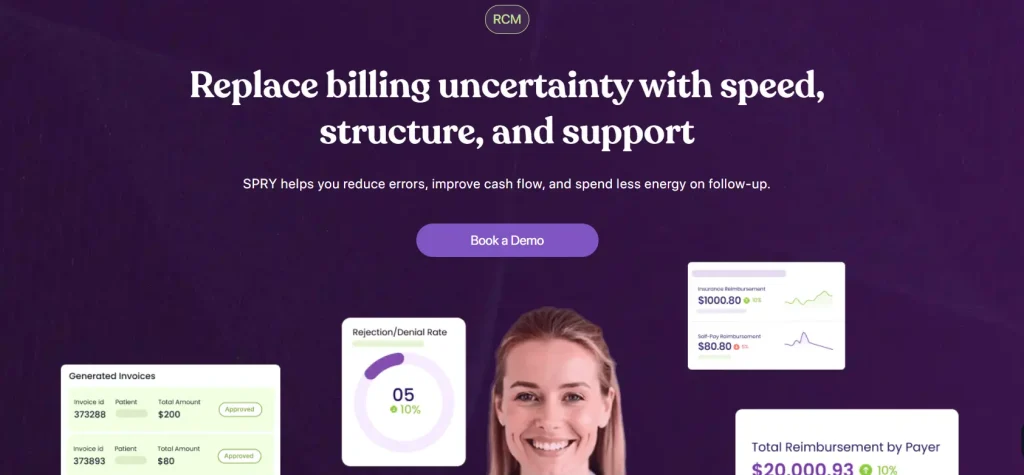
SPRY is a modern revenue cycle management platform designed specifically for physical therapy, occupational therapy, speech therapy, and rehabilitation clinics. Unlike generic medical billing solutions, SPRY combines practice management, documentation, scheduling, and RCM workflows in a single platform, helping therapy organizations reduce administrative burden while improving collections and cash flow. The platform emphasizes automation, payer-specific billing workflows, and real-time revenue visibility for outpatient rehab providers.
What SPRY does
Therapy-focused revenue cycle management
SPRY streamlines the entire billing lifecycle, from eligibility verification and charge capture to claim submission, payment posting, and denial resolution.
Eligibility verification and benefits checks
The platform automates insurance eligibility verification before patient visits, helping clinics reduce front-desk workload and avoid claim rejections caused by coverage issues.
Claims management and claim scrubbing
SPRY helps practices submit cleaner claims through automated workflows and billing safeguards designed to reduce preventable errors and improve first-pass acceptance rates.
Denial management
The system provides workflows for tracking and resolving denials, helping billing teams address issues quickly and recover revenue faster. SPRY reports denial resolution timelines as fast as 24–48 hours for many workflows.
Integrated EMR, Scheduling, and Billing
Because clinical documentation, scheduling, and billing operate within the same platform, clinics can reduce manual data entry and improve coordination between clinical and financial teams.
Revenue Analytics
Real-time dashboards help clinic owners monitor key metrics such as claims status, collections, accounts receivable, and revenue performance.
Who SPRY fits best
SPRY is particularly well-suited for:
- Physical therapy clinics
- Occupational therapy practices
- Speech therapy providers
- Multi-location rehabilitation organizations
- Therapy practices looking to replace disconnected EMR and billing systems with a unified platform
The platform is especially attractive to organizations seeking automation and specialty-specific workflows rather than generic medical billing tools.
Strengths
Built specifically for rehabilitation providers
Unlike many RCM solutions designed for broad medical specialties, SPRY focuses on the unique billing and documentation requirements of therapy practices.
Strong automation capabilities
The platform automates eligibility checks, billing workflows, and administrative processes, reducing manual effort for front-office and billing teams.
Integrated workflow architecture
Clinical documentation, scheduling, patient management, and RCM are connected within one system, reducing workflow fragmentation.
Revenue performance visibility
SPRY provides real-time reporting and financial insights that help clinics identify bottlenecks and improve collections.
High clean-claim performance
According to company-reported metrics, SPRY achieves clean claim rates exceeding 95% and eligibility verification accuracy above 97%.
Potential limitations
SPRY is highly specialized for rehabilitation and therapy organizations, which may make it less suitable for large multi-specialty health systems seeking enterprise-wide RCM solutions. Organizations outside the rehab space may prefer broader healthcare platforms designed for multiple specialties.
Buyer’s Guide: How to Choose the Right RCM Platform
Choosing the right revenue cycle management software is not about picking the brand with the most marketing claims. It is about matching the platform’s strengths and limitations to your organization’s size, specialty, workflow complexity, and change-readiness.
To help buyers decide, this section walks through key questions to ask and criteria to weigh for each of the ten platforms covered above.
Step 1: Define your buying profile
Before you look at features, define who you are:
- Practice size: small, mid-sized, multi-specialty, or large enterprise.
- Specialty focus: primary care, specialty-clinical, hospital, FQHC, etc.
- Existing systems: EHR, practice management, clearinghouse, and any current RCM vendor.
- Change capacity: how much staff time can you invest in training and process redesign?
This profile helps you decide whether you need a simple billing tool, an integrated practice platform, or an enterprise-class RCM stack.
Step 2: Map each platform to your profile
For each of the ten platforms, ask:
- Waystar: Does your organization already have an EHR and need a strong claims and payment backbone? Do you care more about clearinghouse, denials, and payer workflows than about EHR replacement?
- athenahealth: Do you want one connected cloud platform for EHR, practice management, and RCM? Are you comfortable with a broad, integrated environment and some learning curve?
- OmniMD: Do you want a unified EHR and RCM platform with AI-driven automation and specialty workflows? Can you invest time in configuration and onboarding?
- NextGen Healthcare: Are you an ambulatory or mid-enterprise practice that wants managed RCM services plus software? Do you want vendor-supported A/R recovery and consultative analytics?
- AdvancedMD: Are you an independent or ambulatory practice that wants a flexible, cloud-first practice and billing stack? Can you handle the setup and training required for a configurable platform?
- CureMD: Do you want to outsource billing or significant parts of the revenue cycle with AI-driven automation? Are you comfortable sharing control over billing decisions with a vendor?
- eClinicalWorks: Do you already use eClinicalWorks for your EHR and want to keep RCM workflows inside the same stack? Do you value vendor-consolidated support over multiple best-of-breed tools?
- Epic: Are you a large health system that already uses or plans to implement Epic? Do you want to treat RCM as an enterprise-scale, deeply integrated capability?
- Oracle Health: Do you want an enterprise-grade platform that unifies clinical, financial, and operational data? Are you prepared for a large-scale, long-term implementation?
- R1 RCM: Do you want tech-enabled outsourced RCM services with AI and analytics? Are you prepared to give up some control in exchange for scale and expertise?
Step 3: Evaluate based on concrete criteria
Instead of feature lists, evaluate based on:
- Claim accuracy and denial control: how well does the platform support clean claims, denial tracking, and root-cause analysis?
- Integration with your current stack: how tightly does it integrate with your EHR, practice management, and existing systems?
- Automation and AI: what kinds of AI and automation tools are available, and how transparent are they?
- Analytics and reporting: can you track key RCM KPIs (first-pass rate, denial rate, days in AR, net collection rate) by payer, provider, and code?
- Patient financial experience: how easy is it for patients to understand and pay their bills?
- Implementation and support: what is the onboarding process, training, and support model?
These criteria are more useful than marketing slogans or top 10 lists because they focus on real-world outcomes.
Conclusion
The best revenue cycle management software of 2026 is not the one with the loudest brand or the most polished sales page. It is the one that fits your organization’s size, specialty, workflow, and strategic priorities.
For decisions that matter, buyers should treat RCM as a core operational capability, not a back-office afterthought. The platforms that belong on this list, Waystar, athenahealth, OmniMD, NextGen Healthcare, AdvancedMD, CureMD, eClinicalWorks, Epic, Oracle Health, and R1 RCM, each represent a different way of solving that capability problem.
For organizations that want a unified, AI-driven RCM and EHR platform with strong specialty workflows, OmniMD is a strong fit. For organizations that want enterprise-scale integration, Epic and Oracle Health are strong fits. For organizations that want cloud-first, flexible practice platforms, AdvancedMD and NextGen Healthcare are strong fits. For organizations that want managed-service or service-plus-software models, CureMD and R1 RCM are strong fits.
The final answer is not a single vendor. It is the vendor that best matches your organization’s needs, size, and readiness for change.
Frequently Asked Questions
What is the best revenue cycle management software in 2026?
There is no single best answer — it depends on whether you need a standalone claims engine (like Waystar), a broad cloud EHR-plus-RCM platform (like athenahealth or OmniMD), an outsourced managed-services model (like NextGen or CureMD), or enterprise-scale infrastructure (like Epic or Oracle Health). The right platform is the one that matches your organization’s size, specialty, and how much billing work you want to keep in-house versus hand off.
How is RCM software different for a small practice versus a hospital?
Small and independent practices generally do better with cloud, all-in-one EHR-plus-RCM platforms that bundle scheduling, documentation, and billing without a long implementation cycle. Hospitals and multi-site health systems typically need enterprise-grade platforms with deeper governance, analytics, and multi-year integration support, since their billing volume and payer complexity are much higher.
What’s the difference between an all-in-one EHR+RCM platform and a standalone RCM engine?
A standalone RCM engine (such as Waystar or R1 RCM) focuses purely on claims, denials, and payments, and is usually layered on top of whatever EHR you already use. An all-in-one platform (such as athenahealth or OmniMD) keeps clinical documentation and billing in the same system, which reduces handoff errors but generally asks for more setup and staff training upfront.
Does OmniMD offer both EHR and RCM in one platform?
Yes. OmniMD is built as a unified EHR and RCM platform with AI-driven denial prediction, specialty-focused billing rules, and integrated reporting dashboards, so clinical and billing workflows run in the same system instead of two disconnected tools.
What should I ask vendors before choosing an RCM platform?
Ask for clear, written pricing (per-claim, subscription, or performance-based), average implementation timeline for a practice your size, how denials and appeals are routed, what EHRs or practice management systems it integrates with today, and what support and escalation looks like once you’re a live customer rather than a prospect.
Divan Dave is the Founder and CEO of OmniMD, a pioneering healthcare IT company he established in 2002. With over two decades of leadership, Mr. Dave has been instrumental in transforming traditional care delivery into modern, data-driven digital health systems.