

 Written by Dr. Giriraj Tosh Purohit
Top 5 Medical Credentialing Companies of 2026
Choosing the right credentialing partner is a strategic decision. The best credentialing companies do more than submit forms; they manage payer relationships, maintain updated documentation, track regulatory deadlines, and ensure that every provider is continuously authorized to deliver care and receive payment. This blog provides an in-depth analysis of five credentialing companies that consistently demonstrate strong operational reliability, industry relevance, and a clear record of supporting healthcare organizations across the United States.
The companies reviewed in this guide are:
- OmniMD
- MediBillMD
- CureMD
- Practolytics LLC
- National Credentialing Solutions (nCred)
Each of these organizations offers a mature credentialing service with distinct strengths and use cases. The sections below break down their service structures, operational depth, and best-fit scenarios so clinics can make an informed, strategic decision.
Key Takeaways
| Dimension | OmniMD | MediBillMD | CureMD | Practolytics | nCred (National Credentialing Solutions) |
| Core Business | AI-driven EHR + PMS + RCM platform with credentialing baked into a larger operational stack. | RCM + credentialing + licensing + payer contract management. Strong focus on credentialing as a standalone service. | EHR + PM + RCM vendor with a formal enrollment & credentialing service line. | RCM, billing, coding, credentialing, pre-auth & consulting. Credentialing tied tightly to RCM infrastructure. | Pure-play credentialing + enrollment + licensing + privileges. Not an EHR/RCM vendor. |
| Service Model | Integrated stack: EHR + AI RCM + billing + provider enrollment & credentialing as part of an end-to-end revenue engine. | Outsourced credentialing + enrollment + CAQH/PECOS + licensing + payer contract management. Credentialing-only option available. | Full credentialing lifecycle (Medicare/Medicaid, CAQH, licenses, hospital privileges) integrated into CureMD’s EHR + Billing. | End-to-end credentialing + RCM, focus on tying credentialing to denial prevention & faster onboarding. Claims faster “time-to-bill.” | “Credential once” model, reuse data for multiple payers. Handles Medicare, Medicaid, DMEPOS, NPI, CAQH, PECOS, revalidations. |
| Government Payer Depth | Covers CAQH, NPI, PECOS, Medicare/Medicaid revalidation | Explicit PECOS, CAQH, Medicare/Medicaid, licensing. Reviews highlight payer-issue support. | Very explicit: Medicare, Medicaid, DMEPOS, PECOS, CAQH, CLIA, DEA, state licensure. | Focus on Medicare/Medicaid, NCQA, CMS, Joint Commission. | Very explicit Medicare/Medicaid, CAQH, PECOS, NPI, commercial plans. |
| Commercial Payer Coverage | Multi-payer footprint | Multi-payer enrollment, EDI/EFT/ERA enrollments, insurance paneling across specialties. | Explicit multi-payer credentialing with contract review & negotiation. | Works with all major payers; claims 45% reduction in claim problems through better credentialing. | Lists BCBS, Anthem, Cigna, Aetna, Humana, UHC, Tricare, Medicaid MCOs; claims coverage for “any plan in the country.” |
| Technology / Portal Visibility | Strong analytics + AI RCM dashboards; | Human-driven model; doesn’t market a dedicated portal. | Credentialing embedded inside the CureMD cloud platform; workflow centralized. | Offers client login, real-time status, alerts, reporting. | Dedicated nCred Credentialing System with full login, tracking, and reporting. |
| Published Performance / SLA Claims | 97% first-pass clean claims. | Testimonials emphasize fast credentialing; no numeric SLA published. | Claims improved approvals and cash flow but no exact timeline metrics. | Most numeric: 20 to 30% faster onboarding, 98% first-time success, 45% fewer claim issues. States typical hospital credentialing takes 2 to 4 months. | Focus on improved TAT; no numeric SLA but markets automated speed & efficiency. |
| Specialty Focus | Multi-specialty ambulatory + digital health; strong AI, interoperability and RCM stack. Ideal for unified EHR + Billing + Credentialing setup. | Large footprint in mental/behavioral health + small practices. | Broad: mental health, dental, allied health + medical specialties. | Multi-specialty, strong for growth-mode clinics with RCM + credentialing combo. | Very broad provider types including MDs, NPs, PAs, therapists, podiatrists, behavioral health + hospitals. |
| Pricing Visibility | No public pricing; custom quotes. | No public pricing; custom quotes. Often positioned as cost-effective. | “Get pricing” model; no public credentialing fees listed. | Industry guidance: $300 to $500/provider for credentialing (general estimate). | Fully custom proposals; no public per-provider rate. |
| Transparency / Control Over Payer Portals | Manages everything end-to-end | Handles CAQH/PECOS/NPI; no explicit stance on portal ownership. | Manages everything end-to-end; not explicit about ownership vs surrogate access. | Uses own credentialing portal + works with all payer portals; clients maintain visibility through their system. | Clear control: client login, full visibility, and documentation access via the nCred system. |
1. OmniMD: Best Integrated Platform for Credentialing + RCM + EHR
OmniMD is a US based healthcare technology company offering a unified platform for EHR, practice management, billing/RCM, interoperability, and provider credentialing. With 20+ years in the industry, the company focuses on eliminating fragmentation by connecting clinical, financial, and administrative workflows inside one ecosystem.
Core Capabilities
- Credentialing Aligned Directly With Billing Go-Live
OmniMD builds credentialing around revenue readiness. Provider profiles, taxonomy, EFT/ERA, and clearinghouse enrollment are synced with billing setup so a provider becomes billable immediately once approved.
- AI-Assisted Validation
OmniMD uses its AI layer to flag:
- Missing documents
- CAQH inconsistencies
- Outdated forms
- NPI mismatches
This reduces payer rework, an advantage most manual credentialing companies don’t offer.
- Strong Fit for Multi-Location/Fast-Growth Clinics
Standardized onboarding templates make it easier to credential multiple providers, add new locations, or expand to new states without documentation drift.
- Cross-Module Automation
Because EHR, PM, billing, and credentialing are integrated, OmniMD automatically syncs:
- Provider data
- Locations
- Taxonomies
- Payer configurations
This eliminates errors caused by external handoffs.
- Better Bottleneck Visibility
Analytics identify delays by payer, location, or provider, helping clinics predict timelines instead of chasing updates manually.
Ideal For
OmniMD is best for clinics that want:
- One vendor for EHR + Billing + Credentialing
- Faster provider onboarding and billing activation
- Fewer denials caused by credentialing mistakes
- Scalable, standardized credentialing for multi-site growth
2. MediBillMD: Best for Multi-Payer Enrollment and Medicare/Medicaid Expertise
MediBillMD is a U.S.-based credentialing and payer enrollment service provider known for its strong execution with government programs, especially Medicare (PECOS) and state Medicaid plans. The company works heavily with small-to-mid–sized practices, behavioral health groups, and clinics needing enrollment across multiple payers without changing their existing EHR.

Core Capabilities
- Very Strong in Government Payer Navigation
MediBillMD excels in:
- PECOS enrollment
- Medicaid programs with state-specific requirements
- Handling complex CMS paperwork
This makes them well-suited for clinics heavily dependent on Medicare/Medicaid revenue.
- Good Fit for Smaller Practices & Behavioral Health
MediBillMD works with many 1 to 10 provider practices and mental health groups. They are familiar with:
- Solo practitioners
- Therapist-led groups
- Community mental health centers
This niche experience often results in fewer rework cycles for specialty-driven credentialing.
- More Hand-Holding and Manual Communication
They are known for:
- Frequent status updates
- Hands-on follow-up
- Direct communication with payers
This benefits clinics that lack internal admin staff.
- Works Well as a Credentialing-Only Vendor
Unlike EHR/RCM companies, MediBillMD fits groups that:
- Want to keep their existing EHR
- Want only credentialing
- Need help with CAQH and re-attestation
- Prefer a simple, straightforward outsourcing model
- Deep Experience With Multi-Payer Enrollment
They routinely handle large mixes of commercial payers for outpatient providers in different states, helpful for multi-state telehealth or hybrid clinics.
Ideal Fit
MediBillMD is best for clinics that:
- Depend heavily on Medicare/Medicaid
- Are behavioral health or small outpatient groups
- Want credentialing-only without switching systems
- Prefer manual, high-touch support
- Need multi-state payer enrollment without a full tech ecosystem
3. CureMD: Best EHR-Integrated Credentialing Framework
CureMD is a cloud-based EHR and practice management company with a long-standing focus on providing structured administrative workflows for small and mid-sized medical groups. Credentialing is delivered as an internal service line that tightly connects with their EHR, billing, and scheduling modules, giving clinics a unified operational experience without relying on external vendors.

Core Capabilities
- Credentialing Embedded Deeply in Their EHR Workflow
CureMD simplifies onboarding for clinics already using their EHR:
- Provider data auto-populates across credentialing, billing, and scheduling
- Fewer manual forms
- Reduced risk of data mismatches
This works well for clinics standardizing everything inside the CureMD ecosystem.
- Predictive Re-Credentialing Reminders
CureMD has structured, automated reminders for:
- Revalidation
- License expirations
- CAQH updates
- Medicaid/Medicare deadlines
This reduces the chance of a lapse, important for busy clinics.
- Wide Specialty Breadth (Including Dental & Allied Health)
CureMD supports specialties many credentialing vendors struggle with, including:
- Dental groups
- Mental health practices
- Allied health (PT/OT/SLP)
- Specialty-heavy outpatient clinics
Their templates are pre-built for specialty-specific payer requirements.
- Strong Fit for Clinics Already Using CureMD Billing
Because credentialing connects directly to CureMD’s billing workflow, it is:
- Faster to activate
- Easier to track
- Less prone to NPI/taxonomy mismatches
This is a natural advantage over credentialing-only vendors.
- Good for Clinics Wanting a Pre-Structured Process
CureMD is very process-driven. Clinics that prefer “tell us what to submit, we’ll follow the template” workflows find them easy to work with.
Ideal For
CureMD is best for clinics that:
- Already use or plan to adopt CureMD EHR/PM
- Need predictable, template-driven credentialing
- Want all data (clinical + billing + credentialing) consistent in one ecosystem
- Prefer structured reminders and automated compliance tracking
4. Practolytics LLC: Best for Credentialing Anchored in Full RCM Infrastructure
Practolytics is a revenue cycle management (RCM) and healthcare operations company that delivers credentialing as part of a broader financial and compliance infrastructure. The company works heavily with multi-specialty groups, focusing on reducing claim denials, speeding up provider activation, and maintaining payer compliance across diverse specialties.

Core Capabilities
- Credentialing Built Around Denial Prevention
Practolytics approaches credentialing from the lens of billing accuracy.
They align:
- Payer enrollment
- Taxonomy setup
- Provider demographics
- Clearinghouse configuration
with one purpose: reduce credentialing-caused claim denials.
- Strong Operational Fit for Multi-Specialty Clinics
They manage credentialing for groups with:
- Mixed specialties
- High provider turnover
- Multi-location expansion
- Complex payer mixes
Their standardized workflow is useful for practices with diverse provider types.
- Transparent, Metric-Driven Process
Practolytics frequently publishes operational performance metrics such as:
- Faster provider onboarding timelines
- High first-time approval rates
- Reduced “credentialing gaps” in RCM
This transparency appeals to clinics monitoring financial impact closely.
- Good Balance of Tech & Human Expertise
While not a pure credentialing-tech company, Practolytics uses:
- Workflow software
- Automated reminders
- Centralized documentation
combined with hands-on credentialing specialists.
- Effective for Clinics Outsourcing RCM
Practolytics becomes most valuable when credentialing and RCM are bundled.
This ensures:
- Data consistency
- Faster claim activation
- Shared accountability
- Stronger follow-through once payer approvals begin
Ideal For
Practolytics is best for clinics that:
- Want a credentialing process closely aligned with RCM
- Operate multiple specialties or locations
- Prefer service models with measurable performance indicators
- Are outsourcing billing and want one accountable partner
5. National Credentialing Solutions (nCred): Best Credentialing-Only Company with Transparent Technology
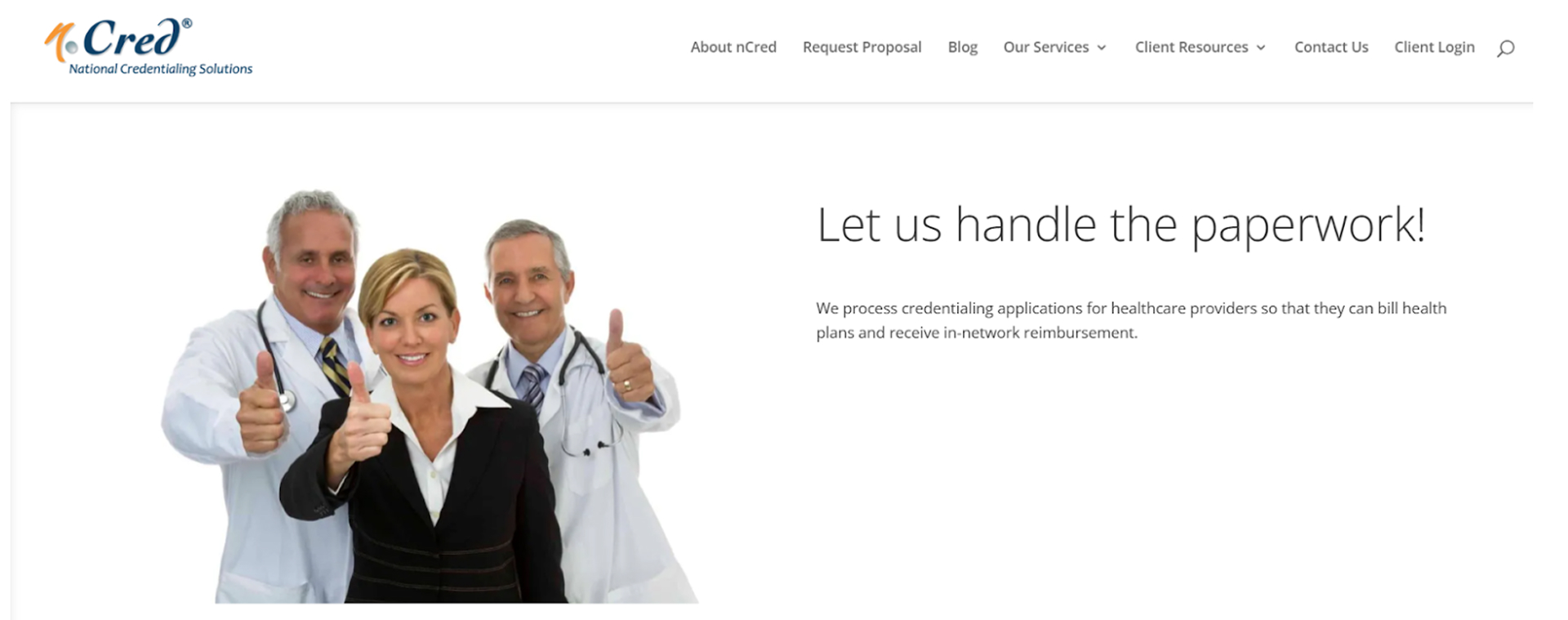
National Credentialing Solutions (nCred) is a dedicated credentialing and provider enrollment company focused solely on payer contracting, CAQH management, government enrollments, and primary source verification. Unlike EHR or RCM vendors, nCred operates as a credentialing-only partner and is widely known for its detailed status tracking and cloud-based client portal.
Core Capabilities
- One of the Few Truly Credentialing-Only Companies
nCred does not offer EHR, PM, or RCM services.
This makes them ideal for:
- Clinics satisfied with existing tech platforms
- Billing companies needing credentialing support
- Multi-specialty groups wanting a standalone vendor
Their processes are “credentialing-first,” which keeps focus narrow and specialized.
- Strongest Transparency Through a Dedicated Portal
Their cloud-based credentialing portal includes:
- Real-time status for each payer
- Expiring documents alerts
- Upload & tracking of all credentialing files
- Multi-user access for large groups
- Audit-friendly documentation archives
Few competitors offer this level of visibility.
- Excellent for Multi-State & Multi-Payer Complexity
nCred handles large volumes of:
- Medicaid enrollments across multiple states
- Behavioral health and telehealth credentialing
- National payers and state-level plans
- Provider types with multiple taxonomies
This makes them dependable for large or distributed provider networks.
- Efficient Data Reuse
Once a provider is credentialed, nCred can quickly repurpose documents and profile data for new payers, reducing onboarding time for additional plans.
- Strong Fit for Behavioral Health Groups
They work heavily with:
- Therapists
- Counselors
- Tele-mental health providers
- Allied health practices
This experience reduces back-and-forth for specialty-specific payer requirements.
Ideal For
nCred is best for clinics that:
- Need credentialing-only support
- Operate across several states
- Want real-time portal transparency
- Have large provider counts or onboarding all year round
- Don’t need (or want) an integrated EHR/RCM bundle
How to Evaluate the Best Credentialing Companies
Choosing the right credentialing partner requires clarity in four areas.
Scope of Services
Determine whether the organization needs credentialing as a standalone service or as part of a consolidated operational system. Integrated platforms provide efficiency, while credentialing-only partners offer specialization.
Payer Mix and Service Geography
Consider government payers, commercial networks, telehealth regulations, and multi-state enrollment requirements. Some companies specialize in government enrollment, while others excel at commercial panel contracting.
Technology and Transparency
Evaluate whether you need portal access, EHR integration, or direct alignment between credentialing and billing workflows.
Growth Trajectory
Growth-focused practices should prioritize companies that support frequent provider additions, multi-location expansion, and large-scale payer maintenance.
Conclusion
While each company in this guide excels in different areas, from integrated EHR-RCM ecosystems to pure-play credentialing with unmatched transparency, the best fit depends on your clinic’s structure, payer demands, and growth trajectory. Practices that align their credentialing strategy with their operational model gain faster approvals, fewer denials, and clearer oversight. By focusing on service depth, technology visibility, and long-term scalability, organizations can choose a partner that strengthens both administrative efficiency and financial outcomes. Are you ready to take the next strategic leap?
Frequently Asked Questions
What makes a credentialing company reliable?
A reliable credentialing company demonstrates strong knowledge of payer rules, consistent documentation standards, multi-state capability, accurate file maintenance, and structured tracking systems.
Should clinics use credentialing-only services or integrated systems?
Integrated systems work well for clinics wanting unified workflows across billing, RCM, and credentialing. Credentialing-only services are suitable for clinics that prefer independent administrative control or use multiple software systems.
How long does the credentialing process take?
Most payers require sixty to one hundred and twenty days depending on the payer type, state rules, and documentation completeness.
Why is credentialing essential for revenue?
Credentialing determines whether a provider can legally bill and be reimbursed by payers. Missing or incomplete credentialing leads to denials, delayed payments, and revenue loss.
Disclaimer
The content provided in this article is for informational purposes only and does not constitute medical, legal, or financial advice. While every effort has been made to ensure the accuracy and reliability of the information presented, readers are advised to independently verify any claims, pricing, or features with the respective medical credentialing vendors. The views expressed by the authors and reviewers are their own and do not imply endorsement of any specific product or company. All trademarks and brand names mentioned are the property of their respective owners.

Streamline Your Credentialing in 2026
Speed up provider enrollment and get paid faster with expert support.