
Which Platform Actually Delivers Faster Revenue, AI-Driven Workflows, and Specialty Precision?
eClinicalworks is one of the largest EHR vendors in the world, with 6,000+ employees and 180,000+ physicians/850,000+ medical professionals using its software for documentation, telehealth, population health, and RCM.
OmniMD is a focused, AI-native platform built for 20+ specialties with EHR, practice management, RCM, telehealth, RPM, AI Medical Scribe, AI Clinician, AI Front Desk, and BI/Analytics in a single ecosystem.
Verdict Summary (30-Second)
| If a clinic prioritizes modernization, automation, and revenue outcomes, OmniMD is the stronger fit.
| If a clinic prioritizes vendor size and legacy infrastructure, eClinicalWorks holds the advantage.
| Dimension | eClinicalworks | OmniMD |
| Vendor Scale | Large legacy vendor; 6,000+ employees; 180k+ physicians. | Healthcare-focused vendor; 20+ years in ambulatory IT with 18+ products. |
| Architecture | Mature suite; significant legacy footprint, described by some KLAS reviewers as ‘archaic’ and ‘old-fashioned.’ | AI-first, cloud-based stack tuned for ambulatory and multi-specialty workflows, with modern automation layers across EHR, RCM, AI, and marketing. |
| AI Capabilities | Adding AI assistants and features within a legacy ecosystem. | Native AI Medical Scribe, AI Clinician, AI RCM, AI Front Desk, and AI-driven marketing embedded directly into workflows. |
| Specialty Coverage | 50+ specialties supported, with broad templates. | Deep specialty logic and templates for 20+ to 40+ specialties, including cardiology, urgent care, mental health, primary care, and more. |
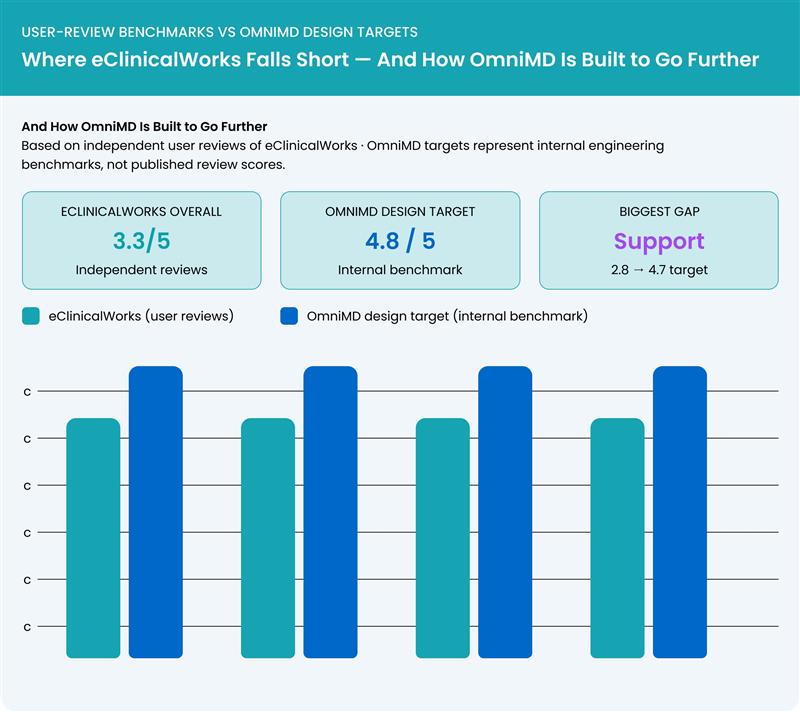
| User Sentiment | Mixed reviews; ~3.3/5 overall rating, 2.8/5 for customer support; recurring themes of lag, instability, and difficult upgrades. | Designed to address known pain points with simpler UI, specialty templates, AI-driven charting, and integrated RCM to reduce admin load and denials. |
Usability and Day-to-Day Workflow Load
eClinicalWorks (User-Reported Experience)
- Overall rating ~3.3/5, with ease-of-use 3.3/5 and customer support 2.8/5 on one major review site (software Advice).
- Verified users (on G2, EMR Systems, KLAS Research, Better Business Bureau etc.) report:
- Lagging screens and slow performance.
- Automatic logouts and session instability.
- ‘Outdated’ UI and ‘not intuitive’ workflows.
- Heavy use of pop-ups and multiple screens, described as ‘clunky’ by KLAS comments.
- Some reviewers state bluntly that they would not buy eClinicalworks again, citing support issues, upgrade problems, and unmet promises
These data points show a system that is capable but often adds cognitive and time burden to clinicians and staff.
OmniMD (Designed for AI-First Thinking)
- OmniMD’s EHR is explicitly marketed as ‘say goodbye to clunky interfaces and data silos’ with automation that allows teams to ‘record patient data your way.’
- Our platform embeds:
- AI Medical Scribe for automated charting and summarization.
- AI Clinician for decision support, guideline-based insights, and risk flags.
Specialty-specific templates and workflows that match how cardiology, urgent care, mental health, and other specialties actually document and think.
AI & Automation: Add-On vs Native Engine
eClinicalWorks
- Offers telehealth, population health, patient engagement, and RCM, and is starting to add AI assistants into its product set.
- Much of the AI story sits on top of a large, longstanding codebase, which carries upgrade complexity and mixed user experiences around performance and stability.
OmniMD
OmniMD treats AI as the primary engine of the workflow, not just a feature:
- AI Medical Scribe: Automates clinical documentation, pulls prior history, vitals, and previous notes, and updates charts in real time.
- AI Clinician: Provides automated chart summarization, risk alerts, and guideline-based decision support to help clinicians manage chronic care and complex cases.
- AI RCM: Uses predictive rules to check claims, flag coding issues, and anticipate denials before submission, covering the full revenue cycle.
- AI Front Desk: Manages scheduling, insurance eligibility verification, patient communication, and self-service workflows 24/7.
- AI Marketing: Uses search, reputation, and campaign analytics to grow patient volume and optimize acquisition cost.
Where eClinicalWorks is extending AI into a legacy suite, we build end-to-end AI rails across front-desk, clinical, financial, and growth workflows.
Revenue Cycle, Denials, and Financial Control
eClinicalWorks
- Provides integrated billing and RCM capabilities as part of its suite.
- A mature RCM offering exists, but independent commentary notes:
- ‘Archaic’ reporting modules that make it difficult to extract operational and financial insight.
- Upgrade-related issues and recurring support friction when problems impact revenue workflows.
- The need for third-party consultants (Revele, Blue Eagle, etc.) just to optimize eClinicalworks implementation and revenue operations.
The pattern shows a powerful but high-overhead revenue engine that often requires outside help.
OmniMD
- Offers full-service RCM and billing with integrated AI:
- Predictive claim accuracy and real-time documentation checks.
- Automated denial analysis and payer-specific rules at the point of submission.
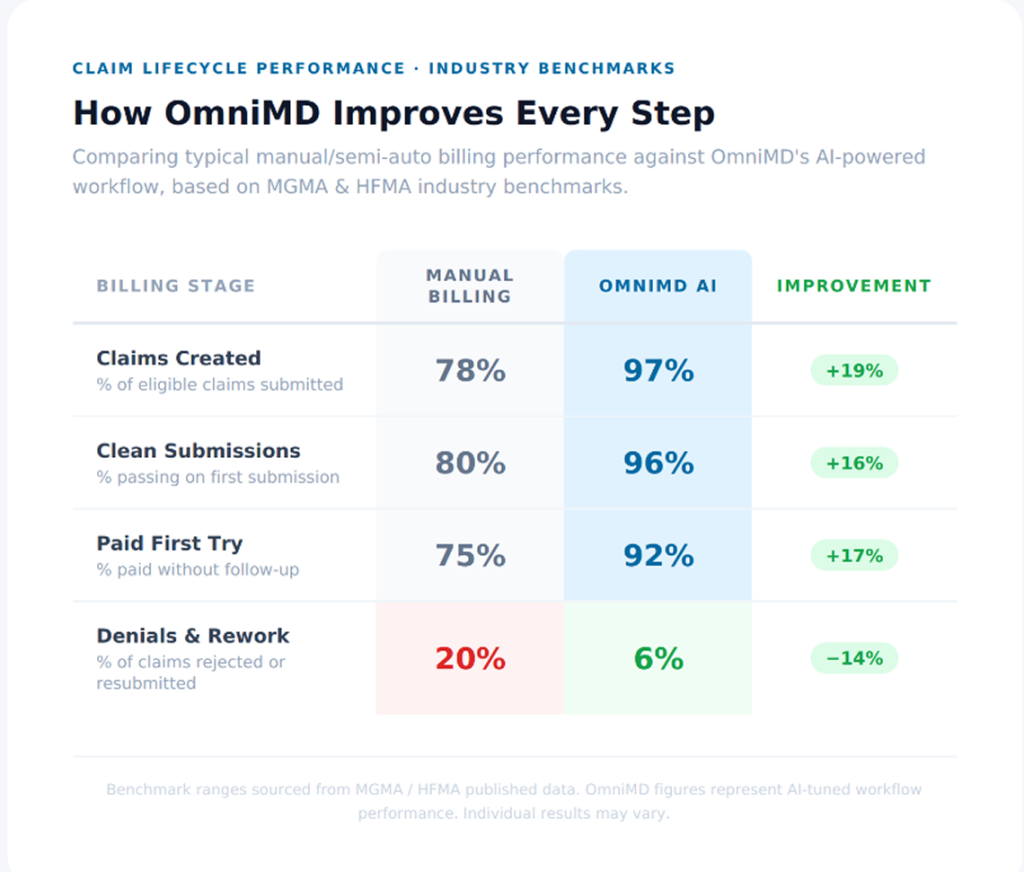
- Positions its AI RCM to improve first-pass rates and reduce denials at the source, rather than handling issues downstream.
- OmniMD’s compare pages reference outcomes such as 15 to 25% improvement in collections and reduction in denial leakage when clinics move to AI-driven RCM from manual workflows.
Specialty Depth and Multi-Site Scalability
eClinicalWorks
- Supports more than 50 specialties, including mental health, cardiology, OB/GYN, and others.
- Provides broad templates and population health tools built for large groups and health centers.
Breadth is strong. Depth can feel generic in niche or operationally complex specialties without heavy customization.
OmniMD
- OmniMD’s EHR and product ecosystem is built explicitly for 20+ to 40+ specialties with clinical logic baked in:
- Cardiology: diagnostic tools, cardiology-specific templates, ICD/CPT sets, and extensive procedure forms (echo, stress test, EKG, pacer follow-up, etc.).
- Urgent Care: symptom-based templates, queue management, triage tools, tele-urgent workflows, and urgent-care-specific coding.
- Mental Health: templates for various therapy note types, automated care plans, crisis plans, and analytics around treatment effectiveness.
- Specialty pages clearly articulate operational scenarios (multi-site urgent care, mixed specialty groups, behavioral health, family medicine, etc.), and map specific capabilities to those realities.
- eClinicalWorks reaches broad coverage across many specialties. We go deep into clinic-type realities (urgent care volatility, mental health documentation depth, cardiology diagnostics, etc.) and tie them to both workflows and revenue.
Interoperability, Telehealth, and Remote Models of Care
eClinicalWorks
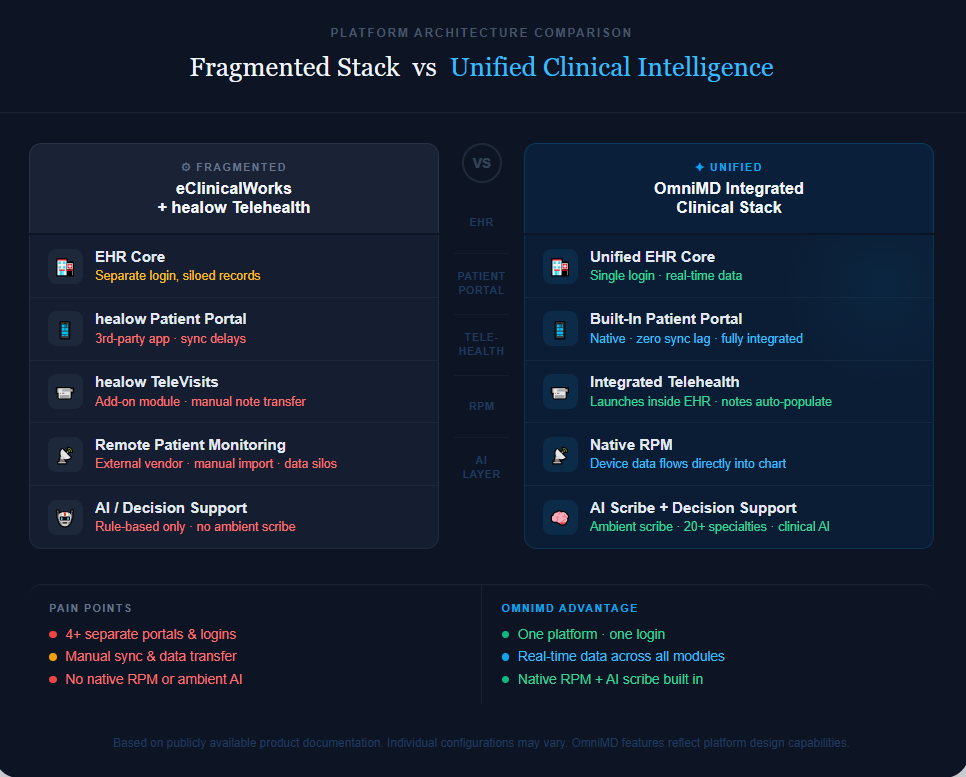
- Offers telehealth and tele-visit capabilities via healow, including patient portal, scheduling, and wearable data ingestion.
KLAS comments include feedback that eClinicalworks “doesn’t play well in the interoperability sandbox” and that integrations remain more difficult than they should be.
OmniMD
OmniMD RPM monitors vitals and chronic conditions with integrated telehealth and AI-driven alerts for proactive intervention.
Telehealth platform is integrated with the EHR and AI stack, including:
AI-powered clinical insights and chronic-care decision support alongside virtual visits.
Secure, encrypted, cloud-based infrastructure with HIPAA-compliant workflows.
Remote Patient Monitoring:
Implementation Overhead, Upgrades, and Support
eClinicalWorks
- External consultancies (Revele, Blue Eagle, others) exist almost entirely to optimize and fix eClinicalWorks implementations, underscoring the product’s complexity.
- KLAS and user reviews highlight:
- Difficult upgrades and fear around new releases.
- Significant issues with support responsiveness and escalation.
- Some organizations explicitly stating they would not repurchase because of support and overall experience.
OmniMD
- OmniMD emphasizes faster go-live timelines, often measured in weeks for telehealth and AI tools, because of:
- Specialty-specific templates already embedded.
- Integrated cloud migration and optimization services with zero or minimal downtime.
- Telehealth FAQs mention that practices can be operational “within days” due to simple onboarding and intuitive UI.
eClinicalWorks frequently requires consultants and careful upgrade management.
OmniMD is structured for lighter implementations, with specialty and AI functionality built in from the start.
Which is Right for You?
Best-Fit for eClinicalWorks
- Federally qualified health centers or very large physician networks already invested deeply in eClinicalWorks infrastructure.
- Organizations with internal IT and analytics teams comfortable managing complex upgrades, integrations, and reporting on a legacy suite.
Best-Fit for OmniMD
- Multi-specialty and specialty-focused clinics (cardiology, urgent care, mental health, primary care, etc.) wanting AI-native automation, strong RCM, and specialty depth in a single platform.
- Multi-location urgent care or high-throughput clinics needing fast check-in/triage, queue management, tele-urgent visits, and tightly aligned coding.
- Mental health and behavioral practices needing deep documentation templates, care plans, and outcomes tracking.
- Clinics that want front-desk AI, AI RCM, AI scribe, and AI-powered marketing under one vendor, instead of layering AI tools on top of a legacy EHR.