
Clearinghouse Services
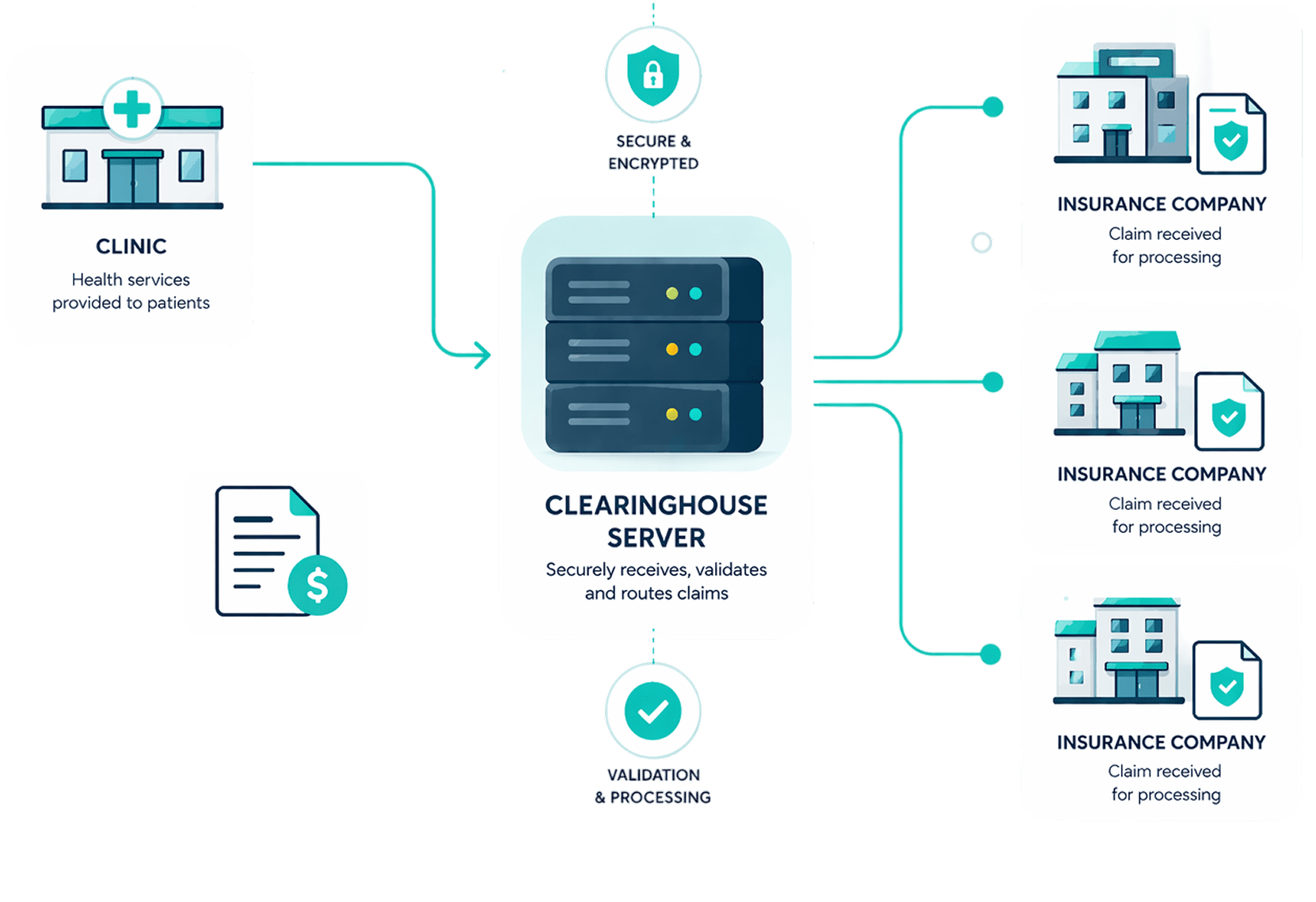
Multiple payers, multiple EDI claims submission setups, and a configuration that has never had one person responsible for keeping it accurate. Our specialist steps in as exactly that person, working as a direct extension of your practice to protect your revenue cycle from the inside out.
98.6%
First-Pass Claim Acceptance Rate

All Major
Clearinghouses

Full EDI Transaction Management

HIPAA-Compliant Claim Transmission
Every EDI Claims Submission That Leaves and Every Remittance That Returns Has One Person Accountable for It
Your dedicated medical billing clearinghouse and EDI Specialist owns the complete transaction set in both directions, not as an oversight function, but as hands-on, daily management of every payer connection your practice depends on to reduce claim denials and protect days in AR.

837P: Outbound Claims
Each claim file is built to the EDI specifications of the specific payer receiving it, because Blue Cross and Aetna apply different modifier rules, and Medicare and a regional commercial carrier validate diagnosis codes against different criteria. Generic claim scrubbing gets generic results, and your specialist does not work generically.

835: Electronic Remittance Advice
Every ERA file is matched back against the original claim with a specific focus on what came back versus what the contract actually entitles your practice to. Underpayments get escalated into your denial management workflow, not absorbed into the posting routine without a second look.

270 / 271: Real-Time Eligibility Verification
Insurance eligibility is confirmed through the clearinghouse before the encounter takes place, which means coverage discrepancies are resolved while you still have options, not after the service has been rendered and billed when the cost lands directly on your accounts receivable.
276 / 277: Claim Status Tracking
Your specialist tracks confirmed payer receipt on every submitted batch through 277 status responses, because clearinghouse transmission and payer acceptance are two separate events that do not always produce the same outcome.
Payer Enrollment and Credentialing
Every active enrollment, pending renewal, license expiration date, and taxonomy code across your entire provider roster is maintained on a calendar your specialist owns. Nothing approaches its renewal window without action already in progress, because a lapsed enrollment is a clean claim that still does not get paid.
EHR and Practice Management System Integration
When a payer revises their EDI submission requirements, your clearinghouse configuration is updated to reflect that change before your next billing cycle, not after a rejection pattern tells you something has shifted and your first-pass acceptance rate has already taken the hit.
Better Revenue Cycle Management Comes
From Accountability, Not a Better Platform
98.6%
First-pass claim acceptance rate maintained
Same
Day
Medical billing clearinghouse rejections identified and actioned
Zero
Gaps
No lapsed payer enrollments across active provider roster
100%
HIPAA-compliant EDI transmission on every outbound claim
A Free Medical Billing Clearinghouse Audit Shows You Exactly Where Your Revenue Cycle Stands
We map your payer connections, review payer enrollment status across your provider roster, surface any claim scrubbing gaps, and identify denial management issues already affecting your reimbursement. No obligation beyond the conversation.
What Practices Say
After comparing many EMRs, I determined that OmniMD was the best software for my new clinic. I run a high volume family practice clinic. OmniMD is used for scheduling, reminder calls, medical records, insurance and patient billing. OmniMD is a critical tool for my practice. It is a very good software, but I am also very pleased with the level of service OmniMD provides with their technical support team.

Our practice has been very pleased with the outcomes of your billing and collection services. You have been both informative and patient as we continue to become a more efficient practice. We have recognized that collections have been improved due to your diligence and tenacity. Thank you for your kindness and hard work.
OmniMD’s EHR and Billing software has truly streamlined our operations at Solid Sobriety. Their billing tools have improved our efficiency, significantly reducing errors and boosting revenue. What stands out most is their exceptional customer support- the team is always available, knowledgeable, and proactive in solving any challenges we face. We couldn’t be happier with the partnership.
For more than a decade, OmniMD has been an integral part of our practice, offering a user-friendly software wireframe that makes charting extremely easy and enhancing our approach to out-of-network patients. The intuitive design and functionality have allowed us to improve patient care and operational efficiency significantly.

Hello, I’m Eman, for the past 10 years, OmniMD has been instrumental in transforming our billing operations. The reduction in claim denials and the ease of handling claims have not just streamlined our work but have also allowed us to focus more on patient care. The efficiency and reliability that OmniMD offers are unparalleled, and it has been a vital component of our practice’s success.




Medical billing case studies
Real billing outcomes from practices using OmniMD
See how two practices improved collections by fixing the parts of the revenue cycle that usually stay hidden: credentialing, claim accuracy, workflow visibility, and follow-up.