
AI SOAP Note Generator
Generate patient-specific, ICD-10 & CPT-aligned SOAP notes in under 30 seconds with our AI-driven clinical documentation automation suite.
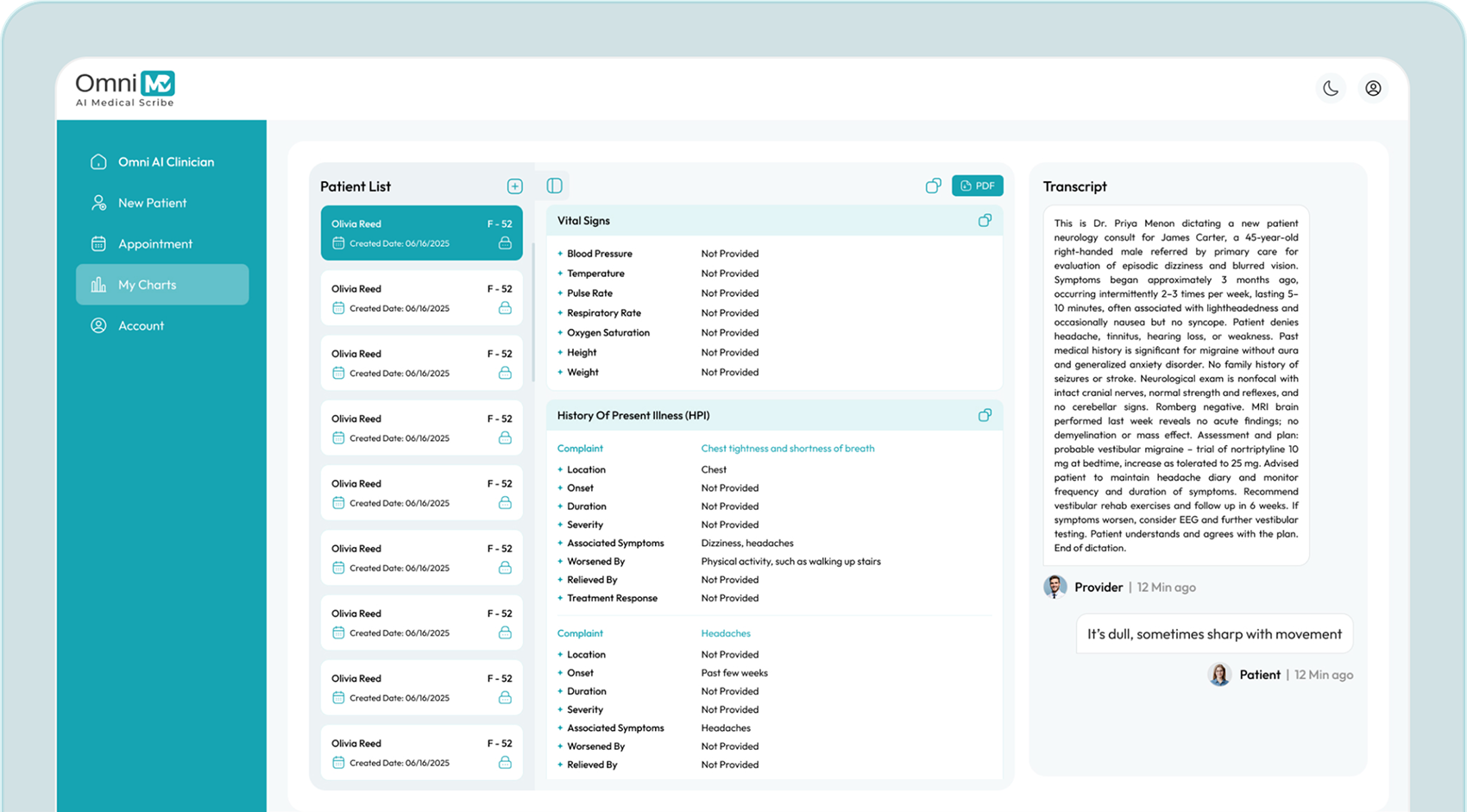
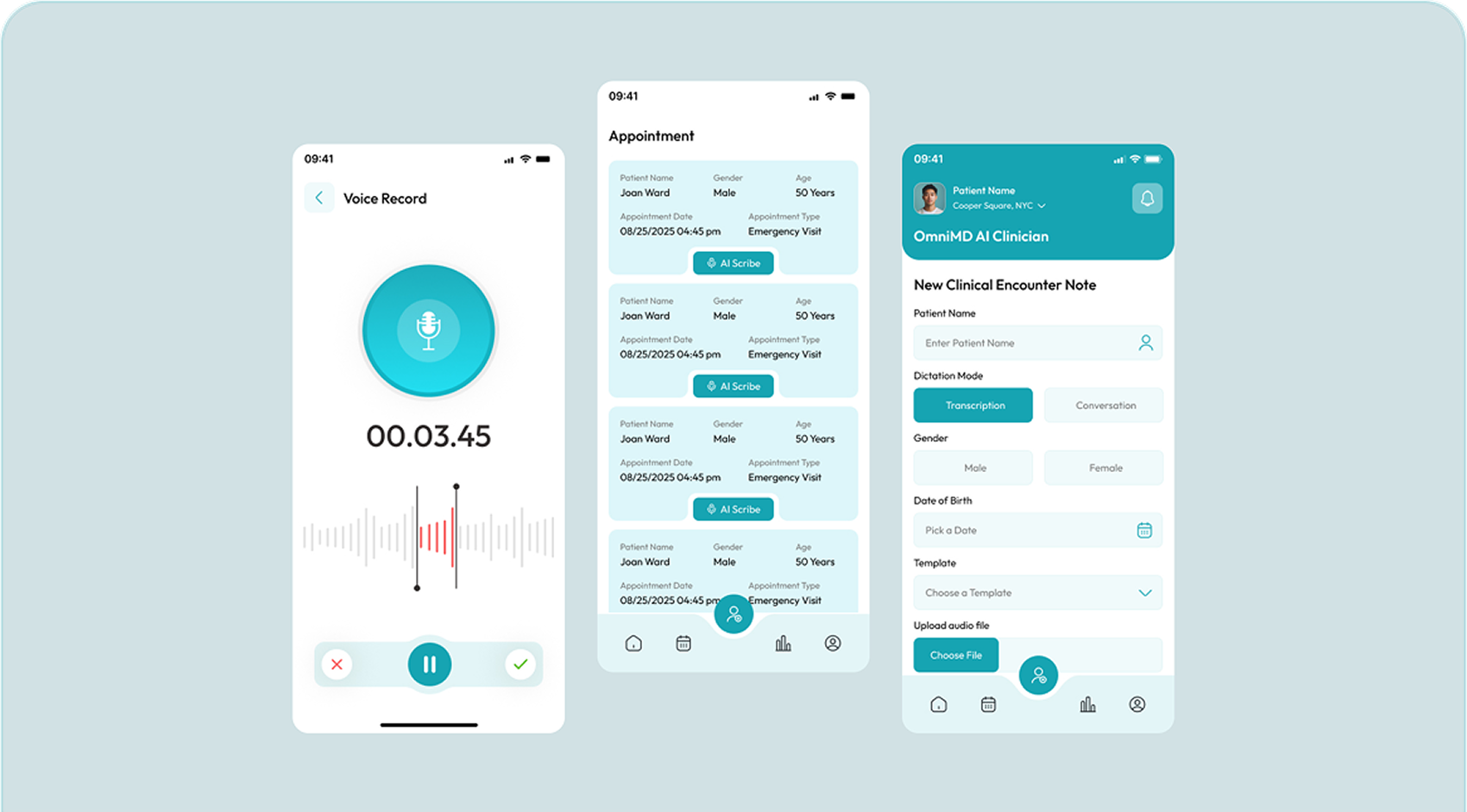
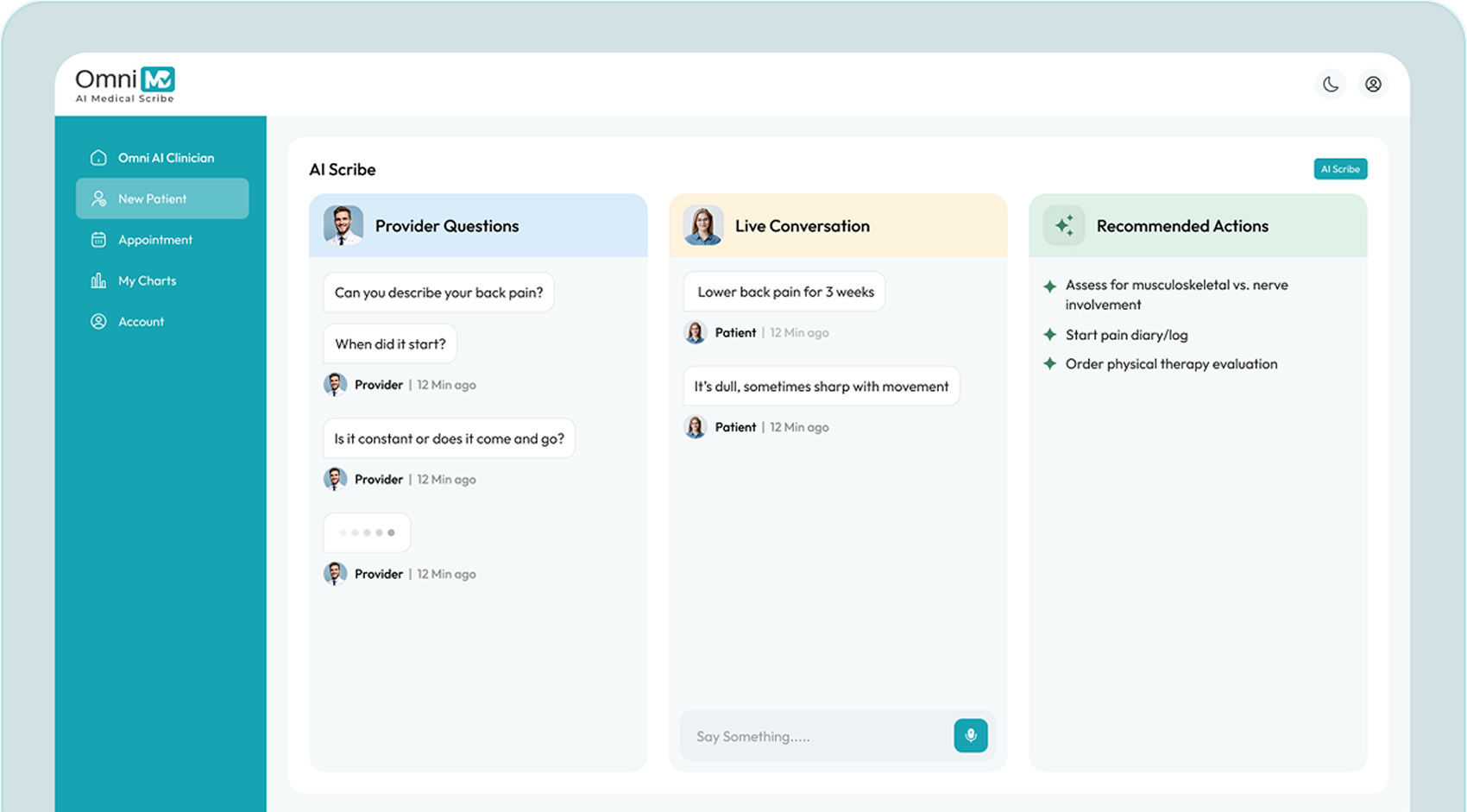
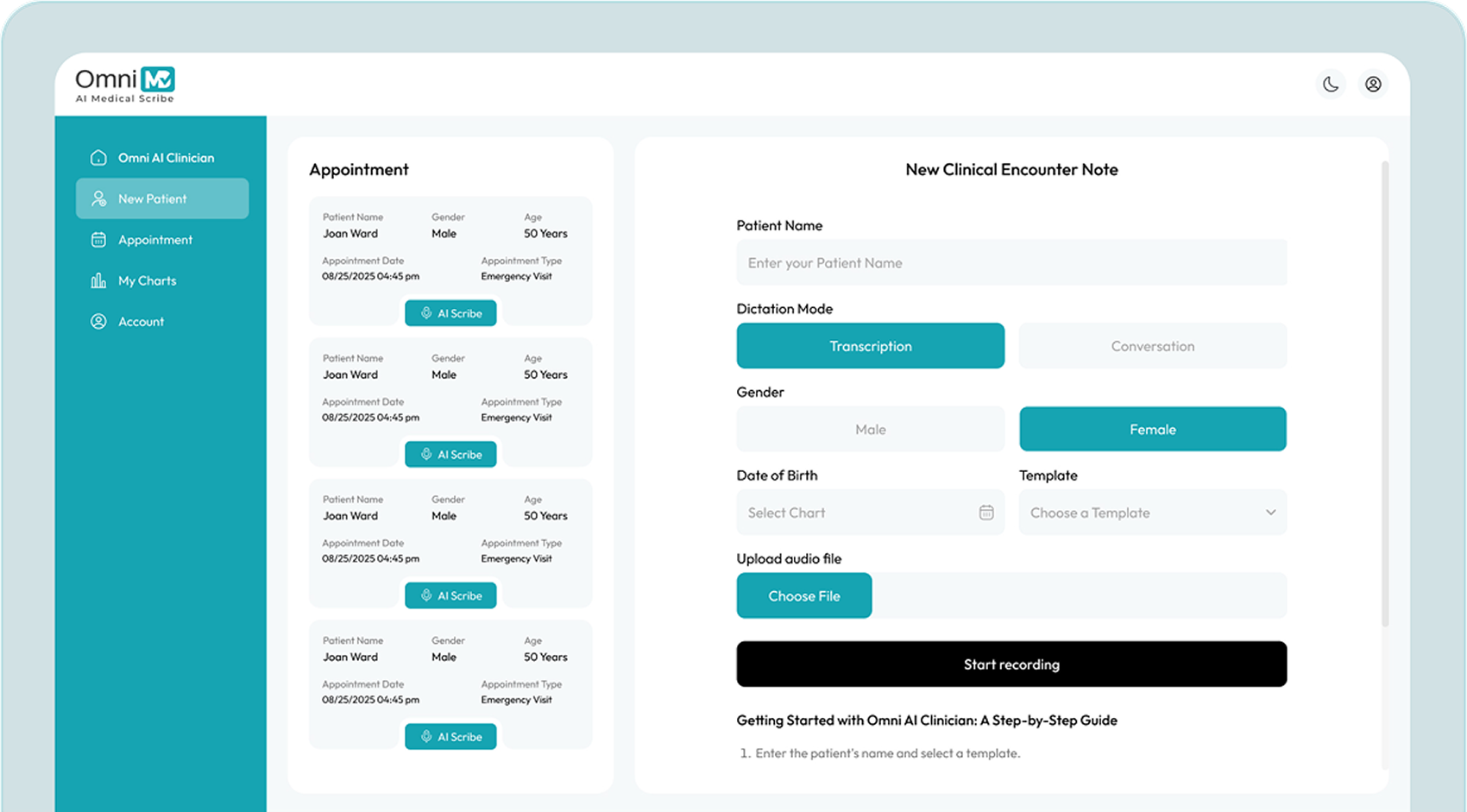
Inside OmniMD’s AI-Powered SOAP Note Generator

Real-Time AI Documentation
- Transforms patient interactions into structured, EHR-ready SOAP notes instantly, during or immediately after a visit.
- Supports data capture for in-person, telehealth, and emergency consultations.
- Reduces charting time by up to 70%, improving provider productivity and throughput.



Real-Time AI Documentation
- Purpose-built for internal medicine, family practice, cardiology, pediatrics, behavioral health, and beyond.
- Trained on diverse medical datasets to interpret complex diagnoses and differential assessments.
- Accurately generates notes for acute problems, chronic disease management, preventive care, and multi-system reviews.

Flawless EHR Integration
- Fully compatible with leading EHR systems (OmniMD, Epic, Cerner, eClinicalWorks, Athenahealth, etc.).
- Automatically populates SOAP sections, Subjective, Objective, Assessment, Plan, into the chart.
- Maintains coding integrity, workflow continuity, and audit-readiness within existing systems.



HIPAA-Compliant and Secure Design
- Built on HIPAA-compliant architecture with end-to-end encryption and advanced data privacy protocols.
- No patient data stored without explicit authorization; all Protected Health Information (PHI) remains secure.
- Backed by enterprise-grade compliance frameworks trusted by healthcare organizations nationwide.

Adaptive Learning and Physician Customization
- The AI engine continually learns from your documentation style, note structure, and specialty preferences.
- Produces notes that reflect your clinical reasoning and preferred language.
- Supports custom templates and configurable note layouts for every type of encounter.


Accurate Coding and Billing Support
- Embeds structured documentation that aligns with CPT, ICD-10, and evaluation and management (E/M) coding guidelines.
- Improves reimbursement accuracy and eliminates incomplete documentation errors.
- Supports compliance with payer and regulatory documentation standards.
What You’ll Love About OmniMD AI SOAP Note Generator
SOAP Notes in 30 Seconds

Get a clean, ready-to-use SOAP note almost instantly after any visit.
Works With Any Input
Speak, type, or upload audio. The system converts everything into a structured SOAP note.

Built for 20+ Specialties

Primary care, urgent care, therapy, and mental health. Notes adapt to your style of care.
Fully HIPAA-Secure
Data stays protected with strong encryption, audit logs, and HIPAA-ready controls.

Insurance-Ready Notes

The AI checks your notes to include the details insurance companies expect.
Easy EHR Connection
Send notes to OmniMD or other EHRs with one click. No extra typing required.

The Results That Make AI SOAP Note Generator Worth It
Fewer denials with insurance-ready clinical notes
Completeness of mandatory documentation fields.
Claim acceptance with properly detailed SOAP notes.
Faster audits due to structured, consistent note formats.
Click to send notes into your EHR
Downtime during note syncing and workflows.
Get the 30-Day AI Medical Scribe Playbook
Week by week setup guide for your practice – no signup needed
Download NowFree PDF – Instant access – No credit card
Trusted by 12,000+ Providers in 600+ Clinics
After comparing many EMRs, I determined that OmniMD was the best software for my new clinic. I run a high volume family practice clinic. OmniMD is used for scheduling, reminder calls, medical records, insurance and patient billing. OmniMD is a critical tool for my practice. It is a very good software, but I am also very pleased with the level of service OmniMD provides with their technical support team.

Our practice has been very pleased with the outcomes of your billing and collection services. You have been both informative and patient as we continue to become a more efficient practice. We have recognized that collections have been improved due to your diligence and tenacity. Thank you for your kindness and hard work.

OmniMD’s EHR and Billing software has truly streamlined our operations at Solid Sobriety. Their billing tools have improved our efficiency, significantly reducing errors and boosting revenue. What stands out most is their exceptional customer support- the team is always available, knowledgeable, and proactive in solving any challenges we face. We couldn’t be happier with the partnership.

I have been a practitioner for over a decade and worked various EMR programs in the past by far OmniMD surpasses all my expectations. It’s easy to navigate and your entire note in one page with only a few clicks to complete. I own a family medical practice/ spa and I am very happy that I chose OmniMD. Their support staff is amazing they are always available to assist you.

The team at OmniMD website developer are absolutely awesome! They developed my website exactly how I envisioned it—clean, precise, and professional. They are highly knowledgeable, incredibly patient, and truly committed to working closely with the customer to ensure everything is just right. I’m so pleased I chose them, and I’m thrilled with the final result. My website is now complete, and it looks fantastic!

What Is a SOAP Note and Why the Format Still Dominates in 2026
A SOAP note is the structured clinical documentation format used by physicians, nurses, therapists, and allied health providers to record patient encounters. The acronym stands for Subjective, Objective, Assessment, and Plan. It was introduced in the 1960s by Dr. Lawrence Weed as a way to organize clinical thinking into a format that any provider could read and act on — and it remains the dominant documentation standard across virtually every care setting in the United States today.
Each section serves a specific clinical purpose. The Subjective section captures what the patient reports: chief complaint, history of present illness, symptoms in the patient’s own words, and relevant social and family history. The Objective section records what the clinician directly observes or measures: vital signs, physical examination findings, diagnostic test results, and medications reviewed. The Assessment section is the clinician’s interpretation: the working diagnosis or differential, coded with the appropriate ICD-10 diagnosis code. The Plan section documents the clinical action: medications prescribed (with CPT code for the encounter), referrals made, follow-up scheduled, and patient education provided.
The format persists for a practical reason: it maps exactly to how payers expect encounters to be documented. The ICD-10 code in the Assessment must support the CPT code in the Plan for a claim to pass medical necessity review. A well-structured SOAP note is not just a clinical record — it is the foundation of an accurate, defensible claim. When the SOAP note is incomplete or the coding is misaligned, the claim gets denied.
OmniMD’s AI medical scribe generates all four SOAP sections from the clinical conversation and simultaneously suggests the appropriate ICD-10 diagnosis code for the Assessment and CPT procedure code for the Plan. This is the step that separates an EHR-native SOAP note generator from a standalone documentation tool.
How OmniMD’s AI SOAP Note Generator Works: From Conversation to Signed Note
Most standalone AI SOAP note tools work through a copy-paste workflow: the AI generates the note outside your EHR, and you manually copy the text into your chart. OmniMD’s generator is built differently. It is EHR-native, meaning the note is created and signed inside the same system where the patient chart, billing workflow, and prior authorization requests all live. There is no copy-paste step and no manual data re-entry.
The workflow has four stages. First, the provider activates ambient recording at the start of the patient encounter. OmniMD’s AI listens to the clinical conversation using real-time speech recognition tuned to medical terminology. The system does not record the audio permanently — it processes the conversation in real time and discards the audio once the note is generated, in compliance with HIPAA’s minimum necessary standard.
Second, the natural language processing engine organizes what was said into the correct SOAP section. Patient-reported symptoms go to the Subjective section. Examination findings go to Objective. The clinical reasoning and working diagnosis go to Assessment. Prescriptions, referrals, and follow-up instructions go to Plan. This section mapping happens in under 30 seconds after the encounter ends.
Third, OmniMD’s AI medical coding engine reads the draft note and suggests the ICD-10 diagnosis codes that match the Assessment and the CPT codes that match the Plan. The provider reviews the suggestions, accepts or adjusts them, and signs the note. The coding suggestions are displayed inline — not in a separate window — so the review takes seconds rather than minutes.
Fourth, the signed note with its finalized codes is available immediately in the patient’s chart and in the billing queue. OmniMD’s AI revenue cycle management system runs the claim through NCCI bundling edits and payer-specific scrubbing rules before it ever reaches the clearinghouse. The result is a workflow where the clinical encounter and the clean claim are generated in the same session, without the provider touching a billing screen.
The Real Cost of Manual Charting in 2026
Physicians spend approximately 3 hours per day on clinical documentation alone, according to data from the American Medical Association. When all administrative tasks are included — prior authorization, inbox management, referral coordination — the total approaches 2 hours of administrative work for every 1 hour of direct patient care. The AMA has estimated that completing all recommended care and administrative requirements would require a physician nearly 27 hours per day. No one works those hours. The gap is filled by working after-hours — what physicians call “pajama time” charting.
The downstream effect is physician burnout. The AMA’s 2024 National Physician Burnout Study found that 43.2 percent of physicians reported at least one burnout symptom — the lowest rate since COVID-19, down from a peak of 62.8 percent in 2021, but still affecting nearly half the physician workforce. Among the drivers consistently cited: excessive documentation requirements and time spent on EHR clerical tasks.
A 2026 multicenter quality-improvement study published in JAMA Network Open found that ambient AI scribe rollout across six health systems reduced the proportion of physicians reporting burnout from 51.9 percent at baseline to 38.8 percent at 30 days. Time savings from AI scribes across the same systems ran between 40 and 90 minutes per physician per day, depending on visit volume and specialty.
OmniMD’s integrated EHR platform is built to eliminate the documentation steps that consume time without adding clinical value. When a SOAP note generates in under 30 seconds and the codes are suggested inline, the provider’s post-visit workload drops to review and sign rather than write and code.
ICD-10 and CPT Alignment: Where Standalone SOAP Note Tools Fall Short
Standalone AI SOAP note generators — the tools that exist as separate apps outside your EHR — do an adequate job of organizing clinical conversation into the four SOAP sections. Where they stop is where the revenue risk begins. A SOAP note that is not aligned to the correct ICD-10 and CPT codes is clinically useful but financially incomplete. When a billing staff member re-enters that note into the EHR and assigns codes manually, the gap between what the note says and what gets billed creates denial exposure.
OmniMD’s approach is different. Because the AI medical coding layer lives inside the same system as the SOAP note generator, the coding suggestions are derived directly from the clinical text in the note — not from a separate entry. When the Assessment reads “Type 2 diabetes mellitus without complications,” the system suggests E11.9 automatically. When the Plan includes a 25-minute office visit for an established patient with moderate medical decision complexity, the system suggests 99214 and checks whether the documentation supports that E/M level under the 2023 AMA guidelines.
This matters because E/M code selection changed substantially after the 2023 AMA revisions. Time-based selection and medical decision complexity rules were restructured. Many practices saw their denial rates for 99213 and 99214 rise after the change because documentation habits had not updated to match the new requirements. OmniMD’s AI flags note content that does not support the selected E/M level before the note is signed, giving the provider an opportunity to add documentation before the claim is generated rather than after it is denied.
For practices managing medical billing in-house, this integration eliminates the most common source of avoidable denials: the gap between what the provider documented and what the billing team coded.
HIPAA Compliance and Patient Consent for AI-Generated SOAP Notes
Every AI SOAP note generator that handles protected health information (PHI) is a HIPAA Business Associate and must execute a Business Associate Agreement (BAA) with every covered entity that uses it. This is not optional. Using an AI documentation tool that has not signed a BAA with your practice puts your practice in direct HIPAA violation, regardless of how good the notes are. When evaluating any AI documentation tool, the first question to ask is whether a signed BAA is provided at the time of onboarding.
OmniMD is a HIPAA-covered entity and executes BAAs with every practice that onboards. The AI SOAP note generator uses end-to-end encryption for all data in transit and at rest. Access controls and role-based permissions ensure that only authorized staff can access patient notes. Audit logs capture every access event and note modification. OmniMD does not use patient conversation data to train AI models — a policy that some standalone tools do not match.
On patient consent, best practice for AI-assisted documentation is to verbally inform patients at the start of the visit that AI is being used to assist with note-taking and to include a consent notation in the note header — for example: “AI-assisted documentation used with patient knowledge and consent.” Some states have begun codifying this requirement in state law. OmniMD’s documentation template includes a configurable consent notation field that practices can turn on or off based on their state requirements and institutional policy.
Regardless of how a note is generated, the provider signing the note bears full legal and clinical responsibility for its accuracy. OmniMD’s review-and-sign workflow places the final note in front of the provider for explicit approval before it is finalized in the chart. No note is ever finalized without a human signature.
SOAP Note Templates by Specialty: Primary Care, Mental Health, Orthopedics, and OB/GYN
SOAP notes are not one-size-fits-all. The Objective section of a primary care wellness visit looks nothing like the Objective section of an orthopedic post-surgical follow-up. A mental health SOAP note must capture therapeutic interventions, DSM-5 diagnoses, and functional assessment in its Assessment section — content that a standard primary care template would not include. OmniMD’s AI SOAP note generator uses specialty-specific templates that adapt the section content to the clinical context.
Primary Care: The Objective section captures vitals, BMI, and preventive screening status (mammography, colonoscopy, immunization review). The Assessment includes all active chronic conditions with their ICD-10 codes. The Plan captures medication changes, referrals, and preventive orders in CPT-coded format. For annual wellness visits, the template generates the AWV-required Health Risk Assessment summary separately from the office visit note.
Mental Health and Behavioral Health: The Subjective section captures mood, affect, and patient-reported symptom severity using validated scales (PHQ-9 score, GAD-7 score) when the provider documents them verbally. The Assessment includes DSM-5 diagnostic codes alongside ICD-10 codes. The Plan captures therapy interventions used in the session, homework assigned, and crisis safety assessment when applicable. DAP (Data, Assessment, Plan) and BIRP (Behavior, Intervention, Response, Plan) formats are also supported for practices that prefer those structures.
Orthopedics: The Objective section captures range of motion measurements, muscle strength grades, specific orthopedic exam findings (McMurray test, Lachman test, Spurling test), and imaging findings referenced from the chart. The Assessment includes laterality (left vs. right) because ICD-10 orthopedic codes require laterality specification for claim acceptance. The Plan captures surgical planning, physical therapy referrals, and DME orders in CPT-coded format.
OB/GYN: The template captures gestational age, fundal height, fetal heart rate, and screening results in the Objective section. The Assessment includes obstetric ICD-10 codes with the appropriate trimester specifier. For gynecologic visits, the template captures pelvic exam findings and HPV/Pap screening status. OmniMD’s EHR software includes an OB flow sheet that feeds directly into the SOAP note template, eliminating duplicate data entry for prenatal visits.
Real-Time vs Post-Visit AI Documentation: Which Workflow Fits Your Practice
AI SOAP note generators operate through two primary workflows. Understanding which one fits your practice type and patient volume is the most important configuration decision you will make when deploying the tool.
Real-time ambient documentation activates recording at the start of the encounter and processes the conversation as it happens. The draft SOAP note is ready for review within seconds of the visit ending. This workflow is best for high-volume practices where the provider sees 20 or more patients per day — primary care, urgent care, internal medicine, and OB/GYN. Time savings are highest here because the provider does not spend any time after the visit constructing the note from memory or dictation. The note exists; it only needs to be reviewed and signed.
Post-visit dictation and structured input works differently. The provider speaks a summary of the visit after the patient leaves, or enters key clinical details through a structured form, and the AI organizes the input into SOAP format. This workflow is better for lower-volume specialty practices — procedural specialties, psychiatry, complex case management — where the visit involves nuanced clinical reasoning that benefits from the provider’s deliberate post-visit summary rather than ambient capture of the full conversation.
OmniMD supports both workflows within the same platform. Practices can configure the default documentation mode by provider or by visit type. A primary care physician can use ambient real-time capture for all standard office visits and switch to structured dictation for complex case conferences or multidisciplinary team meetings. The practice management platform maintains the workflow configuration per provider and logs the documentation method used for each note in the audit trail.
For telehealth visits, OmniMD captures audio from the video encounter directly, without requiring the provider to use a separate recording device or upload an audio file. Telehealth SOAP notes generate through the same workflow as in-person visits, with a “Telehealth encounter” notation added automatically to the Subjective section header.
What OmniMD Providers Report About AI SOAP Note Generation
OmniMD providers across primary care, orthopedics, internal medicine, and mental health consistently report two changes in the first 60 days of using the AI SOAP note generator: a reduction in time spent on documentation after clinic hours, and an improvement in coding accuracy as the AI catches E/M level mismatches before the note is signed. These are the two areas where practices see the fastest return on the implementation effort.
“I reviewed note quality from a primary care group of eight providers that went live with OmniMD’s AI SOAP note generator six months ago. Their average documentation time per visit dropped from 12 minutes to under 3 minutes. The more significant finding was in the Assessment section: the group’s rate of ICD-10 specificity errors dropped by 61 percent compared to their pre-AI notes, because the system was flagging non-specific codes like Z00.00 when the conversation clearly supported a more specific ICD-10 code for the presenting condition. Those errors had been generating payer downgrades that no one had been tracking.” – Dr. Giri, OmniMD Medical Director. Verified on July 2, 2026.
For practices integrating AI documentation with OmniMD’s AI medical scribe capabilities, providers also report improved documentation completeness for prior authorization purposes. Prior authorization reviewers require specific clinical criteria to approve procedures. When the SOAP note consistently captures the clinical details that payers use as authorization criteria — symptom duration, prior treatments tried and failed, functional impact — the approval rate improves and the prior authorization turnaround time shortens because fewer requests require additional information submissions.
Practices in the OmniMD network also report that the AI SOAP note generator improves documentation for remote patient monitoring. When a provider’s care plan for a chronic disease management patient is captured in the Plan section with the correct CPT code (99457 or 99458 for RPM monitoring), OmniMD’s billing system can bill those codes automatically in the month when the monitoring threshold is met, without requiring a separate billing entry from the provider.
Who Should Use OmniMD’s AI SOAP Note Generator
OmniMD’s AI SOAP note generator is built for practices that want documentation and billing to work as one system rather than two separate steps. The following practice types see the largest impact:
- ✓High-volume primary care and urgent care practices seeing 20 or more patients per day where post-visit charting time is the single biggest operational constraint
- ✓Specialty practices (orthopedics, OB/GYN, internal medicine, cardiology) where ICD-10 specificity and E/M level accuracy directly determine reimbursement
- ✓Mental health and behavioral health practices that need SOAP, DAP, and BIRP format support along with DSM-5 and ICD-10 dual-coding capability
- ✓Practices with high prior authorization volume where documentation completeness at the time of the visit directly reduces the back-and-forth with payers
- ✓Multi-provider groups where documentation consistency across providers affects coding accuracy and audit risk
- ✓Practices currently using a standalone SOAP note tool (Freed, SOAPNoteAI, Twofold) that want to eliminate the copy-paste step and connect documentation directly to billing
Practices that transcribe notes by hand or use a traditional human medical scribe, and practices that are currently experiencing burnout-related staff turnover from documentation load, are the most likely to see both time and revenue gains within the first billing cycle after OmniMD deployment.