
EHR for Solo Practitioners

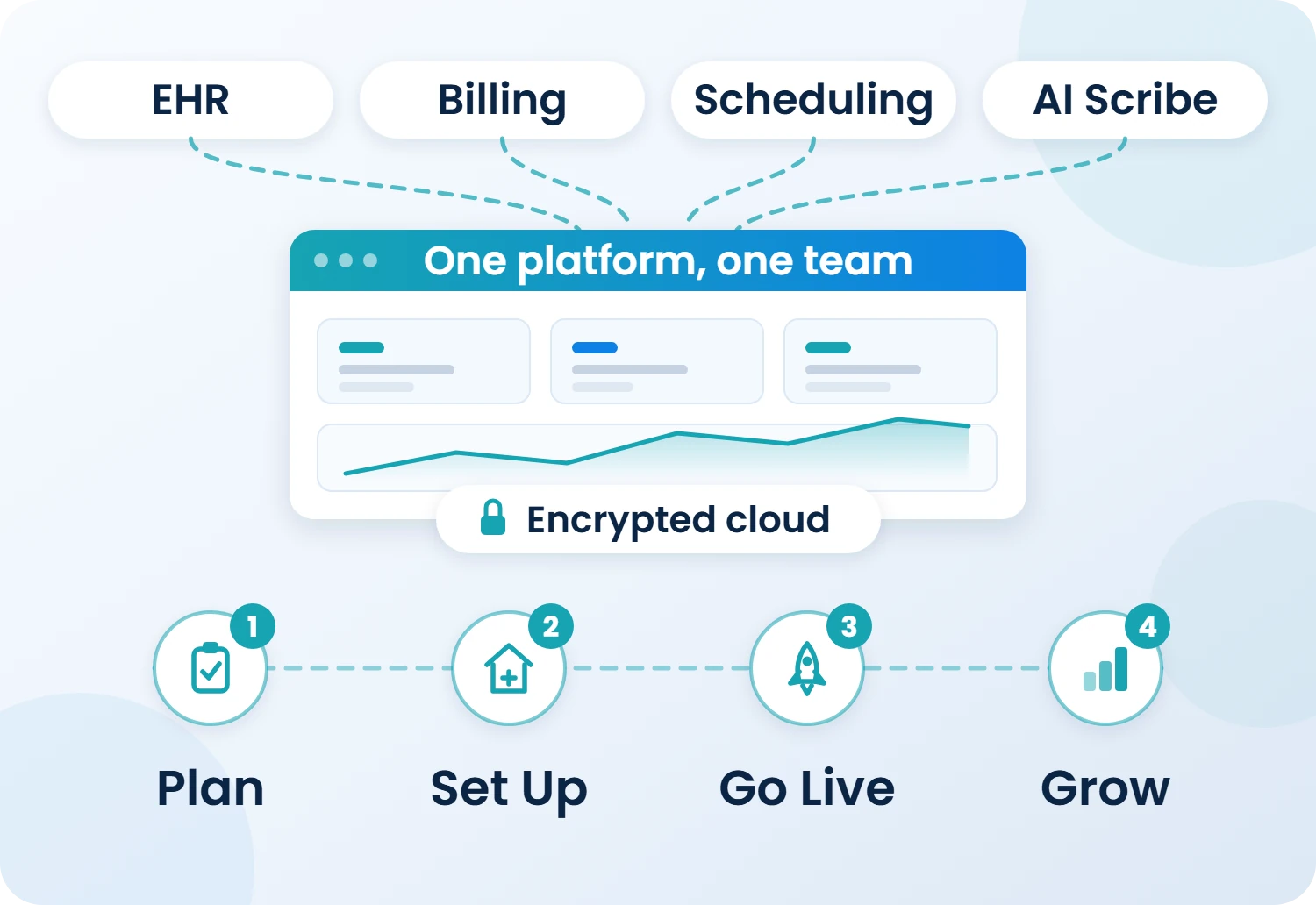
Launch your clinic with a certified cloud-based EHR, integrated medical billing for small clinics, practice management software, AI medical scribe, and AI front desk, all in one unified healthcare IT platform.

Go Live in Weeks

No Multiple Vendors

98% Clean Claim Rate

Built for Independent U.S. Practices
Get your Free Demo
Opening a New Medical Practice?
Starting a new clinic feels exciting, but managing multiple systems doesn’t. Most vendors sell EHR from one company, medical billing from another, and AI tools as add-ons. We deliver an integrated healthcare IT solution that runs under one contract and one support team.
- Encrypted cloud infrastructure
- Role-based access control
- Multi-factor authentication
- Real-time audit logs
- Secure cloud hosting
- No internal IT department required.
Cloud-Based EHR for Solo Practices
Our ONC-certified cloud-based EHR for new medical practices is designed for independent providers and small teams.

Medical Billing for Private Clinics That Protects Cash Flow
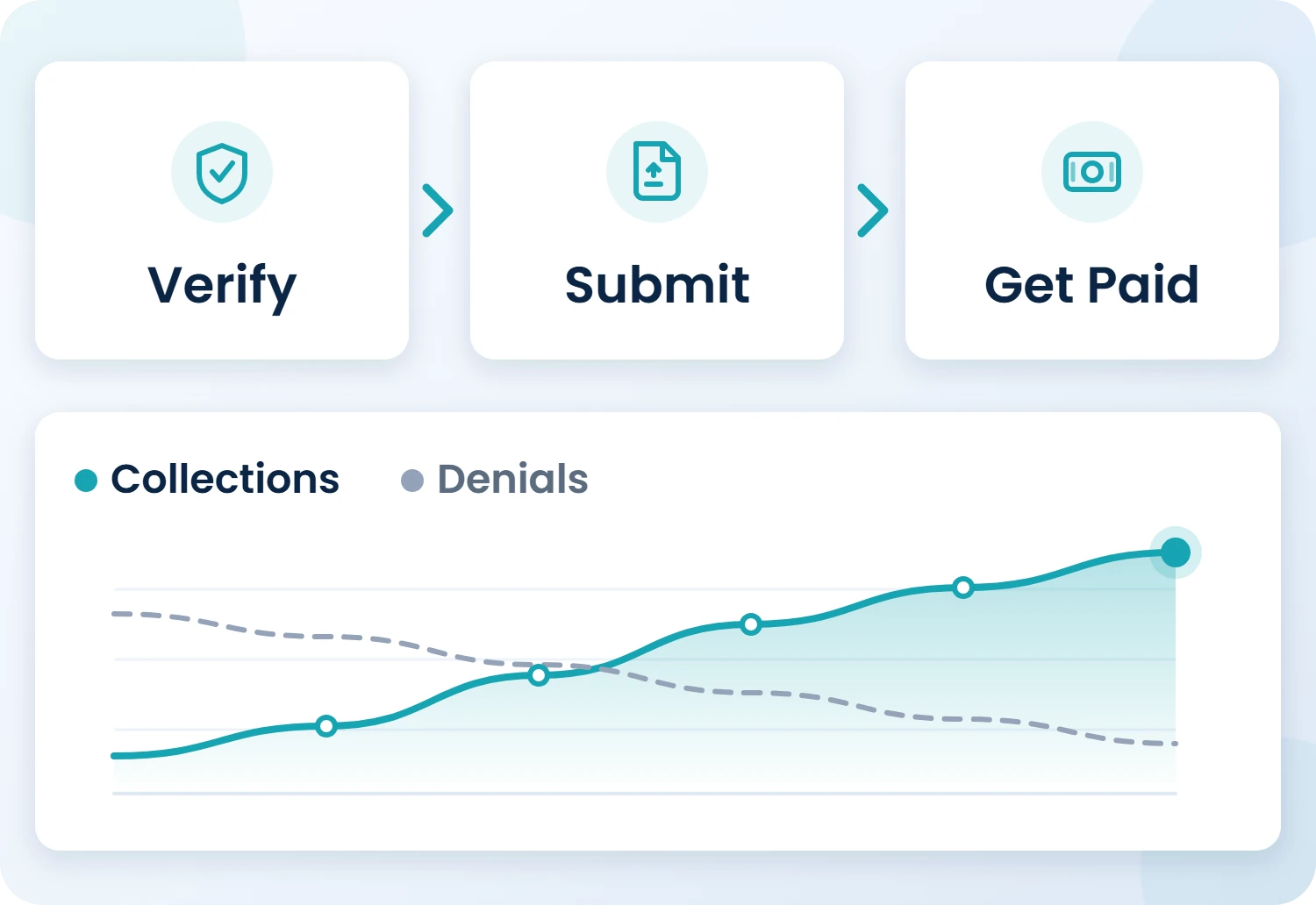
For a new medical practice, revenue is survival. Our integrated medical billing and revenue cycle management for small practices ensures:
- 98% First-Pass Claim Rate
- 29-Day Average A/R
- Real-Time Insurance Verification
- Denial Management Workflows
- Automated Payment Posting
Practice Management Software That Keeps Your Clinic Moving
We understand that solo clinics cannot afford inefficiencies. Our practice management software for small medical offices simplifies:
Eligibility checks before visits

Start Your Clinic With the Right Infrastructure From Day One.

Guided
onboarding

Specialty-specific
configuration

Staff training
included

Data migration
support

U.S.-based
implementation
team
What Is EHR Software for Solo Practitioners?
An electronic health records system (EHR) for solo practitioners is clinical and administrative software that replaces paper charts, manages patient records, processes insurance claims, generates e-prescriptions, and documents encounters, all in one platform. For a solo physician, the EHR is not just a documentation tool. It is the operational backbone of the practice.
The critical distinction for solo physicians is that hospital-grade EHR systems are designed for large organizations with dedicated IT departments, implementation teams, and training budgets. A solo practitioner using an enterprise EHR typically spends 3 to 4 hours per day on documentation tasks designed around workflows that assume a team of 10 or more staff members. The EHR was not built for one physician managing every clinical and administrative function independently.
OmniMD’s EHR platform is built for independent physician practices: cloud-based so there is no server to manage, ONC-certified so it meets federal interoperability requirements, and configured to match specialty-specific workflows rather than requiring the physician to configure the system to match a generic template.
The terms EHR (electronic health record) and EMR (electronic medical record) are used interchangeably in most clinical contexts. Technically, EMR refers to the digital chart within a single practice; EHR implies broader interoperability and data sharing across health systems. For solo physicians evaluating software, this distinction matters less than whether the system covers billing, scheduling, and reporting in one platform. OmniMD functions as a complete EMR and EHR system for independent practice: the patient chart, billing, coding, and practice operations run from a single login with no separate modules to purchase.
How to Choose an EHR as a Solo Physician: 7 Criteria
Solo physicians evaluating EHR systems should assess each vendor against seven criteria that matter specifically to single-provider and small independent practices. Larger practices can afford to absorb a poor EHR selection; solo physicians cannot.
- ONC certification: The EHR must hold current ONC certification (Certified Health IT). This is required for Medicare and Medicaid participation, MIPS reporting, and 21st Century Cures Act compliance. Ask every vendor for their ONC certification number before any demo.
- Implementation timeline: A solo physician cannot be offline for weeks while an EHR is set up. Look for vendors who can deliver a go-live date in 2 to 4 weeks for a single-provider practice, including data migration from your current system.
- Billing integration: Avoid EHRs that require a separate billing vendor. Disconnected billing systems create reconciliation gaps that delay reimbursement and produce denial rates above 5 percent. The EHR and billing should share one patient record, not two siloed systems connected by a data feed.
- Specialty-specific templates: A family medicine workflow is different from a psychiatry workflow, which is different from a pediatrics workflow. Verify that the EHR includes pre-built templates for your specialty, not just generic SOAP note formats.
- AI documentation support: Administrative burden is the primary driver of physician burnout. AMA research shows that physicians spend an average of 2 hours on administrative and EHR tasks for every 1 hour of direct patient care. An AI medical scribe that listens to the encounter and generates a structured note eliminates the after-hours documentation backlog that causes most solo physicians to consider leaving independent practice.
- Support model: As a solo physician, you do not have an IT department to call when something breaks. Verify that the EHR vendor provides direct support during your clinical hours, with a defined response time for critical issues. Offshore or ticket-only support is not adequate for a solo practice.
- Contract terms: Avoid long-term contracts (3 to 5 years) with early termination penalties for a first EHR selection. A solo practice’s volume and specialty focus can change. Look for month-to-month or annual arrangements with clear data portability provisions so you can export your patient records if you switch vendors.
Evaluate each of these criteria against any vendor before signing. The upfront evaluation time saves months of operational disruption after a poor selection. OmniMD’s practice management platform is designed to meet all seven criteria for independent physician practices.
AI Medical Scribe for Solo Physicians: Close Charts Before the Next Patient
The documentation burden in solo practice is disproportionately high relative to the number of patients seen. A solo physician seeing 20 patients per day with an average note time of 8 minutes per encounter accumulates 2 hours and 40 minutes of documentation daily. When that documentation happens after clinic hours, it becomes the primary driver of physician burnout in independent practice.
OmniMD’s AI medical scribe listens to the physician-patient encounter in real time, generates a structured clinical note in your specialty’s format, and populates it in the EHR for physician review and sign-off. The physician reviews and signs rather than dictates, types, or transcribes. For a 20-patient day, this reduces documentation time from 2 hours 40 minutes to approximately 20 to 30 minutes of review time.
For solo practitioners, this has a specific financial implication beyond time savings. Every hour recovered from after-hours documentation is an hour that can be redirected to additional patient appointments, which in a solo practice directly impacts monthly revenue without adding staff.
The AI scribe works across OmniMD’s specialty templates. Family medicine SOAP notes, psychiatry progress notes, pediatric well-visit documentation, and cardiology consultation notes are all supported. The physician does not need to configure the AI for their specialty; the scribe adapts to the specialty template already in the EHR.
Telehealth for Solo Practitioners: EHR and Telehealth in One System
For a solo physician, running a separate telehealth platform alongside a separate EHR creates documentation gaps that do not exist in integrated systems. When a patient is seen via video, the visit note needs to be in the chart, the prescription needs to route through Surescripts, and the visit needs to be billed with the correct telehealth modifier. Managing three disconnected systems to complete one encounter adds 15 to 25 minutes of administrative overhead per telehealth visit in a solo practice.
OmniMD’s telehealth platform is built into the same system as the EHR, billing, and e-prescribing. A telehealth visit in OmniMD opens a HIPAA-compliant video session directly from the patient appointment, pre-populates the clinical note template in the chart, and routes the visit to billing when the physician signs. There is no separate login, no duplicate data entry, and no documentation that sits outside the patient record.
Solo practitioners running telehealth-only or hybrid practices benefit from this integration. A telehealth-only solo practice needs an EHR that handles the full clinical and billing cycle for remote visits: HIPAA-compliant video, e-prescribing for non-controlled substances, and payer-specific telehealth billing requirements. OmniMD covers all of this from one platform without per-visit fees or separate module costs.
Telehealth visit types supported include established-patient follow-ups, chronic disease management, mental health and psychiatry consultations, and specialist telehealth visits. Billing applies standard telehealth CPT codes with automatic modifier appending based on each payer’s rules. For solo practices in states with telehealth parity laws, OmniMD’s billing engine applies the correct reimbursement rules without manual configuration per visit.
Switching EHRs as a Solo Physician: Data Migration and Transition
The single biggest barrier to switching EHRs for solo physicians is fear of losing patient data or experiencing a gap in clinical operations during the transition. This concern is legitimate: poorly managed EHR migrations do result in data gaps, duplicate records, and billing interruptions that can cost a solo practice thousands of dollars in delayed reimbursement.
OmniMD handles data migration as a structured implementation step, not an afterthought. The process for solo physician transitions works as follows:
- Data export from current system: OmniMD’s implementation team works with your current EHR vendor to export patient demographics, medication lists, problem lists, allergy records, and visit history in a standard format (HL7 CCDA or CSV depending on the source system).
- Data mapping and validation: Exported data is mapped to OmniMD’s record structure and validated for completeness before any records are imported. Duplicate records, incomplete entries, and format mismatches are corrected before migration, not discovered after go-live.
- Parallel operation period: For practices with active prior authorization workflows or ongoing claim cycles, OmniMD supports a defined parallel operation window where both systems remain accessible during the transition, preventing billing gaps.
- Go-live and training: Staff training is completed before the go-live date. A solo practice with two to four support staff completes training in one to two days. The implementation team remains available for the first 30 days after go-live for issue resolution.
Solo physicians who have concerns about prior authorization workflows during an EHR transition should ask specifically about the active PA queue migration. Active authorizations in progress at migration time are the most common source of billing disruption during EHR switches.
OmniMD EHR by Specialty for Solo and Independent Practices
Solo physicians across specialties have different documentation requirements, billing code sets, and patient population needs. OmniMD’s EHR is pre-configured with specialty-specific templates that reflect each specialty’s actual clinical workflow rather than requiring the physician to adapt a generic template.
| Specialty | Key Workflow Features | Solo Practice Benefit |
|---|---|---|
| Family Medicine | Annual wellness templates, chronic disease tracking, preventive care reminders, pediatric and adult SOAP notes | One template set covers the full patient age range; no switching between systems for pediatric vs adult visits |
| Internal Medicine | Multi-problem visit documentation, lab result trending, specialist referral tracking, MIPS measure integration | Complex patient documentation completed during the encounter, not reconstructed after hours |
| Psychiatry | PHQ-9, GAD-7, MMSE integration; medication management; progress note templates; controlled substance e-prescribing (EPCS) | Behavioral health documentation requirements met without separate software; EPCS handles Schedule II-V prescriptions |
| Pediatrics | Well-child visit templates (0-18), growth charts, immunization tracking, developmental screening tools | Preventive visit documentation pre-populated; vaccine administration records auto-updated in patient chart |
| OB-GYN | Prenatal visit tracking, gestational age calculators, pap smear recall, colposcopy documentation | Longitudinal prenatal record maintained in a single chart view; recall reminders automated for screening intervals |
| Direct Primary Care (DPC) | Membership panel management, unlimited visit documentation, RPM integration for chronic patients, no claims processing required | EHR configured for subscription-based care models; no insurance billing overhead; patient portal for member communication |
All specialty configurations are included in OmniMD’s standard implementation. Solo physicians do not pay add-on fees for specialty templates or require a separate customization project to make the EHR fit their practice type.
Billing and Revenue Cycle for Solo Practices: What Comes Built In
Solo physicians managing their own revenue cycle face a specific challenge: every dollar of denied or delayed reimbursement directly affects cash flow with no buffer from a larger organizational billing department. A group practice can absorb a 2-week payer delay on a subset of claims. A solo practice cannot.
OmniMD’s integrated medical billing eliminates the most common revenue leaks in solo practice billing:
- ✓ Real-time eligibility verification before every appointment confirms coverage and co-pay amounts, preventing the most common cause of front-end denials in solo practices.
- ✓ AI-assisted coding from the encounter note suggests the most accurate CPT and ICD-10 codes at the point of documentation, reducing under-coding (lost revenue) and over-coding (audit risk).
- ✓ Automated claim scrubbing checks every claim against payer rules before submission, catching modifier errors, diagnosis code mismatches, and procedure bundling issues before they generate a denial.
- ✓ Denial management workflows track every denied claim with the denial reason, required correction, and resubmission deadline, ensuring no denied claim falls out of the follow-up queue.
- ✓ 29-day average accounts receivable across OmniMD solo practice accounts, compared to the industry average of 35 to 45 days for practices using disconnected billing systems.
Solo physicians who currently use a separate billing service should evaluate the cost structure carefully. Third-party billing services typically charge 6 to 8 percent of collections. OmniMD’s integrated billing, combined with its AI revenue cycle management tools, delivers equivalent or better collection rates within the platform cost, eliminating the per-collection fee structure.
What Solo Physicians Report After Switching to OmniMD
The pattern I see consistently in solo physician practices switching to OmniMD is that the first 30 days are about recovering time, and the next 60 days are about what physicians do with that recovered time.
“The physicians who struggle most in their first year of solo practice are usually not struggling with patient care. They are struggling with after-hours documentation. A solo internist I worked with recently was spending 3 hours every evening on notes from 22 patient visits. After implementing OmniMD with the AI medical scribe, she was completing notes before the next patient walked in. That shift does not just affect quality of life. It directly affects how many patients she can see sustainably per day, which is the single largest variable in a solo practice’s annual revenue.” – Dr. Giriraj Purohit, Medical Director, OmniMD. Verified on July 3, 2026.
Solo physicians report that the most tangible first-month impact of OmniMD is the elimination of after-hours chart catch-up. The second most commonly reported impact, measured at 90 days, is a reduction in claim denial rates as the integrated billing system catches errors that a manual billing workflow missed. Both outcomes are measurable within the first quarter of go-live for a single-provider practice.
Who Should Use OmniMD as a Solo Practitioner or New Practice?
OmniMD is built for independent physician practices that need a complete clinical and administrative platform without enterprise complexity, multi-year contracts, or separate vendor relationships for each function.
- ✓ Physicians opening a new solo practice who need to go live quickly with EHR, billing, scheduling, and a patient portal under one contract without building separate vendor relationships.
- ✓ Solo physicians currently using a hospital EHR who are leaving an employed position to open an independent practice and need a system scaled for one provider, not a 500-bed health system.
- ✓ Independent physicians dissatisfied with their current EHR who are experiencing high denial rates, poor support, or documentation burden that consumes more than 2 hours per clinical day.
- ✓ Direct Primary Care physicians operating on a membership model who need panel management, RPM integration, and patient communication tools without insurance billing overhead.
- ✓ Solo specialists (psychiatry, cardiology, endocrinology, dermatology, OB-GYN) who need specialty-specific templates and billing code sets, not generic EHR templates adapted for their specialty.
- ✓ Physicians participating in MIPS or value-based care programs who need automated quality measure tracking and reporting without a separate population health vendor.
Not the right fit: Hospital systems, large multispecialty groups above 20 providers, or federally qualified health centers (FQHCs) that require enterprise-scale EHR infrastructure. OmniMD is purpose-built for the independent physician market, specifically solo and small practices of 1 to 10 providers.
Frequently Asked Questions
Common questions from solo physicians and new practice owners evaluating OmniMD EHR.