FQHC EHR Software for Community Health Centers
Federally qualified health centers exist to serve people that every other system underserves. Delivering on that mission requires more than clinical intent. It requires a platform that connects every touchpoint of care, eliminates the administrative drag that pulls providers away from patients, and generates the financial intelligence health centers need to sustain and grow their impact. OmniMD is the FQHC EHR software built for that purpose.
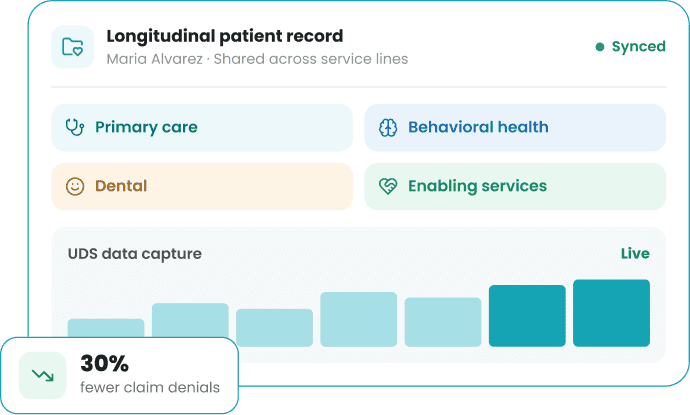
A platform designed around the full scope of community health
Our FQHC EHR connects clinical care, patient engagement, health center operations, and financial performance in one platform. Every capability below runs from a single patient record shared across all service lines.
Patient care & clinical excellence
Care built around the whole person
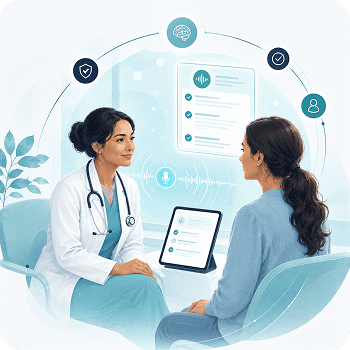

AI Medical Scribe
Ambient listening transcribes patient encounters into structured clinical notes in real time. Providers document by having a conversation, not navigating a system.

AI Clinician
Real-time clinical decision support, care gap identification, and chronic condition risk stratification at the point of care.

Multi-Service Line Record
Primary care, behavioural health, dental, women’s health, and enabling services share one longitudinal patient record. Whole-person care is the default state.

Social Determinants of Health Tracking
Validated SDOH screening embedded in intake. Responses mapped to ICD-10 Z-codes. Referrals to community organizations tracked through to completion.
Health center operations
Operations that run before the visit starts
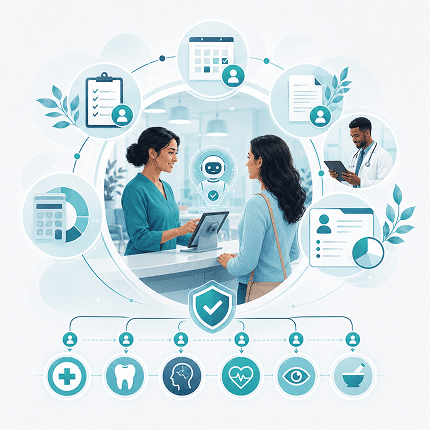

AI Front Desk
Scheduling, insurance eligibility verification, income documentation, and sliding fee calculation handled automatically before the provider sees the patient.

Sliding Fee Scale Automation
Federal Poverty Level calculated at registration. Sliding fee tier assigned and attached to the record, applied consistently across every service line.

Enabling Services Documentation
Transportation, translation, health education, and community health worker visits documented as encounters. They appear in UDS Table 5 automatically.

Population Health Management
Care gap dashboards, patient panel management, and chronic condition tracking built into the workflow. Supports PCMH recognition and value-based care.

Inconsistent sliding fee application is among the most cited findings in HRSA Operational Site Visits.
Financial performance & revenue integrity
Revenue intelligence that
acts before loss
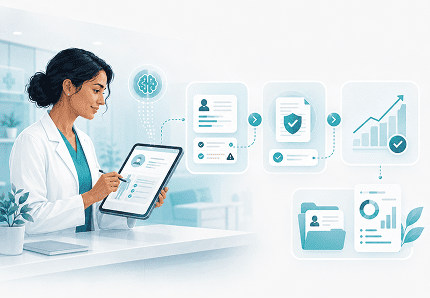

FQHC Billing & AI Medical Coder
ICD-10 and CPT codes generated during documentation. Claims reach billing with eligibility confirmed and codes populated — no separate coding review, no lag between visit close and claim generation.

AI RCM & Denial Management
Denial prediction based on historical payer behavior before submission. Root cause mapping to documentation, eligibility, or coding. A/R prioritized by recovery likelihood, not date order.

Grant Tracking
Program tags applied at the encounter level and linked to the patient record. Federal grant reporting pulls from clinical data directly — no spreadsheet, no manual reconciliation.

Average 30% reduction in claim denial rates across deployed health centers.
HRSA reporting & regulatory intelligence
Reporting that accumulates all year

HRSA UDS Reporting
Required UDS fields captured at the encounter level in real time. Visit type, payer category, diagnosis codes, service location, and provider type map to HRSA categories automatically.

UDS Plus & FHIR-Based Submissions
Native FHIR and HL7 architecture supports the transition to patient-level UDS Plus data extraction. No separate vendor, custom pipeline, or additional development work required.

340B Program Tracking
Eligible patients identified from documented encounters. Interfaces with 340B third-party administrators and pharmacy management systems. Audit-ready documentation in the same record.

The 2026 UDS restructuring affects Tables 4, 5, 6A, and 8A simultaneously. Encounter-level capture turns that restructuring into a review task, not a staffing event.
What changes when your platform is built for community health
Results drawn from community health centers operating on OmniMD across the United States.

5 to 7 minutes
More time with patients
Providers spend 5 to 7 fewer minutes per encounter on documentation. AI Medical Scribe captures visits in real time — notes are complete when the door closes.

30%
Fewer claim denials
Eligibility confirmed at registration. Codes generated during documentation. Claims reach billing complete, not incomplete.

80%
Less time on UDS prep
Reporting data accumulates throughout the year at the encounter level. Year-end reporting becomes a review, not a six-week rebuild.

6 to 8 week
To go-live
Full data migration before day one. Operations continue without disruption during the transition.

Sustainable financial performance
Denial recovery, accurate coding, and real-time revenue intelligence protect the operating margin that funds the mission.
Trusted by health centers nationwide
After comparing many EMRs, I determined that OmniMD was the best software for my new clinic. I run a high volume family practice clinic. OmniMD is used for scheduling, reminder calls, medical records, insurance and patient billing. OmniMD is a critical tool for my practice. It is a very good software, but I am also very pleased with the level of service OmniMD provides with their technical support team.

Our practice has been very pleased with the outcomes of your billing and collection services. You have been both informative and patient as we continue to become a more efficient practice. We have recognized that collections have been improved due to your diligence and tenacity. Thank you for your kindness and hard work.

OmniMD’s EHR and Billing software has truly streamlined our operations at Solid Sobriety. Their billing tools have improved our efficiency, significantly reducing errors and boosting revenue. What stands out most is their exceptional customer support- the team is always available, knowledgeable, and proactive in solving any challenges we face. We couldn’t be happier with the partnership.

I have been a practitioner for over a decade and worked various EMR programs in the past by far OmniMD surpasses all my expectations. It’s easy to navigate and your entire note in one page with only a few clicks to complete. I own a family medical practice/ spa and I am very happy that I chose OmniMD. Their support staff is amazing they are always available to assist you.

See what OmniMD makes possible for your health center.
Every demo is configured to your specific FQHC workflows before the session — your patient population, your service lines, your care model, your HRSA reporting requirements. You see what your health center looks like inside OmniMD.