ASC Billing Services for
Ambulatory Surgical Centers

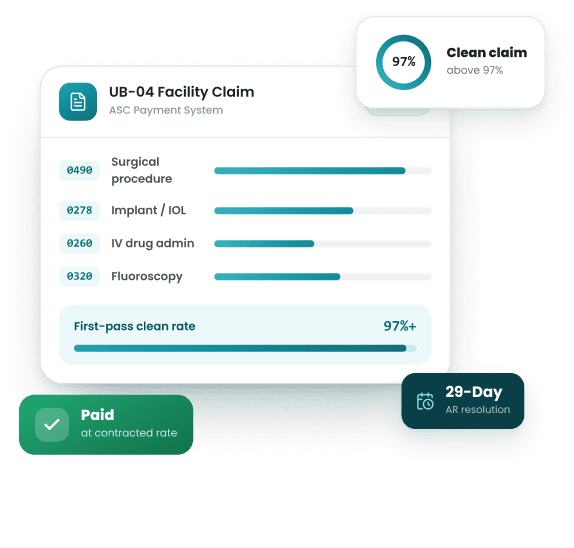
Getting paid for surgical care has never been more complex. OmniMD makes it simple, precise, and consistently above 97%.
medical billing ASC hero image

97+

Clean claim rate

29-Day

AR resolution

ASC

Credentialed coders

HIPAA

Compliant

The Structural Difference That
Makes ASC Billing a Category of Its Own

ASC Facility Fee Billing vs. Physician Billing

Every surgical case generates two independent claims under two entirely different systems. The surgeon files on CMS-1500. The ASC files on UB-04. General billing companies know one. OmniMD manages both under a single operation, eliminating the revenue gap that forms when facility billing and physician billing are handled separately.

This includes

  • Two-claim management : CMS-1500 for physician, UB-04 for ASC facility
  • Separate fee schedule expertise : ASC Payment System, not physician fee schedule
  • Unified operation : no coordination gap between facility and physician billing

UB-04 revenue code map

auto-assigned

0490

Primary surgical procedure line

0278

Implants, joint hardware, IOLs, bone grafts

0300

IV drug administration

0490

Primary surgical procedure line

0320

Fluoroscopy guidance

ASC Revenue Codes and UB-04 Claims

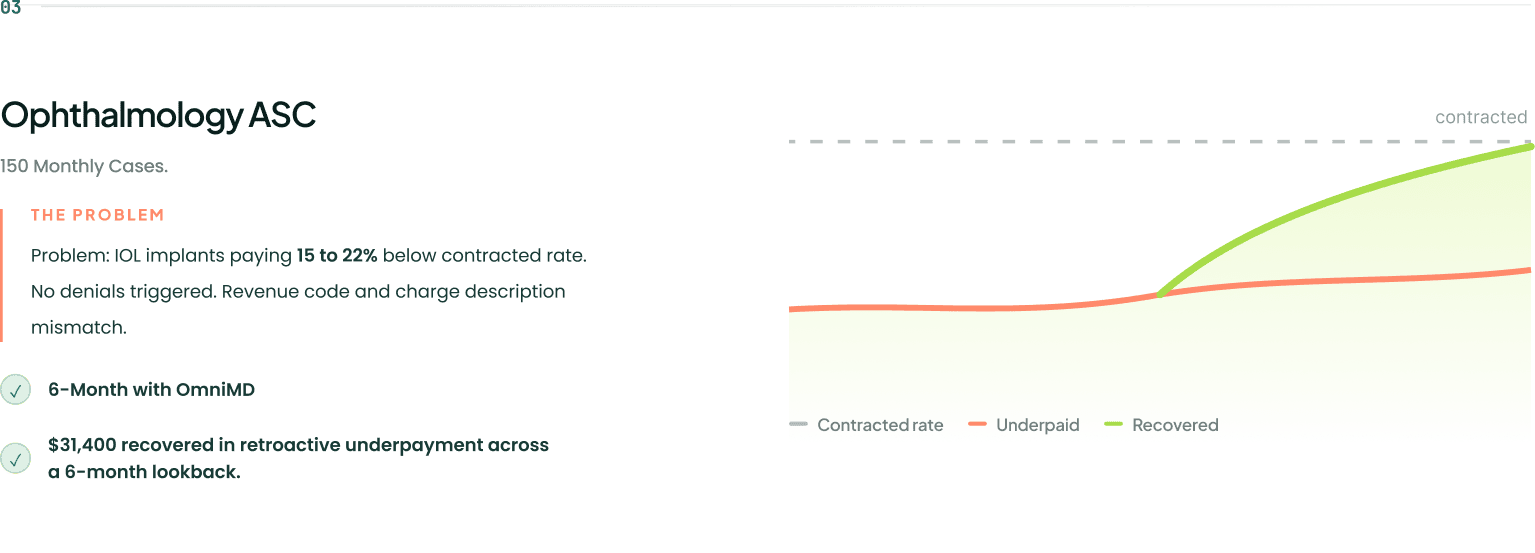
Wrong revenue codes rarely produce denials. They produce payments 15–22% below contracted rate, silently, with no alert from the payer.

OmniMD automates correct code assignment and adds
human review on all high-dollar cases, covering:

Medicare ASC Billing Rules

ASC payment rate is 57 to 67% of OPPS APC : a structurally separate fee schedule. Billing against OPPS rates creates compliance exposure, not revenue.

We ensure correct application of:

  • Covered procedure list : procedures not on the CMS list produce zero payment, no appeal pathway
  • Modifier 73 and 74 : discontinued procedure rules that directly affect reimbursement rate
  • ASCQRP compliance : non-submission triggers a 2% reduction on every Medicare ASC payment for the full year

How OmniMD Manages Every Stage
of Your ASC Revenue Cycle

ASC Charge Capture and Billing and Coding

We deploy ASC-credentialed coders who work exclusively on surgical center
cases, driving accuracy at the point of charge entry.

This includes
  • Automated revenue code assignment by procedure category
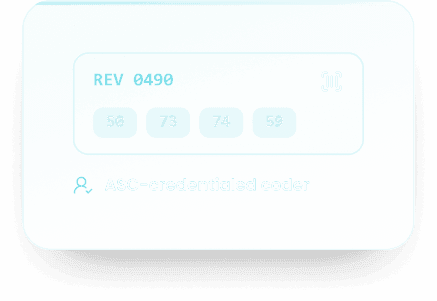
  • Full modifier optimization: 50, 73, 74, 59, and payer-specific requirements
  • Device cost verification on every implant case against CMS thresholds before charge submission
  • NCCI bundling logic review before every claim generates

ASC Facility Claim Submission (UB-04)

We construct every UB-04 with the precision a payer audit demands, transmitting to 50+ payers with payer-specific rules pre-applied.

This includes

  • Revenue codes, condition codes, occurrence codes, and value codes applied by
    trained facility billers
  • EDI transmission to 50+ commercial and government payers
  • 24-hour follow-up on every failed transmission and rejection

ASC Revenue Cycle Management

We manage the full revenue cycle from 48 hours before the patient arrives
through final collections, improving speed, accuracy, and yield across:
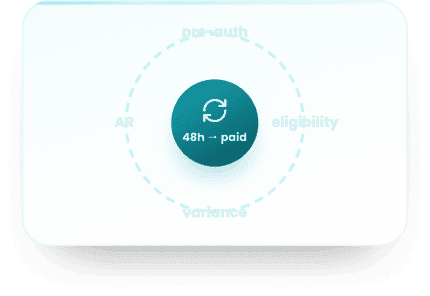
  • Pre-authorization and real-time eligibility verification
  • Payer contract monitoring with payment variance reporting
  • Weekly AR analysis by payer, procedure, and aging bucket

Denial Management for ASC Claims

We trace denials to their origin, not just their outcome. Resubmission without root
cause analysis means the same denial returns next month.

Our process drives results through
  • Root cause categorization by payer, procedure, and coder
  • Written appeals with clinical documentation on high-dollar cases
  • Monthly trend reports with corrective action plans

ASC Billing Compliance and Audits

The OIG flags ASC billing annually for implant charges, high-risk procedures, and
modifier accuracy. We stay ahead of it.

This covers
  • OIG work plan monitoring against your specific procedure mix
  • Pre-submission audits on high-dollar implant and multi-procedure claims
  • Corrective action reports with documented workflow changes

ASCQRP Billing Support

We protect your full Medicare ASC payment rate by managing ASCQRP
obligations year-round:

This covers

  • Quality measure data collection integrated into case workflow
  • CMS submission with deadline tracking and delivery confirmation
  • Year-round monitoring, not a Q4 scramble

ASC Billing Services by Specialty

Orthopedic ASC Billing

Highest dollar-per-case complexity in ambulatory care. We manage the billing risks that cost orthopedic ASCs the most:
  • Device cost verification on every TKA, THA, and spine case before submission
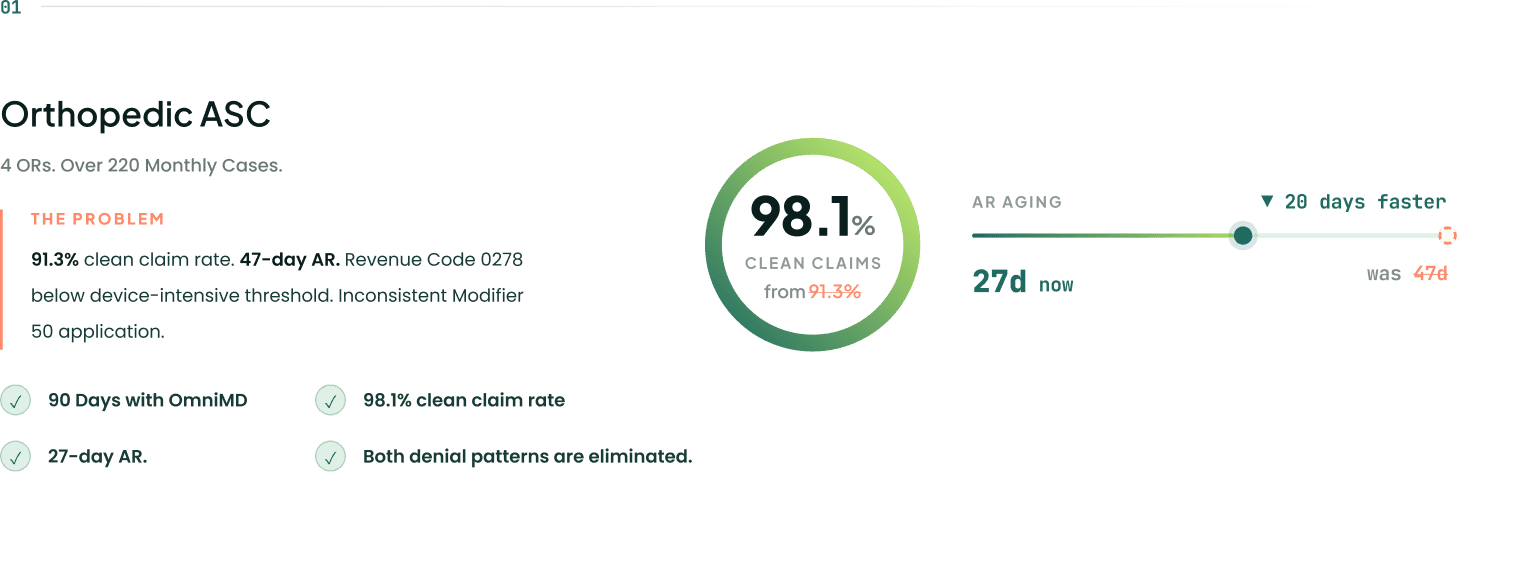
  • Revenue Code 0278 applied only above CMS device-intensive threshold
  • Modifier 50 bilateral application with payer-specific payment rules
  • Prior authorization for elective joint replacement and spine cases

Pain Management ASC Billing

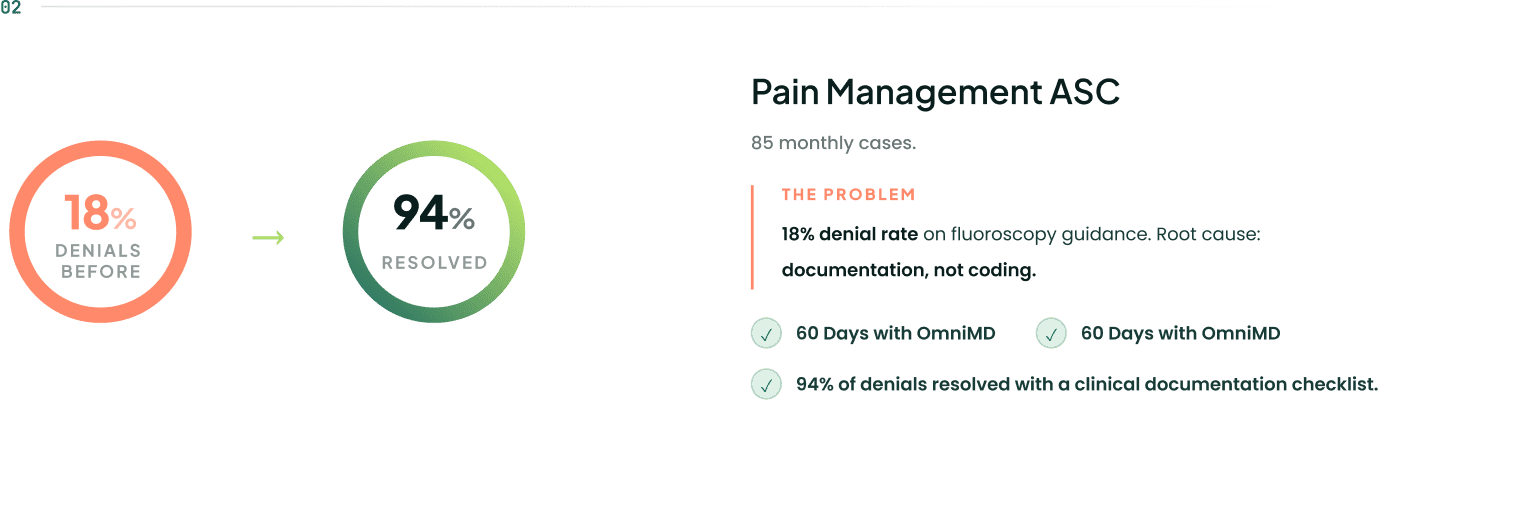
Fluoroscopy guidance denials in this specialty are almost always documentation failures, not coding errors. We prevent them through:

  • Documentation requirement verification before every submission
  • Injection coding across the full epidural and nerve block code set
  • PDMP compliance review integrated into charge capture workflow

Ophthalmology ASC Billing

Bilateral cataract rules differ by session type. Wrong application produces a payer dispute and a patient billing complaint at the same time. We manage it through:
  • IOL implant billing under 0278 with lens cost verification on every case
  • Same-session vs. separate-session bilateral rule application by payer
  • Session-specific modifier review to prevent lookback edit denials

GI and Endoscopy ASC Billing

The screening-to-diagnostic conversion is the most complaint-generating billing event in this specialty. We manage it through :
  • Conversion coding with patient notification documentation support
  • Polyp removal add-on code hierarchy (CPT 45385, 45380, G0106)
  • Colonoscopy billing rules applied by payer across commercial, Medicare, and Medicaid
Capability General Billing Hospital RCM Enterprise RCM OmniMD
ASC facility fee expertise Rarely — Frameworks only Operational daily
UB-04 and ASC revenue codes Limited Sometimes Not in scope Included
ASC-credentialed coders — — — Included
ASCQRP support — — — Included
Implant billing at device threshold Rarely — — Included
ASC-specific denial root cause — — — Included
Clean claim rate 85 to 90% 88 to 92% Varies 97%+

What We Are Building with
Our ASC Billing Clients
Get your free ASC Billing Audit

Most ASC administrators lack precise visibility into three things: clean claim rate by payer, denial rate by procedure, and revenue code accuracy against current CMS guidelines. The OmniMD audit surfaces all three.

  • Clean claim rate by payer, benchmarked against 98%+
  • Top 5 denial categories with root cause identification
  • Revenue code accuracy against current CMS ASC guidelines
  • AR aging by payer and procedure
  • ASCQRP compliance status

Frequently Asked Questions

The specialized process of submitting facility fee claims for ambulatory surgical centers on UB-04 using ASC-specific revenue codes and the CMS ASC Payment System. Structurally distinct from physician billing.

Every case generates two claims: physician on CMS-1500, facility on UB-04. The facility claim pays under the ASC Payment System, classified by revenue codes, spanning pre-auth through charge capture, submission, posting, denial management, and appeals.

Ambulatory Surgical Center. In billing, it refers to the CMS ASC Payment System : separate from the hospital OPPS, with its own fee schedule, covered procedure list, and ASCQRP compliance obligations.

APC (Ambulatory Payment Classification) is the CMS rate-setting grouping system. Hospital outpatients get the full OPPS APC rate. ASCs receive 57 to 67% of that rate. Billing at OPPS rates creates compliance risk.

At 57 to 67% of the comparable OPPS rate, limited to procedures on the CMS covered surgical procedures list. Missing ASCQRP reporting triggers a 2% cut on every Medicare ASC payment for the year.

Both use UB-04 but under different fee schedules, different covered procedure rules, and different revenue codes. Hospital outpatient RCM experience does not transfer automatically to ASC facility billing.

96 to 98%+ at first-pass acceptance. Below 94% signals systematic errors generating denial work, extended AR, and lost reimbursement. OmniMD benchmarks at 97%+.

30 to 45 days from contract to full handoff. Payer enrollment, EDI setup, data migration, coder orientation, and parallel billing period. Every client receives a dedicated transition manager.