
Medical Billing for
Pain Management
Pain management billing is one of the most denial-prone areas in ambulatory care. Multi-level blocks, bilateral procedures, fluoroscopy bundling rules, and payer-specific prior authorization requirements create compounding risk at every step.
OmniMD gives pain management practices the coding logic, compliance guardrails, and AI-driven RCM infrastructure to bill accurately, reduce denials, and get paid faster.

98%
First-Pass Rate
<4%
Denial Rates Reduced from
21% to under 4%
12,000+
Providers
600+
Clinics Nationwide
Why Pain Management
Billing Is High-Risk
A single billing decision, whether to bundle fluoroscopy, which modifier to apply, how many levels to report, can be the difference between a clean claim and a denial.

Bundling errors
Fluoroscopy is bundled into transforaminal ESI codes but is separately billable for interlaminar approaches.

Modifier gaps
Bilateral procedures, multi-site injections, and reduced services each require specific modifiers

Prior auth failures
Most payers require PA for epidural injections, facet procedures, and neuromodulation

Nonspecific ICD-10
Vague diagnosis codes fail medical necessity review across virtually every payer

Documentation gaps
Incomplete procedure notes create audit exposure regardless of coding accuracy
Pain Management
CPT Codes at a Glance
A single billing decision, whether to bundle fluoroscopy, which modifier to apply, how many levels to report, can be the difference between a clean claim and a denial.

Trigger Point Injections

20552
1–2 muscle groups
20553
3+ muscle groups
One code per date of service. Drug must appear on the same claim. Medicare limits to 3 sessions per rolling 12 months.

Facet Joint Injections

64490
Cervical/thoracic, first level
64491
Cervical/thoracic, second level
64492
Cervical/thoracic, third & additional levels
64493
Lumbar/sacral, first level
64494
Lumbar/sacral, second level
64495
Lumbar/sacral, third & additional levels
Applies to intra-articular injections and medial branch blocks. Most payers limit diagnostic blocks to 2 per region before requiring documented progression to RFA.
Epidural Steroid Injections

63320
Interlaminar, cervical/thoracic, no imaging
36321
Interlaminar, cervical/thoracic, with imaging
36322
Interlaminar, lumbar/sacral, no imaging
36323
Interlaminar, lumbar/sacral, with imaging
64479
Transforaminal, cervical/thoracic, single level
64480
Transforaminal, cervical/thoracic, addl level
64483
Transforaminal, lumbar/sacral, single level
64484
Transforaminal, lumbar/sacral, addl level
Fluoroscopy is bundled into transforaminal codes — do not bill 77003 separately. For interlaminar codes, 77003 is separately billable when documented.
Chronic Pain Management HCPCS

G3002
First 30 minutes per calendar month
G3003
Each additional 15 minutes
OmniMD AI Medical Coder
Real-time code suggestions from clinical documentation. Catches undercoding, overcoding, and compliance gaps before submission. Denial risk scoring at the claim level.
Modifier and ICD-10 Requirements
50
Bilateral procedure performed at the same session. Use when the same injection is performed on both sides, such as bilateral facet blocks or bilateral SI joint injections. Some payers require LT/RT in place of modifier 50; verify by payer before submission.
LT / RT
Laterality modifiers required by certain commercial payers instead of modifier 50. When in doubt, confirm the payer’s bilateral billing policy prior to the date of service.
59 / X-modifiers
Distinct procedural service. Required when multiple injections are performed at different anatomical sites on the same date to bypass NCCI edits. Use the appropriate X-modifier (XS, XU, XE, XP) when a payer’s policy requires a more specific distinction than 59 alone.
52
Reduced service. Use when a procedure is partially performed and the documentation supports a reduced level of service.
53
Discontinued procedure. Use when a procedure is started but stopped due to extenuating circumstances. Documentation must clearly reflect the reason for discontinuation.
Prior Authorization and
Documentation Requirement

Prior authorization
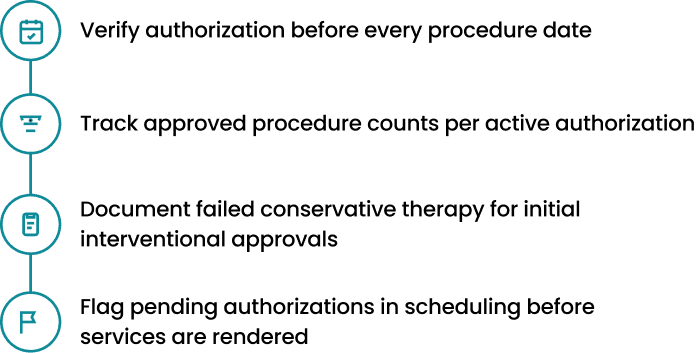

OmniMD’s Pre-Authorization Services automate eligibility verification and payer rule management in real time.

Documentation checklist
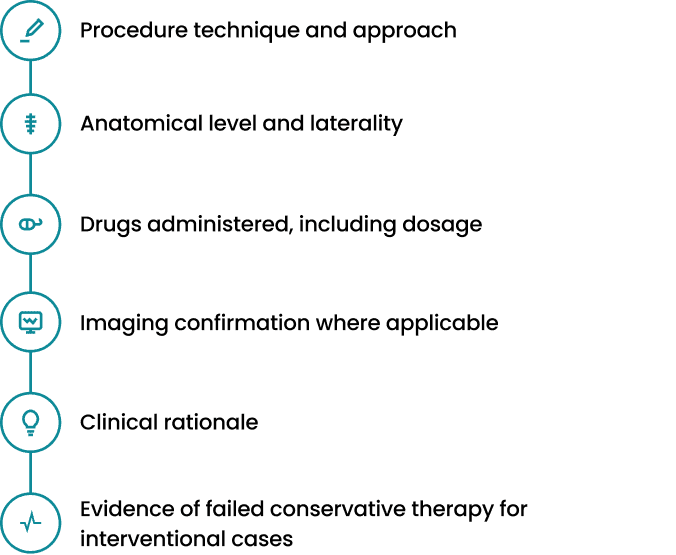
OmniMD’s Pain Management EMR embeds procedure-specific templates so documentation supports billing from the moment the encounter is charted.
The OmniMD
Pain Management Billing Platform

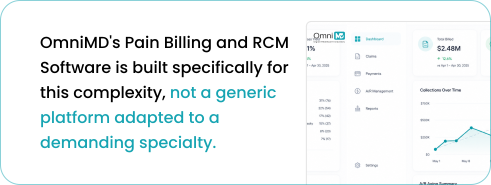
Pain Billing and RCM Software
Industry average: 85%. That 12-point gap is revenue earned and never collected.

AI Medical Coder
Real-time code suggestions, undercoding detection, and denial risk scoring per claim


AI RCM
Predictive claim accuracy, automated denial resolution, AR prioritization by recovery likelihood


Turn Pain Billing Complexity
Into Cleaner Revenue
OmniMD combines specialty-specific billing intelligence with AI-powered automation to help pain management practices bill accurately, reduce denials, and collect what they’ve earned.