
 Written by Dr. Girirajtosh Purohit
AI Medical Scribe for Wound Care: Where Millimeters Decide Outcomes
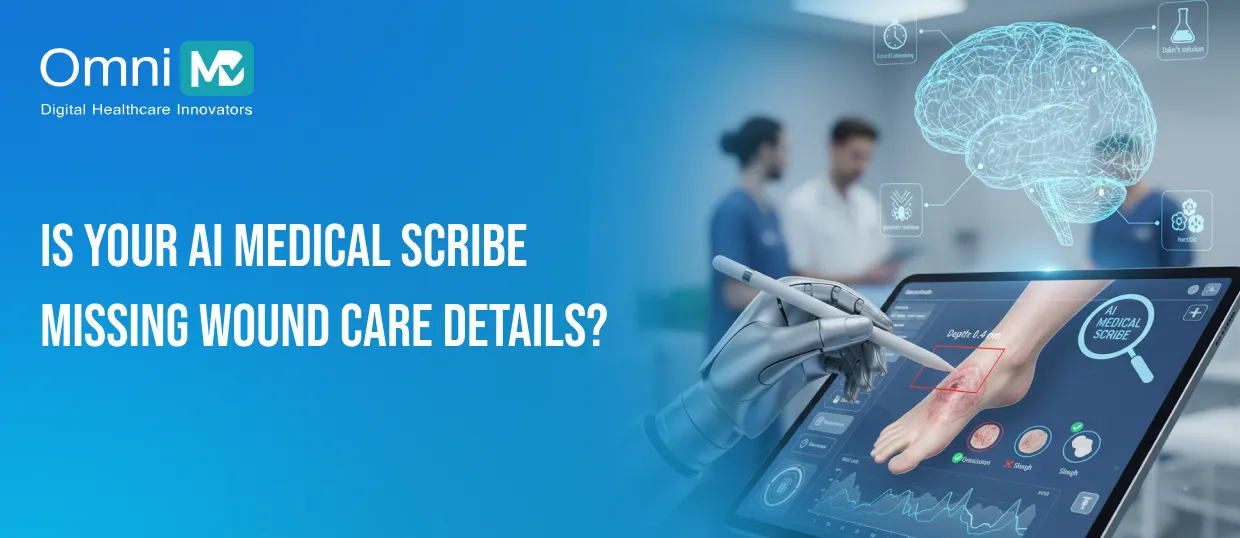
When someone says a millimeter can change everything, it might sound like exaggeration, until you step into a wound clinic. In wound care, a single millimeter can decide whether a treatment plan remains on course or whether it shifts entirely to address new complications.
- A wound shrinking from 3.2 centimeters to 3.0 centimeters is not just a mathematical adjustment; it’s a sign that tissue is regenerating, inflammation is reducing, and the patient’s body is responding to care.
- On the other hand, a wound that expands by even 0.3 centimeters signals a completely different story, one that needs immediate clinical attention.
These small fluctuations carry immense clinical meaning. Each note, photograph, and measurement tells a chapter in that patient’s healing story. And to perform at this level, AI scribe for wound care needs more than generic speech‑to‑text capability. It requires a deep understanding of wound‑care terms, structures, and logic.
For example:
- It must understand “five o’clock undermining” as a spatial reference, not as a time stamp.
- It must know that “Dakin’s solution” relates to irrigation or dressing, not medication.
- It must track changes in measurement precisely enough to show whether a wound is healing or stalling.
These are domain‑specific insights built through training the AI on wound documentation examples and clinical guidelines. A general medical scribe might capture dialogue correctly, but without comprehension of these relationships, much of the meaning is lost. That is why specialty‑specific AI scribes usually perform far better in complex fields like wound care, dermatology, or cardiology than all‑purpose tools.
What Can a Wound-Specific AI Medical Scribe Really Do?
An AI medical scribe for wound care supports clinicians by handling time-consuming documentation tasks. It is not there to make clinical decisions or replace judgment, its role is to listen, organize, and record information accurately. Let’s see how.
Listening Instead of Typing
Imagine a wound assessment room on a busy afternoon. You examine a patient’s diabetic foot ulcer and start speaking naturally to the assistant:
“Ulcer on plantar surface of the left foot, two by one and a half centimeters, 0.4 cm deep, mostly granulation tissue, minimal slough, light serous drainage. No odor. Callused edges.”
When an AI scribe is active, it listens. Rather than recording this as one chunk of text, it identifies the pieces, the size, depth, tissue type, drainage, and odor status,and places each in the correct section of the electronic note. It converts the spoken description into structured data that can feed graphs, reminders, and analytics later.
This step saves minutes during each visit and ensures consistency. But the real benefit comes later, when that same wound is reviewed weeks afterward. Because the earlier data was structured, the clinician can instantly view changes in size or drainage trend, without rereading entire paragraphs of past notes.
Consistent structure turns documentation from a static record into usable information.
From Capturing Words to Understanding Them
But listening isn’t enough if understanding is missing. Generic dictation software can turn speech into words, but it doesn’t understand their meaning. If a clinician says, “One by one centimeters,” a basic transcription tool writes exactly that, but it doesn’t know where to put the number or how to calculate change over time.
An AI-driven wound documentation software understands that measurement refers to “length” and “width” fields and tags them properly. It knows the difference between “granulation,” “slough,” and “necrotic” as categories of tissue, not random words. This level of context detection makes the AI useful across encounters and helps reduce mistakes when providers describe anatomy differently.
Over months, this structured documentation builds a living database that tells the wound’s story in ways raw text never could.
Keeping Procedures as Precise as They Deserve to Be
That same awareness matters during procedures. Debridement notes, for example, aren’t just boxes to tick, they prove quality and compliance. If you record “excisional debridement” but skip the post‑procedure measurements, a good AI scribe notices and prompts you gently. You confirm before signing off, avoiding gaps that might later affect audits or billing.
These gentle cues help clinicians avoid compliance issues later and protect reimbursement integrity without adding extra workflow steps. Instead of a human auditor catching missing pieces days later, the AI catches them in real time.
When Everyone Speaks the Same Language
A common frustration in multi‑provider wound programs is inconsistent terminology. One nurse might say “moderate drainage,” another writes “large amount,” and a third prefers “++ exudate.” All describe roughly the same thing, but the record sees them as different.
AI scribes trained in wound terminology can bring this variation into harmony. They recognize equivalence between terms and convert them into standardized descriptors based on accepted wound‑care vocabularies. This doesn’t change what clinicians say; it simply preserves clarity for analytics, continuity, and future reviews.
So when a new provider opens the chart months later, they can easily understand the wound’s progression without guessing at subjective language.
Why Structured Notes Are Easier to See
Once the language stabilizes, visualization becomes effortless. Because the scribe captures measurements and tissue data in structured form, it can instantly convert progress into visuals, graphs showing gradual size reduction or charts illustrating drainage change over time.
Being able to see those patterns helps you decide whether a treatment plan is effective or if adjustments are needed. It also helps patients understand their own healing path, visual proof of improvement builds motivation and compliance.
Without structured data, that visual insight would take hours to compile manually. With wound measurement documentation automation, it becomes available instantly.
Transparency: Keeping the AI’s Help in Full View
Of course, clarity shouldn’t end at the notes, it should extend to the AI’s own role. Many clinicians ask, “If AI drafts part of my note, who’s responsible for errors?” The answer never changes: the clinician. The AI simply prepares a draft; nothing is final until review and approval.
Most advanced systems even tag which portions were AI‑generated or clinician‑entered, creating transparent audit trails. That openness builds trust, a necessary ingredient before automation can truly blend into care.
Balancing Support With Human Judgment
Once trust forms, the goal shifts to balance. AI handles the repetitive parts, transcribing, structuring, reminding, but treatment judgment will always belong to people. The best systems never try to imitate clinicians’ reasoning; they elevate it, ensuring experts have clean, instant information to base decisions on.
Automation takes care of the rhythm; humans provide the reasoning and empathy. Together, they close the loop between data and care.
How Clear Documentation Shapes Team Learning
As more clinicians use AI medical scribe for wound care, the ripple effects reach training and teamwork. Because notes follow a consistent model, new nurses or residents quickly learn what “good” wound documentation looks like. Built‑in feedback can catch unit errors or inconsistent staging terms before submission.
In team settings, that consistency removes guesswork between shifts, fewer clarification calls, smoother handovers, and faster communication. Over time, the clinic starts to feel more coordinated simply because everyone is speaking from the same page.
What Implementation Looks Like in Practice
Adopting an AI scribe for wound care usually follows several steps.
- First comes pilot testing in a small group of clinicians. Feedback from those early users helps fine‑tune prompts and templates.
- Next, the organization checks how well the AI integrates with its wound care clinic software
- Training sessions then focus on voice patterns, phrasing, and reviewing generated notes effectively. Within a few weeks, most clinicians get comfortable. Over time, as the AI adapts to their language, they find that fewer edits are needed.
- Performance reviews at milestones, one month, three months, six months, help track measurable outcomes such as time saved per note, reduction in after‑hours charting, and improvement in documentation completeness. These metrics often turn skeptical teams into advocates.
Building Trust Through Responsible Design
Behind the scenes, security and integration make all the difference. A good AI scribe meets the same standards as any EHR, encrypted channels, HIPAA‑compliant storage, seamless syncing with patient charts. Accuracy improves as it adapts to each clinician’s rhythm, and direct integration eliminates double entry.
The Long‑Term Impact on Care
Beyond saving time or improving compliance, AI scribes may change how wound data contributes to population health insights. Aggregated, de‑identified documentation across many clinics can reveal patterns of healing in diabetic populations, pressure injuries, or vascular ulcers. Such knowledge supports research and preventive strategies.
At the individual level, clearer documentation builds stronger continuity of care. Whether a patient transfers between acute and outpatient settings or sees multiple specialists, their wound record remains coherent and accessible.
The Future of AI in Wound Care Documentation
Over the next few years, AI scribes for wound care will likely expand beyond recognition and structuring. They may start offering optional insights, such as highlighting wounds that have not improved after several visits or reminding teams of evidence‑based interventions for stagnating ulcers.
Still, even the most advanced AI will remain a helper, not a replacement. The purpose of these tools is to ensure that the patient’s journey is recorded clearly and accurately, freeing clinicians to deliver the human parts of care, assessment, empathy, and trust.
Final Thoughts
Every wound carries a story of healing, challenge, and persistence. Recording that story correctly should not drain a clinician’s time or attention. A wound‑care AI scribe ensures that each observation, measurement, and procedure finds its proper place in the record without forcing the clinician to trade patient connection for keyboard speed.
By turning spoken assessments into organized data, reminding users of missing elements, and keeping the documentation continuous across visits, AI scribes bring structure where human memory alone might falter. They protect compliance, support teamwork, and help clinicians rediscover time and focus for direct care.In the end, the real value is not just efficiency, it is clarity. Clarity in communication, in decision‑making, and in the continuous story of healing.
In wound care, that clarity can mean better outcomes for patients and less strain for those who help them heal.
Wound Care Documentation, Done Right
Capture measurements, assessments, and treatment notes instantly—without slowing your clinic.