
 Written by Divan Dave
6 Healthcare Digital Marketing Agencies Doctors Trust for Sustainable Patient Growth
Most doctors don’t struggle because patients don’t exist.
They struggle because patients can’t find them.Or they find them, but something feels off, so they don’t call.
That space between visibility and trust is where clinics lose patients every day.
Healthcare digital marketing agencies operate in that narrow space between being seen and being trusted. Some understand how fragile that moment is and help clinics move patients across it.
Others focus on surface-level activity, unintentionally widening the gap. This piece is written for doctors who want clarity, not trends or hype, but a practical way to judge fit. By the end, you should be able to clearly say which agency makes sense for your clinic and which ones do not.
Before You Compare Agencies, Reset Your Expectations
Healthcare marketing differs from that in other industries. If you expect quick wins, you will pick the wrong partner.
Patients usually don’t make decisions the moment they land on a clinic’s website. They take time to understand their options, check reviews, and discuss things with family before reaching out.
Most healthcare searches are local, and many decisions are driven by anxiety, uncertainty, or trust rather than urgency. When patients drop off, it’s often because something felt unclear or didn’t inspire confidence.
Simply increasing traffic or running more ads rarely solves this. What actually matters is alignment. The marketing message needs to align with the clinic’s actual capacity, be medically accurate, and support the clinic’s reputation rather than undermine it.
With that context, here is how these agencies actually differ in real clinic settings.
1. GrowthPixel
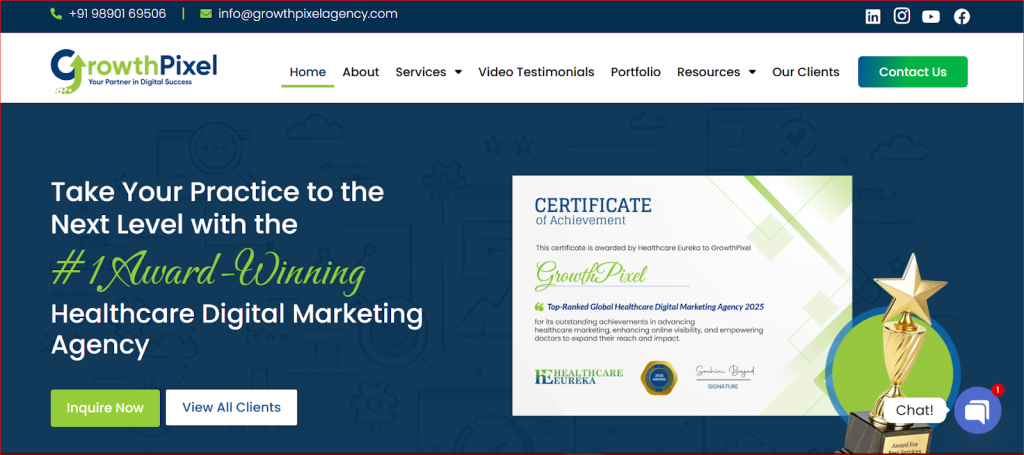
GrowthPixel operates like a true full-service healthcare digital marketing agency.
Instead of treating ads, Google visibility, reviews, and the website as separate projects, they’re treated as a single, connected system. What a patient sees first, what they check next, and what finally convinces them to call is planned together, not in isolation.
Patients don’t move in straight lines.
They might:
- See an ad today
- Read reviews tomorrow
- Visit the website a week later
- Call after a reminder from family
GrowthPixel builds for that reality.
Ads create early awareness.
SEO and Maps handle long-term discovery.
Reviews and content reduce hesitation.
No single channel is treated as “the answer.” Each one supports the others. That reduces dependence on any single source of patients, creating stability over time.
They also focus heavily on operational gaps. Leads are delivered through WhatsApp and email, so clinics don’t miss appointments. Reporting is frequent,t and support is responsive, which matters more than most doctors realise.
Best fit
Clinics that want patient flow to feel steady, not fragile.
Doctors who prefer one team to handle ads, Google visibility, reviews, and the website together, instead of juggling multiple vendors.
Limitations
This is not a “set it and forget it” setup. Doctors will be asked to review messaging, approve content, and stay involved. If you expect to check numbers once a month and stay detached, this will feel slow and demanding.Choose GrowthPixel if you want marketing that compounds over time.
Avoid it if you’re only chasing short-term enquiries with no interest in building something durable.
2. OmniMD Clinic Marketing Services
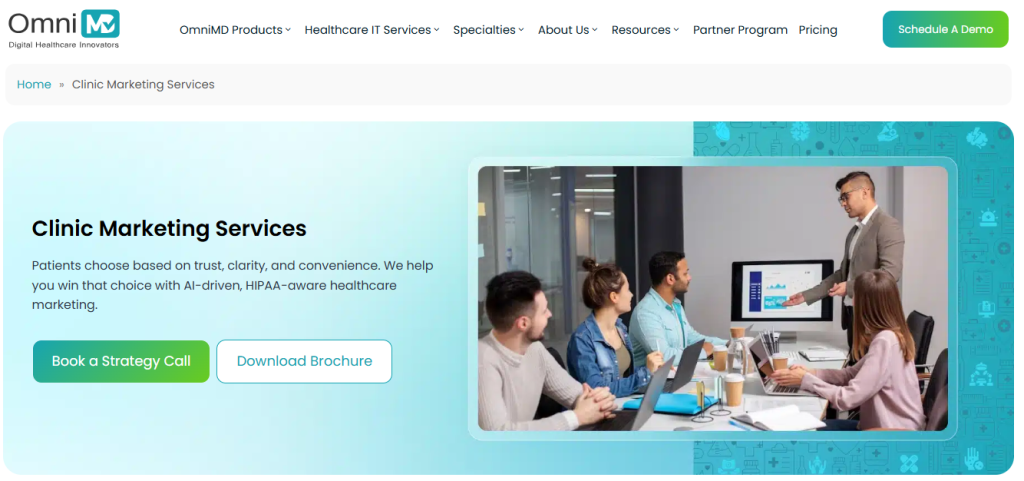
Healthcare marketing only works when it’s aligned with how patients actually choose care.
OmniMD approaches clinic marketing with that reality in mind, connecting visibility, trust, and conversion into one coordinated system rather than isolated tactics.
OmniMD operates as a comprehensive clinical marketing partner.
Instead of treating SEO consulting, reputation management, content, social media, and the website as separate efforts, everything is designed to work together. What a patient finds first, what reassures them next, and what finally drives them to book is planned as a single journey.
Patients don’t decide in one step. They might:
- Search a condition on Google
- Check reviews before trusting a clinic
- Browse the website days later
- Notice social content repeatedly
- Book once confidence is built
OmniMD builds for that reality.
- SEO consulting improves long-term visibility.
- Reputation management builds trust at critical decision points.
- Content marketing educates and reduces uncertainty.
- Social media management reinforces credibility and familiarity.
- Website design and development convert interest into action.
No single channel is treated as the solution. Each supports the others. That reduces reliance on any one source of patient acquisition and creates more consistent growth over time.
OmniMD also focuses on alignment with clinical operations. Messaging reflects real services. Content supports actual specialties. Websites are designed around how clinics schedule, communicate, and follow up with patients, not generic marketing templates.
Best fit
Clinics that want patient acquisition to feel predictable, not campaign driven.
Practices that prefer one healthcare focused team to manage SEO, reviews, content, social media, and the website together instead of coordinating multiple vendors.
Limitations
This is not passive marketing. Clinics will be involved in approvals, messaging alignment, and clinical accuracy. If you want a hands off vendor with minimal input, this approach may feel demanding.
Choose OmniMD if you want marketing that builds authority and trust over time.
Avoid it if you’re only looking for short term traffic spikes without a long term growth strategy.
3. DocStokes
DocStokes is designed for clinics that want patients now.
Their entire model revolves around paid ads. Google searches. Instagram and Facebook feeds. Clear landing pages that ask patients to enquire immediately.
This works best when the treatment already carries urgency or high intent. IVF. Cosmetic surgery. Hair transplants. Procedures where patients are actively weighing options and need a push to start the conversation.
DocStokes often puts doctors on camera. Short videos. Direct explanations. In crowded specialities, this helps patients recognise a face and feel familiarity faster.
But this system runs on momentum.
As long as ads are active, enquiries come in. When budgets tighten or campaigns pause, visibility drops just as quickly. There’s less emphasis on building something that keeps working in the background.
That’s the trade-off. Speed over staying power.
There is limited focus on SEO, Google Maps, or long-term reputation systems. When ad spend slows, patient flow usually follows suit.
Best fit:
Clinics that need fast traction and can sustain ad budgets.
Limitations:
Not ideal if your goal is to reduce dependence on ads over time.Choose DocStokes for speed.
Avoid it if sustainability is your priority.
4. Cardinal Digital Marketing
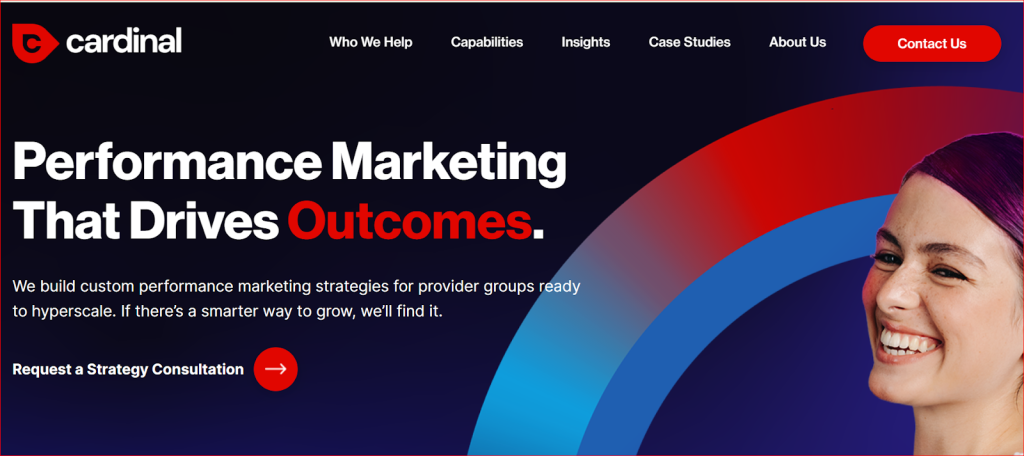
Cardinal works deeply inside healthcare, typically with larger practices.
Their approach is structured and performance-driven. SEO, paid media, attribution, and conversion tracking are handled carefully. Decisions are made from data, not instinct.
This suits clinics that already have patient volume and want efficiency. You can clearly see what converts, what doesn’t, and where money is being wasted.
The downside is complexity.
Smaller clinics often find the process heavy. The reporting, coordination, and internal requirements only make sense when there is staff, budget, and operational maturity.
Best fit:
Growing practices that value measurement, control, and disciplined execution.
Limitations:
It can feel overwhelming for solo doctors or early-stage clinics.Choose Cardinal if you want measurable performance.
Avoid it if you want simplicity.
5. Intrepy Healthcare Marketing
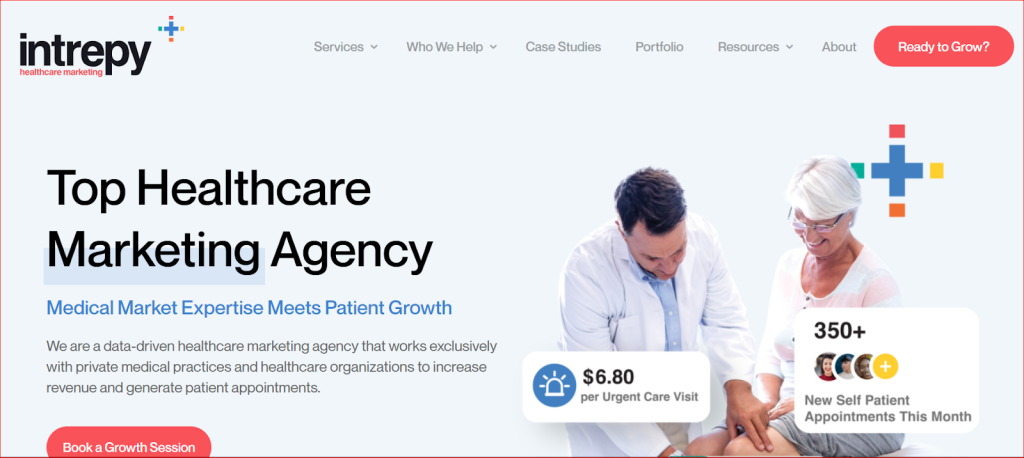
Intrepy focuses on reaching patients at the point where they are actively searching for a doctor rather than passively encountering ads while scrolling online.
Their work is designed to ensure clinics appear in relevant local searches, treatment-related queries, and other moments when patients are intentionally seeking medical care and are closer to making a decision.
They focus on making sure your clinic appears at that moment. On Google Maps. On treatment-specific pages. On searches that usually happen late at night, when patients are trying to understand symptoms before calling anyone.
This kind of marketing doesn’t push patients. It waits for them.
SEO does not produce instant volume. Clinics that expect immediate results often get frustrated early.
Best fit:
Doctors who want stable, long-term visibility and are comfortable waiting.
Limitations:
Not suitable for clinics that need leads immediately.Choose Intrepy for long-term discovery.
Avoid it if speed is critical.
6. Healthcare Success
Healthcare Success operates at an institutional level.
They work with hospitals, health systems, and multi-location practices. Their scope includes branding, patient acquisition strategy, and cross-department coordination.
This model assumes internal teams, long timelines, and multiple decision-makers. It is process-heavy by design.
While this model tends to be overwhelming for small practices, it can work well for larger organisations that have the internal resources to support a more structured approach.
Best fit:
Hospitals and health systems managing scale and consistency.
Limitations:
Not practical for individual doctors or small practices.Choose Healthcare Success for enterprise needs.
Avoid it if you need agility.
Questions You Should Ask Before Signing a Contract with a Healthcare Digital Marketing Agency Anything
Before choosing any healthcare digital marketing agency, ask these questions:
- What happens if we pause ads?
- Who owns my Google Business Profile?
- How are reviews requested and followed up on?
- Can my front desk actually handle more calls?
- Who checks medical accuracy before publishing?
Clear answers matter more than promises.
Final Thought
Good healthcare marketing should bring a sense of stability to a clinic, not urgency or confusion. When done well, patients can find accurate information, feel confident in their choice, and reach out without hesitation.
For the clinic, this translates into predictable workflows, informed conversations, and fewer last-minute scrambles. That level of clarity and control is the real objective. Anything that creates more noise than trust rarely holds value in the long run.

Choose the Right Agency
Compare agencies that help clinics grow with trust, not hype.