
OmniMD vs Veradigm (Allscripts): The Modern Ambulatory EHR Alternative
If you’re a mid‑sized ambulatory or specialty practice in the U.S., you’re likely running an EHR that was built for a different era: before AI, before cloud‑only deployments, and before the need to squeeze every dollar out of your revenue cycle. Many of you are on Veradigm (formerly Allscripts), which has long served as a stable backbone for practices, networks, and even payers.
But stability is not the same as optimization. In today’s environment, practices need systems that:
- Cut denials and speed cash flow
- Reduce charting time so clinicians can see more patients
- Integrate EHR, billing, and patient engagement in one place
- Scale without adding servers, IT staff, or six‑month implementation cycles
OmniMD is designed exactly for that reality: a modern, cloud‑native, AI‑powered platform built for ambulatory and specialty‑driven practices.
In this guide, we’ll walk you through exactly how OmniMD compares to Veradigm, so you can decide whether it makes sense for your practice.
First and Foremost: Know Your Current Pain Points
Before you compare products, start with your own situation. Ask your leadership team:
- Are denials above 10 to 15%?
- Do providers regularly stay late to finish charting?
- Is your staff spending hours rekeying data between EHR, billing, and eligibility tools?
- Are you paying for Veradigm add‑ons (FollowMyHealth, advanced analytics, etc.) that still feel fragmented?
If the answer to several of these is ‘yes,’ then you’re already in OmniMD’s sweet spot. If you’re more concerned with enterprise‑scale data exchange, research, or multi‑hospital integration, Veradigm may still be the better fit.
Now let’s break this down feature‑by‑feature, in a way that directly helps you decide.
EHR Documentation: AI Charting vs Template‑Driven Workflows
Veradigm (Allscripts)
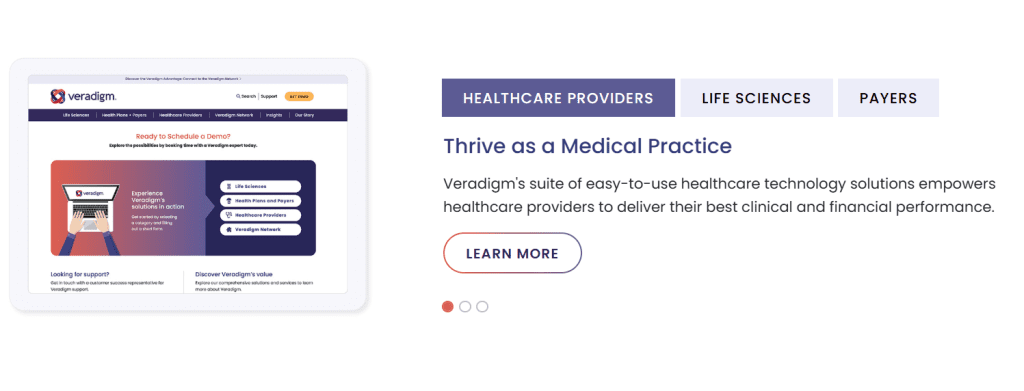
Veradigm’s EHR is built around highly configurable templates. You can scaffold workflows for hundreds of specialties, good for large, complex organizations that want to standardize protocols across departments.
- Strengths:
- Deep template control
- Strong compliance and regulatory support
- Familiar to many legacy Allscripts users
- Limitations from an ambulatory‑practice perspective:
- Heavy reliance on manual data entry
- No native ambient AI charting embedded in the core product
- Customization often requires admin or vendor time
OmniMD
OmniMD flips the script: instead of asking providers to click through templates, it listens to the visit and structures the note automatically.
Key capabilities:
- Ambient AI charting (speech‑to‑text optimized for medical language)
- Automatic generation of SOAP notes, diagnoses, medications, and orders
- Specialty‑specific templates built for 20+ specialties (cardiology, orthopedics, pain management, mental health, etc.)
- 40 to 50% reduction in clicks per encounter, per vendor‑reported benchmarks
This means:
- Less time spent documenting
- Fewer “left‑hanging” notes at the end of the day
- More consistent coding and documentation quality
Buyer insight
If your physicians are burned out by charting or your nurse/MA staff spends more time correcting notes than seeing patients, OmniMD’s AI‑driven documentation is the bigger differentiator.
Practice Management (PMS): Speed vs Enterprise Scale
Veradigm
Veradigm’s practice management is engineered for enterprise environments. You get:
- Robust scheduling rules engines
- Advanced authorization and eligibility workflows
- Predictive tools tied to large‑scale payer data
- Typically 98% clean claim rate through rule‑based validation
This is excellent if you’re a large network, multi‑site system, or tightly integrated with hospital‑owned practices.
OmniMD
OmniMD embeds PMS natively inside the same cloud ecosystem as EHR and RCM.
Key differences:
- Cloud‑only deployment: no servers, no local hosting
- Digital check‑in kiosks, automated reminders, and real‑time eligibility checks
- Everything flows to the billing engine in real time, no separate reconciliation step
For a mid‑size (5 to 50 provider) ambulatory or specialty practice, this means:
- Faster onboarding and fewer IT headaches
- Fewer ‘between systems’ errors
- Easier expansion to multiple locations
Buyer insight
If your physicians are burned out by charting or your nurse/MA staff spends more time correcting notes than seeing patients, OmniMD’s AI‑driven documentation is the bigger differentiator.
Revenue Cycle Management (RCM): Predictive AI vs Stable Rules
Revenue is where this comparison becomes a business decision, not just a tech decision.
Veradigm
Veradigm integrates RCM inside its PMS, providing:
- Eligibility checks
- Claims validation
- Claims tracking and analytics
- Again, 98% clean claims through mature, rules‑based validation
This is strong, but it’s reactive rather than predictive. You still get denials and underpayments, and then you handle them downstream.
OmniMD
OmniMD treats RCM as predictive intelligence, not just a back‑end function.
Key capabilities:
- AI‑driven denial prediction: algorithms analyze your payer history and flag likely issues before claims are submitted
- Auto‑scrubbing of codes and ICD‑10/CPT pairings
- Instant eligibility checks and EOB reconciliation automation
- CFO‑level dashboards that show AR, denials, and collections by payer, provider, and specialty
Results from OmniMD‑using practices:
- Denials reduced from about 21% down to 4%
- Net collections exceeding 95%, which is above typical industry benchmarks of 10 to 20% denials
Buyer insight
If your practice is sensitive to cash‑flow timing or has denial rates above 10%, OmniMD’s predictive RCM is likely to deliver faster ROI than Veradigm’s traditional model.
Patient Engagement and Remote Monitoring
Ambulatory practices today are expected to deliver ongoing care between visits, not just ‘see and send home.’
Veradigm
Veradigm powers FollowMyHealth, one of the most widely adopted patient engagement platforms in the U.S. It offers:
- Patient portals
- Telehealth
- Messaging and appointment scheduling
- Video visits
This is great if you’re part of a large system and want a well‑established, branded portal with broad reach.
OmniMD
OmniMD bundles:
- Secure patient messaging
- Portals
- Digital check‑in
- Remote patient monitoring (RPM) that streams biometrics (BP, glucose, weight, etc.) directly into the chart
RPM is especially valuable for:
- Chronic care management (heart failure, diabetes, COPD)
- Medicare and commercial RPM programs
- Practices looking to capture additional revenue streams beyond in‑office visits
Buyer insight
If you’re already planning or running RPM programs, OmniMD’s built‑in RPM (no extra integration) can save months of setup and per‑month subscription costs you’d otherwise pay for separate tools.
Specialty‑Specific Usability: Day‑One Readiness vs Heavy Customization
Veradigm
Veradigm is highly configurable via rule engines and global parameters. You can shape workflows for large departments, but this usually requires:
- Setup time
- Admin or consultant involvement
- Ongoing tuning
It’s powerful for large, standardized systems.
OmniMD
OmniMD ships with 20+ pre‑built specialty templates that mirror real‑world workflows:
- Cardiology stress tests, echo workflows
- Orthopedic imaging workflows
- Mental health and pain management pain‑scale and opioid‑tracking tools
Practices report being able to:
- Avoid months of ‘template‑building’ overhead
- Go live faster
- Train staff once, then replicate across sites
Buyer insight
If you run a multi‑specialty group or change specialties frequently, OmniMD’s plug‑and‑play specialty templates will likely save you time and money compared with Veradigm’s heavier customization model.
AI and Automation: Where the Real Efficiency Gains Live
This is where OmniMD diverges most clearly from Veradigm.
Veradigm
Veradigm uses rule‑based automation for tasks like:
- Scheduling rules
- Authorization checks
- Claims validation
This is stable and predictable, but it’s not adaptive. It won’t learn from your patterns or predict future bottlenecks.
OmniMD
OmniMD deploys AI across multiple layers:
- Speech‑to‑text dictation with 95%+ accuracy (models similar to state‑of‑the‑art deep‑learning speech engines)
- Auto‑coding that suggests appropriate ICD‑10/CPT combinations
- Denial prediction and AR‑coaching (flagging under‑billed items)
- Context‑aware decision support (reminders, alerts, and quality‑measure nudges)
These features translate into quantifiable time and revenue gains:
- More accurate quality reporting
- Less time spent on coding and charting
- Fewer underpayments and rejected claims
Buyer insight
If your team manually audits codes, double‑checks charts, or spends a lot of time on appeals, OmniMD’s AI tools can turn a compliance burden into a competitive advantage.
Interoperability and Data Exchange
Both platforms support HL7, FHIR, and national standards, but they emphasize different use cases.
OmniMD
OmniMD focuses on day‑to‑day ambulatory interoperability:
- HL7 lab interfaces
- Surescripts e‑prescribing
- Scribe and transcription compatibility
- Tight integration between EHR, RCM, and RPM
You get the data you need to run a practice, without the overhead of enterprise‑level analytics engines.
Veradigm
Veradigm excels in enterprise and research‑grade data exchange:
- Extensive real‑world evidence (RWE) networks
- Large‑scale population health and payer data pipelines
- Integration with hospital systems and research consortia
Buyer insight
If your primary goal is running a lean, profitable ambulatory practice, OmniMD is more than enough. If you’re a research‑driven multi‑site network or tightly coupled to a hospital system, Veradigm’s broader data ecosystem may still be worth the trade‑offs.
Deployment and Implementation: Speed vs Complexity
Veradigm
Veradigm offers cloud and hybrid options, which can be useful if you’re migrating from legacy on‑premise systems. However:
- Migrations can be long and complex
- Hybrid models often require local IT infrastructure
- Go‑live timelines are typically months rather than weeks
OmniMD
OmniMD is cloud‑only and cloud‑native:
- No servers or local hosting
- Typical onboarding in weeks, not months
- Proven onboarding paths for Allscripts/Veradigm migrations
This is especially attractive for:
- Clinics that want to stay agile as regulations and payer rules change
- Practices that want to minimize IT overhead
- Groups that want to switch quickly without a multi‑year project
Buyer insight
If “We don’t want to spend another year talking about EHR implementation” is a common sentiment in your leadership meetings, OmniMD’s speed‑to‑value is a major differentiator.
Security and Compliance
Both platforms are HIPAA‑compliant and meet modern security standards.
- OmniMD uses multi‑tenant cloud encryption, role‑based access, and continuous monitoring—all built into the SaaS model.
- Veradigm uses enterprise‑grade frameworks that are often tied to on‑premise or hybrid environments.
In practice, security is comparable for most ambulatory practices. The real difference is:
- OmniMD: outsourced, managed cloud security
- Veradigm: you take more responsibility for on‑premise/hybrid security
Buyer insight
If you don’t want to manage servers and security patches yourself, OmniMD is the simpler choice.
SWOT Snapshot
| Dimension | OmniMD | Veradigm (Allscripts) |
| Strengths | Unified EHR/PMS/RCM/RPM; AI automation; cloud agility; specialty focus | Heritage presence; large networks; RWE data power; established user base |
| Weaknesses | Smaller market visibility | Modular feel; slower innovation; AI adoption lag |
| Opportunities | Converting legacy users to cloud automation | Deepening payer–provider partnerships |
| Threats | Major vendors expanding cloud portfolios | New entrants redefining automation |
Cost and ROI: When OmniMD Makes Sense
Veradigm is excellent for large organizations that can absorb higher upfront costs and long migrations. OmniMD is optimized for:
- Provider‑based subscription pricing
- Faster ROI through denials reduction and time savings
- No hardware or IT overhead
Estimated benefits for mid‑size practices:
- $100,000+ annual savings or gains from reduced denials and improved collections
- Hours saved per provider per week from AI charting and automation
Buyer insight
If your current Veradigm‑based system feels expensive for what you’re getting, or if you’re paying for multiple add‑ons, OmniMD can simplify your stack and improve your bottom line.
When to Choose OmniMD vs Veradigm
To make this as concrete as possible, here’s a quick decision matrix:
Choose OmniMD if:
- You’re a mid‑size ambulatory or specialty practice (5 to 50 providers)
- Frustrated with high denials (above 10 to 15%)
- Want AI‑driven charting and RCM that actually reduce manual work
- Prefer cloud‑only, low‑IT overhead
- Want built‑in RPM and integrated portals
- Prefer faster implementation and faster ROI
Choose Veradigm if:
- You’re a large hospital system, multi‑site network, or research consortium
- Deeply tied to Allscripts workflows and data pipelines
- Need enterprise‑scale RWE, population health, and payer analytics
- Comfortable with longer implementation timelines and higher TCO
Strategic Recommendation Framework
To help your leadership team decide, here’s a practical framework:
#1. Map your biggest pain points today
- Is it denials? Charting time? Staff burnout? IT complexity?
#2. Align those to vendor strengths
- If denials and time are the issues, OmniMD’s AI‑driven RCM and charting are likely better.
- If you’re more worried about enterprise data and research, Veradigm may still be preferable.
#3. Run a pilot or POC
- Test OmniMD’s AI charting and RCM workflows with one or two providers.
- Measure denials, time‑to‑note‑finalization, and collections before and after.
#4. Model total cost of ownership (TCO)
- Include hardware, IT staff, add‑on modules, and implementation time.
#5. Plan your Veradigm migration in stages
- Start with a single site or specialty.
- Use OmniMD’s migration tools to preserve data and minimize downtime.
Comparative Overview
| Dimension | OmniMD | Veradigm (Allscripts) |
| Strengths | Unified EHR/PMS/RCM/RPM; AI automation; cloud agility; specialty focus | Heritage presence; large networks; RWE data power; established user base |
| Weaknesses | Smaller market visibility | Modular feel; slower innovation; AI adoption lag |
| Opportunities | Converting legacy users to cloud automation | Deepening payer–provider partnerships |
| Threats | Major vendors expanding cloud portfolios | New entrants redefining automation |
Final Thought: OmniMD as the ‘Next‑Generation’ Alternative
Ambulatory success today depends on doing more with less: seeing more patients, paying less attention to avoidable denials, and spending less time on manual work.
Veradigm is a solid, established platform for large systems and research‑driven organizations. But for practices that want to move faster, use AI, and improve their financial health, OmniMD offers a modern, unified alternative that can deliver measurable gains in both efficiency and revenue.
If you’re ready to explore how OmniMD performs as a Veradigm/Allscripts alternative in your environment, OmniMD offers a personalized assessment and demo customized to your denial rates, charting load, and practice size.
Also comparing other EHR platforms? See how OmniMD stacks up against eClinicalWorks, Athenahealth, and AdvancedMD.