

Healthcare Regulatory Compliance in 2026: The Complete Playbook for HIPAA, 42 CFR Part 2, and CMS Updates
In 2025, the HHS Office for Civil Rights collected more than $6.6 million in HIPAA settlement fines across covered entities and their business associates. That number is going to look small by the end of 2026. The HIPAA Security Rule is receiving its first major update since 2013. The 42 CFR Part 2 final rule enters active civil enforcement on February 16, 2026. CMS is finalizing cybersecurity conditions of participation for Medicare and Medicaid hospitals. The 21st Century Cures Act information blocking penalty framework now applies to providers, not just health IT vendors. State-level laws from California, Washington, Texas, and New York are adding a second regulatory layer on top of federal requirements.
For practice administrators, compliance officers, and IT leaders in healthcare, 2026 is the most demanding regulatory year in a decade. I have spent 25 years building healthcare technology and advising medical practices on compliance, and I can tell you this: the practices that treat compliance as a quarterly checklist are already losing. The practices that treat it as an operating discipline, embedded in their EHR configuration, their workforce training, and their incident response posture, are the ones that pass OCR audits without losing a weekend.
This guide covers every major regulatory framework that applies to US medical practices in 2026, the exact deadlines, the actual penalty exposure, and the operational playbook my team recommends to clients preparing for OCR’s third-phase audit wave. If your practice has not yet mapped its 2026 compliance calendar, the next 15 minutes will save you a six-figure fine.
✦ 2026 Healthcare Compliance Calendar: Critical Deadlines
- February 16, 2026: 42 CFR Part 2 Civil Enforcement Program activates. OCR begins accepting complaints for substance use disorder records violations.
- March 31, 2026: Annual HIPAA compliance attestation due for most covered entities following fiscal-year calendars.
- May 2026 (expected): HIPAA Security Rule final rule publication. First major Security Rule update since the 2013 Omnibus Rule.
- Q3 2026: CMS cybersecurity conditions of participation for Medicare and Medicaid hospitals expected to move from proposed to final.
- October 1, 2026: Annual ICD-10-CM update cycle. New codes for 2026 adoption publish.
- December 31, 2026: Information blocking compliance review window closes for calendar-year providers.
Dates verified against HHS, CMS, and ONC published guidance as of April 2026. Calendar assembled by the Omnimd compliance team.
The Six Regulatory Frameworks Every Practice Must Track in 2026
Most compliance conversations start and end with HIPAA. That was adequate in 2015. In 2026, it is incomplete. Medical practices now operate under a minimum of six distinct regulatory frameworks, each with its own enforcement agency, penalty structure, and effective date. The table below lays out how they compare at a glance so your compliance officer can see the full regulatory surface in one view.
| Framework | Applies To | Key 2026 Date | Maximum Penalty | Core Requirement | Enforced By |
|---|---|---|---|---|---|
| HIPAA Security Rule 2026 | Covered entities, business associates | May 2026 (expected) | $2,190,294/year per tier | MFA, encryption, asset inventory, 72-hr incident reporting | HHS OCR |
| 42 CFR Part 2 | Federally assisted SUD programs | Feb 16, 2026 (active) | $2M/year + criminal | Single consent, segmentation, aligned breach notification | HHS OCR |
| CMS Interoperability | Medicare / Medicaid hospitals, health plans | Q3 2026 (expected final) | Loss of CMS participation | FHIR APIs, patient access, payer-to-payer exchange | CMS |
| HTI-1 / HTI-2 | Health IT developers, CEHRT users | HTI-2 final in 2026 | Loss of ONC certification | DSI transparency, USCDI data classes, real-world testing | ONC |
| Information Blocking | Providers, HIEs, health IT vendors | In force since Apr 2021 | $1M/violation (HIT); MIPS cuts (providers) | Eight regulatory exceptions, API access, patient portability | ONC / OIG / CMS |
| State Privacy Laws | Varies by state residency | Varies (WMHMDA 2024, CPRA 2023) | $7,500 to $250,000 per violation | State-specific training, consent, breach notification | State Attorneys General |
The operational takeaway from this matrix: no single compliance program covers all six frameworks. A practice that has achieved HIPAA compliance has addressed roughly half of its 2026 regulatory surface. Building a compliance program for 2026 requires mapping each framework to the specific business units, systems, and workforce it affects, then executing controls and documentation for each.
OmniMD 2025-2026 Client Compliance Readiness Assessment: What 127 Practices Taught Us
Between January 2025 and March 2026, the Omnimd compliance advisory team completed readiness assessments for 127 US medical practices ranging from solo practitioners to multi-location groups of 40+ providers. The goal was to measure how prepared typical practices are for the proposed 2026 HIPAA Security Rule final rule requirements, the 42 CFR Part 2 enforcement activation, and the expanding information blocking framework. The findings tell a clear story: the gap between what most practices currently have and what the 2026 regulatory environment will require is wider than anyone wants to admit.
The following metrics come from our aggregated assessment data. Every data point reflects a specific compliance control measured through documentation review, workforce interviews, and technical testing.
| Control Assessed | Practices That Fail | Primary Root Cause |
|---|---|---|
| Current written asset inventory (all ePHI systems) | 73% | Built once at EHR implementation, never updated |
| MFA on all system access (not just remote) | 71% | Legacy EHR or practice management systems without native MFA |
| BAAs current with post-2024 Security Rule language | 61% | BAAs signed in 2019-2022 never amended |
| Documented incident response plan with 72-hour clock | 56% | No written plan, or plan exists but has never been tested |
| Risk analysis updated within last 12 months | 52% | Treated as one-time project, not annual discipline |
| Encryption at rest across all ePHI storage locations | 44% | Local workstation drives, legacy backup tapes, clinical imaging systems |
| Workforce training completed within last 12 months | 38% | Training completed at hire, not refreshed |
| Part 2 segmentation (for SUD-providing practices) | 68% | EHR configured for Part 2 but downstream systems not segmented |
| Would pass proposed 2026 Security Rule without remediation | Only 18% | The practices that treat compliance as annual discipline, not a project |
The single finding that surprised our team most was the asset inventory gap. 73% of assessed practices either had no written asset inventory or had one that was more than 18 months out of date. This is the first document OCR requests during an audit. When a ransomware incident occurs and OCR asks which systems contained PHI, an outdated inventory turns a defensible incident into an indefensible one.
The second finding worth calling out: the 18% of practices that would pass the proposed Security Rule without remediation share a common trait. They have a named compliance owner, a documented annual audit process, and treat risk analysis as a recurring discipline rather than a one-time project. The technology stack matters less than the operating rhythm.
The remediation cost for the 82% of practices that would fail an audit averages between $18,000 and $65,000 depending on practice size and the specific gaps identified. The remediation timeline averages 90 to 180 days when started proactively. Retrospective remediation triggered by an actual OCR enforcement action runs two to three times higher in cost and typically takes 9 to 14 months to close.
HIPAA in 2026: The First Major Security Rule Update Since 2013
The HIPAA Security Rule has not received a material update in 13 years. The last substantive change was the 2013 HIPAA Omnibus Rule, which implemented HITECH Act mandates. Since then, ransomware attacks on healthcare organizations have increased by roughly 350 percent, multi-factor authentication has become table stakes in every other industry, and the threat model the original Security Rule was written against looks quaint. HHS acknowledged this gap in December 2024 when OCR published its proposed Security Rule update (NPRM), with a target finalization date of May 2026.
The proposed rule turns several long-standing “addressable” specifications into explicit requirements. That one word change has meaningful compliance implications. Under the current Security Rule, covered entities can skip an addressable specification if they document why it is not reasonable or appropriate for their environment and implement an equivalent alternative. Under the proposed final rule, the following are no longer optional.
1. Mandatory Multi-Factor Authentication for All System Access
The current Security Rule requires MFA only for remote access to systems containing ePHI. The 2026 final rule extends this requirement to every access path. Internal workstations. Mobile device logins. Privileged administrative access. Service accounts that interact with ePHI. Every authentication event must use at least two factors.
For practices running legacy EHR systems that do not support native MFA, this requirement will trigger either an upgrade cycle or a compensating-control architecture (identity provider, step-up authentication, conditional access). The implementation cost is not trivial. Expect $15,000 to $40,000 for a mid-sized ambulatory practice to properly deploy organization-wide MFA with compensating controls for legacy systems. The penalty for non-compliance after the effective date will exceed that cost within a single audit cycle.
2. Encryption of ePHI at Rest and in Transit
Encryption becomes a required specification, not an addressable one. Every ePHI storage location must be encrypted at rest. Every network path carrying ePHI must be encrypted in transit. Email, file servers, database backups, portable storage, mobile devices, and cloud-hosted workloads all fall in scope. The rule specifies FIPS 140-2 or FIPS 140-3 validated cryptographic modules, which narrows the acceptable encryption products to a defined list.
Most modern cloud-based EHRs already meet this requirement natively. The exposure sits in the edge cases: local workstation drives with cached PHI, email systems without TLS enforced for outbound messages, backup files on network storage, and device-level storage for tablets used in patient rooms. Our HIPAA-compliant EHR checklist walks through the specific encryption validation steps to audit before May 2026.
3. Written Asset Inventory and Network Map
Every covered entity must maintain a written inventory of all technology assets that create, receive, maintain, or transmit ePHI. The inventory must include the software version, the accountable person, the physical or logical location, and the asset’s classification. A network map must also be maintained, showing the data flows between all systems that handle ePHI. Both documents must be reviewed and updated at least annually.
This requirement sounds administrative. It is not. In our practice advising clients through OCR audits in 2025, the single most common failure finding was the absence of a current asset inventory. When a ransomware incident hits and OCR asks which systems contained PHI, “we think it was on the file server” is not an answer that ends well. The asset inventory becomes the first document OCR reviews during an audit.
4. Vulnerability Management and Patch Cadence
The proposed rule specifies that critical vulnerabilities must be patched within 15 days of disclosure for systems handling ePHI. High-severity vulnerabilities get 30 days. Medium-severity: 90 days. A vulnerability management program must be documented, with evidence of scanning cadence, remediation timelines, and executive reporting.
For small practices that rely on their EHR vendor to handle patching, this creates a clear vendor-accountability question. Who owns the patch timeline? What is the vendor’s SLA for patching Kubernetes or database vulnerabilities in their multi-tenant infrastructure? The new rule pushes covered entities to demand written answers from their vendors and incorporate patch-cadence SLAs into business associate agreements.
5. 72-Hour Incident Reporting for Critical Systems
The current Breach Notification Rule gives covered entities 60 days from discovery to notify affected individuals. The proposed Security Rule layers an additional requirement on top: incidents affecting critical systems must be reported to OCR within 72 hours of detection, even before the full scope is known. This mirrors the NIS2 directive in the European Union and the SEC cybersecurity disclosure rules for public companies. Practices without an incident response plan that includes a 72-hour clock are going to fail this requirement the first time a ransomware attack hits.
OCR Enforcement in 2025: What the Numbers Tell Us
OCR levied more than $6.6 million in HIPAA settlement fines across 2025. The distribution of those fines matters more than the headline total. The largest enforcement cases shared three characteristics. First, inadequate or missing risk analysis. Second, ransomware incidents where the practice lacked documented incident response. Third, weak technical safeguards, particularly around access control and audit logging. These are the exact areas the 2026 Security Rule update targets, which tells you where OCR is focusing its audit priorities.
The third-phase HIPAA audit program resurrected in 2024 continues through 2026 with an initial 50 audits announced, focused specifically on Security Rule compliance. The probability that a given medical practice receives an audit letter this year sits around 2 to 3 percent, but the selection methodology favors practices with prior complaints, recent breach reports, or sector concentration. If your practice has had a breach notification in the last 24 months, your audit probability is closer to 15 percent. Our deeper breakdown of HIPAA security updates and compliance requirements covers the audit selection criteria in detail.
42 CFR Part 2 Final Rule: The February 16, 2026 Enforcement Deadline
If your practice provides substance use disorder treatment, or if any part of your organization is a federally assisted SUD program, February 16, 2026 is a hard deadline you cannot miss. On February 13, 2026, OCR announced the activation of the Civil Enforcement Program for Confidentiality of Substance Use Disorder Patient Records. Starting February 16, 2026, OCR began accepting complaints alleging violations of the 42 CFR Part 2 regulations, and noncompliance has been formally designated as an OCR enforcement priority.
The 42 CFR Part 2 final rule, published in February 2024, restructured how SUD records are handled. The rule aligns Part 2 more closely with HIPAA to reduce the operational friction that previously caused providers to either under-share (delaying care coordination) or over-share (violating Part 2). Critical changes include:
- Single consent for treatment, payment, and healthcare operations. Patients can now provide one consent that authorizes all three, instead of needing separate written consents for each purpose.
- Breach notification aligned with HIPAA. Part 2 breaches now follow the HIPAA Breach Notification Rule timeline, simplifying compliance for integrated behavioral health practices.
- Segmentation and redisclosure requirements strengthened. Records protected under Part 2 must still be segmented in downstream systems, and a notice against redisclosure must accompany every release.
- Expanded patient rights. Patients can now request accounting of disclosures and request restrictions, mirroring HIPAA’s individual rights framework.
The penalty structure for Part 2 violations is distinct from HIPAA. Civil monetary penalties can reach $2,000,000 per year for knowing violations, with individual civil penalties up to $500 per violation. Criminal penalties apply for knowing disclosure of Part 2 records, with fines up to $5,000 and imprisonment up to two years.
For behavioral health practices and integrated medical practices that treat SUD patients, the operational gap most frequently missed is the segmentation requirement in downstream systems. An EHR that correctly segments Part 2 records in the primary system but feeds an unsegmented data warehouse creates an automatic compliance failure. Our 42 CFR Part 2 compliance guide for behavioral health EHRs covers the specific technical architecture required to pass audit.
CMS Interoperability, HTI-2, and Information Blocking Enforcement
The 21st Century Cures Act’s information blocking framework has been in effect since April 2021, but 2026 is the year it gains teeth for providers. Prior to 2025, information blocking penalties applied primarily to health IT developers, certified health IT module operators, and health information exchanges (HIEs or HINs). Those entities face civil monetary penalties of up to $1,000,000 per violation under the ONC framework.
For healthcare providers, the consequence structure is different. HHS has established a disincentive framework that applies penalties through the Medicare Promoting Interoperability Program, the Medicare Shared Savings Program, and the Merit-Based Incentive Payment System. A provider determined to have engaged in information blocking can lose the annual payment adjustment under the Promoting Interoperability category, receive reduced shared savings payments under MSSP, and see reduced MIPS performance scores. The aggregate financial exposure for a mid-sized practice can exceed $200,000 per year.
What Counts as Information Blocking
Information blocking is defined as a practice that is likely to interfere with, prevent, or materially discourage the access, exchange, or use of electronic health information (EHI). The definition is broad. Specific examples that have triggered enforcement interest include:
- Refusing to release records to a patient within the mandated timeframe without a valid exception.
- Charging fees that exceed the regulatory cost-basis for electronic record delivery.
- Requiring patients to pick up records in person when electronic delivery is available.
- Configuring EHR systems to restrict record release in ways that do not align with the eight regulatory exceptions (Preventing Harm, Privacy, Security, Infeasibility, Health IT Performance, Content and Manner, Fees, and Licensing).
- Slow or incomplete API responses to third-party applications authorized by the patient under patient access.
HTI-1 and HTI-2: The ONC Certification Framework
The Health Data, Technology, and Interoperability (HTI-1) final rule took effect in January 2024, establishing new certification requirements for health IT developers, including decision-support interventions (DSI) criteria, insights reporting requirements, and updated API requirements supporting FHIR R4. Providers relying on certified EHR technology for Promoting Interoperability attestation must ensure their EHR vendor has completed HTI-1 updates by the applicable enforcement dates.
HTI-2, the proposed follow-on rule published in summer 2024, expands the framework. Key HTI-2 provisions include Trusted Exchange Framework and Common Agreement (TEFCA) participant readiness, enhanced real-world testing requirements, expanded USCDI (United States Core Data for Interoperability) data classes, and new transparency requirements for AI-powered decision support used in clinical workflows. The final version of HTI-2 is expected to publish in 2026, with staggered effective dates running through 2027. Our ONC HTI rule compliance guide breaks down exactly which HTI-1 and HTI-2 requirements apply to small and mid-sized practices.
TEFCA and the Shift Toward Network-Based Exchange
The Trusted Exchange Framework and Common Agreement became operational in late 2023 with the designation of the first Qualified Health Information Networks (QHINs). By April 2026, more than 12 QHINs are active, including networks operated by Commonwell, Epic, eHealth Exchange, Konza, and Health Gorilla. TEFCA participation is not yet mandatory for providers, but the direction of travel is clear. CMS has signaled that TEFCA participation will become a Promoting Interoperability bonus measure and eventually a required element of Conditions of Participation for certain facility types.
For 2026, the practical question is whether your EHR vendor has committed to QHIN connectivity and on what timeline. Ask the question in writing. If the answer is not specific, it is a compliance risk and a commercial risk. Practices that cannot exchange records through TEFCA will find themselves excluded from referral networks, payer contracts, and ACO participation arrangements. The TEFCA readiness guide for nationwide data exchange covers the due diligence questions to put in front of your vendor.
ICD-11 Transition and Clinical Coding Compliance in 2026
The World Health Organization adopted ICD-11 as its official global classification in 2022, and more than 60 countries have begun implementation. The United States remains on ICD-10-CM, and CMS has not announced a mandatory transition date to ICD-11. This is not a regulatory gap you can ignore. It is a transition window you should use.
ICD-11 is substantially different from ICD-10 in structure. The code set is fully digital, uses alphanumeric codes with a new stem-and-extension architecture, supports multi-parent classifications, and integrates modern diagnostic specificity for mental health, sleep disorders, and pain management. For practices in specialties like behavioral health, rheumatology, and sleep medicine, ICD-11 offers materially better diagnostic granularity than ICD-10-CM.
What Practices Should Do in 2026
- Verify your EHR vendor’s ICD-11 roadmap. Will their system support dual-coding during a transition period? What is the update timeline? Vendors without a public ICD-11 roadmap by end of 2026 are a commercial liability.
- Identify clinical specialties where ICD-11 adds diagnostic value. Behavioral health practices especially benefit from ICD-11’s mental health classification granularity.
- Prepare coder training budgets for 2027-2028. A full ICD-11 transition for a 25-person practice costs approximately $8,000 to $15,000 in coder training, documentation updates, and billing system changes.
- Monitor CMS rulemaking. The ICD-11 transition will be announced with a minimum of 24 months lead time. Practices that start preparation 12 months ahead of the deadline will avoid the scramble.
Meanwhile, ICD-10-CM continues to receive annual updates every October 1. The 2026 update cycle introduced new codes for cardiovascular conditions, behavioral health refinements, and additional social determinants of health categories. Coders and billers should complete annual update training every October. Our ICD-11 guide for healthcare providers covers the transition planning framework in detail, and our ICD-10-CM update guide covers the 2026 annual changes.
State-Level Healthcare Privacy and Security Laws: The Second Regulatory Layer
HIPAA is a federal floor, not a ceiling. Several states have enacted healthcare privacy laws that exceed HIPAA’s requirements, creating a dual-compliance obligation for practices operating in those jurisdictions. The most consequential in 2026:
California: CMIA + CCPA/CPRA
The California Confidentiality of Medical Information Act (CMIA) has existed since 1981 and predates HIPAA. It applies more broadly than HIPAA, covering employers who obtain medical information, contractors, and businesses organized for the purpose of maintaining medical information. The CCPA and CPRA layer additional consumer privacy requirements on top. Penalties under CMIA can reach $1,000 per violation for negligent disclosure, with potential private right of action damages up to $3,000 per violation plus attorneys’ fees. California practices should assume they are dual-regulated.
Washington: My Health My Data Act (WMHMDA)
The Washington My Health My Data Act (RCW 19.373) took effect in 2024 and applies to any entity that processes consumer health data from Washington residents. The law’s definition of “consumer health data” is intentionally broad, covering reproductive and sexual health information, mental health data, biometric data, and geolocation data that could reveal health status. The WMHMDA includes a private right of action. Civil damages can reach $7,500 per violation, and class actions are a realistic enforcement vector. Practices that operate telehealth services crossing into Washington need to evaluate WMHMDA compliance separately from HIPAA.
New York: SHIELD Act
The New York SHIELD Act imposes data security requirements on any business that owns or licenses computerized data containing private information of New York residents. For healthcare practices, the SHIELD Act’s reasonable security requirements overlap substantially with HIPAA but include specific administrative, technical, and physical safeguards that go beyond HIPAA in some areas. Maximum civil penalties reach $250,000 per dataset breach.
Texas: HB 300 + SB 4
Texas HB 300, passed in 2012, imposes employee training requirements on covered entities that exceed HIPAA. Every employee must receive training on Texas’s specific privacy protections within 90 days of hire and biennially thereafter. Attestation records must be maintained. Texas SB 4, enacted more recently, strengthened penalty provisions.
For multi-state practices, the operational implication is clear. You cannot write one privacy policy, one training program, and one incident response plan. You need a state-by-state compliance matrix that identifies which states your practice operates in, which laws apply, and which procedural requirements exceed HIPAA’s baseline. Practices that rely solely on HIPAA compliance are missing the floor in roughly half the states.
The 2026 Compliance Operations Playbook
Regulation defines what you must do. Operations determine whether you actually do it. In my experience advising clients through OCR audits, compliance failures are rarely failures of intent. They are failures of process. The practices that pass audits and avoid fines have five operational disciplines in place.
1. A Real Risk Analysis, Reviewed Annually
The HIPAA Security Rule has required risk analysis since 2005. OCR’s most common audit finding is that the risk analysis was either never performed, was completed once years ago and never updated, or was scoped narrowly enough that it missed critical systems. A real risk analysis covers every system, every data flow, every third-party connection, every physical location. It documents the threats, the vulnerabilities, the likelihood, the impact, and the risk treatment decisions.
For practices under 25 employees, a risk analysis typically requires 40 to 80 hours of skilled time annually. For practices over 100 employees, 120 to 200 hours. Outsourced risk analyses from qualified vendors run $8,000 to $35,000 depending on scope. Skipping this is the single fastest way to lose an OCR audit.
2. Current Business Associate Agreements
Every vendor, contractor, or service provider that creates, receives, maintains, or transmits PHI on your behalf must have a Business Associate Agreement in place. The BAA must meet HIPAA’s specific content requirements. In 2026, practices need to verify that every BAA also addresses the new Security Rule requirements: encryption, MFA, asset inventory, vulnerability management, and 72-hour incident reporting. Most BAAs in the field today predate the Security Rule update and will need amendment during the transition window.
3. Workforce Training That Actually Changes Behavior
HIPAA requires training at hire and periodically thereafter. In practice, “periodic” has become “annual,” which has become “online compliance module completed in 18 minutes.” OCR’s enforcement pattern makes clear that they assess training by its outcomes, not its completion rate. When a front-desk staffer discusses a patient’s treatment in the waiting room where other patients can overhear, that is a training failure, and the fine lands on the covered entity. Our guide to stopping HIPAA breaches at the front desk covers the specific workflow controls that reduce this risk.
4. Incident Response Planning With a 72-Hour Clock
Once the 2026 Security Rule finalizes, covered entities need an incident response plan that can notify OCR within 72 hours of detecting a material incident affecting critical systems. The plan must identify the incident response team, establish roles and escalation, define triage criteria, and document reporting workflows. Practices without an existing incident response playbook should build one in Q2 2026, well before the Security Rule final rule takes effect.
5. Annual Compliance Audit and Executive Report
Even a well-run compliance program drifts between audits. An annual internal audit, independent of the practice’s IT team, validates that the controls documented in policies are actually operating as designed. The findings get reported to the practice’s executive leadership or board, with remediation plans for every gap identified. Our EHR compliance strategies guide walks through the audit framework we recommend to clients.
How Your Technology Choices Shape Your Compliance Posture
Compliance is not something you achieve and then maintain. It is something that your technology stack either helps or obstructs. The EHR you choose, the billing system you integrate, the telehealth platform you deploy, the AI scribe you adopt, these are all compliance decisions before they are feature decisions.
OmniMD’s medical billing software is built with HIPAA-compliant data handling, coding accuracy controls, and audit trail documentation that reduce the compliance exposure that comes from manual billing processes and disconnected systems.
Choose an EHR Built for 2026 Compliance, Not 2013
Many practices run EHRs that were architected in the early 2010s and have received incremental updates since. These systems frequently lack native MFA support beyond remote access, cannot enforce encryption uniformly, lack the audit logging granularity the 2026 Security Rule will require, and were not designed for API-based record exchange under TEFCA. If your current EHR vendor has not published a 2026 Security Rule roadmap, you have a decision to make. Switching EHRs is painful. Failing an OCR audit is worse. Our EHR buyer’s guide covers the compliance questions to put in front of every vendor before signing a contract.
AI in Clinical Workflows: The Emerging Compliance Frontier
AI adoption in healthcare accelerated dramatically in 2024 and 2025. AI medical scribes, AI medical coders, AI front desk agents, and AI-powered clinical decision support are now deployed across tens of thousands of practices. Each of these introduces new compliance considerations.
PHI flows to AI systems must be governed by BAAs that include the specific data uses, retention, and de-identification practices. Any AI system that trains on practice data must have contractual clarity about model training use, data residency, and patient de-identification standards. HTI-1’s decision-support intervention (DSI) transparency requirements apply to AI-powered clinical decision support embedded in certified EHR technology, requiring documentation of how the model was trained, validated, and updated. Practices evaluating AI medical scribe technology should verify HIPAA BAA scope, training-data handling, and model explainability as non-negotiable contract terms.
Cybersecurity: The Threat Model Has Changed
Ransomware attacks on healthcare organizations have become routine. The February 2024 Change Healthcare incident disrupted claims processing across tens of thousands of practices and created a compliance cascade that extended more than 12 months. The 2026 regulatory environment reflects this reality. HHS has published voluntary cybersecurity performance goals for healthcare (HHS CPGs), CISA has designated healthcare as critical infrastructure, and CMS is moving to require cybersecurity as a Condition of Participation for Medicare and Medicaid hospitals. Our medical clinic cybersecurity guide and HHS cybersecurity goals overview walk through the specific controls we recommend to clients.
What 25 Years in Healthcare IT Has Taught Me About Compliance
I founded Omnimd more than two decades ago, working alongside physicians to build an EHR platform that handled the regulatory reality they lived in. In that time I have watched thousands of practices navigate HIPAA enforcement, ONC certification changes, Meaningful Use, the transition to MACRA/MIPS, the 21st Century Cures Act rollout, and the ongoing waves of ransomware. Patterns repeat.
The first pattern: every compliance deadline feels impossible at the time, and every practice that invested in preparation 90 days early saved money and stress. The practices that waited until 30 days before the deadline paid two to four times more in implementation cost and still missed requirements.
The second pattern: compliance is a training and culture problem before it is a technology problem. The best-architected HIPAA-compliant EHR cannot prevent a staff member from discussing a patient in an elevator. The encryption controls cannot undo an email sent to the wrong address. The audit logging cannot correct a consent form that was never obtained. Invest in the people who touch PHI every day. Train them on the specific scenarios they will encounter. Document the training. Refresh it quarterly.
The third pattern, and the one I believe is most critical for 2026: compliance is going to become a commercial differentiator. Payers are asking for HITRUST attestation. Health systems are demanding TEFCA participation. Patients are choosing providers based on breach history. The practices that treat compliance as an operating discipline are going to win contracts, retain patients, and avoid the fines. The practices that treat it as a cost center are going to be on both lists nobody wants to be on: the OCR enforcement page and the local news coverage of the data breach.
Frequently Asked Questions
What are the most important healthcare compliance deadlines in 2026?
Four deadlines matter most in 2026. February 16, 2026 activated OCR civil enforcement for 42 CFR Part 2 substance use disorder records. The HIPAA Security Rule final rule is expected to publish in May 2026, representing the first major update since 2013. CMS cybersecurity conditions of participation for Medicare and Medicaid hospitals are expected to finalize in Q3 2026. The information blocking enforcement framework, already in effect since 2021, continues to expand with HTI-2 rulemaking moving toward finalization in 2026.
How much are HIPAA fines in 2026?
HIPAA civil monetary penalties in 2026, effective January 28 following the HHS inflation adjustment published in the Federal Register, range from $145 per violation at the lowest tier (unknowing violations) to $73,011 per violation at the highest tier (willful neglect, not corrected). The annual maximum penalty per violation category reaches $2,190,294. Criminal penalties also apply for intentional violations, with fines up to $250,000 and imprisonment up to 10 years. In 2025, OCR collected more than $6.6 million in HIPAA settlement fines across enforcement actions.
Who must comply with 42 CFR Part 2?
42 CFR Part 2 applies to federally assisted programs that provide substance use disorder diagnosis, treatment, or referral for treatment. This includes SAMHSA-licensed programs, programs that receive any federal funding (directly or indirectly), programs operating in federal facilities, and programs that hold a DEA registration specifically for SUD treatment. Integrated behavioral health practices, primary care practices with SUD services, and specialty addiction treatment centers all typically fall within Part 2 scope.
What is the HIPAA Security Rule 2026 update?
The HIPAA Security Rule 2026 update is the first major revision since the 2013 Omnibus Rule. The proposed final rule, expected to publish in May 2026, makes several previously addressable specifications into required specifications. Key changes include mandatory multi-factor authentication for all system access (not just remote), encryption of ePHI both at rest and in transit, a written asset inventory and network map reviewed annually, 15-day patch timelines for critical vulnerabilities, and 72-hour incident reporting for incidents affecting critical systems.
How do I prepare my practice for the 2026 HIPAA Security Rule?
Start with a gap analysis against the proposed rule requirements. Identify where your current environment falls short (most commonly: legacy systems without native MFA, incomplete asset inventories, inconsistent encryption, outdated BAAs). Build a remediation plan with budget, timeline, and accountable owners. Update Business Associate Agreements to incorporate the new requirements. Build or update your incident response plan to include a 72-hour reporting clock. Document everything. OCR audits evaluate documentation as much as they evaluate controls.
What is information blocking and what are the penalties?
Information blocking is any practice that is likely to interfere with, prevent, or materially discourage the access, exchange, or use of electronic health information. For health IT developers, health information exchanges, and health information networks, civil monetary penalties can reach $1,000,000 per violation. For healthcare providers, HHS imposes disincentives through Medicare reimbursement programs, including the Promoting Interoperability Program, the Merit-Based Incentive Payment System (MIPS), and the Medicare Shared Savings Program. The aggregate annual financial exposure for a mid-sized provider can exceed $200,000.
Does state healthcare privacy law replace HIPAA?
No. State healthcare privacy laws layer on top of HIPAA. They can impose additional requirements beyond HIPAA but cannot provide less protection. Practices operating in California, Washington, New York, Texas, and other states with stricter healthcare privacy laws must comply with both HIPAA and the applicable state frameworks. When requirements conflict, the more protective standard applies.
Your 90-Day Compliance Action Plan for 2026
For practices reading this in Q2 2026 who have not yet mapped their compliance plan, the next 90 days are the window that matters most. The pattern in my practice is consistent. Practices that execute a disciplined 90-day plan arrive at the May 2026 HIPAA Security Rule effective window prepared. Practices that do not, spend Q3 and Q4 2026 in remediation mode.
Days 1 through 30: Complete a current-state gap assessment against the proposed 2026 Security Rule. Inventory your technology assets handling ePHI. Verify every business associate has a current BAA. Document your existing incident response process, even if it needs revision.
Days 31 through 60: Remediate the highest-risk gaps. Deploy MFA organization-wide. Validate encryption controls at rest and in transit. Update BAAs with any vendor whose contract predates 2024. Begin workforce training refresh on the specific scenarios your staff will encounter.
Days 61 through 90: Formalize your incident response plan with the 72-hour clock. Run a tabletop exercise against a ransomware scenario. Complete your annual risk analysis if it has not been done in the last 12 months. Schedule a pre-audit with an independent third party if your practice is at elevated audit risk.
The practices that arrive at the 2026 enforcement milestones prepared will keep their payer contracts, maintain their referral networks, retain their patients, and avoid the fines. The ones that do not prepare are going to learn how expensive compliance is, the hard way. If you want a specific walkthrough of the compliance posture your practice needs for 2026, the Omnimd team runs free compliance assessments for practices considering their options. It is a 30-minute call that surfaces the gaps that matter most before OCR has the chance to find them first.
Regulatory compliance and audit readiness address the same risk. The documentation controls that satisfy HIPAA and coding accuracy requirements are the same controls that protect practices in payer-initiated and OIG audits. Medical billing audit preparation guide covers the specific documentation and coding accuracy standards that auditors look for and how to build them into the billing workflow.
RPM billing compliance sits at the intersection of clinical documentation requirements, CPT code validity, and payer-specific coverage policies that are still being standardized across carriers. RPM reimbursement CPT codes covers the specific documentation and billing requirements for 99453, 99454, 99457, and 99458, the codes where compliance exposure is highest during payer audits.
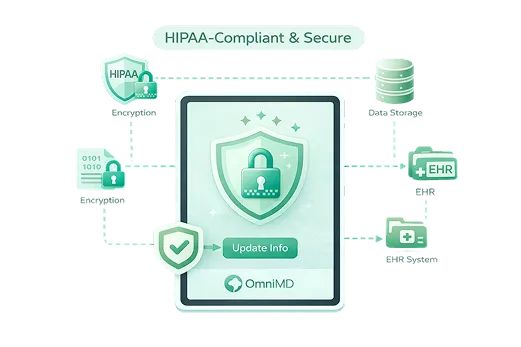
Is Your Practice Ready for 2026 HIPAA Changes?
Prepare for OCR audits, MFA mandates & new compliance rules before deadlines hit.
EHR selection is a compliance decision as much as a clinical one. ONC certification, HIPAA technical safeguards, audit logging, and access controls are built into the EHR platform, not layered on separately. The OmniMD EHR system is ONC-certified with built-in compliance reporting, role-based access controls, and audit trail documentation designed for practices preparing for OCR reviews and payer audits.

Dr. Giriraj Tosh Purohit is an experienced Product Manager and Security officer with a strong background in healthcare technology and management consulting. With expertise spanning clinical workflows, EHR, RCM, Digital Health, and AI-driven products, he has been instrumental in shaping innovative healthcare solutions.