
The Best Alternative to DrChrono (And Why So Many Practices Are Secretly Making the Switch)
It’s 4:52pm on a Friday. A claim just bounced back for the third time this week. Same error as always. You already know how this goes: reload, redo, resend, hope. Somewhere in a support queue there’s a ticket you opened eleven days ago that still says “under review.” You’re not thinking about EHR features right now. You’re thinking about whether it has always been this hard, or whether it just feels that way because you’ve done this same dance for years and never had a reason to look up.
That’s usually how people end up searching for a DrChrono alternative. Not because a demo looked shiny, but because something small broke one too many times.
So let’s not pretend DrChrono is some villain. It’s not. It has real history and it did something genuinely important for this industry. But there’s a second half to this story. If you’re the kind of practice owner who reads the fine print and pays attention to what real users say, not just what the sales deck says, you deserve the full picture. That’s what this page is for.
Who is DrChrono, really
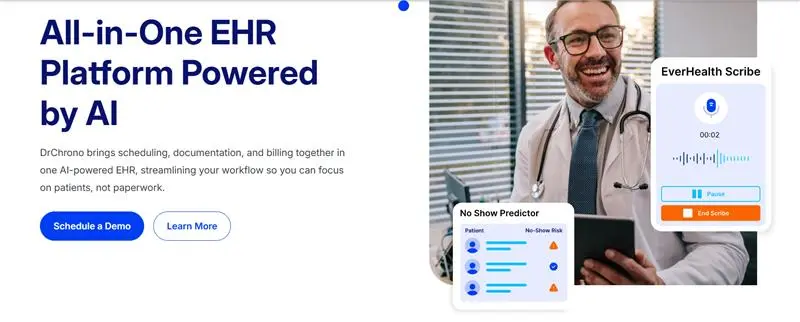
DrChrono was founded in 2009 in New York City by Michael Nusimow and Daniel Kivatinos. The two of them went through the Rose Tech Ventures incubator before heading to Silicon Valley and joining Y Combinator. In 2011, DrChrono built the very first iPad EHR and got Meaningful Use certification that same year. That’s a real milestone. Before DrChrono, charting on an iPad in the exam room wasn’t a normal thing doctors did. DrChrono helped make it normal.
Over the years the company kept adding to the platform:
- E-prescribing, including for controlled substances
- Lab and imaging integrations
- A patient portal called OnPatient
- Telehealth
- AI note-taking tools, added more recently
In November 2021, EverCommerce (a public company on Nasdaq, ticker EVCM) bought DrChrono for about $182.5 million. It now sits inside EverCommerce’s EverHealth group along with brands like Updox and CollaborateMD. At the time of the deal, DrChrono served roughly 4,600 independent practices and 13,000 providers.
That’s a real company with a real product. Nothing about that is in question.
Who is OmniMD, and why you’ve probably heard of it less
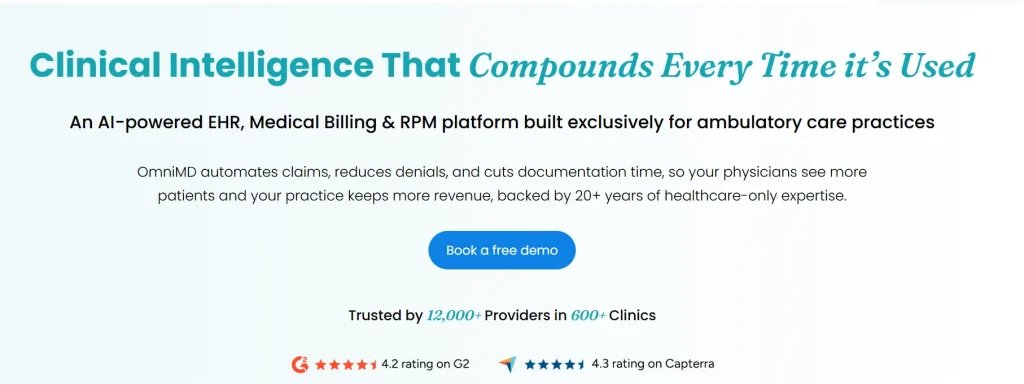
OmniMD has been around longer than DrChrono, since 2002, started by Divan Dave in Hawthorne, New York. Dave came to the US from India in 1984, earned graduate degrees in chemistry and computer science, and worked in leadership at Thomson Financial Group before starting OmniMD. So while DrChrono was still years away from existing, OmniMD was already building EHR and billing tools for practices, first as the healthcare arm of Integrated Systems Management.
OmniMD never chased headlines the way some competitors did. It grew firmly, picked up ONC certification and Meaningful Use compliance in the early 2010s, and in recent years has gone deep on AI:
- An ambient AI Medical Scribe that writes SOAP notes in real time
- An AI Front Desk that handles scheduling and insurance checks
- An AI Medical Coder and AI Medical Biller, built to catch billing mistakes before a claim even goes out
Today it serves more than 12,000 medical professionals across 20-plus specialties. It’s also privately held, so it answers to its customers, not to shareholders.
Two companies, two different paths, both still around in 2026. Now let’s talk about what happens once you’ve used each one for a few years.
What DrChrono users are saying in 2026
I want to be careful here. It would be easy to just grab the worst reviews and call it a day, but that’s not fair to DrChrono and it’s not useful to you either. So instead, let’s look at the pattern across a few different places: Capterra, G2, Trustpilot, and industry sites like EHR Source. A pattern showing up across many places tells you something a single angry review doesn’t.
#1. The acquisition changed the support experience
This isn’t just one upset customer talking. EHR Source’s 2026 review says it plainly: reviews on G2 and Capterra since the acquisition keep pointing to longer hold times, slower ticket resolution, and support staff who know less than they used to. EHR Source calls this a common pattern after this kind of acquisition, and it matches what practice owners are writing on their own.
On G2, one reviewer summed it up bluntly: “Look elsewhere. Support is not helpful.” They described support tickets that either went unanswered or came back saying “we can’t reproduce your issue.”
#2. Claims and billing problems keep coming up
On Capterra, a doctor who had used DrChrono for ten years said claims kept throwing save errors no matter which of four different computers they tried, and the same claim had to be redone over and over before it went through.
Another longtime user wrote that “it is not the same company we started with,” describing a two-month claims backlog after DrChrono switched to an in-house clearinghouse.
On Trustpilot, one practice said DrChrono’s system charged them the full annual plan cost every single month instead of once a year, and it took multiple calls and support tickets to get it fixed.
#3. Contracts lock you in more than you’d think.
DrChrono runs on annual contracts by default, and month-to-month usually isn’t an option. Several Capterra reviewers mention prices going up every year for existing customers.
Getting your data out if you want to leave can be its own fight. One reviewer said DrChrono refused to export their patient records, and they were ready to report it as a HIPAA violation before access was finally restored.
#4. It’s built for Apple, which is great until it isn’t.
DrChrono earned its name as an iPad-first platform, and that’s fair. But it also means practices with mixed devices, or teams that lean toward Android, sometimes run into friction that Apple-only practices don’t.
None of this makes DrChrono a bad product. Plenty of small, mostly-Apple, mostly simple practices are happy with it, including longtime users who like that there was no big upfront software cost the way older EHR companies used to charge.
But if your practice has outgrown ‘simple,’ if you’re dealing with multi-provider scheduling, higher claim volume, or you’ve just had enough of the support slide people keep describing, it’s fair to look at what else is out there.
Where OmniMD tends to win the comparison
I could throw a feature table at you here and call it a day, but I won’t. Feature tables make every EHR look the same on paper, and you already know from DrChrono’s own marketing that paper and real life don’t always match. Instead, here’s what actually sets the two apart once you’ve used them for a year or two.
#1. Support that still feels like support.
On Capterra, one practice manager with over 20 years in healthcare admin called OmniMD the best software she had used in her whole career, and named the support staff who helped her learn billing and Meaningful Use.
Another user, who works in the diagnostic lab space, asked OmniMD’s team to build a custom two-way lab interface and said the team beat every expectation, calling it the best client training he’d seen in twenty years in the field.
On G2, one user summed it up as “very supportive support. quick solution for any issue in the software.” That’s not luck. OmniMD is privately held and still small enough that account teams know their clients by name, which is exactly the kind of relationship a lot of DrChrono users say they lost after the EverCommerce deal.
#2. Billing that actually gets fixed, not just processed.
One OmniMD user ran two billing audits and found they’d been losing $70,000 to $100,000 a year to errors under their old system. After switching, they said they got back on top of their finances and started paying down the debt that had built up.
OmniMD’s AI Medical Coder and AI Medical Biller tools, launched in 2026, are built to catch exactly this kind of missed code or denial pattern before a claim goes out the door, not after it bounces back.
#3. No forced iPad-only setup.
Because OmniMD wasn’t built as an Apple-only product from day one, practices with a mix of devices (Android tablets, PCs at the front desk, iPads in the exam room) don’t have to work around it. It just runs on what you already have.
#4. Two decades of specialty depth.
OmniMD supports more than 20 specialties with built-in templates, from cardiology to psychiatry to pediatrics, something it’s had time to refine since 2002. That depth matters most once your practice outgrows the ‘one template fits everyone’ stage.
#5. Pricing that starts lower and stays predictable.
OmniMD’s EHR Essentials plan starts at $299 per provider per month, and includes an ONC-certified EHR, scheduling, e-prescribing, and a patient portal. It’s not free, nothing good in this business is, but it gives smaller practices a real starting point without the multi-year contract shock some DrChrono reviewers describe.
To be fair, OmniMD isn’t perfect either. Some reviewers say moving between different dashboards, documents, and reports takes a few extra steps, and a few mention a short learning curve during onboarding, which is normal for any system with this much customization.
No software fits every practice perfectly, and anyone telling you otherwise is selling you something instead of helping you.
How to actually decide (skip the checkbox comparison)
Instead of a table where every row says ‘yes’ for both companies and tells you nothing, ask yourself these four questions honestly.
#1. Are you happy with your support today, or are you already dreading the next time something breaks?
If you’re one of the many DrChrono users who’s felt the support slide since the acquisition, that alone is worth taking seriously. Software you can’t get help with when it breaks isn’t really saving you time. It’s just moving the time somewhere else.
#2. Is your team stuck on Apple hardware, or does it need to work on whatever devices you already own?
If your whole practice already runs iPads and you’re happy with that, DrChrono’s iOS setup is a real strength, and you should give it credit for that. If you have a mixed setup, or you’re tired of buying specific hardware just to match your software, that changes things.
#3. Are claim denials and billing mistakes costing you real money right now?
If you’ve had a year like the practice above, where an audit found tens of thousands of dollars quietly leaking out, that’s not a small annoyance. That’s worth switching software over, and it’s exactly what OmniMD’s newer AI billing tools are built to catch before it happens again.
#4. Do you want a company that answers to shareholders, or one that still answers your calls personally?
This isn’t a knock on public companies in general. It’s just worth knowing which kind of company you’re signing a multi-year contract with, since that shapes how fast things change and who you’re really talking to when something breaks.
If your answers add up to “I need better support, my hardware isn’t all Apple, and billing mistakes are actually hurting my bottom line,” OmniMD is worth a real look. Not because DrChrono is broken, but because you’ve outgrown the version of your practice DrChrono was built for.
Frequently asked questions
#1. Is DrChrono a bad EHR?
No. It pioneered iPad charting and still holds a 3.9 out of 5 on Capterra and a 3.4 on G2, which puts it right in the middle for this industry. It works well for small, Apple-based practices with simple billing needs. The complaints that come up most are about support since the 2021 EverCommerce deal, contract terms, and how claims get processed.
#2. Why did DrChrono’s support get worse after the acquisition?
EHR Source’s 2026 review says this is a common pattern across the industry after this kind of acquisition, not something unique to DrChrono. Reviewers on G2 and Capterra describe longer hold times and less experienced support staff since EverCommerce took over in November 2021.
#3. Is OmniMD cheaper than DrChrono?
OmniMD’s entry-level plan starts at $299 per provider per month. DrChrono doesn’t publish exact prices, and real user reports describe contracts going over $1,500 a month for a three-provider practice once you add in extras and yearly increases. Always get a written, itemized quote from either company before comparing final numbers, since your specialty and provider count will change the total.
#4. Does OmniMD work on Android and Windows, not just Apple devices?
Yes. Unlike DrChrono, which was built for iPad first, OmniMD wasn’t built around one type of hardware, so practices with mixed devices don’t need to switch everything to Apple to use it.
#5. How long has OmniMD been around compared to DrChrono?
OmniMD was founded in 2002. DrChrono was founded in 2009. That’s seven extra years of healthcare IT experience before DrChrono even existed.
#6. What if I’m already locked into a DrChrono contract?
Reach out to OmniMD directly. Most healthcare IT companies, OmniMD included, have moved practices over from other EHR contracts before, and can help you time your switch around your current contract’s renewal date instead of breaking it early.

Is Your EHR Slowing Down Your Practice?
OmniMD combines AI documentation, smarter billing, and responsive support to simplify daily workflows and improve productivity.

Dr. Giriraj Tosh Purohit is an experienced Product Manager and Security officer with a strong background in healthcare technology and management consulting. With expertise spanning clinical workflows, EHR, RCM, Digital Health, and AI-driven products, he has been instrumental in shaping innovative healthcare solutions.