What Nobody Tells You Before You Renew With Greenway Health
Nobody searches for a Greenway Health alternative on a good day. Usually something just happened. The portal crashed during a busy morning. A biller spent forty minutes on hold. Someone noticed the contract auto-renewed for years you didn’t remember agreeing to.
Then you typed something into Google, half expecting to land on a generic ‘top 10 EHR’ listicle that tells you nothing you didn’t already know.
So let’s skip the corporate biography this time and start where you actually are.
The moment that usually triggered the ‘Greenway Health Alternative’ search
Three things show up over and over in reviews from the past year or so, and they tend to be the exact moments that send someone looking for a way out.
#1. The system going down at the worst possible time.
On Capterra’s Intergy reviews page, a reviewer who otherwise likes the software wrote on March 13, 2026: “I do experience system sudden shutdown while carrying out billing.” Same page, a different reviewer posted two weeks later, on March 27, 2026, flagging ongoing issues with chart merging and pulling up scanned documents.
#2. The contract that quietly grows teeth.
A BBB complaint against Greenway Health, filed January 27, 2025, describes a practice whose contract auto-renewed for five years without a clear heads-up. The rate jumped: “they changed the monthly rate from $1,650/month to $2,600/month,” and the practice was quoted a $100,000 buyout to exit. If you’re trying to get Greenway to send you renewal terms before a deadline, this is a documented pattern, not a one-off.
#3. Small friction that adds up.
Back on Capterra, an April 7, 2025 reviewer described a decent overall experience but singled out the check-in and check-out schedule view as a recurring annoyance, echoing a February 28, 2025 review from another user who noted there’s no way to see which patients are checked in that’s visible to the whole front desk.
If those frustrations sound familiar, you are not alone, and there are options built to avoid exactly these issues. OmniMD focuses on smoother daily flows, faster AI documentation, and clearer support experiences that many recent users say help them move through the day with less friction. Practices that switched often mention quick wins in documentation time and billing efficiency without the same level of repeated workarounds.
What actually changes when practices move to something like OmniMD
Instead of a feature list, here’s what the switch tends to look like in practice, based on what people who made it actually wrote afterward.
One OmniMD user on Capterra had spent nine years managing billing in-house before finally handing it over. Two audits later, they discovered they’d been losing seventy to a hundred thousand dollars a year without knowing it. That’s not a marketing stat, that’s someone’s actual practice.
Another recurring theme is what happens to documentation time when everything, EHR, billing, scheduling, sits in one database instead of stitched-together modules. One reviewer on G2 put it simply: it “saves half of our time documenting and charting.”
And a diagnostic lab partner who works across multiple client practices, so they’ve seen a lot of onboarding processes, called OmniMD’s implementation team the best client training they’d seen in twenty years in that space. That’s a specific, comparative claim from someone with a wide sample size to judge against.
How your staff feels after a switch
Doctors and front desk staff are the ones who feel a clunky system the most. Slow charting and confusing screens wear people down, and a review of the research shows this really does drive people to quit.
Teams that move to a simpler, AI-friendly system often say they feel less drained. New hires learn faster too, and fewer people quit because they’re sick of fighting the software. For whoever’s running the practice, that means a steadier team and less money spent hiring and training all over again. You won’t see this in a sales brochure, but it’s the first thing people bring up once they’ve actually switched.
Staying safe and compliant
Cyber threats keep growing, and the rules keep changing (HIPAA updates, interoperability rules, value-based reporting). So it matters more than ever that your system is reliable. Greenway’s been around a long time and bundles in a lot of compliance tools, which works well for bigger, more complex practices.
OmniMD, on the other hand, leans on newer cloud technology, with everything running through one connected system instead of scattered pieces. For a practice that worries about breaches or fines, that track record is worth something.
Three questions to ask yourself before making a final switch
#1. Is what’s bugging you the software itself, or the contract?
These need different fixes. A clunky screen might get better with Novare’s new AI tools. A bad contract won’t fix itself no matter what software you pick, so get your renewal and exit terms in writing no matter what you decide. And don’t forget to count the hidden costs too, like training time and downtime.
#2. Are your billing losses about a broken process, or not enough staff?
One practice that recovered six figures a year didn’t just switch software. They also brought in a managed billing service. That’s a bigger decision than just picking new software, especially if you deal with tricky payers or a lot of denied claims.
#3. Can you actually test the system at your busiest hour before signing anything?
Whatever vendor you’re looking at, ask to run through your busiest hour, not some quiet demo scenario. Also ask how well it’ll grow with you, how deep it connects with your lab or pharmacy partners, and how good the AI really is if cutting down on paperwork is your main goal.
Where Greenway still makes sense
This isn’t a one-sided story. It really depends on your practice’s size, specialty, and priorities. Greenway does well for bigger, more complex setups.
If you run an FQHC, IPA, ACO, or multiple locations, Greenway gives you everything bundled together: telehealth, remote monitoring, chronic care management, patient portal, all under one contract. Some practices like that better than juggling separate vendors. Greenway’s Novare platform just won “Most Improved Physician Practice Solution 2026” from KLAS, which shows real year-over-year progress. And people who’ve stuck with Greenway a long time tend to praise how customizable it is and how solid the support feels once you’re settled in.
So if your real complaint is just the interface, not the contract or lost billing, and you’re not in a rush for AI tools or want to avoid any migration risk, sticking with Greenway and pushing them to fix specific issues might be the safer move, especially for bigger organizations already deep into their setup.
Smaller or specialty practices tend to care more about flexibility and clear pricing, though, so the calculation looks different for them.
About OmniMD
OmniMD’s been building EHR and practice management software for a long time, and it works across 20+ specialties. It brings clinical, financial, and day-to-day tools together in one place, including AI-powered documentation and an option for full-service billing. It’s built for practices of different sizes that want things to run smoothly without the baggage that comes with older systems. People who’ve made the switch tend to give it high marks for being easy to use and for having support that actually responds.
FAQ
Is switching EHRs mid-year risky?
It takes some planning either way. Most vendors run the old and new systems side by side while your data moves over, and they’ll train your staff too. Still, expect a few weeks of bumps no matter what. How smooth it goes really comes down to how clean your data is and whether your team’s on board.
Should I just wait and see how Novare turns out?
That’s a fair call, especially with the 2026 KLAS win behind it. If your main gripe is the old interface, not the contract or lost billing, ask for a Novare-specific demo before deciding anything. Early feedback on the AI is good, but you still want to see how it holds up at your actual volume.
Does OmniMD do billing too, or just the software?
Yes, both. Users say the combined billing service cuts down on in-house work and gets claims out faster.
What should I check before signing any new EHR contract?
Get the auto-renewal clause, how much notice you need to give to leave, how much rates can go up, your rights to your own data, and support guarantees, all in writing. Ask about peak-load performance too. This goes for any vendor, not just Greenway. And try to negotiate some training credits and implementation support while you’re at it.
Is a smaller vendor like OmniMD too risky for a growing practice?
OmniMD isn’t actually that small. It’s an established platform that’s proven it can scale. A lot of users say it holds up well as they grow, with strong satisfaction scores and support that keeps pace, without needing to hire a ton of extra staff. Best bet is to weigh it against your own volume and specialty needs, and see how it does in a trial.
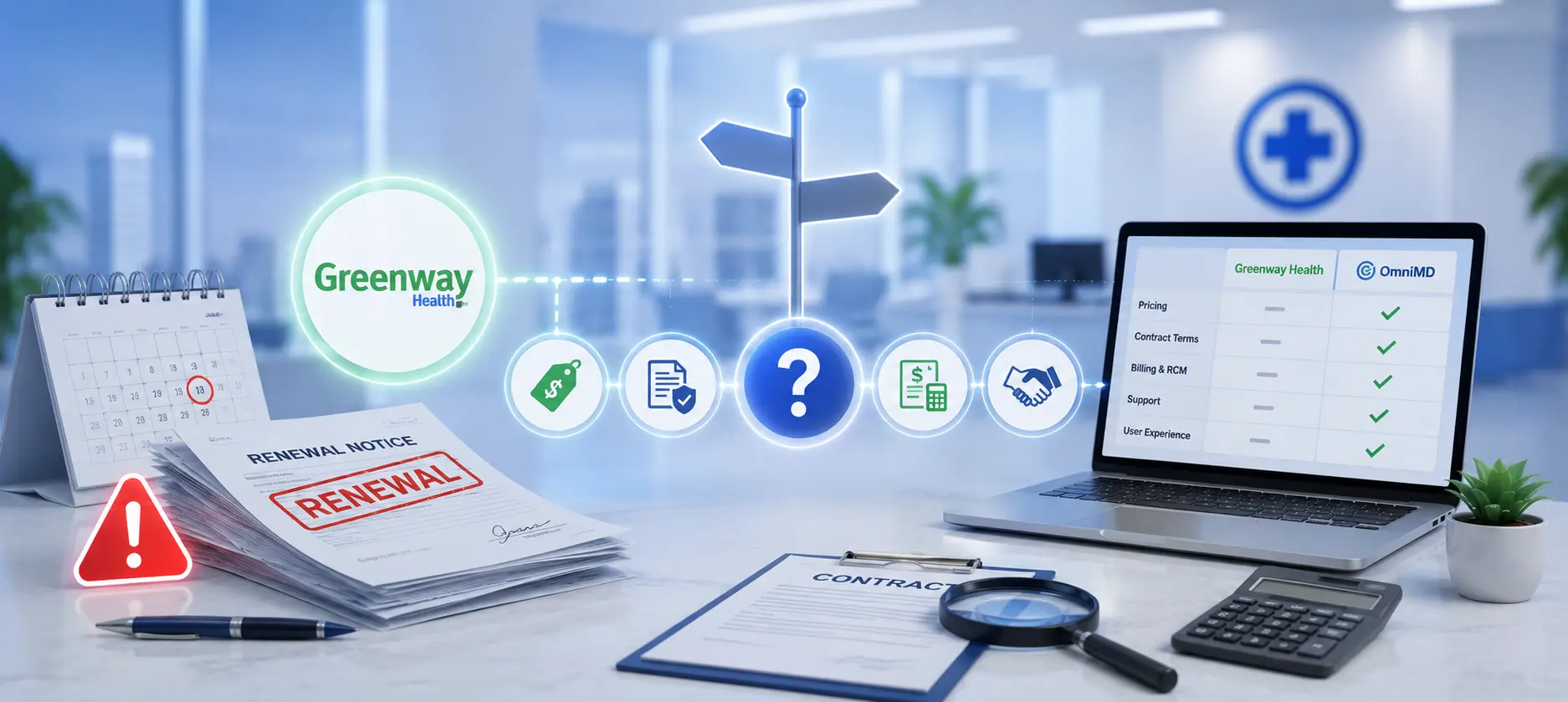
Worried About Renewing Your Greenway Health Contract?
Compare OmniMD’s transparent pricing, flexible contracts, and integrated billing before making your next decision.

Dr. Giriraj Tosh Purohit is an experienced Product Manager and Security officer with a strong background in healthcare technology and management consulting. With expertise spanning clinical workflows, EHR, RCM, Digital Health, and AI-driven products, he has been instrumental in shaping innovative healthcare solutions.