
Top 10 Medical Coding Automation Tools for US Healthcare Providers in 2026
The Key Takeaway
| Tool | Best Fit | Key Strength | Watch Out For |
| 1. CodaMetrix | Large health systems, academic hospitals | #1 in 2026 Best in KLAS; works with 500+ hospitals | Priced for enterprise, not small practices |
| 2. Fathom Health | Physician groups needing broad specialty coverage | 93%+ straight-to-bill rate; HITRUST i1 certified | Newer brand; full rollout can take 4-6 months |
| 3. OmniMD | Independent and small-to-mid practices | AI coding built into its own EHR and billing system | Self-reported numbers; no KLAS presence yet |
| 4. Nym Health | Orgs where audit trails matter most | Every code comes with a traceable reason; 100% customer satisfaction (KLAS) | Covers only 6 specialties so far |
| 5. RapidClaims | Orgs wanting coding + documentation + scrubbing in one bundle | Covers ICD-10, CPT, HCPCS, and HCC in one platform | Bundle strength varies by module, ask for numbers per piece |
| 6. CombineHealth AI (Amy) | Practices where documentation gaps drive denials | Flags gaps while coding, not after | Newer entrant, fewer large case studies |
| 7. Solventum 360 Encompass | Hospitals needing inpatient DRG accuracy | Decades of real hospital data behind its logic | Computer-assisted, not fully automatic |
| 8. Optum Encoder Pro / CAC | Orgs already in the UnitedHealth/Optum ecosystem | 20+ reference books, CCI checks built in | Assisted, not autonomous coding |
| 9. Transcure | Practices wanting to outsource billing entirely | 7 AI agents covering the full billing cycle | All numbers self-reported; no KLAS ranking |
| 10. blueBriX | Value-based care orgs, especially behavioral health | Governance layer validates any AI agent against payer contracts | Doesn’t build its own coding AI, uses a partner’s |
You have probably seen ten ‘best coding tools’ lists already, and most of them read like the vendors wrote them. Same names, same big claims, no honest word about where each tool falls short. That is not much help when you are the one who has to explain the purchase to a CFO, and then explain it to a coding team that is already worried about their jobs.
In this list, we try to do it differently. Every tool below comes with the type of organization it fits, plus something to watch out for, not just what the vendor says on its homepage. Nothing here is made up. When a number comes from a vendor’s own case study instead of an outside source, that is pointed out, because those two things are not the same kind of proof.
One thing to keep in mind before you read on: these tools are not all the same kind of thing. Some are built for big health systems running full automation across many specialties. Others are built for a small or mid-size practice that just wants a documentation gap caught before a claim goes out. Matching the tool to your own size and specialty mix matters more than picking the name you saw first.
1. CodaMetrix (CMX CARE)

CodaMetrix began as a tool built inside Mass General Brigham before it became its own company, and you can still see that hospital background in how it works. Its CMX CARE platform reads a patient’s whole record over time, not just one note, before it picks a code. That is what lets it catch things a simple keyword tool would miss.
Best fit: Big health systems and academic hospitals with many specialties, especially radiology, pathology, surgery, and E/M coding.
What stands out:
- Ranked number one in the 2026 Best in KLAS list for autonomous coding, working with more than 500 hospitals, including nine U.S. News & World Report Honor Roll hospitals
- Works directly with Epic and has Epic Toolbox status for full automation
- UMass Memorial Medical Center says its automation rate reached 86%, up 15 points since it went live, according to the hospital itself
- Mayo Clinic gave the platform its yearly VIBE award for the best technology project in the health system, which is a separate honor from any automation number
- Updates its code sets on a set schedule so it keeps up with CMS and AMA changes instead of falling behind
Watch out for: Reviewers on Gartner Peer Insights say the first EHR setup can take real IT work, and this platform is priced for big health systems, not small ones. If you have 15 providers, this is probably more than you need.
2. Fathom Health
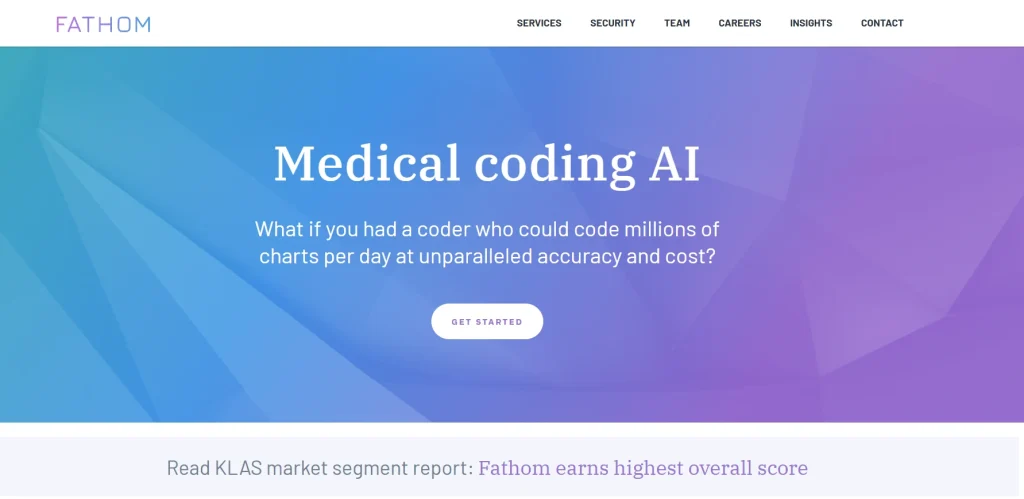
Fathom says it covers more specialties and care settings than any other autonomous coding company, from emergency medicine and radiology to primary care, surgery, hospital medicine, home care, and telehealth.
Best fit: Physician groups and health systems that need one tool to cover many different kinds of care, including primary care groups focused on risk adjustment.
What stands out:
- It codes and sends 93%+ of visits straight to billing with no human check, according to the company, with the rest going to a human coder as an exception
- A senior care group called Your Health says it hit a 95.5% automation rate and raised its risk scores by 0.66 in one year after going live, according to Fathom’s own announcement
- Holds HITRUST i1 certification, which matters if your compliance team asks for that specific standard
- Trained on more than 750 million patient visits across specialties, according to the company, which backs up its claim of wide coverage
Watch out for: Some industry writers point out that Fathom’s brand is newer than some older players, and a full rollout at a large organization has taken four to six months in past cases. If your leaders expect a two-week setup, tell them now that it will take longer.
3. OmniMD
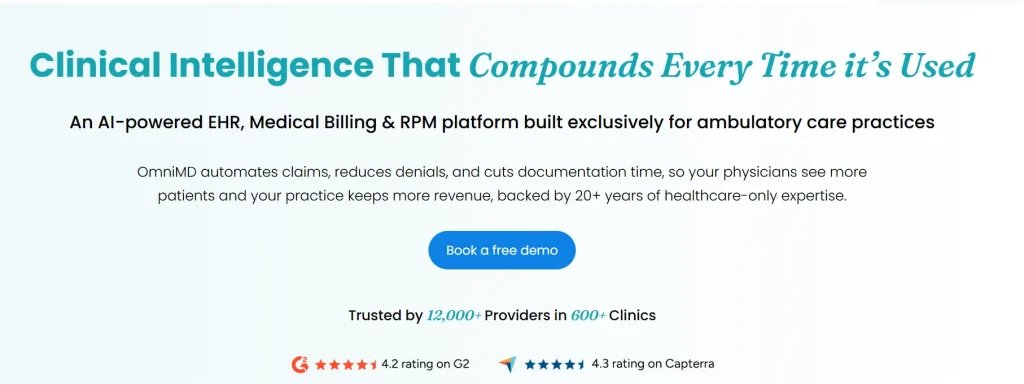
OmniMD does things differently from most tools on this list. Instead of being limited to AI coding inside its own EHR and billing stack, it also supports integration with third-party healthcare IT software and is built to work across a wide range of care settings, including enterprise and large hospital environments. If you want a platform that can fit into existing workflows instead of forcing you to rebuild everything around one system, that is the appeal here.
Best fit: Healthcare organizations of all sizes, from independent practices to large hospitals and enterprise groups, that want strong AI capabilities, broad interoperability, and the flexibility to integrate with third-party healthcare software while still keeping EHR, practice management, billing, and automation connected in one ecosystem.
What stands out:
- Reads doctor’s notes, operative reports, and discharge summaries on its own to pick ICD-10, CPT, and HCPCS codes, with no separate coding step needed
- Checks each claim for denial risks before it goes out, helping catch modifier mistakes and bundling errors early
- Runs coding inside the same EHR and billing system your practice already uses, so there is no extra login or extra screen slowing people down
- Built for practices that want AI coding inside a unified workflow instead of a separate standalone tool
- Supports a 97% first-pass claim acceptance rate with its AI coding tool
Watch out for: Its strongest value is likely for organizations that want coding connected to EHR, billing, and revenue cycle workflows in one ecosystem, rather than a narrowly focused coding-only tool. That makes it less of a pure point solution and more of a platform decision.
4. Nym Health
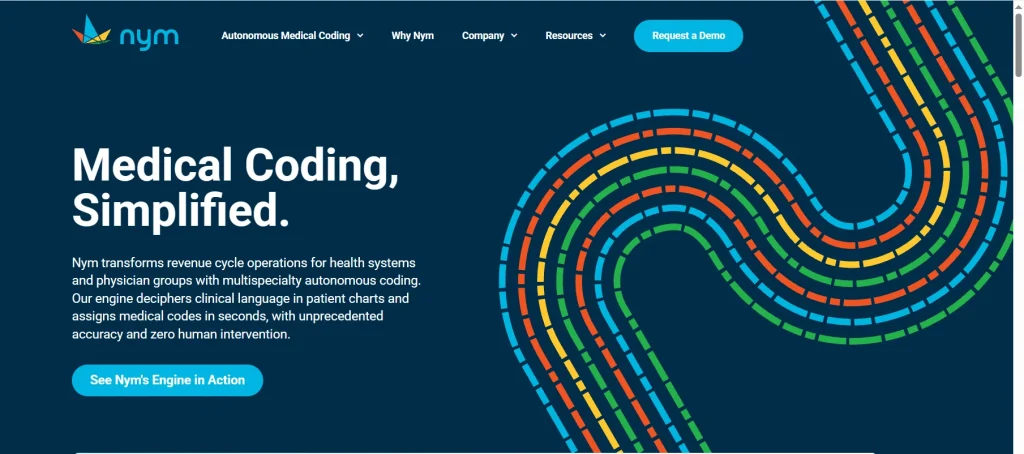
What sets Nym apart is not its automation rate. It is how well it explains itself. The company built its Clinical Language Understanding engine to give a full, traceable reason behind every code it picks, which speaks directly to the ‘black box’ worry that compliance officers bring up most.
Best fit: Organizations where trust and audit trails are the main thing holding them back, especially in emergency medicine, radiology, and urgent care, which are Nym’s strongest areas.
What stands out:
- Every code it picks comes with a written reason tied back to the exact part of the note that supports it
- Got a 100% customer satisfaction score in a KLAS spotlight report, meaning every customer they talked to said they would buy it again
- Inova health system cut its weekly backlog of unbilled discharges by 50% after putting Nym in its emergency departments
- Picks up new coding rules as soon as they come out, instead of waiting for a set update schedule
Watch out for: Nym covers fewer specialties than Fathom, OmniMD or CodaMetrix right now, sticking to six areas including emergency medicine, radiology, outpatient surgery, and urgent care. If you need strong coverage for inpatient surgery or a wide mix of specialties, check this first before you assume it fits.
5. RapidClaims
RapidClaims takes a bundle approach instead of selling one single tool. It packages four connected tools together: RapidCode for automatic coding, RapidAssist for catching documentation gaps in real time, RapidScrub for checking claims before they go out, and RapidCDI for improving documentation tied to risk scores.
Best fit: Organizations that want coding, documentation help, and claim checking all working together, instead of stitching together separate tools from separate vendors.
What stands out:
- Covers ICD-10-CM, ICD-10-PCS, CPT, HCPCS, and E/M levels across many specialties in one system
- Built-in HCC capture aimed at risk-based payment, which matters if your practice is in a Medicare Advantage or ACO deal
- Checks claims against CMS and HIPAA rules before they go out, instead of catching problems only after the fact
Watch out for: Since this is a bundle, judge each part on its own instead of assuming the whole thing works equally well. A tool that is strong on coding is not always just as strong on documentation help, so ask for numbers on each piece during a trial, not just one blended score.
6. CombineHealth AI (Amy)
CombineHealth built its tool, called Amy internally, to solve the same trust problem Nym focuses on, but with a strong focus on treating documentation and coding as one connected job instead of two separate tools bolted together.
Best fit: Practices and health systems where documentation gaps, not just wrong codes, are the main reason for denials, and where you want one tool handling both jobs.
What stands out:
- Flags documentation gaps at the same time it codes a chart, instead of coding first and pointing out gaps later
- Built around being explainable and rule-aware, rather than chasing the highest automation number at any cost
- The company itself tells buyers not to judge the tool only on automation rate and accuracy, which is a more honest starting point than most sales pitches
Watch out for: CombineHealth is newer than CodaMetrix, Fathom, or Nym, so ask directly for client references and real denial rate numbers instead of relying on their marketing. Less time in the market means fewer big case studies to point to.
7. Solventum 360 Encompass (formerly 3M)
This is the old-school pick on the list, and that is not a knock against it. Solventum’s 360 Encompass system, built on decades of 3M’s coding and documentation work, is still used widely across US hospitals, especially for getting inpatient DRG payments right.
Best fit: Hospitals already running 3M or Solventum tools, or organizations that need strong inpatient DRG and complication capture more than they need outpatient automation.
What stands out:
- Puts coding help, documentation checks, and audit tools together in one system
- Flags preventable readmissions, complications, and safety issues before a claim goes out, which is a real strength for inpatient work
- Comes as either an on-site system or a cloud system, which matters if your hospital has its own setup already
- Decades of real hospital use mean the coding logic has been tested against a huge amount of real data
Watch out for: This is a computer-assisted coding tool, not a fully automatic one. A human still checks every code. If your goal is cutting coder hours through full automation, this is a different kind of tool than OmniMD, CodaMetrix, Fathom, or Nym, so do not compare automation numbers across them directly.
8. Optum Encoder Pro and Optum CAC
Optum, part of UnitedHealth Group, sells a classic code lookup tool (Encoder Pro) plus a computer-assisted coding layer for bigger organizations. It is one of the oldest, most established names in this space, unlike the newer startups on this list.
Best fit: Organizations that want a proven, widely used encoder and coding tool with a stable, well-known company behind it, especially if you already use other Optum or UnitedHealth tools.
What stands out:
- Long history and wide use across hospitals and outpatient billing teams
- Encoder Pro packs in content from more than 20 code and reference books, lets you cross-check CPT against ICD codes, and checks your codes against CCI edits before a claim goes out
- Backed by a large, stable parent company, which matters if you care about long-term vendor risk
Watch out for: Like Solventum, this sits closer to the assisted end of the scale, not the fully automatic end. If you already work with UnitedHealth or Optum, ask how this fits with your other tools instead of treating it as its own separate choice.
9. Transcure
Transcure is a different kind of company than the rest of this list. It is not software you buy and run yourself. It is a full outsourced medical billing and RCM company. It serves more than 40 specialties, and it built its own set of AI tools to run its own billing work. Coding is just one part of what it offers, not the whole product.
Best fit: Practices that want to hand off billing entirely to an outside company, and want that company to run on AI-backed tools, rather than practices that want to buy and run their own coding software.
What stands out:
- Built seven named AI tools that cover different parts of billing: ELIXA checks insurance eligibility, PRIA handles prior authorization, CODIN handles coding and compliance, CLAIR checks and cleans up claims, DEXA works on denials, ARIA follows up on unpaid claims, and REMITA handles payment posting
- CODIN, the coding tool, reads clinical notes and checks claims against NCCI and MUE rules before they go out, according to the company
- The company says it hits a 99.99% claim accuracy rate and cuts manual billing work by up to 70% once a practice fully uses all its tools
- HIPAA-compliant, and connects to most EHR and payer systems through standard data links, according to the company
Watch out for: Every number here, the accuracy rate, the effort cut, the denial recovery rate, the revenue growth, is the company’s own marketing claim, not a number checked by an outside group. Transcure also does not show up yet in KLAS or similar outside rankings the way CodaMetrix, Fathom, or Nym do. Since coding (CODIN) is just one of seven bundled tools, look at that piece on its own rather than assuming the whole package performs the same way, and check that your specialty is one of the 40-plus Transcure already handles.
10. blueBriX
blueBriX belongs in a different bucket than every other tool on this list. It is not a coding engine itself. It is an EHR and care management platform built for value-based care. It has a ‘governance layer’ that lets a practice plug in AI agents, its own or someone else’s, and check every AI suggestion against the exact rules in a payer contract before anything goes out.
Best fit: Organizations already using, or considering, blueBriX for value-based care management, especially in behavioral health, who want HCC coding and risk adjustment checked against payer contract terms as part of a bigger governance system, rather than organizations shopping for a standalone coding tool.
What stands out:
- Runs HCC coding suggestions through what it calls a Trust Engine. It checks every code against your payer’s HCC model and contract rules before it goes out, and keeps a full audit trail, according to the company
- Lets you plug in a coding AI from another company through an open system it calls Bring Your Own Agent. You are not locked into one company’s model, and you can swap the AI later without rebuilding your setup, according to the company
- Also offers plain, human-staffed coding services, covering ICD-10-CM, ICD-10-PCS, CPT, HCPCS, and HCC coding with coding audits, as part of a wider RCM service
- The company says a first HCC coding or prior authorization workflow can go live within 4 to 8 weeks of signing a contract
Watch out for: blueBriX promotes AI-powered HCC coding, but its public materials do not clearly disclose whether the underlying coding engine is built entirely in-house or powered by a third-party partner. Before accepting performance claims, ask who provides the core coding technology, whether any external AI vendors are involved, and which outcomes are attributable to blueBriX versus its technology partners. Evaluate the coding engine’s validation, accuracy, and customer results on their own merits, rather than relying solely on the platform’s overall marketing.
Specialty-Focused Point Solutions
Beyond the tools above, more and more companies focus on just one specialty instead of trying to cover a whole hospital. If most of your coding volume sits in one or two specialties, like radiology, anesthesia, or emergency medicine, a tool built just for that specialty can sometimes beat a general tool, simply because it has less ground to cover and can dig deeper into the tricky parts of that one kind of documentation. Two names worth reaching out to if this fits you:
- Maverick Medical AI: Built just for radiology and imaging groups. Its mCoder tool runs across RadNet, the biggest outpatient imaging company in the US, which has run more than 10 million reports through the tool. The company says its customers see direct-to-bill rates as high as 93%, though that number is self-reported and depends on how good each client’s documentation is.
- Aidéo Technologies: Built special coding logic just for anesthesia, including handling for overlapping cases and specific modifiers, on top of covering radiology, surgery centers, and emergency medicine. Its Gemini platform is built to help coders first and automate fully second, which is a different approach from the fully automatic tools higher up on this list, and may work well for organizations that want AI help without giving up the human review step.
Best fit: Single-specialty practices or hospital departments, like a large radiology group, an anesthesia staffing company, or an ED physician group, where your coding volume does not justify a big multi-specialty contract.
How to Narrow This List Down
With 10 names in front of you, it is tempting to just pick whichever one has the biggest KLAS ranking or the flashiest case study number. Do not. The right filter is your own organization, not the vendor’s marketing.
- Start with your specialty mix, not the vendor’s brand.
A tool built mainly for radiology and pathology will behave differently on your orthopedic or behavioral health charts, no matter how good its overall numbers look.
- Split fully automatic tools from computer-assisted ones before you compare them.
OmniMD, CodaMetrix, Fathom, and Nym sit on the fully automatic end. Solventum and Optum sit closer to the assisted end. Comparing their automation numbers directly is like comparing two different kinds of tools.
- Split software you run yourself from a service you outsource to.
Transcure is a billing service with AI built in, not a coding tool you install. That is a business choice as much as it is a technology choice.
- If a coding tool is really a wrapper around someone else’s AI, ask who builds the intelligence behind it.
blueBriX is upfront about this: its HCC coding today runs through a partner’s AI, not its own. That is not a flaw, but it changes what you are buying, and who you should ask for accuracy numbers.
- If you run any value-based or Medicare Advantage contracts, put real weight on risk adjustment.
Fathom and RapidClaims both have real, documented strength here. A tool that is great at fee-for-service coding but weak on long-term risk capture will cost you money every year, with no single denial ever pointing it out.
- If your compliance team has raised the black box worry before, look hardest at Nym or CombineHealth.
Since being able to explain and trace every code is the main thing both of them are built around.
- If you run a smaller practice, ask yourself honestly if you even need a big enterprise tool.
Several tools on this list are built and priced for large health systems. A tool built for one specialty, an all-in-one system like OmniMD, an outsourced service like Transcure, or a well-set-up computer-assisted tool might get you most of the benefit for a lot less money and a lot less setup time. Do not pick any of these off a list, including this one. Test every vendor against a sample of your own charts, across your own specialty mix, including your messiest documentation, before you sign anything. The tool that looks best in a vendor’s demo is not always the tool that works best on the charts your coders see every day.
Still Losing Revenue to Coding Errors & Claim Denials?
Automate medical coding with OmniMD to reduce denials, improve coding accuracy, and accelerate reimbursements.

Dr. Giriraj Tosh Purohit is an experienced Product Manager and Security officer with a strong background in healthcare technology and management consulting. With expertise spanning clinical workflows, EHR, RCM, Digital Health, and AI-driven products, he has been instrumental in shaping innovative healthcare solutions.