

Top-Rated Healthcare Practice Management Software Compared by Real Use Cases
Last verified: October 8, 2026, against vendor pricing pages, Capterra profiles, and primary industry studies.
| SimplePractice | TheraNest | Tebra | Practice Fusion | AdvancedMD | eClinicalWorks | OmniMD | |
|---|---|---|---|---|---|---|---|
| Overview | |||||||
| Founded | 2012Santa Monica, CA | 2013Birmingham, AL | 2004 (Kareo)Irvine, CA | 2005San Francisco, CA | 1999South Jordan, UT | 1999Westborough, MA | 2002 |
| Ownership | Vista Equity PartnersTaken private 2024 | KKR-backedEnsora Health | IndependentPost-merger | Veradigm / AllscriptsAcquired 2018 | Francisco PartnersPrivate equity (2024) | Privately held | Privately held |
| User base | 250,000+ practitioners | Not disclosed | Large U.S. ambulatory base | Small / entry-level practices | Mid-to-large practices | 180,000+ physicians/NPs | ~12,000+ providers |
| Primary focus | Behavioral health | Behavioral / mental health | General ambulatory | Primary care | Multi-specialty | Large ambulatory | Multi-specialty |
| Pricing | |||||||
| Starting price | $49/moStarter plan | $29/therapist/moEssentials plan | $49–$799/provider/moCustom quote range | $199/provider/moAnnual commitment | $429/provider/moPM + billing bundle | $499–$599/provider/moConfig-dependent | Custom quoteContact vendor |
| Full EHR + PM bundle | $99/moPlus plan | ~$89/therapist/moPremier | Bundled / modular pricing | EHR + Billing ServicesVeradigm billing package | $729+/provider/mo | $499–599EHR only or EHR + PM | Configuration-based |
| Pricing model | Tiered flat | Tiered + per-claim | Modular custom quote | Per provider / annual | Modular + encounter option | Modular + % collections | Custom quote |
| Per-claim fees | $0.33–$0.39/claim (tiered) | Free–$0.23/claim (tier-dependent) | Varies by config | Billing services availablePricing on request | $0.87–$1.74 PM-only; $1.08–$2.17 PM+EHR | 2.9% of collections (flat)RCM option | Varies by contract |
| Implementation cost | Minimal / self-serve | Low | Moderate | Low | $1,000–$3,000+/provider | No start-up costs advertised | Varies by scope |
| Notable add-on costs | AI notes $35/mo; e-Rx $49/mo + $89 setup; CPT $20/yr | Telehealth $12/mo; Wiley $25/mo; CPT $19.50/yr (unlimited admin users free) | Module-dependent | 3rd-party billing required | Training, migration, modules | Telehealth, messaging, compliance modules | Varies by scope |
| Pricing transparency | High — published | High — published | Low — quote only | High — published | Medium — ranges available | Medium — ranges available | Low — quote only |
| Free trial | ✓ 30-day free trial | ✓ 21-day (no CC required) | ✗ Demo only | ✗ Demo only | ✗ Demo only | ✗ Demo only | ✗ Demo only |
| Specialty & clinical fit | |||||||
| Specialty support | Therapy, counseling, dietetics, wellness | Mental health, psychiatry | General medical, primary care, multi-specialty | Primary care (limited customization) | Multi-specialty; configurable templates | Multi-specialty; large ambulatory | 20+ specialties incl. cardiology, pediatrics, psychiatry |
| Specialty-specific templates | BH optimized | BH / DSM-5 | General / configurable | Basic primary care | Broad specialty library | Broad specialty library | 20+ specialty templates |
| Group therapy support | ● Plus plan only | ✓ All tiers | ✗ | ✗ | ✗ | ✗ | ● Via psychiatry templates |
| DSM-5 workflows | ✓ | ✓ | ✗ | ✗ | ✗ | ✗ | ✗ |
| Wiley Treatment Planning | ● Essential+ tiers | ● Premier or $25/mo add-on | ✗ | ✗ | ✗ | ✗ | ✗ |
| Population health tools | ✗ | ✗ | ● Limited | ✗ | ● Limited | ✓ Robust | ● Reporting-level |
| System architecture & EHR integration | |||||||
| EHR included | ✓ Native | ✓ Native | ✓ Native | ✓ Native (EHR-only) | ✓ Native | ✓ Native | ✓ Native |
| Integrated PMS + EHR | Single platform | Single platform | Single platform | EHR only — billing external | Single platform | Single platform | Single-database |
| Database architecture | Unified | Unified | Unified (modular) | EHR only — no billing DB | Unified (modular) | Unified (modular) | Single-databaseClinical + billing unified |
| ONC certification | ✓ | ✓ | ✓ | ✓ | ✓ | ✓ | ✓ |
| HIPAA / BAA | ✓ | ✓ | ✓ | ✓ | ✓ | ✓ | ✓ |
| Core PMS features | |||||||
| Appointment scheduling | ✓ | ✓ | ✓ | ✓ | ✓ | ✓ | ✓ |
| Automated patient reminders | ● Essential+ only | ✓ | ✓ | ✓ | ✓ | ✓ | ✓ |
| Insurance eligibility verification | ● Plus plan only (auto) | ✓ | ● Via integrations | ✓ | ✓ | ✓ | ✓ |
| Electronic claims submission | ● $10–35/mo incl.; $0.25 after | ● Advanced+ tier; per-claim fee | ✓ | ✗ External only | ✓ | ✓ | ✓ |
| Denial management | ● Basic | ● Moderate | ✗ | ✗ | ✓ | ✓ | ✓ |
| Patient billing & payments | ✓ | ✓ | ● Via 3rd party | ✓ | ✓ | ✓ | ✓ |
| A/R aging & financial reporting | ● Basic | ● Moderate | ✓ | ✓ | ✓ 150+ reports | ✓ | ✓ |
| Integrated RCM services | ✗ | ✗ | ✓ Outsourced option | ✗ | ✓ | ✓ | ✓ In-house or outsourced |
| Telehealth & digital tools | |||||||
| Telehealth included | ✓ All tiers | ● Advanced+ or $12/mo add-on | ✓ | ● Via 3rd-party integration | ✓ | ● May be add-on | ✓ |
| e-Prescribing | ● $49/mo + $89 setup | ✓ | ✓ Native | ✓ | ✓ | ✓ | ✓ |
| Patient portal | ✓ | ✓ | ✓ | ✓ | ✓ | ✓ | ✓ |
| Mobile app | ✓ Widely used | ✓ | ● Limited | ✓ | ✓ | ✓ | ● Less extensive |
| AI documentation tools | ● AI Note Taker $35/mo | ● AI Session Assistant (Premier) | ● Some AI features | ✗ | ● Limited | ● Limited | ● Automation tools |
| Patient acquisition / marketing | ✗ | ✗ | ✓ PatientPop heritage | ✗ | ✗ | ✗ | ✓ |
| Calendar sync | ● Essential+ only | ✓ | ● Basic | ✓ | ✓ | ✓ | ✓ |
| Usability & implementation | |||||||
| Learning curve | Very low | Low | Moderate | Low | Moderate-high | High (“click-heavy”) | Moderate |
| Onboarding complexity | Minimal / self-serve | Low | Moderate | Low | High | High | Moderate |
| IT staff required | None typically | Minimal | Some | Minimal | Dedicated team advised | Dedicated team advised | Some |
| Customization depth | Low-moderate (tier-gated) | Moderate | High (modular) | Low | High | Very high | High (20+ specialty configs) |
| Scalability | |||||||
| Solo practice | ✓ Ideal | ✓ Ideal | ● Possible | ✓ | ● Cost may be high | ✗ Overkill | ● Possible |
| Small group (2–10 providers) | ✓ | ✓ | ● With external billing | ✓ | ✓ | ● Complex for small teams | ✓ |
| Mid-size (10–50 providers) | ● Stretches at scale | ● Moderate fit | ✗ | ✗ | ✓ Designed for this | ✓ | ✓ |
| Enterprise / large group (50+) | ● Limited | ● Limited | ● Possible | ✗ | ✓ | ✓ Primary market | ✓ |
| Multi-location support | ● Limited | ● Limited | ✓ | ✗ | ✓ | ✓ | ✓ |
| Best fit summary | |||||||
| Ideal for | Solo–small BH practices prioritizing ease of use | BH practices needing structured clinical + insurance billing | Independent practices focused on growth + consolidated billing | Very small primary care with external billing already in place | Mid-size+ practices needing deeper financial reporting | Large ambulatory groups with high volume + IT resources | Multi-specialty practices wanting unified EHR + RCM |
| Not suited for | Multi-specialty, enterprise, complex billing | Non-BH specialties, large scale | Budget-sensitive solo providers | Practices needing integrated billing or scalability | Practices with limited admin staff or budgets | Small practices or teams without IT support | Practices needing upfront pricing transparency |
| Key differentiator | Lowest learning curve; best BH UX | Lowest BH cost; strong group therapy support | Most complete patient acquisition + billing ecosystem | Simplest EHR entry point | Deepest financial analytics (150+ reports) | Largest feature set; population health tools | Single-database architecture across clinical + billing |
Feature availability and pricing shown reflect published vendor information and are subject to change; confirm current details directly with each vendor before purchasing.
Last verified: October 2026. Vendor pricing and plan structures change frequently; always confirm current rates directly with each vendor before signing a contract.
One Critical Caveat Before Reading Further
A higher rating does not mean a platform is right for your practice, and a lower rating does not mean it’s wrong for yours. SimplePractice’s 4.6 reflects deep satisfaction among solo behavioral health practitioners, a group for whom the platform is genuinely optimized. It says nothing about whether the platform suits a multispecialty group, a primary care clinic, or any environment where complex billing, population health tools, or multi-location reporting matter.
Equally, eClinicalWorks’ 3.3 rating reflects frustration with navigation complexity and cost unpredictability, not a failure at scale. It remains one of the most functionally complete ambulatory systems available and serves over 130,000 providers. The rating captures usability friction, not capability absence.
The table above is designed to move the evaluation beyond ratings entirely. Use ratings as one directional signal. Use the table to assess specialty fit, architectural structure (whether EHR and billing share a single database or rely on connected tools), feature coverage at each tier, and realistic total cost of ownership, all of which vary far more meaningfully across platforms than the star scores suggest.
7 Leading Practice Management Software to Improve Efficiency and Workflow
Every healthcare practice runs two parallel operations simultaneously.
The first is clinical: seeing patients, documenting visits, ordering tests, writing prescriptions.
The second is administrative: booking appointments, verifying insurance, submitting claims, collecting payments, and making sense of the numbers at the end of the month.
For decades these two sides of a practice were managed with separate tools, and the gap between them was a constant source of billing errors, delayed payments, and staff exhaustion. Practice Management Software exists to close that gap. At its core, a PMS handles the administrative and financial layer of a healthcare practice.
Core functions any credible PMS must cover:
- Appointment scheduling with automated patient reminders
- Insurance eligibility verification before each visit
- Electronic claims submission and tracking
- Denial management and resubmission workflows
- Patient billing and payment collection
- Financial reporting covering accounts receivable aging, payer performance, and revenue trends
A Practice Management Software Is Not, Strictly Speaking, an EHR
An EHR stores clinical information, patient histories, diagnoses, medications, lab results, and clinical notes, and is used primarily by physicians and clinical staff. A PMS stores operational and financial data and is used primarily by front desk staff, billing teams, and administrators.
Most platforms in this guide combine both into a single system. When EHR and PMS share one database, a completed clinical visit flows directly into billing without manual re-entry, reducing errors and saving staff time. Platforms that connect two separate tools through an API introduce synchronisation risk, meaning data can fall out of step at the seams where the systems meet. That architectural difference is worth understanding before evaluating any vendor, because it shapes not just what features you get, but how reliably those features work together, and that reliability question leads directly to the next decision you need to make before speaking to anyone.
What You Need to Know About Your Own Practice Before Talking to Any Vendor
The reason so many practices end up on the wrong platform is not that they failed to read enough reviews. It is that they started evaluating vendors before they had clarity on their own requirements.
A $450 per provider per month platform might be exactly right for one practice and completely wrong for another, not because the software is good or bad, but because the fit was never properly assessed.
Before opening a single demo, answer these six questions honestly.
1. What is your specialty, and does the platform support it natively?
Behavioral health practices need DSM-5-ready note templates and group session scheduling. Cardiology needs specialty-specific order sets and imaging workflows. Primary care has a different set of priorities. Platforms that claim to serve all specialties with generic templates often create daily friction. Ask every shortlisted vendor how many active providers in your specialty currently use their platform, and request a reference call with one.
2. How many providers will use the system, and what is your three-year growth projection?
Most platforms price per provider per month. A rate that looks manageable for a solo practice becomes a significant line item for a ten-provider group. Run the cost math for your current provider count and your expected count in three years, and use both numbers as the brackets for budget planning.
3. Do you need an integrated EHR and PMS, or do you want to keep your existing clinical system?
If you already have an EHR you are satisfied with, look for platforms with verified third-party integration credentials. If you are starting fresh or willing to migrate, an integrated platform on a shared database will produce fewer data quality problems over time, for the architectural reasons described in Section 1.
4. What is your current claim denial rate?
The industry average for a claim denial rate is between 5% and 10%, with the lower rate being better. The situation is worsening: per Kodiak Solutions (May 2025), the initial denial rate on claims increased 2.4% to 11.81%. If your denial rate is above 10%, billing automation and pre-submission claim scrubbing should be your top evaluation criterion, ahead of interface design or telehealth features.
5. What is your telehealth volume?
If telehealth visits represent more than 10% of your total appointments, evaluate this feature carefully for each platform. Some platforms include telehealth in the base price; others charge per provider per month or per visit as a separate line item. The cost difference is meaningful at scale.
6. What is your true year-one budget ceiling?
Year-one total cost includes subscription fees, implementation and onboarding charges, data migration costs if switching platforms, and internal staff time during training and go-live. A platform priced at $100 per provider per month can realistically cost $15,000 or more in year one for a five-provider practice once all associated costs are included. Knowing your real ceiling before talking to vendors is what keeps you from being anchored by the first quote you receive.
Undoubtedly, getting the decision right the first time is worth the extra evaluation effort, and the most reliable way to make a better initial decision is to compare platforms against verified user ratings rather than marketing claims. Those ratings, and the platforms behind them, follow below.
|
Features |
|||||||
|---|---|---|---|---|---|---|---|
|
Scheduling |
Simplified |
Group & Individual |
Intuitive |
Basic |
Advanced |
Advanced |
Advanced |
|
Billing & RCM |
Smooth |
Simplified |
In Fine State |
Basic |
Comprehensive |
Comprehensive |
Comprehensive |
|
Patient Portal |
Comprehensive |
Secure Client Access |
Functional |
Limited |
Robust |
Robust |
Advanced |
|
Telehealth |
HIPAA-Compliant |
Built-In |
Basic |
None |
Built-In |
Built-In |
Optional Integration |
|
Customization |
Moderate |
Limited |
Moderate |
Minimal |
High |
High |
Highly Customizable |
|
EHR Integration |
Partial |
None |
Full |
Full |
Full |
Full |
Full |
|
Analytics & Reporting |
Moderate |
Basic |
Real-Time |
Basic |
Advanced |
Advanced |
Advanced |
|
Mobile App |
Yes |
No |
No |
No |
Yes |
Yes |
No |
1. SimplePractice
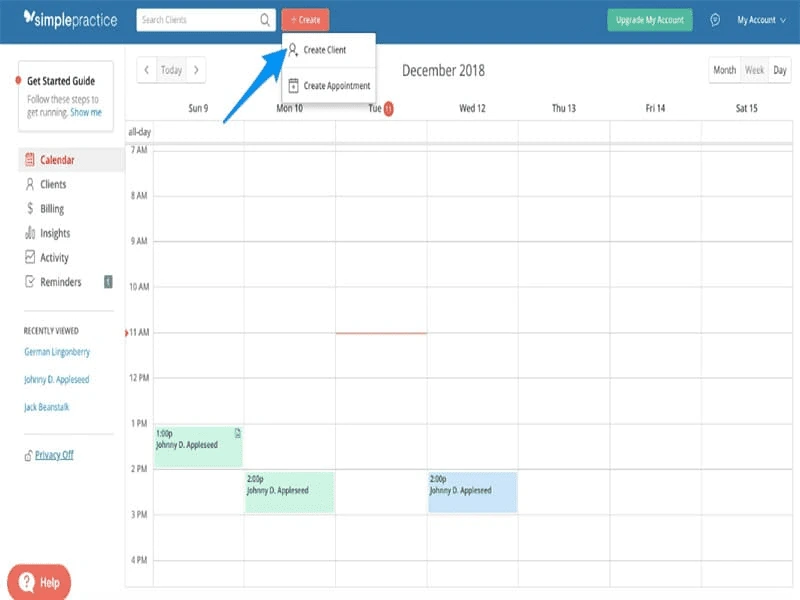
SimplePractice PMS Dashboard
Capterra: 4.6/5 (2,828+ reviews)
Founded: 2012, Santa Monica, California
Ownership: Vista Equity Partners (EngageSmart taken private in 2024)
Users: 250,000+ practitioners
SimplePractice is a behavioral-health-first practice management platform widely adopted across therapy, counseling, dietetics, and wellness practices. Its main value is not system complexity but operational simplicity, bringing scheduling, documentation, telehealth, billing, and client communication into a unified workflow that minimizes administrative overhead.
Rather than trying to serve every specialty, it optimizes for speed of adoption and ease of daily use, especially in small to mid-sized practices.
What each plan includes and excludes
Starter at $49/month:
- Scheduling, telehealth, billing, online payments, progress notes
- Does not include: appointment reminders, calendar sync, group therapy, insurance verification (manual workflows only)
Essential at $79/month:
- Adds: appointment reminders, calendar sync, Wiley Treatment Planners
- Claims: $0.39 down to $0.33 per claim, tiered by volume (no free allowance as of October 2026)
Plus at $99/month:
- Adds: group therapy, automatic insurance verification, premium support
- Claims: $0.39 down to $0.33 per claim, tiered by volume (no free allowance as of October 2026)
Key takeaway (non-pricing insight):
- Feature access is tier-gated, meaning operational maturity depends on plan selection rather than customization depth
- Most practices do not operate on base tiers alone once billing becomes active
Additional costs on all plans
- AI Note Taker: $35/month per clinician
- e-Prescribing: $49/month per clinician + $89 setup fee
- CPT coding fee: $20/year per clinician
Important interpretation:
- The platform is structurally ‘modular,’ meaning cost scales with documentation automation needs, prescribing requirements, and billing volume
- This creates variability in total cost depending on practice behavior, not just size
Workflow and usability (core differentiator)
- One of the lowest learning curves in this category
- Setup typically requires minimal IT involvement
- Strong end-to-end behavioral health workflow integration: intake to notes to scheduling to billing to telehealth
Operational impact:
- Reduces administrative time for solo providers significantly
- Minimizes need for dedicated billing or systems staff in small practices
Clinical and administrative capability depth
- Strong in: individual therapy workflows, client communication, documentation speed
- Moderate in: complex billing scenarios, multisite reporting
- Limited in: multispecialty clinical workflows, enterprise-level operational analytics
Strengths
- 4.6/5 rating across 2,828+ reviews signals high satisfaction consistency
- Strong behavioral health specialization with 250,000+ users
- Fast onboarding and low implementation friction
- Integrated telehealth included without separate system dependency
- Mobile apps widely used in daily clinical workflows
Limitations
- Advanced capabilities depend heavily on tier selection
- Add-ons can materially increase cost per clinician
- Not designed for multispecialty or hospital-linked environments
- Insurance workflows require higher-tier plans for automation
- Cost predictability decreases as add-ons accumulate
Best for
- Solo practitioners and small behavioral health groups (typically 1 to 20 providers)
- Clinics prioritizing ease of use over system configurability
Decision lens: This platform is best evaluated by workflow simplicity vs long-term scaling needs, not base subscription price
2. TheraNest (Ensora Mental Health)
Capterra: 4.4/5 (1,029 reviews)
Founded: 2013, Birmingham, Alabama
Ownership: KKR-backed Ensora Health
Primary focus: Behavioral and mental health practices
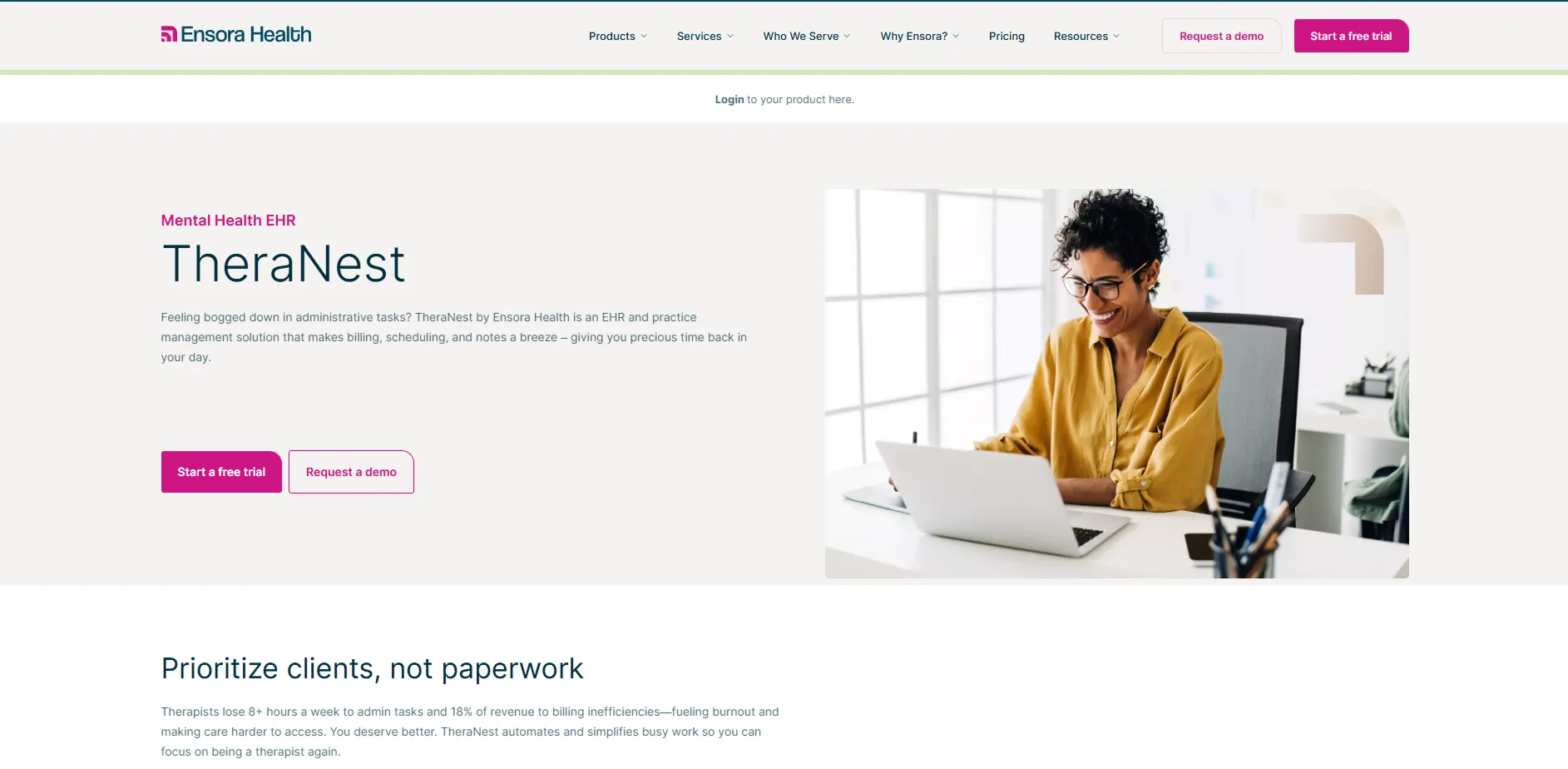
TheraNest is a structured behavioral health platform designed for practices that require more operational control than lightweight systems provide, especially around insurance workflows, group therapy, and treatment planning.
Compared to SimplePractice, it is less focused on interface minimalism and more focused on clinical structure and administrative coverage.
Current plan structure
- Essentials: $29/therapist/month — Core practice management, Basic documentation workflows
- Advanced: ~ $59/therapist/month — Adds insurance billing + telehealth functionality, More complete clinical workflow coverage
- Premier: $89/therapist/month — Includes Wiley Practice Planners, Integrated telehealth, AI Session Assistant
Trial: 21 days full access, no credit card required
Key interpretation:
- Lower entry pricing reflects a modular expansion model, not a fully bundled system
- Operational completeness increases significantly with tier upgrades
Additional operational costs
- Telehealth add-on: $12/therapist/month (lower tiers)
- Wiley Treatment Planners: $25/therapist/month (if not included)
- Claims processing: free (50/mo on Advanced), then $0.23 per submission; unlimited free on Premier
- Admin users: unlimited and free on every plan
- CPT licensing: ~$19.50 per therapist annually
Key insight:
- Effective cost depends heavily on insurance volume, staffing structure, and telehealth usage
- This creates a usage-sensitive pricing model, not a flat-cost system
Workflow and operational design
- Strong focus on behavioral health clinical structure: SOAP notes, DSM-based workflows, treatment planning, group therapy documentation
Operational advantages:
- Better suited for structured group practices than lighter tools
- Supports multi-provider coordination more explicitly than SimplePractice
Billing and insurance handling
- Built for insurance-heavy workflows
- Claims processing fees apply per submission
- Supports structured billing workflows but introduces per-transaction variability
Impact:
- More control over billing structure
- Less predictable monthly cost compared to flat-fee systems
Strengths
- Strong behavioral health specialization (4.4/5 across 1,000+ reviews)
- Lower entry cost ($29/month starting point)
- Good support for group therapy and treatment planning
- Flexible tier expansion for growing practices
- No credit card required for trial access
Limitations
- Telehealth not universally included across tiers
- Per-claim billing adds variability in operational cost
- Less suitable outside behavioral health
- Post-acquisition support consistency reported as mixed in reviews
- System requires tier upgrades for full operational maturity
Best for
- Solo therapists scaling into group practices
- Clinics with moderate insurance dependency
- Practices needing more structure than lightweight systems provide
Decision lens: Best evaluated by clinical structure + insurance complexity vs pricing simplicity, not base subscription cost
3. Tebra (Formerly Kareo and PatientPop)
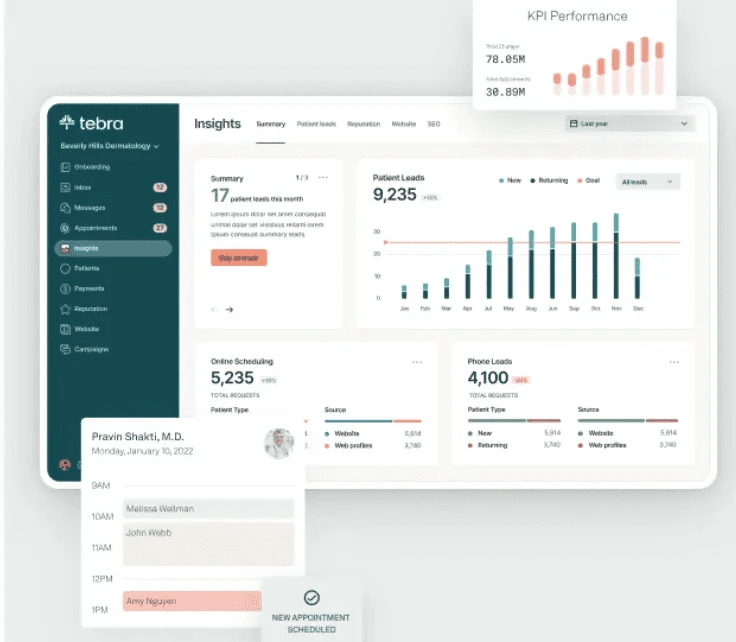
Tebra PMS Dashboard
Capterra: 3.93/5 (1,335 reviews)
Founded: Kareo 2004, Irvine, California; merged with PatientPop in 2021 to form Tebra
Users: Large independent practice base across U.S. ambulatory care
Tebra is an all-in-one platform combining clinical EHR, practice management, billing, and patient acquisition tools. Its positioning is centered on operational consolidation, reducing the need for separate billing, scheduling, and marketing systems.
Compared to behavioral-health-specific tools, Tebra is designed for general medical and ambulatory practices, which makes it more flexible but also more complex in configuration and cost structure.
How pricing works (structure, not just cost)
Tebra does not follow a fixed public pricing sheet and instead uses a custom-quote model based on: provider type (MD/DO vs NP/PA), claim volume, and modules selected (EHR, billing, patient engagement).
Tebra’s published pricing places physician bundles at $599–$799/provider/month standard, with lower-volume configurations around $349–$399/provider/month, consistent with the $49–$799 range shown in the comparison table above.
A key structural point is that pricing is modular, not flat, meaning removing one module can reprice the entire bundle, and staffing scale does not necessarily increase cost directly (non-clinical staff often included).
Workflow and operational scope (core value driver)
Clinical + administrative integration
- EHR + scheduling + billing + patient engagement in one system
- Reduces reliance on external tools for appointment reminders, patient outreach, and online reputation management
Billing and revenue cycle
- Built-in claims management and eligibility verification
- Supports both in-house billing and outsourced RCM workflows
- Claim processing fees or bundled billing models depending on configuration
Operational strengths
- Largest functional breadth in this comparison (clinical + billing + marketing)
- Strong for practices focused on patient acquisition + retention
- Staff scaling is relatively efficient because non-clinical users are typically not billed separately
- Integrated patient engagement tools reduce dependence on third-party systems
Operational limitations
- Complexity increases significantly during onboarding compared to lighter EHRs
- Pricing transparency is limited due to quote-based structure
- Feature depth varies depending on purchased modules
- Review feedback consistently highlights variability in support experience across implementations
Best for
- Independent primary care and multi-specialty practices
- Clinics prioritizing growth + patient acquisition + integrated billing
- Practices that want fewer vendors rather than simpler workflows
Decision lens:Tebra is best evaluated by how much operational consolidation it replaces, not its per-provider subscription cost alone.
4. Practice Fusion
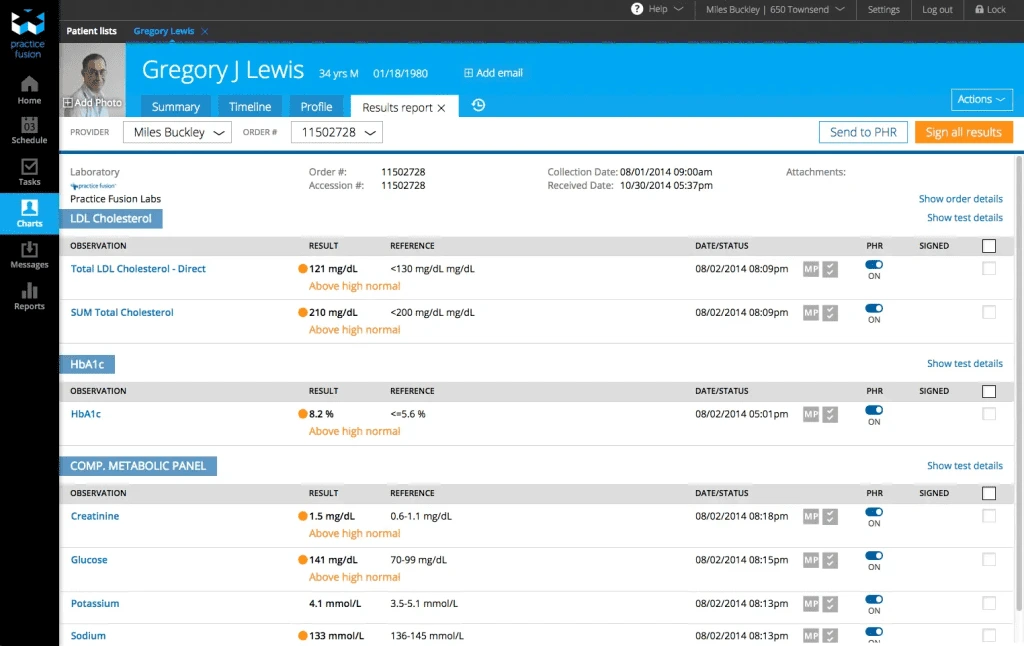
PracticeFusion PMS Dashboard
Capterra: 3.7/5 (439 reviews)
Founded: 2005, San Francisco, California
Ownership: Veradigm (Allscripts), acquired 2018
Practice Fusion is a cloud-based EHR primarily used in small primary care and independent practices. Its core design focus is simplicity and accessibility rather than depth or scalability.
It is generally positioned as an entry-level EHR system, particularly for practices that already have external billing arrangements.
Pricing and cost structure
Practice Fusion is priced at a flat $199 per provider/month (annual commitment model). Veradigm, which owns Practice Fusion, now offers an EHR with Billing Services package directly, so native billing is no longer the structural gap it once was. Practices should confirm current billing-package pricing directly with Veradigm, since it is not yet published at the same level of detail as the base EHR subscription. Telehealth still depends on external integrations rather than a fully native module.
Strengths in simplicity
- Easy-to-learn interface compared to enterprise EHRs
- Minimal configuration required
- Faster onboarding than most mid-tier systems
Clinical functionality
- Core EHR capabilities include: charting, e-prescribing, lab integrations, scheduling
- Designed primarily for straightforward primary care workflows
Operational strengths
- Low implementation complexity
- Suitable for small practices with stable workflows
- Lightweight system reduces administrative overhead initially
Operational limitations
- Billing services are a newer add-on from Veradigm, not yet as deeply native as competitors with a single shared database
- Limited customization for specialty workflows
- Dependency on third-party tools increases total operational complexity over time
- Scaling beyond small practice size typically requires migration
Best for
- Very small primary care practices
- Clinics with existing billing infrastructure outside the EHR
- Providers prioritizing simplicity over long-term scalability
Decision lens: Practice Fusion should be evaluated as a starter EHR, not a long-term operational platform.
5. AdvancedMD
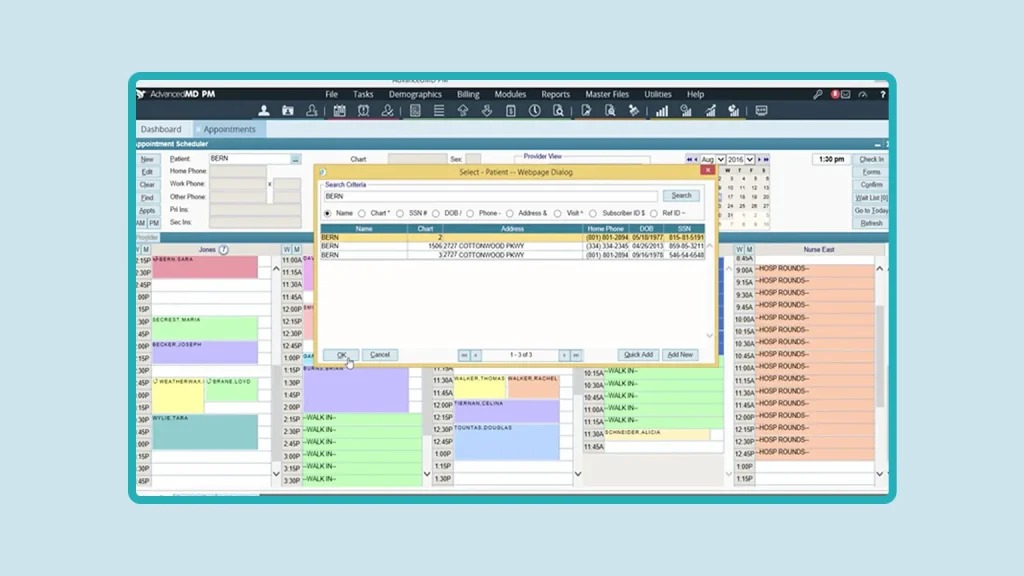
Capterra: 3.6/5 (467 reviews)
Founded: 1999, South Jordan, Utah
AdvancedMD is a modular EHR + practice management + billing platform designed for practices that need deeper operational control and financial reporting capability. Unlike simpler systems, AdvancedMD is structured around modular expansion and encounter-based pricing options, making it flexible but more complex to configure.
Pricing structure
- Practice Management + billing: approximately $400–$430 per provider/month starting range
- Full EHR + PM bundles: often $700+/provider/month depending on modules
- Encounter-based pricing alternative: $0.87–$1.74 per claim for PM-only, $1.08–$2.17 per claim for PM+EHR
Implementation costs: onboarding and setup fees are commonly reported in the $1,000–$3,000+ per provider range (varies significantly). Training and migration may add additional cost depending on practice size.
Strengths in depth
- Highly configurable workflows
- Strong reporting suite with 150+ built-in reports
- Flexible dashboards for financial tracking
- Suitable for complex billing environments
Operational strengths
- Strong reporting and analytics capability
- Flexible pricing models for low-volume vs high-volume practices
- Scales well from mid-sized to larger organizations
- Broad feature coverage across clinical and billing operations
Operational limitations
- Higher implementation complexity than simpler EHRs
- Learning curve is steeper for front-office staff
- Billing and backend workflows often described as less intuitive than clinical side
- Costs increase significantly with modules and scale
Best for
- Mid-sized to larger independent practices
- Organizations with dedicated administrative or billing teams
- Practices prioritizing financial reporting and operational control
Decision lens: AdvancedMD should be evaluated based on operational depth vs implementation overhead, not base subscription cost.
6. eClinicalWorks
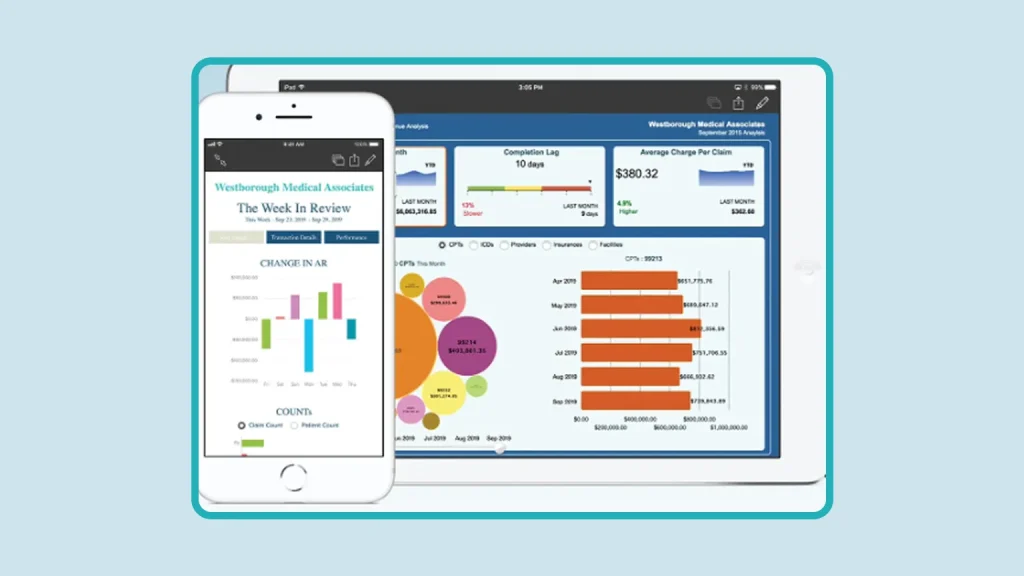
Capterra: 3.3/5 (396 reviews)
Founded: 1999, Westborough, Massachusetts
Users served: 180,000+ physicians/NPs and 850,000+ professionals
eClinicalWorks is one of the largest ambulatory EHR systems in the U.S., covering clinical documentation, practice management, RCM, telehealth, and population health tools. Its key characteristic is scale and feature density, but it also carries one of the lowest satisfaction ratings in this comparison, largely due to complexity and cost variability.
Pricing structure
- Approximately $499–$599 per provider/month depending on configuration
- Additional RCM services are billed at a flat 2.9% of collections, or via add-on modules
eClinicalWorks advertises no start-up costs. Migration and training fees may still apply depending on scale, along with optional add-ons for telehealth, messaging, and compliance modules.
Workflow and system complexity
- Highly comprehensive feature set across EHR, billing, population health, and patient engagement
- Strong scalability for large practices
- Robust integration ecosystem
- Designed for high-volume, multi-provider environments
- Supports complex billing and compliance workflows
Operational strengths
- Deep feature coverage across clinical + administrative + population health domains
- Strong scalability for large ambulatory groups
- Broad functionality reduces need for external systems
Operational limitations
- High learning curve and operational complexity
- Frequent feedback about “click-heavy” navigation
- Cost unpredictability due to modular add-ons
- Implementation effort is significantly higher than mid-tier EHRs
Best for
- Large ambulatory practices
- High patient-volume organizations
- Systems with dedicated IT and billing teams
Decision lens: eClinicalWorks is best evaluated by scale capability vs usability friction, not sticker price or individual feature availability.
7. OmniMD
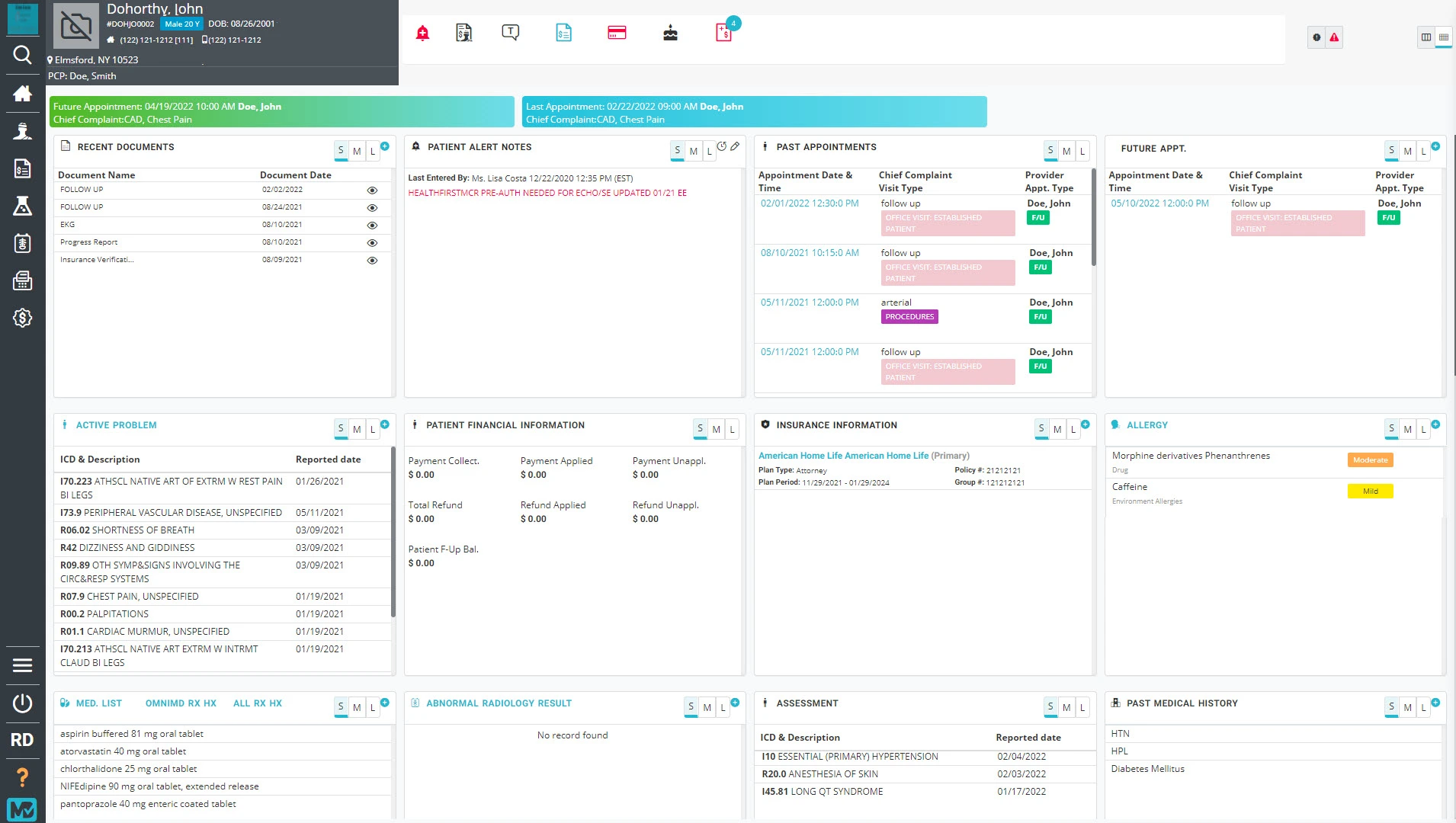
OmniMD Practice Management Software Dashboard
Capterra: 4.5/5 (52 reviews)
Founded: 2002
Users: ~12,000+ providers
Specialties: 20+ specialties
OmniMD is a cloud-based, ONC-certified electronic health record (EHR), practice management, and revenue cycle management platform built on a single-database architecture. Clinical, administrative, and billing workflows operate within one integrated system rather than separate connected modules.
Our platform supports multispecialty clinical environments and independent practices that require unified workflows across documentation, scheduling, billing, and reporting.
Compared with systems that rely on loosely connected modules, OmniMD maintains a unified data environment where clinical and financial workflows operate on the same underlying system. This structure is designed to reduce fragmentation and improve consistency across operational functions.
Pricing structure (custom-quote model)
OmniMD does not publish fixed public pricing tiers. Pricing is determined based on number of providers, selected modules (EHR, practice management, RCM, analytics), and scope of revenue cycle management services. Industry estimates generally place the platform in a mid-tier to enterprise mid-tier pricing range, depending on configuration.
Our pricing structure is influenced primarily by how the platform is deployed: whether billing is managed internally or through integrated RCM services, and the extent of workflow consolidation across clinical and financial operations.
Workflow and system design
Clinical documentation, scheduling, billing, and reporting operate within a single database environment. This enables reduced dependency on external integrations, fewer data reconciliation points between systems, and consistent reporting across clinical and financial workflows.
Clinical and administrative workflows
Our platform includes specialty-specific templates across 20+ specialties, supporting workflows such as primary care, psychiatry, pediatrics, cardiology, and urgent care.
- Eligibility verification workflows
- Claims submission and tracking
- Scheduling and front-office operations
- Automation tools supporting intake and operational efficiency
Billing and revenue cycle management
OmniMD includes integrated revenue cycle management capabilities that support both in-house billing operations and outsourced RCM services managed within the same platform environment.
- Claims submission and tracking
- Denial management workflows
- Payer performance monitoring
- Accounts receivable reporting and analytics
Because billing and clinical workflows operate within the same system, financial data and clinical documentation are not separated across disconnected tools, which helps maintain consistency in reporting and operations.
Operational strengths
- Single-database architecture across clinical, administrative, and billing functions
- Strong support for multispecialty workflows across 20+ specialties
- Integrated RCM options within the same platform environment
- Scales from solo practices to multi-location organizations
- Unified operational and financial reporting structure
Operational limitations
- Pricing is not publicly disclosed and requires direct engagement
- Smaller verified review base (51 Capterra reviews) compared to larger EHR platforms
- Some variability in navigation efficiency across workflows, based on user feedback
- Reporting capabilities are functional but less advanced than dedicated analytics-first systems
- Mobile experience is less extensive than lighter, mobile-first platforms
Best for
- Multispecialty practices requiring a unified system across clinical and billing operations
- Practices preferring integrated RCM within the same platform rather than separate billing tools
- Organizations prioritizing system consolidation over lightweight usability or transparent pricing
Decision lens: OmniMD is best evaluated based on how effectively our platform unifies clinical, administrative, and financial workflows into a single system, rather than on standalone pricing or interface simplicity.
The seven platforms above cover meaningfully different approaches to practice management. The right decision requires one more step: knowing exactly what to ask when you sit down with a vendor in a demo.
Questions to Ask in Every Vendor Demo
Vendor demos are designed to show software at its best. The questions below are designed to reveal what demos do not show.
On pricing and total cost:
- What is included in the base subscription and what costs extra? Can I see this in writing before this demo ends?
- Do you charge per-claim fees, per-visit fees, or clearinghouse fees above the monthly subscription?
- What are implementation and onboarding fees for a practice of my size and specialty?
- What does data migration from my current system cost, and who handles it?
On support:
- What is your average first-response time for support tickets?
- Will I have a dedicated account manager or a shared support queue?
- What are your support hours, and is after-hours support available?
On contracts and data portability:
- What is the contract term and the required notice period for non-renewal?
- What are the early termination fees?
- If I leave, can I export a complete set of patient records and billing history in a format other systems can actually read?
On real-world fit:
- How many active providers in my specialty currently use your platform?
- Can you connect me with two or three current customers in my specialty and practice size for a reference call?
On compliance:
- Are you HIPAA-compliant, and will you sign a Business Associate Agreement?
- What is your ONC certification status?
Written answers to these questions from two or three shortlisted vendors will tell you more than any feature list. Once you have them, the right platform for your situation typically becomes clear, which is exactly what the decision framework in the next section is designed to formalise.
Which Platform Fits Your Situation
1. Solo mental health therapist, minimal insurance billing
TheraNest Essentials at $29/therapist/month is the lowest entry point for behavioral health. SimplePractice Starter at $49/month is the alternative if ease of use, mobile experience, and faster onboarding matter more. In both cases, additional costs for claims, telehealth, or AI tools can increase total monthly spend beyond the base subscription.
2. Small behavioral health practice needing a complete clinical + billing workflow
SimplePractice Plus at $99/month offers a more complete behavioral health system with scheduling, documentation, billing, and telehealth in one place. However, total monthly cost typically increases once AI notes and e-prescribing are added. TheraNest Advanced at $59/therapist/month ($54/month billed annually) provides a lower base-cost alternative with structured insurance and group workflow support, depending on configuration and add-ons.
3. Small mental health practice (up to 3 providers) looking for structured EHR + practice management without long-term commitments
AdvancedMD Now at $130/provider/month offers a month-to-month setup with core EHR, telehealth, and practice management included, making it a flexible entry point for small teams before scaling into more complex operational systems.
4. Small primary care practice with straightforward workflows and external billing support
Practice Fusion at $199/provider/month covers core EHR functionality such as charting, e-prescribing, scheduling, and integrations. Since native billing is not included, most practices will require a third-party billing partner, which can significantly increase total operational cost depending on setup.
5. Independent practices focused on growth, patient acquisition, and integrated billing operations
Tebra ranges from approximately $49 to $799/provider/month depending on provider type and selected modules. It combines EHR, practice management, billing, and patient engagement tools in a single ecosystem, but pricing and configuration vary based on practice structure and workflow requirements.
6. Independent to mid-sized practices needing deeper financial control, reporting, and operational scalability
AdvancedMD starts at approximately $429/provider/month for practice management and billing, or $729/provider/month for the full EHR + PM suite. It is typically used in environments where reporting depth, revenue cycle visibility, and structured financial workflows are more important than simplicity of setup.
7. Growing ambulatory practices with high patient volume and complex billing needs
eClinicalWorks is typically priced between approximately $449 and $599/provider/month depending on whether EHR-only or EHR + practice management modules are selected. Additional costs may apply for implementation and optional add-ons. It is generally suited for larger, operationally complex environments where scale and feature breadth are key requirements.
Practices across all sizes seeking a unified system that scales from small clinics to enterprise healthcare organizations
OmniMD supports healthcare organizations across multiple stages of growth, from small independent practices to mid-sized groups and large multi-location enterprises.
It is built on a single-database architecture where EHR, practice management, and revenue cycle management operate within one connected system. This allows clinical, administrative, and financial workflows to remain aligned without relying heavily on separate integrated tools.
This structure applies differently depending on practice size:
- Small practices: benefit from starting with a unified system that reduces the need to adopt multiple disconnected tools early in their growth stage
- Mid-sized practices: use the platform to maintain consistency across providers, locations, and billing operations without fragmented systems
- Large or enterprise organizations: use the same architecture to support higher patient volumes, multispecialty workflows, and centralized reporting across departments
Across these use cases, OmniMD is typically evaluated based on how effectively it reduces operational fragmentation while maintaining continuity between clinical and financial workflows, rather than being limited to a single practice size category.
Pricing is configuration-based and depends on modules, scale, and whether revenue cycle management is handled in-house or through integrated services.
Frequently Asked Questions
Is practice management software the same as an EHR?
No. An EHR stores clinical information like diagnoses, medications, and visit notes, and is used mainly by clinical staff. A PMS handles the operational and financial side, scheduling, claims, billing, and is used mainly by front desk and billing teams. Most platforms in this guide combine both, but they are technically separate functions.
How much does practice management software typically cost?
It varies widely by practice type and scale. Solo behavioral health platforms like SimplePractice and TheraNest start in the $29 to $99 per month range, while full EHR and PM suites built for larger or multi-location practices typically run $400 to $700+ per provider per month. Implementation and add-on costs can shift the total significantly, so the base subscription price alone rarely reflects what you will actually pay.
Do I need an integrated EHR and PMS, or can I keep them separate?
If you already have an EHR you are happy with, look for a PMS with verified third-party integration credentials rather than switching everything at once. If you are starting fresh or open to migrating, an integrated platform on a single shared database tends to produce fewer data quality problems over time than two connected tools working across an API.
⚠️ Disclaimer: This blog is intended for informational and educational purposes only and was prepared using information collected, reviewed, and cross-referenced from publicly available sources as available at the time of publication. Data referenced throughout this blog, including pricing, product features, ratings, review counts, implementation details, ownership information, market benchmarks, and platform comparisons, was compiled from vendor websites, product documentation, third-party software review platforms, industry publications, public reports, and independent research sources.
Sources referenced in developing this article include, but are not limited to: Capterra, G2, GetApp, Software Finder, SelectHub, ITQlick, Software Advice, EHR Source, vendor pricing and support documentation (including SimplePractice, Ensora Health/TheraNest, Tebra, Practice Fusion, AdvancedMD, eClinicalWorks, and OmniMD), U.S. Department of Justice public records, NPR, CNBC, PMC (NIH), APA documentation, Becker’s Payer Issues, Definitive Healthcare, TechTarget, Experian Health, Ease Health, Black Book Research, and other publicly available industry resources where applicable.
Because pricing models, product capabilities, contract terms, ownership structures, implementation costs, policies, and market data may change without notice, the information presented should not be treated as exhaustive, final, legal, financial, purchasing, compliance, or implementation advice. Not every source referenced in the research process is individually linked within the article.
Readers are encouraged to independently verify current pricing, features, certifications, contractual terms, and product suitability directly with vendors and to use their own professional judgment and discretion before making any purchasing or operational decisions.

Dr. Giriraj Tosh Purohit is an experienced Product Manager and Security officer with a strong background in healthcare technology and management consulting. With expertise spanning clinical workflows, EHR, RCM, Digital Health, and AI-driven products, he has been instrumental in shaping innovative healthcare solutions.