

How To Improve Medical Practice Revenue: 12 Proven Strategies For U.S. Clinics
U.S. medical practices are facing a dual financial squeeze: costs are rising on one side, and reimbursements are eroding on the other. Staffing shortages, payer complexity, growing patient financial responsibility, and relentless claim denials are eating into margins that were never comfortable to begin with.
But here is what most practice leaders get wrong: they assume the path to stronger revenue is seeing more patients. In reality, the fastest and most sustainable revenue improvements come from fixing the systems that already exist, plugging the leaks in billing, optimizing scheduling, renegotiating payer rates, and expanding the services a practice already has the capacity to offer.
$125B+ estimated annual loss to U.S. healthcare due to poor billing practices, claim denials, and administrative inefficiencies, much of it recoverable with the right system in place.
This guide covers 12 proven, KPI-backed strategies across six dimensions of practice revenue: revenue cycle management, operational efficiency, patient experience, technology, cost control, and revenue expansion. For each strategy, we include the implementation essentials and the specific metrics you need to measure whether it is working.
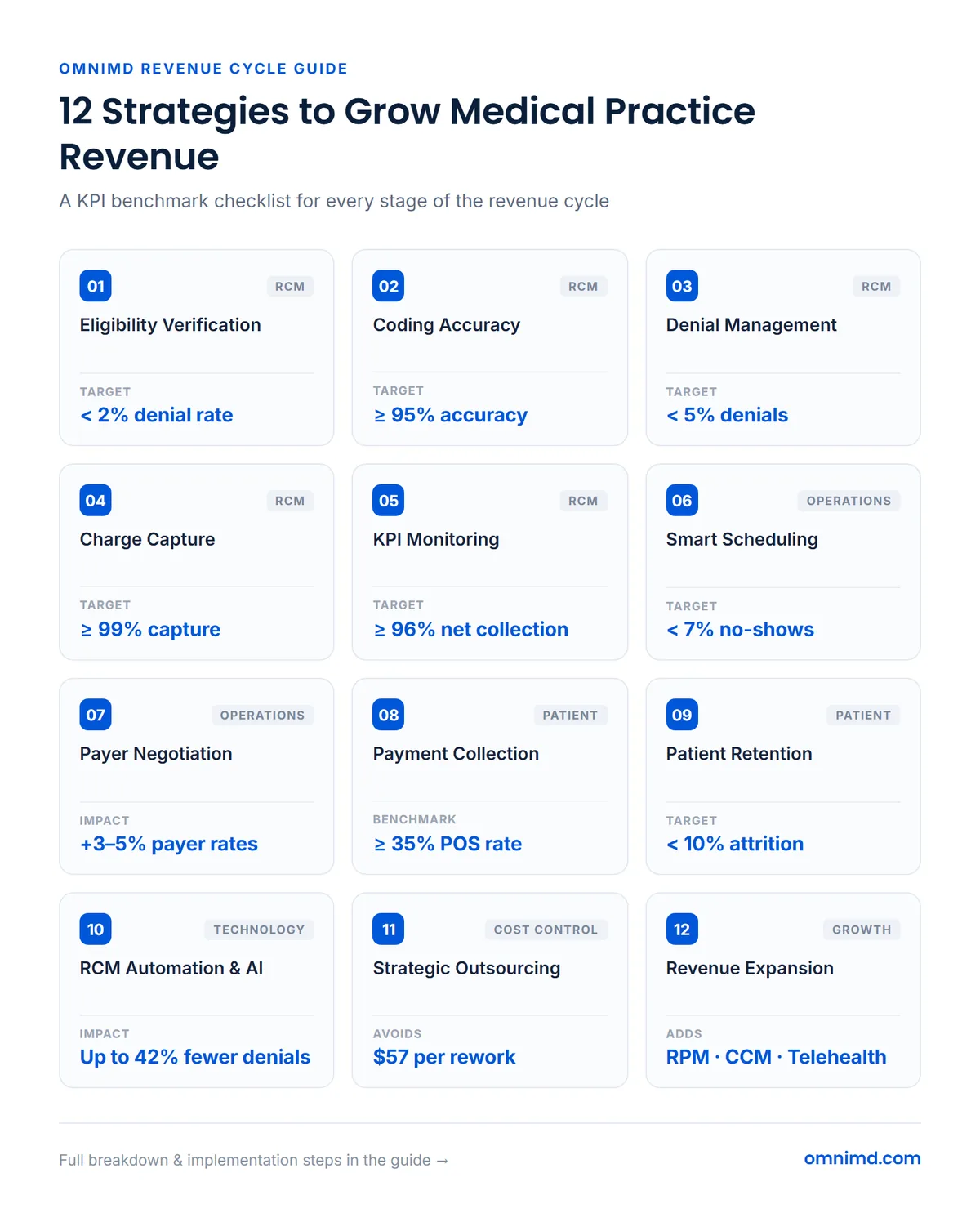
Part-1: Revenue Cycle Management
Strategy 1: Strengthen Front-End Eligibility Verification
Why it matters:
Eligibility errors are among the most preventable causes of claim denials. A 2024 industry survey found that approximately 27% of claim denials in U.S. clinics stemmed from eligibility-related errors, making it the single largest preventable denial category. Almost all of them could have been caught before the patient ever walked in the door.
Verifying insurance at the time of scheduling (not just at check-in) gives your team time to resolve issues, collect accurate co-pay information, and flag authorization requirements before the appointment.
Implementation essentials:
- Verify insurance at scheduling and again 48 to 72 hours before the appointment
- Confirm deductibles, co-pays, out-of-pocket maximums, and prior authorization requirements
- Use automated real-time eligibility tools to reduce manual lookup time
- Flag discrepancies immediately so front-desk staff can contact patients before arrival
Track these KPIs:
- Eligibility-related denial rate: Target: < 2%
- Front-end clean claim rate: Target: ≥ 95%
- Avg. verification time per patient: Target: < 3 min
Strategy 2: Improve Medical Coding Accuracy
Why it matters:
Coding errors, whether undercoding, overcoding, or mismatched diagnosis-procedure pairings, are responsible for a significant share of denials and delayed reimbursements. According to AAPC Audit Services, up to 19% of E/M visits nationwide are undercoded, with each undercoded level-3 to level-4 visit losing roughly $37 in Medicare reimbursement per encounter.
Accurate coding starts with thorough clinical documentation. When documentation is vague or incomplete, coders are forced to make assumptions, and assumptions get denied. The most effective practices treat documentation quality as a revenue issue, not just a clinical one.
Implementation essentials:
- Conduct quarterly internal coding audits across CPT, ICD-10, and HCPCS codes
- Run regular CDI (clinical documentation improvement) reviews with providers
- Use AI-assisted coding tools to catch missed codes and flag high-risk pairings before submission
- Track denial root causes by code type to identify recurring problem areas
Undercoding is often invisible, your practice may be consistently billing E/M level 3 for visits that qualify as level 4. AAPC Audit Services found that up to 19% of E/M visits are undercoded nationwide, each costing roughly $37 or more in lost Medicare reimbursement per encounter.
Track these KPIs:
- Coding accuracy rate: Target: ≥ 95%
- Denial rate (coding errors): Target: < 3%
- Undercoding discovery rate: Baseline → track trend
Strategy 3: Implement Proactive Denial Management
Why it matters:
Initial claim denial rates reached 11.8% in 2024, up from 10.2% in 2020, a 15.7% increase over four years, according to Kodiak Solutions data covering 300,000+ physicians, while high-performing organizations maintain denial rates below 5%. The difference is not luck: it is a systematic, data-driven process that treats every denial as actionable information.
The most effective denial programs do two things simultaneously: they work the current backlog (appeals, resubmissions, write-off decisions) and they fix the upstream processes that generated the denials in the first place. Without the second step, denial management becomes a permanent treadmill.
| Denial Reason | Description | Prevention Strategy |
|---|---|---|
| Eligibility issues | Insurance inactive or incorrect at time of service | Verify insurance 48 to 72 hours before appointment |
| Coding errors | Incorrect CPT, ICD-10, or HCPCS codes | Regular coding audits and AI-assisted code review |
| Missing authorization | Required prior auth not obtained | Pre-authorization workflows with automated tracking |
| Incomplete documentation | Clinical notes do not support billed level of service | CDI programs and documentation training for providers |
| Duplicate claims | Same claim submitted more than once | Claim scrubbing software before every submission |
| Timely filing exceeded | Claim submitted past payer’s filing window | Automated claim tracking with escalation alerts |
Track these KPIs:
- Overall denial rate: Target: < 5%
- First-pass resolution rate: Target: ≥ 90%
- Denial appeal success rate: Target: ≥ 50%
- Denial write-off rate: Target: < 2% of charges
Strategy 4: Optimize Charge Capture
Why it matters:
Every service your clinical team performs that is not properly documented and billed is revenue that disappears permanently. Charge capture gaps, missed charges, late charges, or services that fall through the cracks between clinical documentation and the billing system, are more common than most practice leaders realize.
Implementation essentials:
- Integrate charge capture directly into clinical documentation workflows (not as a separate step)
- Enable real-time charge entry at the point of care to reduce end-of-day reconciliation errors
- Perform monthly charge capture audits comparing billed services against clinical notes
- Review high-volume procedure codes specifically for patterns of missed ancillary charges
Track these KPIs:
- Charge capture rate: Target: ≥ 99%
- Lag time: service to charge entry: Target: same day
- Missed charge discovery rate: Track monthly trend
Strategy 5: Monitor Revenue Cycle Metrics Continuously
Why it matters:
You cannot improve what you do not measure. Practices that track a core set of revenue cycle KPIs consistently outperform those that rely on end-of-quarter financial reviews, because they catch problems while they are still small.
| Revenue Cycle Metric | Industry Benchmark | Source |
|---|---|---|
| Clean claim rate | ≥ 95% | Medical Billers & Coders / ModMed |
| Claim denial rate | < 5% | Industry standard |
| Days in accounts receivable | 30–40 days | HFMA / MD Clarity |
| Net collection rate | ≥ 96–97% | MGMA, via ModMed |
| First-pass resolution rate | ≥ 90% | Industry standard |
| Cost to rework a denied claim | Avg: ~$57 | Premier Inc. 2023, via AzebraTech |
Review these metrics weekly at the operational level and monthly at the leadership level. Any metric moving in the wrong direction for two consecutive weeks should trigger a root-cause review.
PART 2: OPERATIONAL EFFICIENCY
Strategy 6: Optimize Scheduling to Reduce No-Shows and Idle Time
Why it matters:
An empty appointment slot is pure revenue loss. Research estimates the average no-show rate is approximately 19% across U.S. specialties, while well-managed practices benchmark at 5 to 7% per MGMA 2024 data. Every percentage point of reduction translates directly to the bottom line.
Implementation essentials:
- Use automated multi-channel reminders (SMS, email, phone) 48 hours and again 24 hours before appointments
- Maintain an active waitlist to fill same-day cancellations immediately
- Analyze no-show patterns by provider, appointment type, day of week, and insurance type, then adjust scheduling templates accordingly
- Consider small deposit or pre-registration requirements for high-risk appointment types
- Track “third next available” (TNAA) as your primary patient access metric, MGMA recommends benchmarking this against specialty-specific DataDive data
Track these KPIs:
- No-show rate, Target: < 7% (industry avg: ~19%)
- Third next available (TNAA): Track vs. specialty benchmark
- Provider utilization rate: Target: ≥ 85%
Strategy 7: Negotiate Payer Contracts Strategically
Why it matters:
Most practices accept payer rates at renewal without pushback. This is one of the most significant missed revenue opportunities in healthcare, payer rates are almost always negotiable, and even a 3 to 5% improvement across major payers adds meaningful revenue annually with no additional patient volume required.
Implementation essentials:
- Review every payer contract annually, set calendar reminders 90 days before expiration
- Benchmark your current rates against Medicare fee schedules and regional market data
- Analyze your payer mix to identify which contracts have the most leverage (volume + margin)
- Come to negotiations with data: your quality outcomes, patient volume, and specialty access position in the market
- Be willing to terminate contracts with persistently below-market payers if the math does not work
Track these KPIs:
- Revenue per encounter (by payer): Track & benchmark
- Contractual adjustment rate: Monitor by payer
- Net collection rate (by payer): Target: ≥ 96–97% (MGMA)
PART 3: PATIENT COLLECTIONS & EXPERIENCE
Strategy 8: Improve Patient Payment Collection
Why it matters:
According to the KFF 2024 Employer Health Benefits Survey, approximately 27% of workers enrolled in employer-sponsored insurance are in high-deductible plans, and 87% of all covered workers carry a general annual deductible. Patient financial responsibility has become one of the largest and fastest-growing components of practice revenue, and one of the hardest to collect after the fact. The best time to collect patient balances is before or at the point of service.
Implementation essentials:
- Collect estimated patient responsibility at check-in, before the appointment, not during billing
- Provide itemized, easy-to-understand billing statements (not EOB-style documents patients cannot read)
- Offer digital payment options: online patient portal, text-to-pay, and mobile wallet
- Set up automated payment reminders at 7, 14, and 30 days post-service
- Offer flexible payment plans for balances over $200, patients who can pay over time are far more likely to pay at all
- Train front-desk staff to discuss financial responsibility without discomfort, scripted, empathetic language helps
Track these KPIs:
- Point-of-service collection rate: Industry benchmark: ≥ 35%
- Patient bad debt rate: Target: < 3% of revenue
- Digital payment adoption rate: Target: ≥ 40%
Strategy 9: Build Patient Retention and Reduce Attrition
Why it matters:
Acquiring a new patient costs 5 to 7 times more than retaining an existing one, a well-established figure in healthcare marketing literature. Yet most practices focus almost entirely on new patient acquisition while paying little attention to whether established patients are slipping away. Reducing annual patient attrition by even a few percentage points can deliver substantial recurring revenue impact.
Implementation essentials:
- Track your active panel size monthly and flag unusual declines by provider or location
- Implement proactive outreach for patients who are overdue for follow-up or preventive care
- Monitor and respond to online reviews (Google, Healthgrades) within 48 hours
- Conduct periodic patient satisfaction surveys and act visibly on the results
- Ensure your digital presence (website, Google Business Profile, online scheduling) is frictionless and up to date
Track these KPIs:
- Annual patient attrition rate: Target: < 10%
- New vs. established patient ratio: Track monthly trend
- Average star rating (Google/HG): Target: ≥ 4.3
PART 4: TECHNOLOGY & AUTOMATION
Strategy 10: Adopt Revenue Cycle Automation and AI
Why it matters:
Administrative tasks consume enormous amounts of staff time and introduce human error at every step. McKinsey estimates AI-driven automation improves productivity in RCM administrative workflows by 15 to 30%. Separately, Experian Health case data shows practices using AI-supported eligibility verification have cut denial rates by as much as 42%.
Implementation essentials:
- Automate eligibility verification to run in real time at scheduling and again at check-in
- Use claim scrubbing software that applies payer-specific edits before every submission
- Implement AI-powered denial prediction to flag claims likely to be rejected before they leave the system
- Automate prior authorization workflows with real-time payer rule engines
- Use AI medical coding tools to convert clinical documentation directly into accurate, compliant codes
The ROI on RCM automation is typically measurable within 60 to 90 days. The clearest signal is a rising first-pass resolution rate combined with a falling denial rate.
Track these KPIs:
- Automation rate (RCM tasks): Track % of tasks automated
- Time saved per biller per week: Track & benchmark
- Error rate reduction: Compare pre/post deployment
PART 5: COST CONTROL
Strategy 11: Outsource Non-Core Functions Strategically
Why it matters:
Maintaining full in-house billing, coding, and prior authorization teams is expensive. For many practices, selective outsourcing of high-complexity or low-volume RCM functions delivers better results at lower cost than staffing everything internally.
Implementation essentials:
- Identify which RCM functions are high-complexity but low-volume in your practice (complex denials, secondary claims, legacy AR), these are strong outsourcing candidates
- Evaluate outsourced billing partners by clean claim rate, denial recovery rate, and turnaround time, not just cost
- Set clear SLAs before signing any outsourcing agreement and review performance monthly
- Do not outsource functions where proximity to clinical staff is critical (e.g., pre-auth that requires provider input)
Track these KPIs:
- Overhead as % of revenue: Track vs. MGMA specialty benchmark
- Cost to rework a denied claim: ~$57 avg (Premier Inc., 2023)
- SLA compliance rate: Target: ≥ 95%
PART 6: REVENUE EXPANSION
Strategy 12: Add Ancillary Services and Diversify Revenue Streams
Why it matters:
Fee-for-service reimbursement continues to face pressure from payers. Practices that depend entirely on encounter-based billing are increasingly vulnerable. Adding ancillary services creates revenue streams that supplement traditional billing.
High-impact ancillary services to consider:
Remote Patient Monitoring (RPM): CMS reimburses RPM setup and monthly management through core CPT codes (99453, 99454, 99457). For practices with chronic care populations (diabetes, hypertension, CHF), this represents meaningful recurring revenue with limited additional staff time once the program is established. See Smart Meter RPM’s full CMS reimbursement breakdown.
Chronic Care Management (CCM): CPT 99490 and related codes pay for non-face-to-face care coordination time for patients with two or more chronic conditions. Often underutilized and highly reimbursable.
Telehealth: Post-pandemic reimbursement parity for telehealth has improved significantly. Extending hours with virtual visits captures revenue from patients who cannot or will not come in person.
Behavioral health integration: Adding a licensed counselor or psychiatric NP to a primary care or specialty practice can significantly expand billable services and improve patient outcomes.
Track these KPIs:
- Revenue from new services: Track monthly post-launch
- RPM enrollment rate: Track % of eligible chronic patients enrolled
- Telehealth adoption rate: Track vs. in-person volume
Conduct Regular Revenue Cycle Audits
All of the strategies above depend on one thing: knowing where you stand. Revenue cycle audits are the mechanism that keeps your finger on the pulse of practice finances. Without periodic audits, small inefficiencies compound silently until they show up as a significant revenue problem.
A comprehensive revenue cycle audit should review:
- Coding accuracy across your highest-volume CPT codes
- Denial patterns by payer, code, and denial reason code
- Accounts receivable aging (especially anything over 90 days)
- Charge capture completeness
- Patient payment collection rates and bad debt trends
- Payer contract performance versus benchmarks
Aim for a full audit annually, with focused spot audits on high-risk areas quarterly. Practices that audit regularly rarely face large revenue surprises, they fix problems while they are still recoverable.
How OmniMD Supports Revenue Optimization Across All 12 Strategies
OmniMD is a fully integrated healthcare platform built to address the entire revenue cycle, from the moment a patient is scheduled to the day the final payment is posted. Rather than requiring practices to stitch together multiple point solutions, OmniMD connects clinical documentation, billing, coding, and analytics within a single system.
Key capabilities that directly support the strategies above:
AI-powered eligibility verification
Real-time insurance checks at scheduling and check-in, with automatic flagging of discrepancies
Integrated AI medical coding
Converts clinical documentation to accurate, compliant codes with denial risk scoring before submission
AI RCM with denial prediction
Identifies claims likely to be rejected and routes them for review before they leave the system
AI medical billing
Learns payer-specific behavior patterns and adapts claims accordingly, reducing avoidable denials
Denial management and AR follow-up
Systematic denial categorization, appeal workflows, and AR prioritization by recovery probability
Practice management and scheduling
Automated reminders, waitlist management, and scheduling analytics to reduce no-shows
Real-time RCM analytics
Dashboards tracking clean claim rates, denial rates, days-in-AR, and collection rates with drill-down by payer, provider, and code
Remote patient monitoring
Built-in RPM capabilities to help practices launch and scale this high-value ancillary revenue stream
Final Thoughts
Improving medical practice revenue is not a single initiative, it is a layered effort across billing accuracy, operational efficiency, patient relationships, technology adoption, cost discipline, and strategic expansion. The practices that grow sustainably are the ones that address all of these dimensions systematically, not just the most obvious one.
Start by benchmarking where you stand today on the KPIs in this guide. The gaps between your current performance and the target benchmarks are your revenue opportunity, and in most cases, the largest gains come from closing the upstream gaps that generate avoidable denials before they ever reach a biller.
Most practices can see measurable improvement in 60 to 90 days with focused effort on strategies 1 through 5 alone.
Frequently Asked Questions
Q1. How long does it take to see results after implementing revenue improvement strategies?
Most practices see measurable improvements within 60 to 90 days of addressing front-end RCM issues. Payer contract renegotiations and ancillary service launches typically take 3 to 6 months to reflect in revenue.
Q2. What is the difference between gross and net collection rate, and which should I focus on?
Gross collection rate measures collections against total billed charges. Net collection rate measures collections against what you were contractually entitled to receive, making it far more accurate. Focus on net collection rate. Anything below 96% signals money is being lost to bad debt or billing errors.
Q3. How do I know if my practice is undercoding?
Key signals: your E/M visits are heavily skewed toward level 3, your average revenue per encounter is below specialty peers, and your documentation consistently supports a higher level than what was billed. A formal coding audit is the most reliable way to confirm and quantify it.
Q4. Should small practices do RCM in-house or outsource it?
Practices billing fewer than 500 claims per month often find outsourcing more cost-effective. Mid-size practices typically benefit from a hybrid model, keeping eligibility and charge entry in-house while outsourcing denial management and complex AR follow-up.
Q5. What is prior authorization and why does it affect revenue?
Prior authorization is a payer requirement to approve certain services before they are performed. Missing or incorrect prior auths result in denied claims that often cannot be appealed. Automating prior auth tracking within your scheduling workflow is the most effective prevention.
Q6. How does value-based care affect practice revenue?
Under fee-for-service, revenue depends on visit volume. Under value-based arrangements, a portion ties to quality metrics and patient outcomes. Practices that invest in care coordination and chronic disease management often generate shared savings payments that supplement or exceed traditional fee-for-service revenue.
Q7. What is AR aging and why does it matter?
AR aging tracks how long claims have been unpaid, in buckets of 0 to 30, 31 to 60, 61 to 90, and 90+ days. Recovery rates drop sharply after 90 days. A healthy practice keeps 90%+ of AR in the 0 to 60 day bucket.
Q8. How does billing staff turnover affect revenue?
High billing staff turnover causes spikes in denial rates and days in AR within 30 to 60 days of a departure. Cross-training, documented workflows, and technology that captures payer behavior patterns reduce this risk significantly.
Platform choice compounds all of this. A CFO-level evaluation of billing software covers the automation depth, reporting and integration questions that determine how much revenue a practice keeps.

Dr. Giriraj Tosh Purohit is an experienced Product Manager and Security officer with a strong background in healthcare technology and management consulting. With expertise spanning clinical workflows, EHR, RCM, Digital Health, and AI-driven products, he has been instrumental in shaping innovative healthcare solutions.