
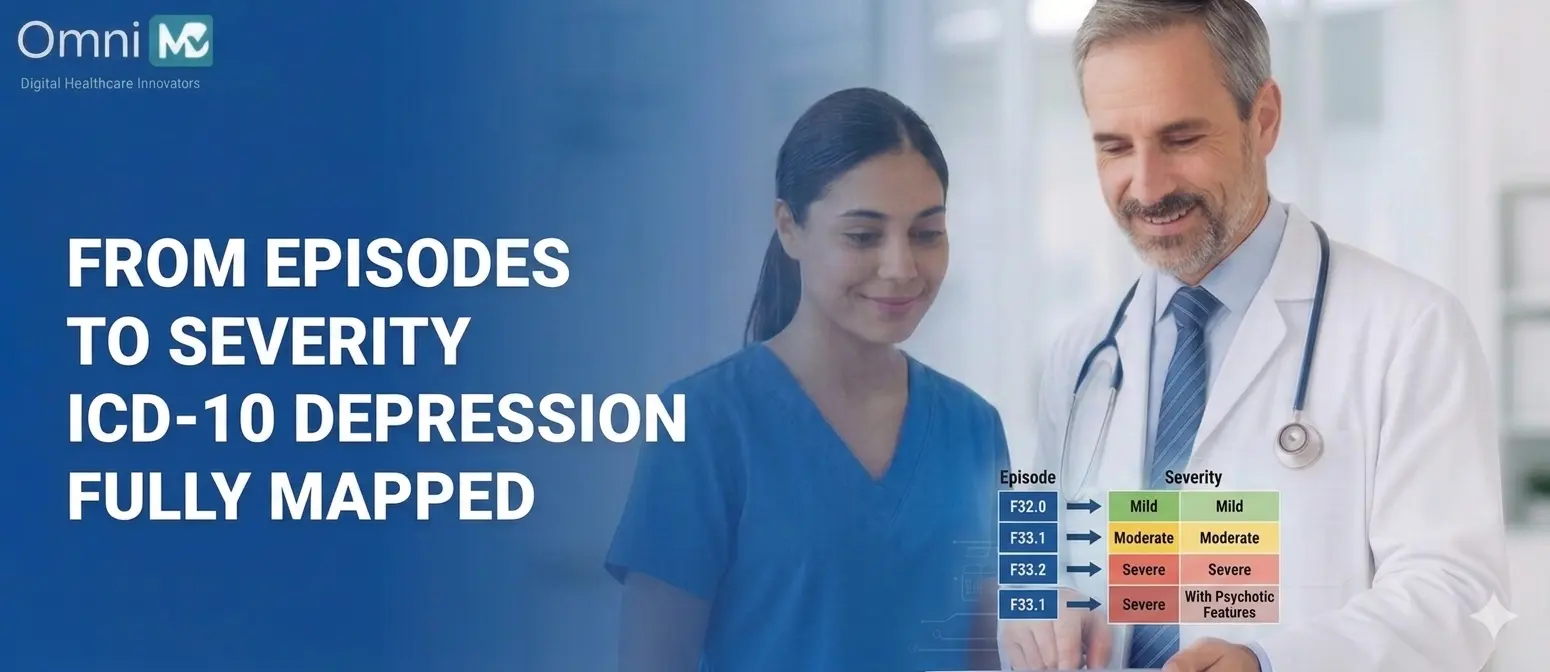
ICD-10 Codes for Depression: Episodes, Severity & Specifiers
Depression doesn’t announce itself the same way twice. It steals quietly from some, crashes loudly into others, and for millions, becomes a relentless cycle that no single episode can fully capture. Behind every patient sitting across from a clinician lives a story that deserves to be documented with precision, because in healthcare, how you name something is how you treat it, fund it, and fight for it.
That’s exactly why understanding ICD-10 codes for depression from F32 single depressive episodes to F33 recurrent depressive disorder, across every severity level and specifier is non-negotiable for any practice that takes both patient outcomes and coding compliance seriously. For context on how these codes sit alongside the broader ICD-10 codes used in behavioral therapy, understanding the full diagnostic picture is essential.
Why Accurate ICD-10 Depression Coding Is a Business Issue, Not Just a Clinical One
Incorrect or under-specified depression codes create problems on multiple fronts for any practice handling significant volumes of mental health diagnoses.
Claim Denials and Underpayment
Payers often require a specific severity level to authorize certain treatments inpatient admission, ECT, combination pharmacotherapy. If your code doesn’t reflect the clinical reality, you may not get paid for what you provided. This is one of the most common drivers behind claim denials in mental health practices.
Audit and Compliance Risk
Consistently using unspecified codes (F32.9, F33.9) when documentation supports a more specific diagnosis is a red flag in payer audits and OIG reviews. Practices with high rates of unspecified coding attract scrutiny far faster than those maintaining specificity.
Continuity of Care Breakdowns
When a patient moves between providers, coders, or care settings, vague codes create gaps. A patient documented as “depression NOS” looks very different from one correctly coded as F33.3, and treatment decisions follow accordingly. The challenges this creates are well-documented in mental health clinical documentation, where coding gaps directly affect downstream care quality.
Quality Metrics and Reporting
Value-based care arrangements increasingly tie reimbursement to outcomes. Accurate diagnosis coding is the foundation of meaningful outcomes measurement, you cannot manage what you cannot precisely define.
Core Diagnostic Criteria: What ICD-10 Requires Before You Code
Before assigning any depression code, the clinical documentation must support all of the following:
- Minimum duration: Symptoms present for at least 2 weeks
- Core symptom triad, at least two of three must be present: depressed mood most of the day nearly every day; markedly diminished interest or pleasure (anhedonia); reduced energy or increased fatigability
- Additional symptoms from the specified list: sleep disturbance, appetite/weight change, psychomotor change, concentration difficulties, feelings of worthlessness or guilt, recurrent thoughts of death or suicidal ideation
- Functional impairment in occupational, social, or other key areas of life
- Exclusion of substance-induced causes, organic illness, or prior manic/hypomanic episode (which would indicate a bipolar code in the F31 block)
Severity is then determined by counting how many additional symptoms are present and assessing the degree of functional impairment, a step many practices skip, defaulting to unspecified codes that invite exactly the kinds of audits described above.
F32: Depressive Episode (Single)
F32 is used when the patient is experiencing their first clinically significant depressive episode, or when there is insufficient documentation of prior episodes. The primary subcodes each carry distinct clinical and billing weight.
F32.0: Mild Depressive Episode
2 core symptoms plus 2 additional symptoms. The patient is distressed but generally able to continue most daily activities, though with effort. Somatic syndrome may or may not be present.
Typical management: Watchful waiting, low-intensity psychological interventions (CBT, guided self-help), or low-dose antidepressant therapy. Often managed in primary care.
F32.1: Moderate Depressive Episode
2 core symptoms plus 3 to 4 additional symptoms. The patient will usually have considerable difficulty continuing with social, work, or domestic activities. Combined treatment, antidepressant plus psychotherapy, tends to outperform either alone at this severity level.
F32.2: Severe Depressive Episode Without Psychotic Symptoms
2 to 3 core symptoms plus 4 or more additional symptoms, several at marked intensity. Suicidal ideation is common. Social and occupational functioning is severely disrupted or near-impossible.
The somatic syndrome is almost invariably present: early morning awakening (2+ hours before usual), diurnal mood variation worst in the morning, marked psychomotor retardation or agitation visible to others, significant appetite loss and weight change, and loss of libido.
Billing implication: This code supports medical necessity for inpatient admission, intensive outpatient programs, and higher-acuity pharmacotherapy. Under-coding to F32.1 can result in denied authorizations for these levels of care.
F32.3: Severe Depressive Episode With Psychotic Symptoms
All criteria of F32.2, plus psychotic features during the current episode. These may be:
- Mood-congruent: Delusions of guilt, nihilistic delusions, delusions of poverty or ruin, somatic delusions, accusatory auditory hallucinations
- Mood-incongruent: Persecutory delusions, thought insertion, referential delusions, content unrelated to depressive themes
- Depressive stupor: Severe psychomotor retardation leading to near-mutism and unresponsiveness
Billing implication: ECT is a first-line treatment option here, and combination antidepressant plus antipsychotic therapy is the pharmacological standard. Missing this code means failing to secure authorization for the treatments the patient actually needs.
F32.8: Other Depressive Episodes
Atypical presentations, masked depression, and mixed anxiety-depressive states that don’t fit the categories above. Often used for presentations with mood reactivity, hypersomnia, hyperphagia, or leaden paralysis (atypical features).
F32.9: Depressive Episode, Unspecified
Used only when severity truly cannot be determined. This should be a last resort, not a default. Over-reliance on this code is one of the most common findings in coding audits of mental health practices.
F33: Recurrent Depressive Disorder
F33 is applied when there is a confirmed history of two or more depressive episodes, separated by at least two months of remission or near-remission. The subcodes mirror F32 in severity structure, but recurrence carries its own clinical and administrative weight.
Establishing recurrence is clinically and administratively significant. It strengthens the case for long-term maintenance antidepressant therapy, informs risk assessment and safety planning, increases the likelihood that specialist psychiatric involvement will be deemed medically necessary, and carries greater weight in prior authorization decisions for higher levels of care. For practices using integrated systems, the top mental health EHR platforms make recurrence documentation and historical episode tracking significantly easier to maintain.
F33.0: Recurrent, Current Episode Mild
History of 2 or more episodes; current episode meets mild severity criteria.
F33.1: Recurrent, Current Episode Moderate
History of 2 or more episodes; current episode meets moderate severity criteria.
F33.2: Recurrent, Current Episode Severe Without Psychotic Symptoms
One of the most clinically serious non-psychotic depression codes. The patient has a documented recurrent illness and is currently in a severe episode, significant functional collapse, pervasive somatic features, active suicidal ideation, and urgent clinical need.
Treatment and documentation: High-dose antidepressants, augmentation strategies (lithium, antipsychotic augmentation, thyroid hormone), or ECT if medication-resistant. Active safety planning must be documented. This code supports inpatient admission, intensive outpatient programs, and complex medication management billing.
F33.3: Recurrent, Current Episode Severe With Psychotic Symptoms
The most severe depressive category in ICD-10. All criteria of F33.2 apply, plus psychotic features, mood-congruent or mood-incongruent delusions, hallucinations, or depressive stupor.
Key differential to document: Schizoaffective disorder (F25) must be ruled out in the clinical notes. If psychotic symptoms persist independently of the mood episode, schizoaffective disorder is the more appropriate code.
Treatment: ECT is often the treatment of choice. Inpatient admission is almost always required and clinically justified. Antidepressant plus antipsychotic combination is the pharmacological standard.
F33.4: Recurrent, Currently in Remission
Two or more prior episodes confirmed, with no significant depressive symptoms for several months. Critical for maintenance prescribing decisions, relapse prevention documentation, and ongoing specialist follow-up justification.
F33.9: Recurrent, Unspecified
Recurrent nature established but current severity unclear. Use sparingly.
Key Specifiers to Document in Clinical Notes
ICD-10 does not append specifier codes the way DSM-5 does, but specifiers documented in clinical notes directly support the severity code selected and strengthen medical necessity arguments. This distinction becomes even more relevant as practices plan for the eventual transition to ICD-11, where specifier documentation will carry forward into the updated framework.
Somatic Syndrome
Document when 5 or more of the following are present: early morning awakening, morning-worst diurnal variation, psychomotor retardation or agitation, appetite loss, weight loss, loss of libido, anhedonia. Its presence upgrades the clinical picture and supports higher severity coding.
With Psychotic Features
Specify mood-congruent vs. mood-incongruent. The distinction carries prognostic significance and influences the differential diagnosis, particularly the schizoaffective disorder ruling discussed under F33.3.
With Melancholic Features
Severe anhedonia, mood non-reactivity, disproportionate guilt, pronounced somatic features. Responds better to biological treatments than psychotherapy alone, documenting this specifier supports authorization for pharmacological intensification.
With Atypical Features
Mood reactivity present; hypersomnia, hyperphagia, leaden paralysis, rejection sensitivity. MAOIs and certain SSRIs show stronger evidence for this subtype. Documenting atypical features can support medication choices that differ from the standard first-line approach.
Seasonal Pattern
Consistent autumn/winter onset with spring/summer remission. Cross-reference with F38.1. Light therapy is a first-line evidence-based option and should be documented alongside the seasonal pattern specifier.
Related Depression Codes You Should Know
The F32/F33 family doesn’t cover every mood disorder a mental health or primary care practice will encounter. The following codes address related presentations that require careful differential documentation:
| Code | Diagnosis | Key Distinction |
|---|---|---|
| F34.0 | Cyclothymia | Persistent mild mood instability, neither pole reaches episode threshold |
| F34.1 | Dysthymia | Chronic depressed mood 2+ years, sub-episode severity |
| F41.2 | Mixed anxiety-depressive disorder | Both present; neither meets standalone threshold |
| F43.21 | Adjustment disorder with depressed mood | Stressor-linked, onset within 3 months |
| F38.1 | Other recurrent mood disorders | Recurrent brief depressive disorder; seasonal patterns |
Common Coding Errors That Trigger Denials and Audits
These are the most frequent depression coding errors found in payer audits and OIG reviews. Practices handling behavioral health diagnoses, particularly those navigating the documentation requirements of HIPAA 42 CFR Part 2 for behavioral health EHR compliance, are especially exposed when coding is under-specified.
Defaulting to Unspecified Codes
F32.9 and F33.9 should never be routine. If the clinical documentation supports a specific severity, the code must reflect it. Auditors look for patterns of unspecified coding as a proxy for documentation gaps, and they find them.
Failing to Establish Recurrence
F33 requires clear documentation of prior episodes with remission periods. Without this in the notes, F32 is the defensible choice, but you may be missing meaningful clinical and financial history that affects authorization decisions.
Overlooking Bipolar History
Always screen and document. Depression in a patient with a prior manic episode is coded under F31 (bipolar affective disorder), not F32 or F33. Miscoding here creates both clinical and compliance problems, and it’s one of the most consequential errors a mental health practice can make.
Missing Psychotic Features
F32.3 and F33.3 have significant treatment and authorization implications. If psychosis is present and documented clinically but not captured in the code, you’re both under-coding and potentially failing to justify the treatments being delivered, a compliance and revenue problem simultaneously.
Under-Coding Severity
Coding “moderate” when clinical documentation clearly supports “severe” is one of the most financially impactful errors in mental health coding. It affects prior authorization, level of care justification, and reimbursement rates, compounding across every affected claim.
Quick Reference: ICD-10 Depression Codes at a Glance
| Code | Description |
|---|---|
| F32.0 | Single episode, mild |
| F32.1 | Single episode, moderate |
| F32.2 | Single episode, severe, no psychosis |
| F32.3 | Single episode, severe with psychosis |
| F32.8 | Single episode, other (atypical, masked) |
| F32.9 | Single episode, unspecified |
| F33.0 | Recurrent, current episode mild |
| F33.1 | Recurrent, current episode moderate |
| F33.2 | Recurrent, current episode severe, no psychosis |
| F33.3 | Recurrent, current episode severe with psychosis |
| F33.4 | Recurrent, currently in remission |
| F33.9 | Recurrent, unspecified |
How OmniMD Helps Practices Get Depression Coding Right
Knowing the codes is one thing. Applying them consistently, accurately, and in compliance with payer requirements across a busy practice is another challenge entirely. That’s where OmniMD’s integrated approach makes a measurable difference.
OmniMD offers an integrated suite of healthcare IT solutions purpose-built for medical practices, including EHR, medical billing services, and revenue cycle management. For mental health practices, OmniMD’s coding and RCM services are designed to close the gap between what clinicians document and what gets coded, billed, and reimbursed.
Coding Accuracy and Specificity
OmniMD’s trained coding specialists understand the nuances of psychiatric diagnosis coding, the F32 vs. F33 distinction, severity level selection, somatic syndrome documentation, and psychotic feature capture. Under-coding and unspecified codes are among the most common revenue leaks in mental health practices, and OmniMD’s workflow is built to catch them before claims go out. A free RCM billing audit can surface exactly where your practice’s depression coding is leaving revenue unclaimed.
Denial Prevention and Audit Readiness
With depression coding errors being a frequent trigger for claim denials and payer audits, OmniMD’s RCM process includes coding reviews aligned with ICD-10 guidelines, so your practice isn’t left vulnerable to the compliance risks outlined in this guide.
EHR-Integrated Documentation Support
OmniMD’s mental health EHR platform is designed to support structured clinical documentation that maps directly to accurate diagnosis coding, making it easier for clinicians to capture the detail that coders and payers need, without adding friction to the clinical workflow.
Final Thoughts
Accurate ICD-10 depression coding is where clinical quality and practice sustainability meet. Getting it right protects your patients, supports your clinicians, and keeps your revenue cycle healthy.
If your practice sees a significant volume of depressive disorder diagnoses, and most mental health practices do, investing in regular coding reviews, clinician documentation training, and periodic audits focused on severity specificity and recurrence documentation pays dividends. The codes covered in this guide, particularly the F33 family and the severe episode codes F32.2, F32.3, F33.2, and F33.3, are the highest-stakes entries in your coding workflow. Staying current with ICD-10-CM updates and their billing accuracy implications is part of that ongoing commitment.
Frequently Asked Questions
How do I code depression in a patient with a bipolar history?
Depression in a patient with a confirmed history of mania or hypomania is coded under F31 (bipolar affective disorder), not F32 or F33. Specifically, F31.3 through F31.5 cover bipolar disorder with a current depressive episode at varying severity levels. Using F32 or F33 here is a coding error with both clinical and compliance consequences.
What does “somatic syndrome” mean in ICD-10 depression coding?
It refers to a cluster of biological symptoms, early morning awakening, mood worst in the morning, visible psychomotor changes, significant appetite and weight loss, and loss of libido, that signal a more severe, biologically-driven episode. Documenting its presence or absence directly strengthens medical necessity and supports the severity code selected.
Is dysthymia the same as depression in ICD-10?
No. Dysthymia (F34.1) is a chronic, persistent low mood lasting at least two years, sitting below the threshold for a full depressive episode. What makes it clinically tricky is “double depression”, where a patient with dysthymia also develops a superimposed depressive episode, which must be coded separately alongside F34.1.
How does ICD-10 depression coding differ from DSM-5?
The core concepts align, but the structure differs. DSM-5 appends specifiers directly to the diagnosis code, while ICD-10 builds severity into the 4th-character subcode and captures specifiers in clinical notes. DSM-5 also uses a single “major depressive disorder” category, whereas ICD-10 formally separates single episode (F32) from recurrent disorder (F33), a distinction that carries real weight in treatment planning and reimbursement.
How often should a practice conduct a depression coding audit?
At minimum, once a year, but high-volume mental health practices benefit from quarterly reviews. Audits should specifically target severity specificity, recurrence documentation, and unspecified code usage. Catching under-coding patterns early prevents compounding revenue loss and keeps the practice ahead of payer scrutiny. A partner like OmniMD can build this into your ongoing RCM workflow so it’s proactive rather than reactive.

Dr. Giriraj Tosh Purohit is an experienced Product Manager and Security officer with a strong background in healthcare technology and management consulting. With expertise spanning clinical workflows, EHR, RCM, Digital Health, and AI-driven products, he has been instrumental in shaping innovative healthcare solutions.