
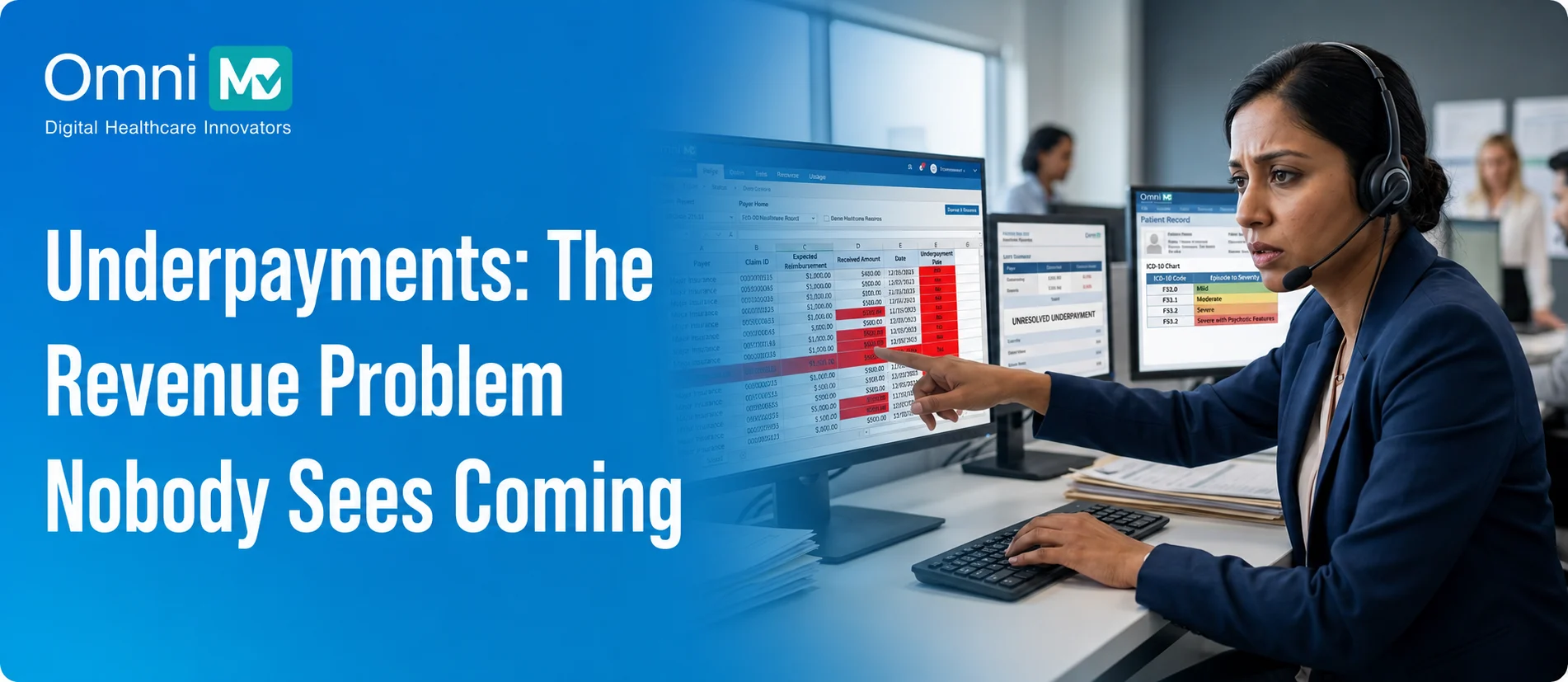
Payer Underpayment Recovery: The Hidden 15% Revenue Gap
Healthcare organizations spend enormous effort improving denial management, reducing AR days, and accelerating collections. Revenue cycle teams monitor rejected claims closely because denials create immediate operational pressure and visible disruptions to cash flow.
But one of the largest sources of revenue leakage often receives far less attention: payer underpayment recovery.
Unlike claim denials, underpayments are difficult to detect because claims are still processed and paid. The reimbursement arrives, the ERA is processed through a medical billing clearinghouse and posts successfully, and the claim disappears from operational focus, even when the payment amount is lower than what the provider was contractually owed.
The dangerous assumption hidden inside every revenue cycle: a paid claim is an accurate claim. It’s often not.
Over time, unnoticed contract underpayment discrepancies can quietly erode margins at scale. That’s why payer underpayment recovery is becoming a growing strategic priority for healthcare providers looking to protect revenue without increasing patient volume.
What Is a Payer Underpayment?
A payer underpayment occurs when reimbursement received is lower than the contracted or expected amount for a healthcare service. Because the discrepancy often appears small on individual claims, it rarely triggers a denial workflow or escalation review, which is exactly why it compounds undetected.
Contract underpayment specifically refers to situations where a payer reimburses below the rates defined in your executed contract, whether due to outdated fee schedule logic, misapplied modifiers, or incorrect contract interpretation.
Common types of payer underpayments include:
- Incorrect or outdated fee schedule application
- Modifier reimbursement errors (25, 59, TC, 26)
- Partial payments for fully billed services
- Downcoded CPT reimbursements
- Multiple procedure reduction errors
- Improper bundling adjustments
- Incorrect patient responsibility calculations
- Claims paid at prior-year contract rates after renewal
Example: A specialty practice submits a properly coded claim with approved modifiers. The payer reimburses using a prior-year contract rate. Since the claim is marked “paid,” it never enters a denial queue. Multiply that across thousands of encounters and the revenue gap becomes material.
Why Payer Underpayment Recovery Gets Overlooked
Most organizations have structured denial management workflows, but contract underpayment rarely receives the same operational attention. Because payment posts successfully, reimbursement variances hide inside normal financial activity.
Key reasons underpayments go undetected:
- Revenue cycle teams prioritize denial queues first
- Manual contract analysis is slow and hard to scale
- High claim volume obscures individual payment variances
- Legacy systems lack reimbursement variance detection
- Small discrepancies appear financially insignificant in isolation
- Appeals filing windows expire before issues are identified
Even a 3 to 5% reimbursement variance across high-volume specialties can translate into hundreds of thousands, or millions of dollars in annual revenue loss. The challenge is not simply recovering that revenue. It’s identifying that it was lost in the first place.
8 Root Causes of Contract Underpayment
Payer underpayments can originate from multiple points within the reimbursement process. Some are isolated claim errors; others reflect systemic issues that affect reimbursement performance over long periods.
1. Outdated Fee Schedules
Payers may continue reimbursing at older contract rates after renewals, especially when reimbursement logic is not properly refreshed following contract updates. This is one of the most common and persistent sources of contract underpayment.
2. Modifier Miscalculations
Incorrect payer processing of modifiers such as 25, 59, TC, and 26 can reduce or eliminate appropriate additional reimbursement without triggering a formal denial.
3. Bundling Errors
Services eligible for separate reimbursement may be incorrectly bundled together, resulting in lower total payment and no visible claim rejection.
4. Downcoding
Claims reimbursed at a lower CPT level than billed reduce reimbursement without triggering a denial, making them especially easy to miss in standard review workflows.
5. Contract Interpretation Inconsistencies
Complex payer agreements often contain reimbursement language that creates misalignment between expected and actual payment, particularly for specialty services or value-based arrangements.
6. Multiple Procedure Reduction Errors
Improper reductions applied to secondary procedures can systematically suppress reimbursement across high-volume specialties over extended periods.
7. No Escalation Workflow for Smaller Variances
Without structured recovery processes, smaller discrepancies may expire before anyone acts on them. Payer underpayment recovery requires deadline-aware workflows to be effective.
8. Limited Variance Monitoring
Organizations relying heavily on manual review struggle to identify recurring underpayment patterns across multiple payers, locations, and contract types.
The Financial Impact of Undetected Payer Underpayments
Underpayments don’t just reduce individual claim reimbursement. They create long-term financial instability by quietly affecting operating margins, forecasting accuracy, and revenue predictability.
Because losses are difficult to identify in real time, leadership may believe reimbursement performance is stable while revenue leakage continues beneath the surface.
Cumulative underpayment exposure affects:
- Cash flow predictability and AR forecasting
- Staffing and operational budget planning
- Technology investment capacity
- Provider compensation models
- Multi-location scalability
- Long-term financial planning and margin stability
How payer underpayments compare to other revenue cycle risks:
| Revenue Cycle Issue | Visibility Level | Immediate Action Taken? | Long-Term Financial Risk |
|---|---|---|---|
| Denials | High | Usually Yes | Moderate |
| Eligibility Errors | Medium | Often Yes | Moderate |
| Payer Underpayments | Low | Often No | Extremely High |
| Contract Underpayment | Very Low | Almost Never | Extremely High |
In today’s environment of compressed margins and rising administrative complexity, contract underpayment represents one of the most significant, and least addressed, forms of hidden revenue erosion.
Why Manual Payer Underpayment Recovery Is No Longer Sustainable
Many healthcare organizations still rely on spreadsheets, manual audits, and staff review processes to identify reimbursement discrepancies. While these methods may surface isolated issues, they cannot keep pace with the complexity of modern payer contracts.
Today, organizations manage:
- Thousands of payer contract variations across specialties
- Frequent mid-year reimbursement updates
- Complex modifier and bundling rules by payer
- Multi-location billing workflows
- High daily claim volumes with no automated variance flagging
As administrative demands grow, manual review becomes reactive rather than proactive. Teams focus on visible denial queues while contract underpayment continues accumulating unnoticed.
Organizations cannot recover revenue they never detect. This is why automation has become essential for sustainable payer underpayment recovery.
OmniMD’s medical billing software compares every remittance against contracted payer rates automatically, flags underpayments at posting, and tracks appeal status by payer, eliminating the manual spreadsheet workflows that let systematic underpayments go unrecovered.
From Reactive Recovery to Proactive Revenue Protection
Healthcare organizations that consistently perform well in payer underpayment recovery share one operational shift in common: they stop treating underpayments as exceptions and start treating them as expected variance points requiring continuous monitoring.
This shift changes daily revenue cycle operations:
- Reimbursement accuracy is monitored continuously, not audited retroactively
- Payer behavior trends are identified earlier in the payment cycle
- Contract underpayment discrepancies are addressed before filing deadlines expire
- Contract expectations are reconciled against actual payment behavior in near real-time
- Dependency on retrospective audits is reduced
Over time, this creates a more stable and predictable revenue cycle where financial performance is based on actual contracted reimbursement, not assumed payment accuracy.
Building a High-Performance Payer Underpayment Recovery Strategy
Effective underpayment recovery requires more than occasional audits. It demands structured, continuous processes that improve reimbursement visibility while enabling faster intervention.
Regular Contract Reviews
Payer agreements should be reviewed on a defined schedule to ensure reimbursement expectations stay accurate across all active contracts. Rate changes, renewals, and addenda must be reflected promptly in internal fee schedules.
Automated Variance Detection
Technology-enabled variance detection reduces dependence on manual review and identifies contract underpayment discrepancies at scale, across high claim volumes, multiple payers, and complex specialty billing.
Prioritized Recovery Workflows
Not every underpayment requires the same level of escalation. Prioritization ensures resources are focused on high-impact recovery opportunities with the strongest ROI and clearest appeal path.
Standardized Appeals Processes
Consistent follow-up procedures reduce missed deadlines and improve recovery rates. Filing deadline awareness must be built into underpayment recovery workflows from the start.
Ongoing Payer Trend Monitoring
Tracking repeat issues across payers surfaces systemic contract underpayment patterns earlier, enabling proactive negotiation and contract correction.
Real-Time Revenue Analytics
Improved financial visibility supports better forecasting, operational planning, and revenue cycle decision-making at both the practice and executive level.
7 Questions Every Revenue Cycle Leader Should Be Able to Answer
Many providers underestimate the scope of existing reimbursement leakage. If your team cannot answer these questions clearly, contract underpayment may already be affecting your financial performance:
- Do we know our expected reimbursement rates by payer and CPT?
- How frequently are payment variances reviewed, and by whom?
- Are smaller discrepancies being ignored due to staff workload?
- Can we identify recurring underpayment trends across specialties and locations?
- Are appeals consistently initiated before payer filing deadlines expire?
- Do our current systems support automated recovery workflows?
- Do we have a documented estimate of potential revenue leakage today?
If these questions are difficult to answer, payer underpayment recovery may represent your single largest untapped revenue opportunity.
How OmniMD Helps Close the Underpayment Gap
Identifying underpayments is only half the challenge. The real difficulty lies in detecting them consistently, across high claim volumes, multiple payer contracts, and constantly changing reimbursement rules.
At OmniMD, payer underpayment recovery is addressed as part of a broader revenue cycle intelligence approach designed to improve reimbursement accuracy and financial visibility at scale.
Key capabilities that support underpayment recovery:
- Automated payment variance detection benchmarked against contracted rates
- Real-time reimbursement analysis across CPTs, modifiers, and specialties
- Identification of recurring payer-specific contract underpayment patterns
- Workflow-driven escalation and recovery prioritization
- Integrated revenue cycle analytics for leadership-level financial transparency
- Appeals tracking, deadline monitoring, and follow-up efficiency
What makes this approach effective is not detection alone, it’s operational alignment. Revenue cycle teams move from reactive review cycles to proactive revenue protection, where underpayments are flagged as part of daily workflow rather than discovered months later during audits.
Why Payer Underpayment Recovery Will Become a Bigger Priority
Healthcare organizations are operating under increasing financial pressure from multiple directions. Narrower margins, rising administrative complexity, and evolving reimbursement models are forcing providers to become more proactive about revenue protection.
Trends accelerating the urgency of underpayment recovery:
- Increasing payer contract complexity across commercial and government payers
- Greater financial pressure on health systems and independent practices
- Growth of value-based and performance-tied reimbursement models
- Rising administrative costs requiring automation to offset
- Higher demand for financial transparency from boards and leadership
Organizations that build strong payer underpayment recovery infrastructure now will be better positioned to protect margins and sustain financial performance through continued industry change.
Strengthen Your Revenue Cycle Visibility
Payer underpayments rarely appear as urgent issues, but over time, they can significantly impact financial performance without being immediately visible in standard reporting.
Improving visibility into reimbursement accuracy is the first step toward closing that gap.
With solutions designed to support revenue cycle data analytics, automation, and reimbursement tracking, OmniMD helps healthcare organizations move from reactive revenue recovery to proactive financial protection.
Take the Next Step
- Identify hidden reimbursement leakage
- Improve payer contract visibility
- Strengthen underpayment recovery workflows
- Enhance overall revenue cycle performance
Because in healthcare revenue cycle management, what you don’t see can still cost you.
Stop Letting Underpayments Go Unnoticed
See how OmniMD helps healthcare organizations strengthen reimbursement visibility, reduce revenue leakage, and improve underpayment recovery through intelligent revenue cycle management solutions.
Frequently Asked Questions (FAQ)
How is a payer underpayment different from a denial?
A denial means the claim was not paid at all. An underpayment means the claim was paid, but for less than the contracted amount. Underpayments are harder to detect because they don’t interrupt cash flow or trigger denial workflows, the payment simply posts at the wrong amount.
Why do contract underpayments often go unnoticed?
Most revenue cycle systems are built to flag denials and rejections. Once a claim is marked “paid,” small reimbursement variances are rarely reviewed unless specific payer underpayment recovery processes are in place. Without automated variance detection, discrepancies accumulate silently.
Which organizations are most at risk?
Any organization with high claim volumes and multiple payer contracts is exposed. Specialty practices, multi-location health systems, and complex billing environments carry higher risk due to reimbursement variability and contract intricacy. Industry estimates suggest underpayments affect 3 to 15% of total billed revenue.
Can underpayments be recovered after payment has posted?
Yes, through structured appeals, contract reconciliation, or payer correction processes. However, recovery success depends heavily on timely detection. Once payer filing deadlines pass, recovery is often no longer possible, which is why early identification matters.
What role does automation play in payer underpayment recovery?
Automation enables variance detection at scale, across claim volumes, payers, and contract types that manual review cannot efficiently cover. It speeds up identification, improves recovery prioritization, and supports proactive monitoring of payer performance trends over time.

Divan Dave is the Founder and CEO of OmniMD, a pioneering healthcare IT company he established in 2002. With over two decades of leadership, Mr. Dave has been instrumental in transforming traditional care delivery into modern, data-driven digital health systems.