
Align Your EHR With USCDI v3 Before the Mandate Forces You
Healthcare is not slowing down. Clinics today are expected to move faster clinically, operationally, and digitally. Keeping your EHR current is no longer optional. It is a basic requirement for staying compliant and delivering consistent care.
With the introduction of USCDI v3 mandate, practices are facing an important shift. Now EHR systems must support a broader and more detailed set of data standards before federal requirements take effect. Delaying alignment can create avoidable challenges, including workflow disruptions, compliance risks, and missed opportunities for smoother patient care.At OmniMD, we recognise that interoperability and compliance can feel overwhelming. That is exactly why our EHR is designed to simplify EHR alignment with USCDI v3 for clinics of all sizes. Preparing beforehand allows practices to stay focused on patient care while meeting evolving federal expectations.
What is USCDI v3?
USCDI stands for the United States Core Data for Interoperability. It defines a standardized set of health data that certified EHR systems are required to capture and exchange in a consistent way.
USCDI v3 compliance represents the latest update (version 3) to this framework. Compared to earlier versions, it expands the scope of required data to make sure that the health information is more complete, usable, and shareable across systems. These additions are designed to support better coordination, reporting, and clinical decision making.
Key USCDI v3 data elements include:
- Expanded demographic information, such as race, ethnicity, gender identity, disability status, and caregiver details
- Social determinants of health, including housing stability, food security, education, employment, and social support
- Health insurance information, such as payer details, plan types, and coverage periods
- Structured care team data showing all providers involved in a patient’s care
By standardising these data elements, USCDI v3 strengthens healthcare data standards and ensures that patient information can move accurately between systems. This reduces fragmentation and supports better outcomes.For clinics, this means an EHR must do more than store information. It must be able to exchange it securely and consistently. Aligning early helps practices stay ahead of the 2026 deadline tied to federal EHR compliance requirements.
Why Aligning Your EHR Matters
Waiting to align your EHR with USCDI v3 introduces unnecessary risk. Clinics that prepare early gain more control and experience far fewer disruptions.
1. Compliance with Federal Mandates
USCDI v3 alignment is required to meet federal health IT standards. Clinics that fall behind may face certification challenges or penalties. Early preparation helps ensure compliance without last minute pressure.
2. Improved Patient Care
Standardized data allows clinicians to access more complete patient records across care settings. This reduces duplicate testing, improves continuity of care, and supports better clinical decisions.
3. Enhanced EHR Interoperability
Alignment strengthens health data interoperability, allowing patient information to move securely between interoperable EHR systems. Referrals, transitions of care, and follow-ups become more efficient when systems speak the same language.
4. Operational Efficiency
When an EHR is aligned with USCDI v3, staff spend less time correcting incomplete or inconsistent records. Workflows become more predictable, freeing teams to focus on patients instead of manual data cleanup.
Aligning your EHR is not just about compliance. It is a strategic investment in long term efficiency and care quality.
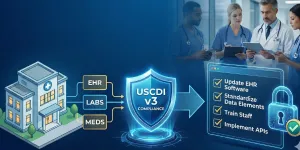
Steps to Align Your EHR With USCDI v3
USCDI v3 alignment does not need to be complex. A structured approach helps clinics move forward with confidence.
1. Map Your Data Elements
Begin by reviewing existing EHR data fields. Identify gaps where required USCDI v3 elements, such as social determinants or caregiver information, are missing or inconsistently captured. Clear mapping provides a strong foundation.
2. Update Forms and Workflows
Once gaps are identified, update intake forms, clinical documentation, and questionnaires to capture required information. Standardized workflows help maintain accuracy and reduce variation across teams.
3. Ensure Interoperability Readiness
USCDI v3 relies on FHIR based data exchange to support secure and standardized communication. Your EHR should be able to send and receive required data across systems while supporting broader interoperable EHR systems.
4. Test and Validate
Testing should occur well before deadlines approach. Validate that data is captured correctly, exchanged accurately, and accessible where needed. Early testing reduces compliance risk.
5. Train Clinical and Administrative Teams
Staff should understand why new data elements matter and how they fit into daily workflows. Clear training improves adoption and reduces friction during implementation.
Following these steps helps clinics meet USCDI v3 requirements without disruption.
How OmniMD Helps Clinics Prepare
OmniMD simplifies USCDI v3 compliance by embedding interoperability and regulatory readiness directly into everyday workflows.
- Built-in compliance tools support required data capture without additional software
- Data mapping and validation help maintain accuracy and completeness
- Standards based APIs support secure data exchange
- Multi-specialty readiness ensures alignment across care models
- User friendly workflows minimize training time and operational impact
With OmniMD, clinics can focus on patient care while we manage the complexity of evolving health data interoperability requirements.
Final Thoughts
USCDI v3 is more than a regulatory update. It reflects a broader shift toward connected care, reliable data exchange, and stronger coordination across healthcare systems.
Clinics that prepare early avoid rushed upgrades and reduce long term operational strain. More importantly, they build a foundation that supports both compliance and quality care as healthcare data standards continue to evolve.
At OmniMD, we help practices navigate these changes with confidence. Aligning your EHR today supports compliance, improves efficiency, and positions your clinic for what comes next.
USCDI v3 Deadline Is Coming
Is your EHR ready? Avoid compliance risks and revenue disruption.