
The Best Alternative to NextGen EHR You Probably Haven’t Heard Of Yet
NextGen has a certain kind of gravity in the ambulatory EHR world. It has been around since 1974, it has the awards on its website, it comes up in conversations between practice managers, and it has enough name recognition that searching for it feels like the responsible first step. Nobody gets questioned for looking at NextGen. It is the safe choice.
But safe and right are not always the same thing. And the practices that tend to find this page are usually the ones who already know the difference, because they have been living it.
First, Some Context on Both Platforms
NextGen Healthcare has been around since 1974. It started as a company called Quality Systems, Inc., built initially for dental practices by founder Sheldon Razin.
Over the decades, NextGen Healthcare has expanded into ambulatory care, added EHR capabilities in the early 2000s, went public on NASDAQ, and eventually rebranded as NextGen Healthcare in 2018.
The company history shows a long list of accolades, including a string of top rankings in Black Book Research and strong recognition from KLAS for its specialty and behavioral health products.
In 2025, NextGen went through a significant ownership shift. Private equity firm Thoma Bravo, which had held a majority stake, brought in a new co-investor called Madison Dearborn Partners. A new CEO, Srinivas Velamoor, was named to take the top spot after a planned transition.
That is not a red flag on its own. But it is worth knowing when you are thinking about a long-term platform decision. Ownership changes at PE-backed software companies tend to affect priorities over time, whether that is pricing, support structure, or product roadmap.
Today, NextGen positions itself as a full ambulatory platform. Its main offerings include:
- EHR and practice management
- Medical billing and revenue cycle support
- Patient engagement and portal tools
- Telehealth
- AI documentation features
It comes in two main products: NextGen Enterprise for larger specialty practices and NextGen Office for smaller clinics.
OmniMD’s Story is Less About Headlines and More About Staying Power
What began as five people in a modest New York room is now, two decades later, a platform serving over 12,000 medical professionals across more than 600 facilities and 20+ specialties.
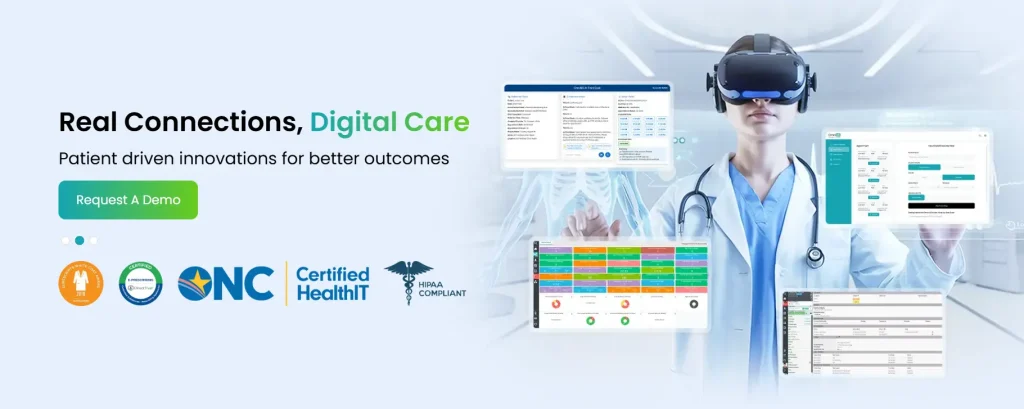
Founded in 2002 as part of Integrated Systems Management, a technology firm with roots in software development and enterprise solutions, OmniMD was already building clinical and financial tools for healthcare practices in an era when many of its current competitors were still in their planning stages.
It has grown without outside funding, which means the company has had to earn its customers the hard way, by delivering results rather than by outspending competitors on marketing.
💡 Here’s what we offer today, all built as one connected system from the start:
- EHR with specialty-specific templates across 20+ specialties
- Practice management and scheduling
- Revenue cycle management and billing
- Telehealth
- AI Medical Scribe, AI Front Desk, and AI Clinician
- Remote patient monitoring
- Patient engagement and portal tools
- Chronic care management
- Interoperability tools built on FHIR, HL7, JSON, and XML
Where NextGen Does Well, and Where Clinicians Start to Feel the Gap
Before anything else,
NextGen is not a bad product.
It would not have survived 50 years in one of the toughest software markets in the world if it were.
For large, multi-specialty ambulatory groups with dedicated IT staff, experienced administrators, and the budget to match, NextGen Enterprise can genuinely deliver.
But a lot of practices are not that. And for them, the experience looks a little different.
Here is what real users have been saying as recently as 2025 and 2026.
#1. The system can feel like a lot to take on.
Verified NextGen Office users on Capterra describe the learning curve this way:
“The features are extensive, but it is like being thrown into an airplane cockpit and told to figure out how to fly on your own.”
This is a recurring theme.
NextGen is highly configurable, which is a genuine strength, but that configurability comes with a steep learning curve and, often, a heavy reliance on consultants or internal power users just to get the system set up properly.
Users on TrustRadius say the same thing:
“Tech-savvy staff can accomplish a lot, but people who are not as comfortable with computers can really struggle.”
💡 In a typical medical office, not everyone is a power user. When a platform requires that, it secretly transfers a hidden cost onto the practice.
#2. Performance issues that go beyond occasional slowness.
Across verified reviews on multiple platforms, another, the most common complaint is speed.
An evidence-based analysis of NextGen user feedback published in early 2026 found that performance issues persist even on modern hardware, suggesting the bottleneck is architectural, rooted in NextGen’s legacy client-server design, rather than something a practice can fix by upgrading its computers.
The impact of that slowness compounds across a full patient day:
- Charting delays that push documentation well beyond the clinical encounter
- Scheduling lag that frustrates front-desk staff and slows patient check-in
- Claims processing bottlenecks that delay revenue cycle timelines
- Provider frustration that contributes to burnout and staff turnover
💡 If the problem were hardware, you could buy new computers. When the problem is how the software was originally built, that is harder to outrun.
#3. An integration approach that works differently from most modern platforms.
The same 2026 analysis called out NextGen’s closed API as a notable outlier among EHR platforms.
Users report that NextGen Office limits other platforms from integrating via API, while most competitors offer open APIs that enable seamless access.
💡 The practical consequences for your practice include:
- Vendor lock-in, where you are forced to use NextGen’s own modules for functionality that competitors enable through standard integrations
- Manual data re-entry between systems, which introduces errors and consumes staff hours
- Third-party AI, patient engagement, and analytics tools that simply cannot connect
- A migration path that becomes significantly harder and more expensive over time
#4. Known bugs that stay known for a long time.
On Capterra’s Enterprise review page, one administrator put it as:
“We are constantly dealing with known issues that are not resolved. We have issues with the portal experience and often hear about them too late. It’s honestly embarrassing to have to constantly tell patients we are having issues with the portal.”
Another IT director on the same page was more direct:
“I cannot wait to get out of our NextGen contract and move to a company that does not feel like a sinking ship.”
💡 That specific word, embarrassing, says something real. When a platform issue becomes something a provider has to explain to their patients, it stops being a vendor problem and becomes a trust problem.
#5. Support that some users say has declined.
Users who left detailed feedback on SoftwareFinder pointed to a clear shift after recent ownership transitions, with experienced support staff let go and the function becoming more outsourced.
Reviewers on Software Advice surface similar themes, describing support responses that do not actually address the problem and resolution timelines that drag into days or weeks. One reviewer put it bluntly:
“Customer service is non-existent as prices continue to soar.”
Not everyone’s experience. But a pattern worth taking seriously before you sign a multi-year contract.
#6. The patient portal.
In 2026, patient-facing tools are not a nice-to-have. They are part of how practices keep patients engaged and reduce no-shows, refill calls, and front-desk volume. A portal that requires workarounds or frustrates patients lands squarely back on your staff.
Across review platforms, a consistent complaint is that NextGen’s texting and emailing tools are ineffective without the patient portal, and the portal itself needs meaningful updates to stay competitive in the current landscape.
So Where Does OmniMD Come In?
If you have read this far, you are probably not looking for someone to tell you NextGen is terrible. You are looking for someone to tell you honestly whether there is something better for the kind of practice you run or want to run. That is a fair question and it deserves a real answer.
OmniMD is not a bigger, flashier version of NextGen. It is a different kind of platform, built from a different starting point. It was designed to work just as seamlessly for solo providers as it does for growing, multi-specialty medical groups, which means you are not paying for a system built for 200-provider health systems and trying to shrink it down to fit a 5-provider practice.
Here is where OmniMD tends to make the clearest difference for practices that have been frustrated with their current setup.
#1. Everything is actually connected.
OmniMD’s EHR, practice management, billing, and AI tools were all built as one system, not assembled through acquisitions.
💡 That means when you move through a full patient workflow, nothing falls through the gaps between systems that were not originally designed to talk to each other:
- Schedule the patient
- Verify eligibility in real time
- Document the visit with AI-assisted charting
- Send a clean claim
- Track and follow up on any denials
All of that happens inside the same data environment, with no manual handoffs between disconnected platforms.
#2. AI that does real work, not just demo-stage features.
OmniMD’s AI Medical Scribe converts ambient, real-time conversation into structured clinical notes without requiring a separate device or a second screen. Alongside it, the AI Front Desk handles scheduling and intake as a HIPAA-compliant conversational agent, and the AI Clinician supports clinical decision-making at the point of care.
💡 These are not add-ons you negotiate separately or features that live behind an extra fee tier. They are part of the platform. For a practice trying to reduce the time providers spend charting after hours, or reduce the load on front-desk staff, they address real, daily friction.
#3. Specialty coverage that is surprisingly broad.
OmniMD is built for more than 20+ medical specialties, each with purpose-built templates and workflows covering cardiology, orthopedics, mental health, urgent care, pulmonology, rheumatology, and more.
💡 You are not repurposing a generic template and hoping it holds up under audit. The clinical documentation is built around how your specialty actually works.
#4. Support that practices describe as a partnership, not a ticket system.
Users who have compared OmniMD to other platforms consistently describe the support model as a genuine partnership rather than a ticket queue.
When you are dealing with a billing issue or a workflow problem, the difference between reaching someone who knows your setup and submitting a ticket to a general queue is not small. It is the difference between a problem resolved today and a problem that sits for a week.
#5. Open interoperability.
OmniMD connects with major labs and other EHR systems through its interoperability platform, supporting seamless data exchange using FHIR, HL7, JSON, and XML standards.
💡 With us, you are not locked into a closed ecosystem, and adding third-party tools doesn’t require a workaround.
Who Should Seriously Consider Making a Switch
Ofcourse, this is not a message for everyone. If you are a large multi-specialty group with a dedicated IT team, established NextGen workflows, and the internal resources to maintain them, the calculus of switching is genuinely complicated and may not be the right move right now.
💡 But if you recognize yourself in any of these situations, it is worth having a real conversation about what else exists:
- You are a small to mid-sized practice, maybe 1 to 20 providers, and NextGen feels like more system than you actually need, requiring more setup time, more training, and more ongoing management than you have capacity for.
- You are spending too much time on documentation. Providers are staying late to finish charts, and the AI tools you were promised have not meaningfully changed that reality.
- Your front desk is still manually handling things that should be automated, like insurance verification, appointment reminders, and intake forms.
- Your patient portal is generating friction instead of solving it, and patients are calling the office for things that should be self-service.
- You are locked into a contract and dreading what renewal looks like, especially if prices have been climbing while the support has felt thinner.
- You are brand new to this and your colleague mentioned NextGen, so you started there, but you have not signed anything yet and you want to know what else is out there before you commit.
An Actionable Takeaway
NextGen built something real over 50 years, and it still works well for the practices it was designed to serve at scale. That is worth acknowledging, and this page is not trying to pretend otherwise.
But the healthcare software market has changed significantly. AI documentation, open interoperability, unified platforms, and genuine specialty depth are no longer differentiators. They are baseline expectations. And the question for any practice evaluating software in 2026 is not which brand has been around the longest. It is which platform actually fits how you work, what you can afford, and where you want to be in five years.
OmniMD has been through the full arc of healthcare IT, from the early era of paper conversion to ONC-certified EHRs to AI-powered clinical tools today. It has done that without outside funding, without a headline acquisition, and without changing hands between private equity firms. It has just kept building and kept serving the practices that rely on it.
A 30-minute demo will tell you more than any checklist ever will.

Dr. Giriraj Tosh Purohit is an experienced Product Manager and Security officer with a strong background in healthcare technology and management consulting. With expertise spanning clinical workflows, EHR, RCM, Digital Health, and AI-driven products, he has been instrumental in shaping innovative healthcare solutions.