
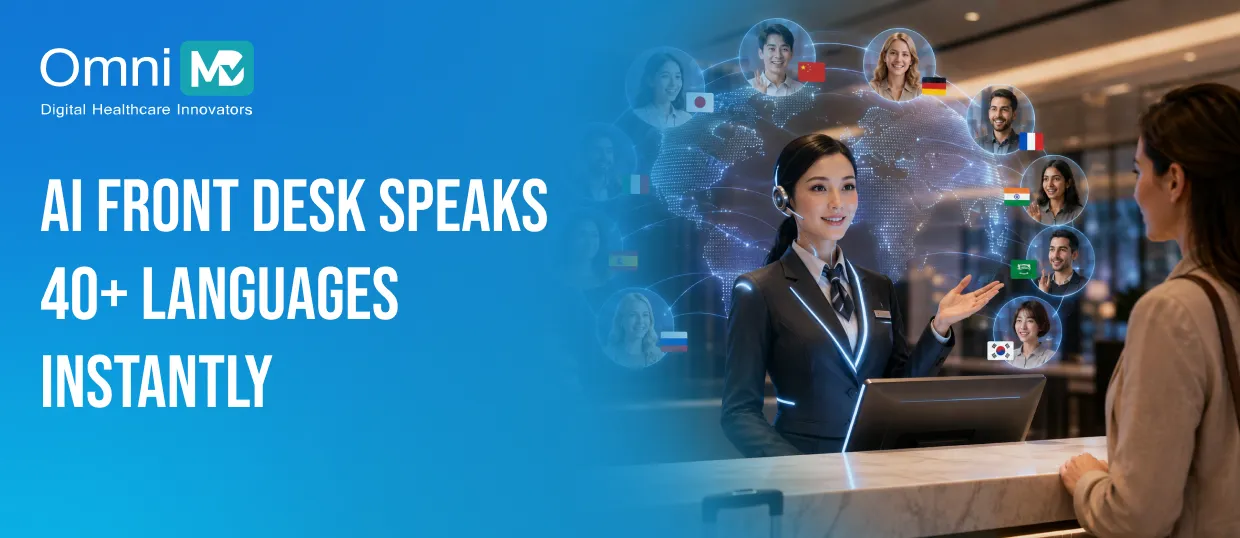
Section 1557 in 2026: How AI Front Desks Help US Clinics Close the Language Gap (Without Adding Headcount)
About 68 million people in the US speak a language other than English at home, and 8.2 percent of the population speaks English less than very well, and that is before you even get to the compliance piece.
Here is where it shows up in your numbers:
- The financial impact runs $150,000 or more a year for a multi-physician practice, per AgentZap’s data.
- 23% of calls to medical practices go unanswered, per AgentZap’s report, whether from hold time, voicemail, or a disconnect.
- Solo and small practices see even higher miss rates, often 30% or more, per the same phone statistics.
Now stack a language mismatch on top of that missed call. The patient does not leave a voicemail and wait. They call the practice down the street that answers in Spanish, Vietnamese, or Mandarin, and you never find out you lost them. This carries a health cost too, not just a revenue one.
A 2024 study in the Permanente Journal looked at inpatient stays at a rural academic hospital and found Spanish speaking patients stayed 2.34 days longer on average than English speaking patients.
That health cost is exactly what pulled regulators into this space, which brings us to Section 1557.
What Section 1557 Requires (and Why You’re Probably Already Behind)
Section 1557 of the Affordable Care Act says you can’t discriminate based on race, color, national origin, sex, age, or disability in your health programs, and language access falls under that. The current requirements are outlined in the 2024 final rule.
Here’s what this means for your practice?
- If you’ve got 15 or more employees, you need someone officially designated to coordinate compliance, plus a written grievance procedure on file, as the same FAQ page explains.
- As HHS’s own FAQ page says, if you take any federal money at all, including Medicare or Medicaid, this rule applies to you.
- You also need a Notice of Availability that covers English plus the top 15 languages spoken by people with Limited English Proficiency (LEP) in your state. That’s spelled out in 45 CFR 92.11. It has to be posted both in your office and on your website, and it can’t be buried three clicks deep in a footer.
But you can’t just point to Maria at the front desk because she speaks pretty good Spanish. OCR’s letter says plainly that self-identified bilingual staff doesn’t satisfy the requirement. And if you’re leaning on machine translation for anything important, like a consent form or discharge instructions, a real human translator still needs to check it before it goes out.
One more thing that changed recently and is worth flagging. Practices used to be told to check LEP.gov to find their state’s top 15 languages. That site was suspended in 2025 as part of a broader federal policy shift on language access, and no replacement has been published yet. But your compliance obligation didn’t go away, just the government’s central tool for it. So, pull the numbers straight from the US Census Bureau’s American Community Survey language data instead, and use HHS’s own translated notice templates, which are hosted directly on hhs.gov and don’t depend on the suspended site.
However, the deadline for all this already passed. So if your notice isn’t posted yet, this isn’t something to plan for next quarter. It’s overdue.
Why This Is Harder Than It Sounds
Even practices that want to do this right run into a wall, because there just aren’t enough certified medical interpreters to go around. A Baylor University study published in February 2026 found the interpreter shortage isn’t easing up. What happens instead is bilingual staff, with zero formal training, get pulled into exam rooms to translate symptoms, questions, and instructions on the fly.
That’s not a great situation. Untrained interpretation carries real risk. A family member might soften a diagnosis to protect someone’s feelings. A patient might nod along because they don’t want to admit they didn’t catch the dosage instructions. None of that is really anyone’s fault, but it’s exactly the kind of gap Section 1557 is trying to close.
So the real question isn’t whether you need language access. You do. It’s how you handle the routine stuff without spending your entire interpreter budget on calls that never needed a certified human in the first place.
Where an AI Front Desk Helps (and Where It Doesn’t)
A multilingual AI front desk isn’t trying to replace the interpreter in your exam room. Its job is simpler: catch the call before it becomes a patient you never hear from again, and do it in whatever language the patient is already speaking.
Here’s a fuller picture of what a well built AI front desk covers, and how each piece connects back to your language access plan.
- Language detection and call handling: It picks up on the caller’s language in the first few seconds and greets them in it, no transfer, no hold music while someone tracks down a Spanish speaking staff member. It can also answer calls, texts, web chat, and patient portal messages all at once, across every channel a patient might reach out on, and it identifies the patient against your existing record within seconds.
- Online and self-service scheduling: Patients book, reschedule, or cancel appointments themselves through your website, a scheduling assistant, or a mobile app, in their own language, without playing phone tag with your front desk.
- Digital patient intake with special requests logged upfront: This is the piece that ties directly back to Section 1557. A properly built intake flow captures special requests like interpreter needs, wheelchair access, or a preferred provider at the moment of booking, and routes that information to staff automatically, before the patient walks in the door. Your team knows in advance that a live interpreter needs to be arranged for a specific visit, instead of scrambling for one in the waiting room.
- Real-time insurance verification: Eligibility, coverage, referrals, and prior authorizations get checked instantly, and anything missing gets flagged before the visit instead of at check-in. For a multilingual patient population, that removes one more layer of back and forth that used to require a phone call in a language your staff may not speak fluently.
- Preferred language capture that follows the patient: Once a patient’s language preference is on file, it stays attached to their record instead of getting asked again at every single visit. That’s exactly the kind of documentation OCR wants to see as part of a working language access plan.
- Automated after-visit follow-up: Once the visit is done, patients get their summaries, lab results, and next steps automatically, and can get their questions answered around the clock instead of leaving a voicemail nobody picks up until morning.
- Sentiment tracking on every call: Some systems run sentiment analysis in real time and flag a frustrated or at-risk patient before that frustration turns into a lost patient. For a caller who’s already navigating a language barrier, catching that frustration early and routing them to a human matters even more.
- Around the clock coverage: It’s there at 8pm on a Saturday, not just 9 to 5, which covers exactly the hours when a lot of LEP patients call because that’s when they’re off work themselves too.
- Clean handoff when something needs a person: When a call needs clinical judgment, involves a complex insurance dispute, or touches on something sensitive, the AI routes it to a staff member with a full transcript attached, so the patient never has to repeat themselves from scratch and nothing falls through the cracks.
- Specialty-specific setup: Intake questions, insurance rules, and follow-up steps get configured per specialty, so a wound care practice, a behavioral health clinic, and a primary care office each get workflows built around how they actually run, not one generic script stretched across everyone.
- HIPAA and SOC 2 Type II compliance, built in from the start: Every interaction runs on a compliant platform with encryption, access controls, and audit trails, which matters just as much for language access documentation as it does for anything else in the chart.
Though AI translation works fine for administrative tasks like scheduling and intake, it is not a substitute for a qualified interpreter when it comes to clinical conversations or informed consent. Those moments still need a real, trained human. What AI does is free up your interpreter budget for the calls that require one, instead of spending it on someone who just wanted to reschedule an appointment.
A full time medical receptionist’s base salary at $42,000 to $55,000 a year, before benefits or turnover. A practice running two or three front desk staff can spend $120,000 to $180,000 a year on reception labor before a single patient is seen. An AI system runs on a subscription instead, handles unlimited calls at once instead of one at a time, and doesn’t take sick days or need HIPAA retraining every year. For a practice trying to fund both a language access plan and a solid interpreter budget at the same time, that math is worth sitting down with.
How to Build This Out
- Pull your state’s top 15 LEP languages from Census Bureau ACS language data, since LEP.gov is currently down, and check that your Notice of Availability is posted everywhere it needs to be, on site and online. If it’s not there yet, treat this as a today problem, not a someday problem.
- Use HHS’s own translated notice templates on hhs.gov instead of waiting on a replacement for LEP.gov.
- Figure out how your EHR needs to talk to whatever front desk system you use, so a patient’s language preference and interpreter needs to follow them instead of getting re-asked every visit.
- Decide, in writing, which calls the AI system handles (scheduling, intake, billing, after hours) and which ones always go to a person or a contracted interpreter (consent, diagnosis, anything clinical).
- If you’ve got 15+ employees, name your Section 1557 coordinator and put it on paper.
- Write down your escalation path. One page is enough. Just show who handles what and how a call gets routed to a live interpreter when it needs one. That’s what OCR wants to see if they ever come asking.
This is where a healthcare specific AI front desk tends to pay for itself the fastest. OmniMD’s AI Front Desk, for instance, is built directly into the OmniMD EHR rather than bolted on through a separate API, so scheduling, insurance verification, patient communication, and special requests like interpreter needs write straight into the same chart your providers work from. No middleware layer to reconcile, no sync delay. That kind of setup is the difference between a language access plan that looks good on paper and one that holds up when someone calls after hours needing help in a language your front desk doesn’t speak.
FAQs
Does Section 1557 apply to my clinic?
If you take any federal funding, Medicare or Medicaid included, yes, per the HHS FAQ.
What languages does my Notice of Availability need to cover?
English plus your state’s top 15 LEP languages, per 45 CFR 92.11. Pull the language data from the Census Bureau since LEP.gov is currently suspended.
Is AI translation enough on its own to be compliant?
For scheduling and intake, yes. For clinical encounters and informed consent, no, you still need a qualified human interpreter, per OCR’s December letter.
Can AI just replace human interpreters completely?
No, and it isn’t meant to. It cuts down how often you need one for routine calls, but clinical settings still need a real person, and it doesn’t fix the interpreter shortage on its own.
What happens if the AI can’t handle a patient’s question?
A well built system routes the call to a staff member with a full transcript attached, so the patient doesn’t have to repeat themselves and no call gets dropped.
What if my practice hasn’t posted the notice yet?
Don’t wait. The rule has been in effect since July 2024, so this is an active gap, not a future deadline.
Did the recent court rulings on Section 1557 change the language access rules?
No. Those injunctions apply only to the gender identity and pregnancy termination provisions. Language access requirements remain fully in effect.

Dr. Giriraj Tosh Purohit is an experienced Product Manager and Security officer with a strong background in healthcare technology and management consulting. With expertise spanning clinical workflows, EHR, RCM, Digital Health, and AI-driven products, he has been instrumental in shaping innovative healthcare solutions.