
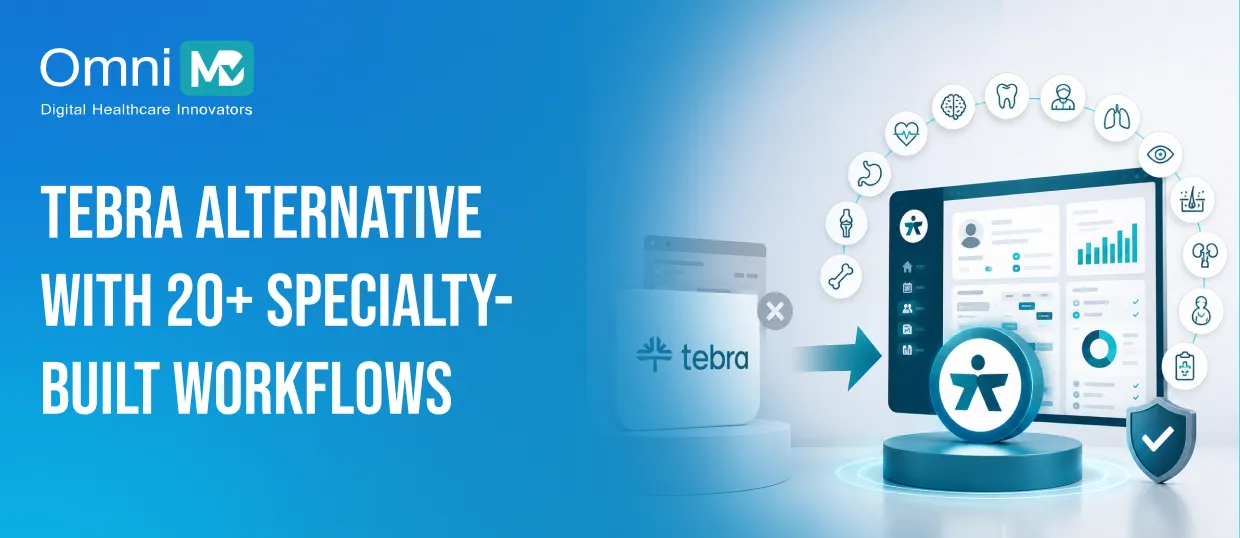
Here Is What No One Told You Before You Searched ‘Tebra Alternatives’
TL;DR
Tebra works well for solo providers who need a quick, affordable start and strong patient marketing tools. If you need stronger billing, deeper specialty support, and a team that stays responsive after day one, OmniMD is the more complete long-term platform.
Tebra
Since 2021Formed from the 2021 merger of Kareo (2004) and PatientPop (2012). Two separate products still being unified.
Clean interface, fast to go live (1–2 weeks)
Strong patient marketing tools from PatientPop
AI Note Assist launched June 2025, 500K+ notes generated in 6 months
Billing module built separately from EHR, still being integrated
Support quality drops after onboarding ends (consistent across reviews)
Cancellation and data export harder and costlier than expected
Hits a ceiling for specialty practices and growing groups
OmniMD
Since 2002Built as one unified platform from the ground up. No merger, no integration debt, no outside investors.
97% first-pass clean claim rate, denials reduced from 21% to under 4%
AI Scribe, AI Front Desk, AI Clinician, AI RCM, all native to one platform
Purpose-built workflows for 20+ specialties
Support stays responsive after onboarding per verified user reviews
Scales from solo providers to multi-location groups
Smaller brand name, fewer public reviews to browse vs Tebra
Some users note screen navigation has a learning curve
Key Numbers at a Glance
OmniMD clean claim rate
97% first-pass
Tebra clean claim rate
Not publicly stated
Tebra Capterra rating
3.9 / 5 (1,361 reviews)
OmniMD Capterra rating
4.5 / 5 (51 reviews)
Tebra pricing
~$49–$799 / provider / mo
OmniMD pricing
Available on request
You probably did not wake up this morning planning to look for a Tebra alternative. Something pushed you here.
Maybe it was a billing issue that kept coming back.
Maybe support stopped picking up the way they did during onboarding.
Maybe you are still shopping and Tebra keeps coming up in your research but something about it does not feel quite right.
Whatever brought you here, we promise that we will not waste your time with vague comparisons. In this blog, we are going to talk about what Tebra is, where it genuinely works, where real users say it falls short, and why OmniMD is the platform thousands of practices turn to when they need more than Tebra can offer. Let’s begin
What Is Tebra, Really? The Full Picture.
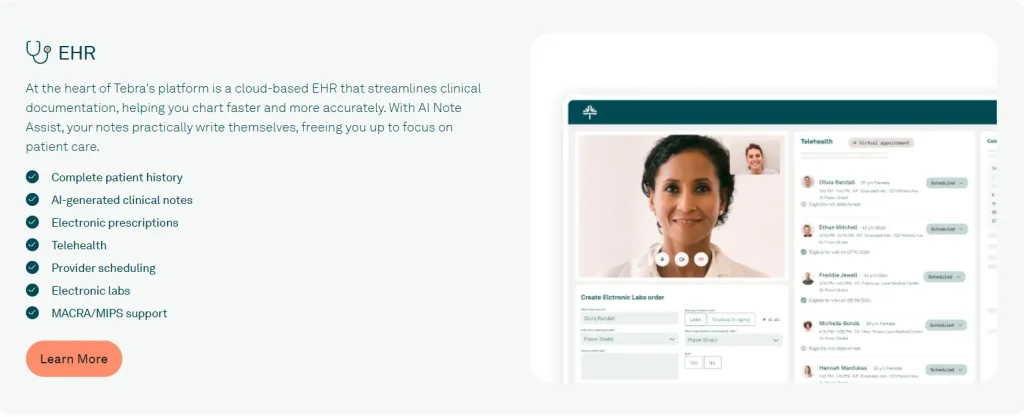
Tebra is a four-year-old brand name sitting on top of two much older companies.
In 2004, Dan Rodrigues founded Kareo in Irvine, California, to make medical billing easier for small practices. Kareo grew steadily over 17 years and became a well-known name in ambulatory billing software. Meanwhile, PatientPop was founded in 2012 in Santa Monica, California, with a completely different goal: help practices grow their patient base through digital marketing, online booking, and reputation management.
In November 2021, Kareo and PatientPop merged and called the combined company Tebra, a name derived from “vertebrae,” meant to signal that it would become the backbone of independent practice operations. The company raised $65 million to support the merger and later hit a $1 billion valuation in 2022 after a Series B round. In December 2025, Tebra raised another $250 million, this time specifically to build out AI-driven automation across its EHR and billing tools.
As of 2025, Tebra serves over 140,000 healthcare providers covering more than 120 million patients in the United States. Those are real numbers that reflect real scale.
But here is what matters to you as a practice: Tebra is still, in 2026, working to fully stitch together two products that were built independently, by two separate companies, for two separate purposes. One was built around billing. The other was built around patient acquisition. Combining them into one seamless platform takes time, and the seams still show.
What Is OmniMD? And Why Has It Never Been in the Spotlight?
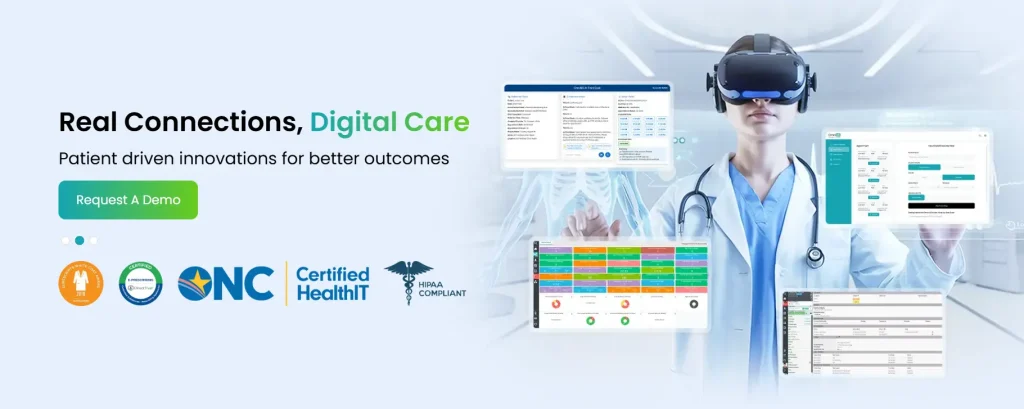
OmniMD does not show up in every “top EHR” listicle the way Tebra does. Part of that is because OmniMD never made $250 million in headlines. But there is a different kind of story here.
OmniMD was founded in 2002 as part of Integrated Systems Management (ISM), a technology firm that has been in software development and enterprise consulting since 1989. That means OmniMD was building clinical and financial tools for healthcare practices while Kareo’s founder was still in the early stages of planning Kareo.
Today, OmniMD is headquartered in Hawthorne, New York, and serves healthcare professionals across more than 600 facilities and 20+ specialties, including primary care, cardiology, urgent care, internal medicine, psychiatry, pediatrics, and more. Its platform covers EHR, practice management, RCM, AI Medical Scribe, AI Front Desk, AI Clinician, remote patient monitoring, telehealth, chronic care management, and patient engagement, all built as one connected system rather than assembled from a merger.
OmniMD has grown without outside funding, which is worth pausing on. It means the company has had to earn its customers the hard way, by delivering results rather than by outspending competitors on marketing. That operating model shapes how the product and support actually work.
Where Tebra Works Well (and We Mean This)
Before we get into the friction points, it is worth being honest about what Tebra does well, because the practices that thrive on it are real.
Tebra’s interface is genuinely easy to pick up. Users across multiple review platforms consistently say that new staff can learn the system quickly, that charting feels clean, and that the onboarding process is structured and helpful.
For a solo provider or a very small practice that has low billing complexity, needs a simple clinical workflow, and wants to get live within a week or two, Tebra is a reasonable fit. Its patient marketing tools, inherited from PatientPop, are also a genuine differentiator. If building an online presence and attracting new patients is a top priority, those tools are hard to match at a similar price point.
Tebra’s AI Note Assist launched in June 2025 and by the end of that year had already generated more than half a million notes. That is meaningful adoption.
So Tebra is not a bad product. The practices that are happy on it tend to be exactly the profile it was built for: small, straightforward, primary care or general practice, low billing complexity, and not planning to scale significantly.
The challenge is that most practices do not stay that simple forever.
What Tebra Users Are Running Into in 2026
The reviews across Capterra, G2, GetApp, Trustpilot, the Better Business Bureau, and Software Advice tell a consistent story. Not every user has problems. But the same categories of problems come up so often that they stop looking like edge cases.
Billing Complexity Is a Real Pain Point
Tebra’s EHR and its billing module were built by two different companies for two different purposes. That history still shows up in how users experience the billing side. This is not a criticism of Tebra’s ambition. Merging two large products is genuinely hard. But it is a real consideration for a practice that needs everything to work together without friction from day one.
The split between a well-liked EHR and a frustrating billing experience is one of the most frequently repeated themes in Tebra’s review history. One office manager on Software Advice described it this way: the EHR side is great and easy to use, but the billing is not. Tebra acknowledged this feedback directly in its own response, saying it is actively working to make billing “just as seamless and user-friendly as the EHR.” That is an honest answer, but it also confirms the gap exists.
Other users describe specific billing frustrations:
- Insurance take-backs require so many steps it has been compared to “an act of congress to post”
- Claim clearinghouse rejections that make the billing process inefficient and unreliable
- Billing requiring a separate desktop application download, which users describe as outdated for a cloud-first platform
On G2, inadequate and inefficient reporting is the single most repeated complaint category. Users consistently describe having to stitch together data manually from exports because the built-in reports do not give them what they need. This is not a minor inconvenience when you are trying to track revenue performance across a practice.
Support Changes After Onboarding Ends
This is perhaps the most consistent pattern in Tebra’s recent reviews, and it matters because it is the kind of thing you cannot see during a sales demo.
Tebra’s onboarding managers are praised frequently and genuinely. The problem is what comes after. Sam M., an ARNP who reviewed Tebra on Capterra in December 2025, described calendar appointments that were regularly inaccurate, a mobile app that would not sync reliably, and patients missing cancellation notifications because the system failed to send them. She had submitted multiple support cases. None had been resolved. She had requested a full data export on December 7, 2025, and was still waiting for a response at the time she wrote her review.
- Steve, reviewing on Trustpilot in March 2026, put it more bluntly: “HORRENDOUS customer service, they take no responsibility for system being down, changing your schedule or medications/notes not being saved. If you get someone it is overseas, they know nothing.”
- Marina P., CEO of a small practice, reviewed Tebra on G2 in May 2026. Tebra turned off clinical access to charts and billing for eight days, charged a full month, and left a backlog of claims her team was still working through six months later. She described a pattern of technological instability, no ownership of problem-solving, and privacy concerns that were reported and documented but never addressed.
- Software Advice aggregated feedback captures the broader sentiment: case follow-ups by email are described as being “like conversing with a bot, giving inaccurate solutions showing they did not understand the issue.”
Leaving Is Harder Than You Would Expect
This is something comparison pages almost never cover, but it shows up consistently enough in real user accounts that it deserves a place here.
- One Trustpilot reviewer canceled Tebra after an experience with unresolved clinical workflow issues and was billed for an additional month, with Tebra citing a 30-day notice requirement the user says did not exist in their original Kareo-era contract. After posting their honest experience publicly, they were contacted by Tebra and asked to remove the review.
- A 10-year customer on Software Advice described their exit as “the absolute worst experience,” with the account being billed over $5,000 in transaction fees during the offboarding process.
- A BBB complaint from March 2026 documents Tebra charging $83.60 after a contract had already expired. It took multiple emails with multiple employees over several weeks to resolve. Tebra confirmed it was a technical error.
For reference, Tebra’s own terms of service state directly that no refunds are issued when a customer stops using the service before the contract term ends.
None of this means every departure from Tebra is contentious. But knowing the terms before you sign is very different from discovering them when you are trying to leave.
Where OmniMD Is Built Differently
#1. Billing Built In, Not Merged In
OmniMD’s RCM was not acquired from another company and integrated after the fact. It was built inside the same system that handles clinical documentation and scheduling, from the very beginning.
That architectural difference produces measurable results:
- 97% first-pass clean claim rate
- Denial rate reduced from 21% to under 4% for practices on the full platform
- Notes move from a patient encounter directly into billing with no manual handoff, no API bridge, no reconciliation step between systems
If your practice has been spending time chasing denials or manually stitching together billing reports, this is not a minor upgrade. It is a fundamentally different experience.
#2. AI That Works Across the Whole Platform
Tebra’s AI Note Assist is a real feature. But it operates in one part of one workflow. OmniMD’s AI tools span the entire platform:
- AI Medical Scribe: ambient documentation that flows directly into billing, no separate step required
- AI Front Desk: handles incoming calls, scheduling, and intake to reduce front desk congestion
- AI Clinician: clinical decision support built into the encounter itself
- AI RCM: automation across the revenue cycle, not just documentation
If you are using OmniMD’s EHR or RCM, none of these require a third-party integration. They were built as part of the platform.
#3. Specialty Depth That Matches Your Practice
Tebra’s templates and workflows are optimized primarily for general and primary care. If you are in cardiology, urgent care, behavioral health, orthopedics, internal medicine, pediatrics, or any of 15+ other specialties, OmniMD was built with purpose-specific workflows for each one. You are not adapting a general-purpose system to fit your specialty. The system already fits.
#4. Support That Operates Like a Partnership
This is where OmniMD user feedback is consistently and meaningfully different from Tebra’s.
Lucia T., a Nurse Practitioner who reviewed OmniMD on Capterra in August 2025: “I feel that I can count on them any time of the day. They are very quick in responding to whatever our issue is even outside business hours. 10/10.”
- Brandy C., a Nurse Practitioner who reviewed OmniMD on Capterra in April 2025: “What truly sets OmniMD apart is their commitment to customer success. Whenever we needed assistance, their team was responsive, knowledgeable, and dedicated to ensuring our operations ran smoothly.”
- Neal C., an Office Manager who reviewed OmniMD on Capterra in September 2025: “The Omni team is responsive, knowledgeable, and has significantly improved our billing performance.”
Edna W., a Family Nurse Practitioner, shared something more significant. After nine years of losing $70,000 to $100,000 annually with in-house billers, she finally moved to OmniMD’s billing services. “I am back on the top of my game paying my bills again including the monies I had to borrow just to keep the practice going.”
That last one is worth sitting with. That is not a feature comparison. That is what the right billing platform can actually mean for a practice that has been bleeding revenue without fully realizing it.
#5. Real-Time Financial Visibility
Where Tebra users describe manually exporting data to answer basic revenue questions, OmniMD’s BI dashboards give you live answers:
- Which providers are generating the most revenue
- Which CPT codes are underperforming
- Which payers are delaying reimbursement and why
- Where claims are getting stuck before they turn into denials
The difference between seeing a problem in real time and discovering it three months later in an export is, for many practices, the difference between a recoverable situation and a real financial hit.
Summary
| Metrics | Tebra | OmniMD |
|---|---|---|
| In business since | 2004 (Kareo) / 2021 (as Tebra) | 2002 |
| How it was built | Merger of two separate companies | One platform, built as one |
| Providers served | 140,000+ | 12,000+ across 600+ facilities |
| Specialties | Primarily general / primary care | 20+ with purpose-built workflows |
| Billing architecture | Kareo-origin; partially unified with EHR | Native RCM built into the same system |
| First-pass claim rate | Not publicly stated | 97% |
| AI tools | AI Note Assist | AI Scribe, AI Front Desk, AI Clinician, AI RCM |
| Reporting | Manual exports common per user reviews | Real-time BI dashboards |
| Support after onboarding | Frequently cited as a drop-off point | Consistently praised across review platforms |
| Capterra rating | 3.9 / 5 (1,361 reviews) | 4.5 / 5 (51 reviews) |
| G2 rating | 4.1 / 5 (259 reviews) | 4.2 / 5 (11 reviews) |
| Pricing | Custom quote; ~$49 to $799/provider/month | Available on Request |
Final Thoughts
Tebra is a real platform with a real track record. For the practice it was designed for, it works. The practices that do well on it tend to be small, simple in their billing needs, and not planning to scale significantly in the near term. If that is you, Tebra is a defensible choice.
But the evidence from 2026 user feedback is consistent: billing and reporting are the platform’s persistent weak points, support changes noticeably after onboarding ends, the merger integration is still ongoing, and leaving the platform is harder and more expensive than most practices anticipate going in.
OmniMD is built for the practice that needs more than a starting point. It has been a single unified system since 2002, it covers 20+ specialties, and the support model it runs is one that users consistently describe as a genuine partnership rather than a ticket queue.
If you are currently on Tebra and something is not working, there is a real alternative. If you are evaluating Tebra before signing anything, you now have the questions worth asking and the benchmarks worth comparing.

Dr. Giriraj Tosh Purohit is an experienced Product Manager and Security officer with a strong background in healthcare technology and management consulting. With expertise spanning clinical workflows, EHR, RCM, Digital Health, and AI-driven products, he has been instrumental in shaping innovative healthcare solutions.