
AI Scribe for Family Medicine, Built for Every Issue a Visit Carries
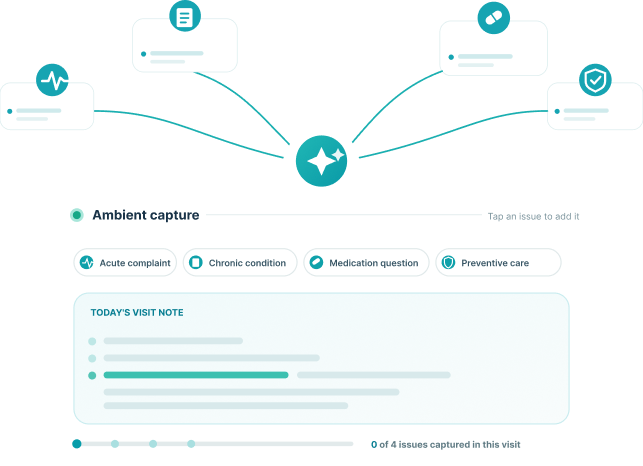
Family medicine covers more ground in one visit than any other specialty. Built on OmniMD’s AI medical scribe, our AI scribe for family medicine listens to the whole visit and drafts one note that gives every acute, chronic and preventive issue its own assessment and plan, ready for your review.
Because we understood family medicine, we built better
A family medicine panel spans a full lifespan, and every age band needs its own approach. Click a segment below to see what each one covers.

Growth, immunization, development
Growth charts, immunization schedules, developmental milestones. None of it lives in a standard adult template.
Chronic care and prevention, side by side
A diabetes check-in and an overdue cancer screening, in the same visit. Both need equal weight in the note.
Polypharmacy and geriatric assessment
Five or six medications to reconcile, plus a geriatric assessment. A general template was never built for this.
The Hidden Second Shift
86 min
of EHR work after clinic hours, every weekday, for the average family physician (Annals of Family Medicine, 2017).
One Panel, Every Age
All ages
on one family medicine panel, from newborn well-child visits to geriatric care.
Revenue Riding on the Note
9%
is the maximum MIPS penalty on Medicare Part B payments (AMA), and quality scores depend on what the note documents.
Everything our family medicine AI scribe handles
Everything a family medicine practice needs from an AI scribe, built into one system.

Multi-problem capture
Documents every problem addressed in the visit, each with its own assessment and plan.

Preventive care detection
Flags overdue USPSTF screenings and Annual Wellness Visit components during the encounter.

HCC and risk-adjustment coding
Codes every chronic condition addressed for accurate risk adjustment, not just the primary diagnosis. See the family medicine ICD-10 and CPT code reference.

Medication reconciliation
Checks refills and interactions against the patient’s full medication list, across every chronic condition.

HEDIS and
MIPS tagging
Attaches quality measure tags at the point of documentation, built for value-based contracts.

Full lifespan templates
Covers pediatric, adult, and geriatric visit logic natively, in the same system.

Native EHR write-back
Notes land directly in your chart once approved, in OmniMD’s family medicine EHR or the EHR you already use. No export step, no separate reconciliation.

Panel-level registry view
Rolls individual visits up into a population health view, so gaps are visible across the whole panel.

Lab integration
Pulls lab results and pending orders into the same view as the note, so nothing requires a separate login.

Visit-over-visit chart comparison
Compares today’s visit against the last one, so a shift in a chronic condition or a lab value doesn’t get missed.
Chart at the speed of conversation
Five steps, start to finish, from the first word to the chart updating itself.

Listens
Captures the full
conversation, start to finish.

Drafts
Turns it into a note organized the way you’d write it, in minutes.

Checks
Flags anything overdue, a
screening, a shot, before you move on.

Tags
Codes attach automatically.
Nothing to reconstruct later.

Syncs
Drops straight into the chart once you approve it.
How OmniMD compares with other AI scribes for primary care
| Capability | Generalist EHR scribes | Single-specialty scribes | ✓OmniMD family medicine scribe |
|---|---|---|---|
| Native EHR write-back | Manual copy | Export needed | Automatic |
| Multi-problem visit structuring | Single complaint | Not applicable | Acute, chronic, preventive together |
| USPSTF & AWV gap detection | None | None | Flagged during the visit |
| HCC & risk-adjustment coding | Generic only | Not applicable | Per condition addressed |
| Cross-condition medication reconciliation | Separate module | Not applicable | In the note |
| HEDIS & MIPS measure capture | Manual lookup | None | Tagged at documentation |
| Template range, pediatric to geriatric | One template | Single age band | Full lifespan |
| Panel-level registry view | History only | App-limited | Built in |
Calculate the clinical documentation hours you get back
Enter your numbers. Watch the dial show what you get back.
Bring in one of your own visits and see for yourself
Any visit, any day. We'll turn it into a note in your own templates, right in front of you.