The Patient Billing Statement
That Doesn’t Ring Your Front Desk
OmniMD’s patient billing statements turn confusion into clarity and clarity into faster patient collections, connected directly to your revenue cycle. Don’t take our word for it; see it in your own claims.
12,000+
providers across
600+
clinics nationwide
Built into
Your EHR, Practice Management, and RCM platform
20+ years
of healthcare-only expertise
Patient Statements Are Not
Paperwork. They Are Brand Output.
Every patient statement software on the market can technically generate a bill. Very few are built to make sure the patient understands it, trusts it, and pays for it without calling your office to ask what it means.
That gap costs more than a phone call. It shows up as delayed patient collections, disputed balances, and billing staff hours spent explaining charges a clearer statement should have explained on its own.
OmniMD’s patient billing statements were built to close that gap, and to
get you paid.
Where Most Patient Billing
Statements Fall Short
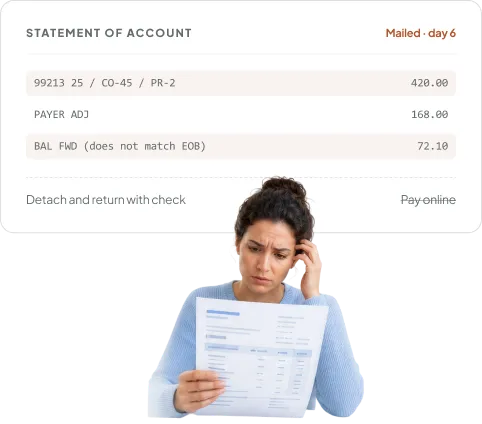

Complex codes and payer language

Hidden payment options

Bills that don’t match the visit or EOB

One template for every patient and balance

Manual follow-ups costing teams 10 to 15 hours weekly
The OmniMD Difference in
Patient Statement Software

Clarity by Design
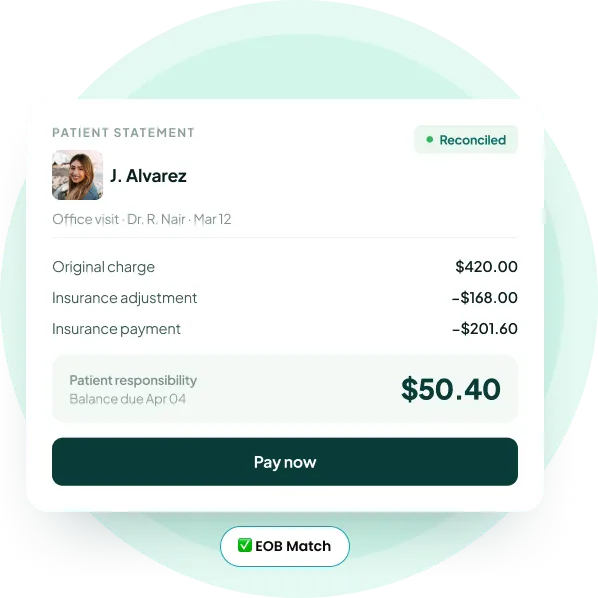
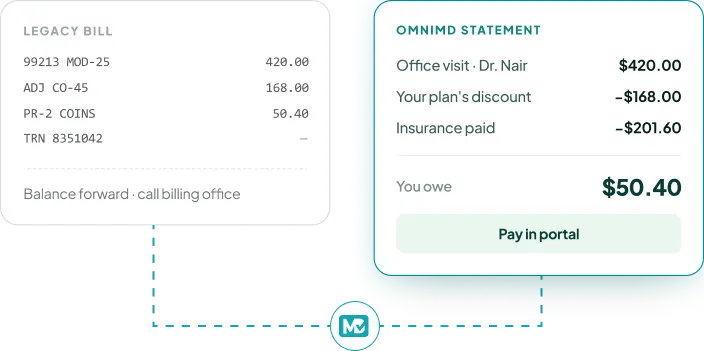
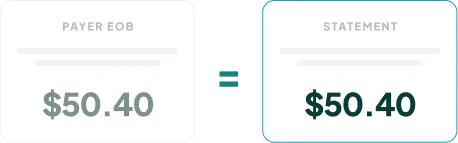
Plain-language line items, visit context, and provider detail on every patient statement, reconciled against the actual payer EOB so the number a patient sees always matches what their insurance already reported.

Payment Without Friction
Online bill pay, payment plans, and portal-based payment sit directly inside the patient statement experience through your patient portal, so patients can pay the moment they understand the balance.


Fewer Calls
Clear, itemized patient billing statements cut the ‘what is this charge’ calls that eat into front desk time, so staff can spend it on the patients standing in front of them.


One Connected Revenue Cycle
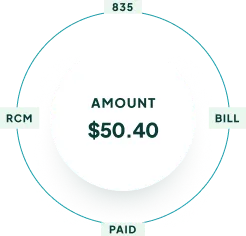
Patient responsibility amounts flow automatically from the payer’s 835 remittance straight into the statement queue, so every patient statement reflects real, current, reconciled data, never a stale export.

Built for How Independent Practices Actually Collect
Configured for independent and small to mid-size practices, not adapted from enterprise hospital billing logic that was never built for how you actually operate.

Outcomes That Come From Clearer Patient Statements
25%
Higher self-pay collections
15hrs
Saved weekly on billing tasks
95.34%
Net collections with payments in under 35 days
81%
Fewer claim denials, reducing the rate from 21% to 4%
75%
Fewer billing errors
Traditional Statements vs. OmniMD Patient Statements
| Category | Traditional / Legacy Statements | OmniMD Patient Statements |
|---|---|---|
| Reconciliation | Manual, often after the fact |
 Automatic, tied to the 835 remittance
|
| Delivery | Paper mailing, multi-day cycle |
Portal access the same day it's ready
|
| Payment | Separate login or mailed check |
Pay directly from the statement
|
| Match to EOB | Frequently mismatched, driving disputes |
Reconciled to match what the payer already reported
|
| Format | One template for every balance |
Context-aware: visit detail, provider, plain language
|
Your Patients' Financial Data
Handled the Way Their Clinical Data Is
HITRUST
certified
SOC 2 Type
II certified
End-to-end HIPAA-compliant infrastructure