
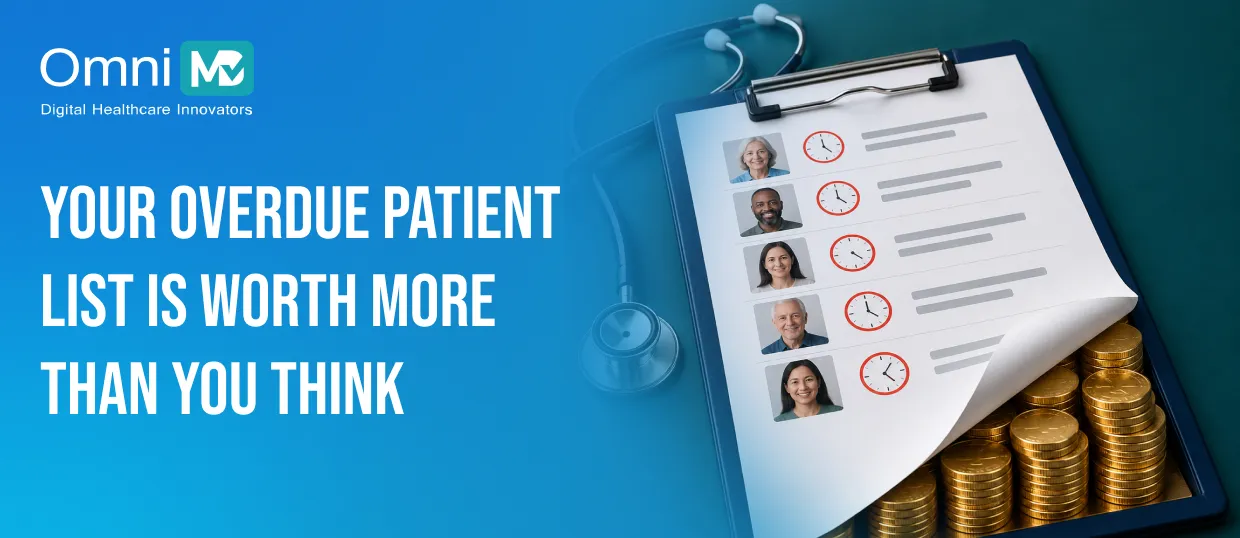
AI Patient Recall: How AI Front Desk Agents Fill Schedules with Overdue Patients
This is for you if you run scheduling or day to day operations at a primary care, endocrinology, or cardiology practice, and your patient list is big enough that people slip through the gaps.
- You probably already know your no-show number
- What you want to fix is smaller and more specific, patients overdue for one particular kind of chronic care follow up
- These patients are sitting inside your EHR right now, waiting for something to reach out and close the gap
That gap follows patients into a part of your practice that has nothing to do with the calendar.
Why the overdue list matters more than it looks
A missed A1C test or a missed diabetic eye exam costs your practice in more than one place, and this is the first thing an AI recall agent needs to understand about each patient before it ever sends a message.
- It shows up as a gap in your Comprehensive Diabetes Care score under HEDIS
- HEDIS is the measure many value based contracts use to work out your quality bonus
- A patient can come in three times a year for something else and still count as a gap in care, if none of those visits included the one test the measure is looking for
A single missed test like this can cost more in quality bonus dollars than the visit itself would have brought in as a fee for service charge. Some patients on that list carry far more of that cost than others, which is exactly why the agent’s first job is not outreach. It is ranking.
How the agent decides who to contact first
An agent working a recall list in printed order, top to bottom, wastes its highest value contact attempts on whoever happens to sit at the top of an export.
- A patient who is 3 months overdue with a rising A1C and an early eye finding needs to be flagged ahead of a patient who is simply next on the list
- A patient who is 14 months overdue but has steady numbers and no findings can sit lower in the queue
- The agent can only make this call if it reads structured EHR data directly, last A1C, last screening result, past diagnosis, rather than working from a static export someone pulled last month
A well ranked queue still fails if the agent reaches the right patient through the wrong channel. Getting the channel right is the next piece of the job.
How the agent decides which channel to use
A 2026 survey of 1,000 U.S. patients gives the agent a clear default to work from.
- A texting preference study found that 90% of patients would rather get healthcare messages by text than by phone, email, or the patient portal
- 97% specifically want appointment reminders sent that way
- Willingness to switch providers over the lack of texting climbs to 42% among Gen Z patients, against 20% of Baby Boomers
An agent built around one fixed channel misses that generational spread. The better design defaults to text for the first attempt and shifts for patients who do not engage, rather than treating every name on the list the same way. Getting a patient to open the message is only half the job though. Getting them to act on it depends on something else entirely.
What actually gets a patient to act
A 2026 survey of 473 providers and 3,196 patients found a mismatch worth building an agent around.
- 81% of providers assumed forgetting was the leading cause of missed visits
- Patients themselves pointed to work conflicts (31%), weather (30%), and emergencies (27%) far more often than simple forgetfulness
- 69% of patients said they wanted to reschedule online without calling the office
An agent designed only to send reminders is solving the problem providers assume exists, not the one patients actually report. A reminder that cannot also rebook the visit on the spot misses most of what patients say they need. That gap between reminding and rebooking is exactly where the agent’s real value shows up.
How the agent stays compliant automatically
- The FCC extended its waiver on the strict ‘revoke all’ rule in a January order, pushing full enforcement out to January 31, 2027
- A later revocation rules update from September split revocation into two tracks, so an opt out on a routine informational text now only stops that category of message rather than every future message
- Violations carry statutory damages of $500 per message, tripled to $1,500 for willful violations, so the agent needs to track and honor opt outs the moment they happen, not on a delay
Handling consent correctly protects the campaign legally. It still says nothing about whether a reply actually turns into a filled slot, which is the step where the agent earns its keep.
How the agent turns a reply into a booked visit
- The agent needs to pull a real open slot from the live schedule inside that same conversation, not route the patient to a callback queue
- Booking directly into the PMS while the patient is still responding closes the loop before that willingness fades
- A patient who agrees and then waits days for a follow up call often does not answer the second time
That single capability, closing the loop inside one conversation, is what separates a recall agent from a basic reminder tool, and it is exactly what the earlier data on rescheduling friction points toward.
Why this only works at agent scale
- The same 2026 MGMA poll of 190 medical groups found 32% saw no-show rates rise in 2026, with rising patient costs named as a leading driver
- A peer-reviewed benchmark traces the most reliable cost figure to a VA study across ten clinics, putting the average missed appointment at roughly $196, with MGMA data placing U.S. single-specialty no-show rates around 6.81%
- A list of 600 overdue patients, ranked, messaged through the right channel, and needing 2 to 3 attempts each before most respond, is a volume of contact an agent runs continuously in the background
What changes with a chronic care patient is how much it costs the agent to get the timing wrong. A missed cleaning means one lost visit. A missed retinopathy screening can mean missing an early sign of something that gets harder to treat the longer it goes unnoticed.
How to measure whether the agent is actually working
- Research on rescheduling friction found that removing barriers to booking outperforms penalty based approaches, the same principle behind an agent that books instantly rather than making the patient call back
- An agent that reaches everyone on the list at the same pace treats a low risk and a high risk patient identically, which defeats the ranking step from earlier
- For a chronic care panel, the number that matters is how many care gaps in a specific measure, an A1C test, a retinal screening, closed within the year
- Whether those closed gaps belonged to the higher risk patients in the first place matters just as much as the raw count
That last condition is the one most dashboards never check, and it is where an agent can look successful on volume while missing the patients who needed it most.
The gap that’s easy to miss
- An agent can run a smooth, fully compliant, well timed campaign
- And still end up mostly booking the lower risk patients who were likely to come in anyway
- The higher risk patients, the ones who needed the outreach most, stay untouched if the agent does not escalate an unresponsive high risk case to a different channel or a different message instead of dropping it after the standard sequence
A full calendar and a healthier patient panel are not the same outcome, and only tracking which specific care gaps closed tells the agent, and you, which one it actually delivered.

Kamal Sharma is a distinguished healthcare technology leader and CTO at OmniMD, renowned for driving transformation at the nexus of clinical excellence and digital innovation. Over a career spanning advanced EHR platforms, revenue cycle management, and Digital Health ecosystems including RPM, Telehealth, and Patient Portals, he has consistently architected patient-centric, outcome-oriented systems.