
Looking for an Elation Health Alternative in 2026? Here’s the One Thing Worth Checking Before You Decide
You can like your EHR and still find yourself wondering why getting paid through it feels more complicated than it should. For many practices, that is the point where looking for an alternative starts.
We will not deny that Elation Health is a genuinely well-built EHR. It won Best in KLAS for small practice ambulatory EHR two years running, in 2025 and again in 2026, and its clinical charting is loved by a lot of doctors.
Honestly, we’re not here to trash it. But we are here to dig into what real users are actually complaining about in 2026 across Reddit threads, G2, Capterra, and Quora, and where an alternative genuinely closes those gaps.
And once we dug in, one pain point kept surfacing over and over, louder than anything else. It wasn’t the charting. It wasn’t the interface. It was billing, and specifically, how much it costs and how disconnected it feels once you actually try to get paid.
Let’s walk through it together.
First, What Elation Health Does Well
Before we get into the gap, credit where it’s due. Elation Health is built around a ‘clinical first” philosophy, and it shows.
- Doctors get a single-page, three-panel chart that keeps the note, the chart summary, and patient context all visible at once, so you’re not clicking through five tabs mid-visit.
- It has a solid AI scribe that listens during the visit and drafts structured notes, built-in Zoom telehealth, e-prescribing with real-time drug interaction checks, and a mobile app for checking schedules on the go.
Elation serves around 32,000 clinicians and 16 million patients, mostly in primary care, direct primary care, family medicine, internal medicine, and pediatrics. If you’re a solo doctor who just wants a clean chart and nothing else to think about, a lot of people genuinely love it here.
So why are people still searching for an alternative?
The answer starts to become clearer when you look at what users are actually running into after they have been using Elation day to day.
The Pain Points That Keep Showing Up in 2026
We went looking through actual 2026 reviews on Capterra, G2, and forum discussions, not old complaints from 2020 that no longer apply. Here’s what real users are saying right now, this year.
Billing feels like a second product you have to buy. On Capterra reviews, one clinic owner says: Elation is more focused on upselling than on making the core product usable. Another reviewer, a director of operations who’d used the platform for over two years, said outright that you have to pay for billing software on top of the regular Elation fee, and that mid-level prescribing practitioners get zero discount.
Support can be a black hole. Multiple 2026 reviews mention long waits, no phone line, and support tickets that sit for over two weeks without so much as an acknowledgement. One user said they were “very concerned” about the company’s staffing after 17 days of silence on a support email, according to a 2026 review.
Leaving is harder than joining. This one stood out. A director of operations described trying to cancel their annual contract and being told Elation would not refund the unused months, would charge extra just to pull their own data out, and would only give them 60 days of read access after the move, compared to a full year they’d gotten from a previous vendor, according to another Capterra review.
The billing module itself has real limits. Elation Billing, the add-on product, only allows one claim per patient encounter, according to Elation’s billing FAQ. If a visit needs more than one claim, staff have to create separate visit notes to work around it. On top of the subscription, there are extra flat fees for things like mailed claims and mailed statements.
But none of this means Elation is a bad product. It means the billing side of the business, the part that actually determines whether your practice gets paid on time, feels bolted on rather than built in. And once you notice that pattern, you start seeing it everywhere in the reviews.
How Billing Works Underneath
Elation’s EHR starts around $349 to $400 a month per provider. Billing is a separate product called Elation Billing, priced on its own, and it comes with its own list of line-item fees: $1.15 per mailed or faxed claim, $0.95 per mailed statement, and $1.50 plus $0.30 per page for appeals. It works, and Elation has recently added AI to speed up claim creation. But structurally, it’s still two systems stitched together: one for charting, one for getting paid, each with its own subscription and its own fee schedule.
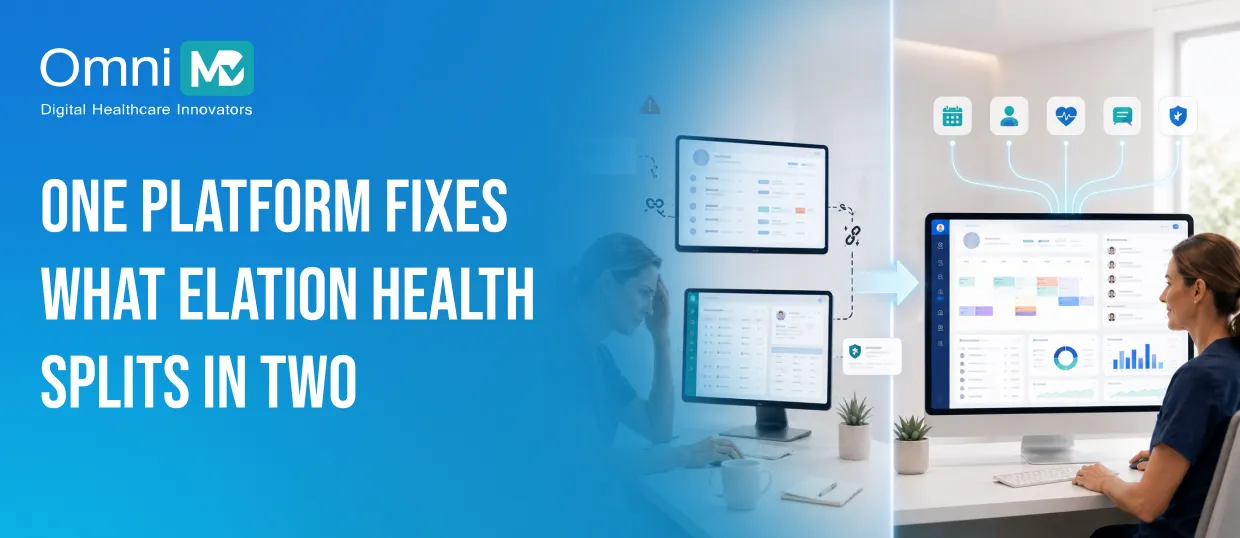
We, at OmniMD, take a genuinely different approach, and this is the piece worth understanding clearly. Our EHR, practice management, and revenue cycle management (RCM) all run on one shared record. There’s no separate clearinghouse fee bolted onto a separate billing product, because the billing engine isn’t a separate product. Claims are generated straight from the encounter note, automatically scrubbed for coding errors, and submitted without anyone re-typing anything into a second system.
Moreover, practices using OmniMD’s RCM have seen their claim denial rate drop from an industry-typical 21% down to under 4%. For context, the industry-wide initial denial rate climbed to 11.81% in 2024. That gap between 21% and under 4% isn’t a marketing number, it’s the direct result of catching coding errors before a claim ever leaves the building instead of after a payer rejects it.
And we take this even further with something Elation simply doesn’t offer: if you use OmniMD’s billing services, the EHR itself is free. Instead of paying twice, once for the chart and once for the claims engine, you pay one team to handle your revenue cycle, and the software that captures the clinical data feeding those claims comes along with it.
That’s the edge. Elation treats billing as an upsell with its own fee list, while OmniMD treats billing as the thing the entire platform is actually built around, to the point where it can pay for your EHR.
At a Glance: Elation Health vs. OmniMD in 2026
| Category | Elation Health | OmniMD |
| Founded | 2010 | 2002 |
| Best for | Solo and small primary care, DPC clinics | Small, mid-size, and enterprise-level practices across 20+ specialties |
| Starting price (EHR) | ~$349 to $400/month per provider | From $299/month per user, free EHR option with billing services |
| Billing/RCM | Separate ‘Elation Billing’ product, own subscription, per-claim and per-statement fees | Built into the same platform, no separate clearinghouse fee |
| Denial rate impact | Not independently reported | Clients report up to a 97% reduction in denial rates with OmniMD RCM. |
| Claims per encounter | One claim per encounter (workarounds needed for more) | No such limit, billing generated directly from the encounter |
| Support | Email-based, mixed reviews on response time in 2026 | 24/7 live human support |
| Contract exit terms | Reported refund and data-access friction (60-day read access) | Flexible, no lock-in horror stories |
| AI scribe | Included, reduces documentation time by up to 2 hours/day | Included (AI Clinician), reduces documentation time by up to 72% |
| Capterra rating (2026) | 3.9 out of 5 (79 reviews) | 4.5 out of 5 (51 reviews) |
| Specialties covered | Primarily primary care | 20+ specialties |
| Free trial | Not available | Available |
So, Should You Switch?
If your only concern is the clinical chart itself, Elation is still a well-designed piece of software, and plenty of solo primary care doctors are happy with it. This isn’t about pretending otherwise.
But if you’ve felt that specific sting, opening a second bill for billing software you didn’t expect, waiting weeks for a support reply, or watching your denial rate creep up because two systems don’t quite talk to each other cleanly, that’s not a ‘YOU’ problem. It’s a documented pattern, and it’s the exact gap OmniMD was built to close. One record, one platform, billing that’s actually part of the product instead of a separate invoice, and a support team that picks up the phone.
That’s really the whole story here. Not a flashier interface. Not more buttons. Just the part of running a practice that actually keeps the lights on, handled the way it should have been from the start.
FAQs
Is OmniMD cheaper than Elation Health?
OmniMD’s EHR starts lower, from $299 a month, and can be free for practices that use its billing services. Elation starts around $349 to $400 a month, plus a separate billing subscription and per-claim fees on top.
Does OmniMD support primary care specifically, like Elation does?
Yes. OmniMD supports primary care along with 20-plus other specialties, so it works whether you’re staying in primary care or your practice grows into other areas later.
Is switching EHRs difficult?
Data migration is the biggest factor, and it depends on how much history you’re moving. Our team handles setup and migration as part of onboarding, and unlike some vendors, our current reviews don’t show a pattern of restrictive post-exit data access.
What’s the single biggest reason practices switch away from Elation Health in 2026?
Based on current G2 and Capterra reviews, it’s billing costs and support responsiveness, specifically the feeling of paying twice (EHR plus a separate billing product) while support tickets sit unanswered.

Dr. Krishna Nathwani is a Business Analyst and Healthcare Technology Specialist at OmniMD, where she works at the intersection of medicine and digital health. With a background in clinical practice, she brings firsthand insight into how EHR systems, AI-powered tools, and intelligent workflows can reduce physician burden and improve patient care.