
10 Best AI Medical Receptionists in 2026 Compared on Pricing and EHR Fit
The best AI medical receptionist answers every call, books straight into your EHR, hands tricky calls to a person with the full story, and signs a BAA that covers call recordings. Those four jobs decide whether the tool lightens your front desk or creates a second inbox for your staff to clean up.
For clinics that want phones, scheduling, check-in, eligibility and billing running on one connected system, OmniMD AI Front Desk leads this list. Specialty groups tend to shortlist Assort Health, large health systems lean toward Luma Health or Hyro, and small practices that want a posted price usually start with DeepCura.
| Platform | Best for | Starting price | EHR connection |
| OmniMD AI Front Desk | Front desk, EHR, PM and billing in one workflow | By practice size and call volume, no setup fee | OmniMD EHR, athenahealth, others via FHIR and HL7 |
| Assort Health | Specialty groups like orthopedics and dermatology | Custom quote | Epic, athenahealth, PM systems |
| Luma Health | Health systems and multi-site groups | Custom quote | Epic, Oracle Health, MEDITECH and more |
| Hyro | Large health system call centers | Custom enterprise quote | Epic plus CRMs like Salesforce |
| DeepCura | Small practices wanting a posted price | $129 per provider per month | 7+ EHRs incl. athenahealth, eClinicalWorks |
| Notable | Enterprise referral and authorization backlogs | Custom enterprise quote | Works inside the EHR |
| Sully.ai | Adding AI one role at a time | Custom quote | 50+ EHRs incl. Epic, Cerner, MEDITECH |
| DoctorConnect ARIA | Less common or regional EHRs | Quote, listed from $75 to $150 per location | 150+ EHR and PM systems |
| Hello Patient | Medical groups wanting a managed rollout | Custom quote | Confirm for your EHR |
| Weave | Small offices already on Weave phones | Add-on module or higher bundle | PM integrations incl. athenaOne |
Each platform above earned its slot through the same scoring sheet, and the weight behind each line of that sheet explains why a tool that dazzles in a demo can still land lower on the list.
How We Ranked These AI Medical Receptionists
Those weights come from the work a medical front desk handles in a normal week, so call handling and EHR write-back carry the most points. This is because feature count earned nothing on its own, because a long feature page tells you what a vendor sells and very little about how it performs on an after-hours call to move a follow-up visit.
| What we scored | Weight | What earned full points |
| Medical call handling | 20% | Natural conversation, interruptions handled, several requests in one call |
| EHR and PM write-back | 20% | Books, moves and cancels inside your EHR in real time |
| HIPAA, BAA and data controls | 15% | BAA covers recordings and transcripts, clear retention rules |
| Connected front-office workflow | 10% | Calls, intake, eligibility and billing share one record |
| Scheduling and patient access | 10% | Knows visit types, provider rules and new versus returning patients |
| Human handoff and safety | 10% | Warm transfer with context and a clear on-call path |
| Customer evidence | 10% | Named customers, third-party reviews, published outcomes |
| Pricing clarity | 5% | Posted pricing or a clear pricing model before the demo |
What an AI Medical Receptionist Handles on a Patient Call
An AI medical receptionist handles the full arc of a patient call, from the moment the phone rings to the update that lands in the chart afterward. Practice leaders already know where they want that help first. In a February MGMA Stat poll, MGMA found scheduling (31%), calls (27%), registration and eligibility (23%) and prior authorization (16%) ranked as the top front-office targets for AI.
The work splits into four moments, and a strong platform covers all of them.
Before the visit
- Books, reschedules and cancels appointments against your provider templates
- Captures demographics and insurance details, then checks eligibility
- Sends intake forms matched to the visit type
- Fills canceled slots from a waitlist
During the call
- Answers questions on hours, locations, parking and accepted insurance
- Logs prescription refill requests and routes them to the right clinical queue
- Handles billing balance questions and referral status checks
- Recognizes when a caller describes symptoms and transfers to clinical staff
After the call
- Texts a confirmation with the date, time and prep instructions
- Writes the appointment, notes and any task back to the EHR
- Alerts staff about anything it could not finish
After hours
- Takes bookings overnight so the morning starts with a clean schedule
- Gives emergency instructions and routes urgent calls to your on-call line
- Falls back to a callback task when a request needs a human
An old-school answering service covers only a sliver of that list, and generic AI phone tools cover a bit more, which is why the three get mixed up so often.
AI Medical Receptionist vs Answering Service vs Generic AI Phone Agent
That mix-up costs practices money, because each option solves a different slice of the phone problem. A medical answering service puts a human operator on your overflow line who mostly takes messages. A generic AI phone agent is a voice bot you configure for any business, and healthcare rules become your team’s job. An AI medical receptionist is built for clinics, with scheduling rules, EHR access and clinical escalation baked in.
| Capability | Medical answering service | Generic AI phone agent | AI medical receptionist |
| Answers every call at once | Limited by staffed operators | Yes | Yes |
| Books into your EHR | Rarely | Only with custom build work | Yes |
| Knows visit types and provider rules | No | Only if you script them | Yes |
| Verifies insurance | No | Rarely | Often |
| Routes symptom calls safely | Operator judgment | Depends on your setup | Built-in clinical escalation |
| Signs a BAA | Varies by vendor | Varies, sometimes on higher tiers only | Expected |
| Who maintains it | The service | Your team | The vendor |
The term ‘virtual medical receptionist’ adds one more wrinkle, since many vendors use it for a remote human working your phones. Ask any vendor whether a person or software picks up, and whether that changes after hours.
Once you know you need the clinic-built category, the field narrows to ten platforms worth a demo.
The 10 Best AI Medical Receptionists Reviewed
Every profile below follows the same order, so you can compare one platform’s EHR story or weak spot against another’s without hunting.
1. OmniMD AI Front Desk
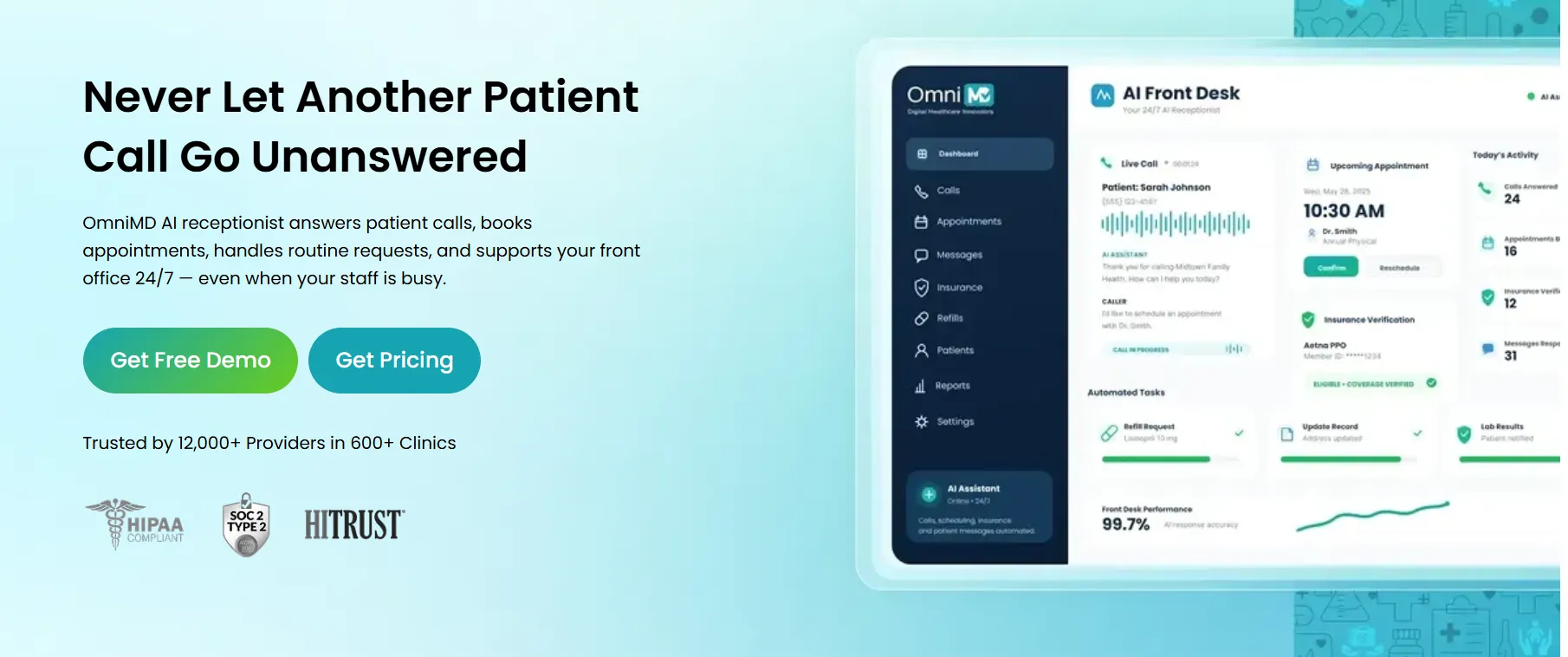
OmniMD AI Front Desk is the best AI medical receptionist for practices that want the phone line, intake, eligibility, coding and billing sharing one patient record. We launched it in July 2025 on top of more than two decades of EHR, practice management and RCM software, and our platform serves 12,000+ providers across 600+ clinics.
| Launched | Pricing | EHR connection | Review score |
| Jul-25 | Based on practice size and call volume, no setup fee, no multi-year lock-in | Native with OmniMD EHR and PM, live with athenahealth, others through FHIR and HL7 | OmniMD EHR rated 4.5 out of 5 on Capterra |
What it covers inside your clinic
- Answers calls around the clock, books visits in real time and transfers to staff with context
- Lets patients self-schedule through your website, the AI scheduling assistant or the mobile app, with forms, consent and confirmations sent automatically
- Verifies eligibility, coverage, referrals and prior authorizations at booking and flags missing data before the visit
- Logs special requests like interpreter needs or wheelchair access and routes them to staff
- Summarizes every call and scores caller sentiment so staff can follow up with frustrated patients
- Shares one record with OmniMD’s AI Medical Coder, AI RCM and AI Medical Scribe
- Tracks call answer rate, check-in time, verification accuracy, no-shows and collections on a live dashboard
- Runs on a HIPAA and SOC 2 Type II compliant platform, and go-live usually takes no more than two weeks
Dr. Mayank Patel at East Tremont Vascular Healthcare put it this way. “The AI Front Desk has made a noticeable difference in our day-to-day workflow. It handles routine calls and scheduling reliably, which gives our staff more time to focus on patients in the office.”
Where it falls short
- The AI Front Desk is young, so independent reviews of it are still few, and the 4.5 Capterra score covers OmniMD’s EHR
- A practice that only wants a phone bot and plans to keep separate billing and intake vendors will get less from it.
OmniMD’s edge is the shared record, and Assort Health takes a different route by going deep on the specialty call itself.
2. Assort Health
Specialty groups fielding complicated calls about imaging, procedures and post-op care get the strongest fit from Assort Health. Its agents run on Synapse, a proprietary model trained on specialty workflows, and a feature called Patient Journey Memory carries context from one call or text to the next.
| Founded | Pricing | EHR connection | Funding |
| 2023 | Custom quote | Epic, athenahealth and PM systems | $222M+ raised, $1.2B valuation |
What it covers
- Scheduling, intake, triage and specialty FAQs across fields like orthopedics, dermatology and cardiology
- Refills, lab results, referrals and billing questions over voice, text and web
- Context handed to nurses or staff when a call needs a human
Assort raised a $120 million Series C led by Menlo Ventures in June and is expanding into health system operations, including academic medical centers.
Where it falls short
- Built for specialty depth, which a single-provider primary care office may pay for and never use
- Primary care offices whose calls are mostly simple bookings can choose a lighter tool.
Specialty depth works for groups, while health systems running thousands of calls a day need orchestration across departments, which is where Luma Health lives.
3. Luma Health
Health systems that want calls, referrals, faxes, waitlists and payments run by one operational AI layer should look at Luma Health first. Its Spark AI core powers Navigator, an agent that handles patient conversations over voice, SMS and chat with EHR context.
| Founded | Pricing | EHR connection | Scale |
| 2015 | Custom quote | Epic, Oracle Health, MEDITECH, athenahealth, eClinicalWorks, NextGen, Nextech, Greenway | 1,000+ health systems, 100M+ patients |
What it covers
- Conversational scheduling and rescheduling written back to the EHR
- Fax Transform, which reads and classifies incoming faxes
- Waitlist outreach that fills canceled slots
- Intake, e-consent and patient-reported outcome tools added through its acquisition of Tonic Health from R1
At Becker’s Annual Meeting this spring, UAMS presented with Luma’s president on moving from Epic-first automation to autonomous patient access workflows.
Where it falls short
- Its newest launches, like Patient Pipeline, target Epic health systems first
- One or two locations with a single front desk lead will rarely use enough of it to justify the rollout.
Luma stretches across the whole patient journey, and Hyro narrows its focus to the health system call center.
4. Hyro
Large health system contact centers use Hyro to deflect high call volume while keeping clinical calls with humans. Its agents work across phone, web chat, SMS and mobile apps.
| Founded | Pricing | EHR connection | Scale |
| 2018 | Custom enterprise quote | Epic, plus CRMs such as Salesforce | 50+ health systems, 30M+ patients engaged |
What it covers
- Scheduling, authentication, reminders and follow-ups from first hello to resolution
- Prescription refills and billing help
- Routing of clinical or urgent requests to staff
Tampa General Hospital deployed Hyro’s voice agents across patient access and call center operations, connected to its existing Epic EHR and phone systems.
Where it falls short
- Contracts follow enterprise procurement timelines
- Its customers are large health systems, so independent clinics sit outside its focus
Practices with only a handful of locations will find better-sized options further down this list.
Enterprise contracts like Hyro’s sit at one end of the market, and DeepCura sits at the other with a price you can read before any demo.
5. DeepCura
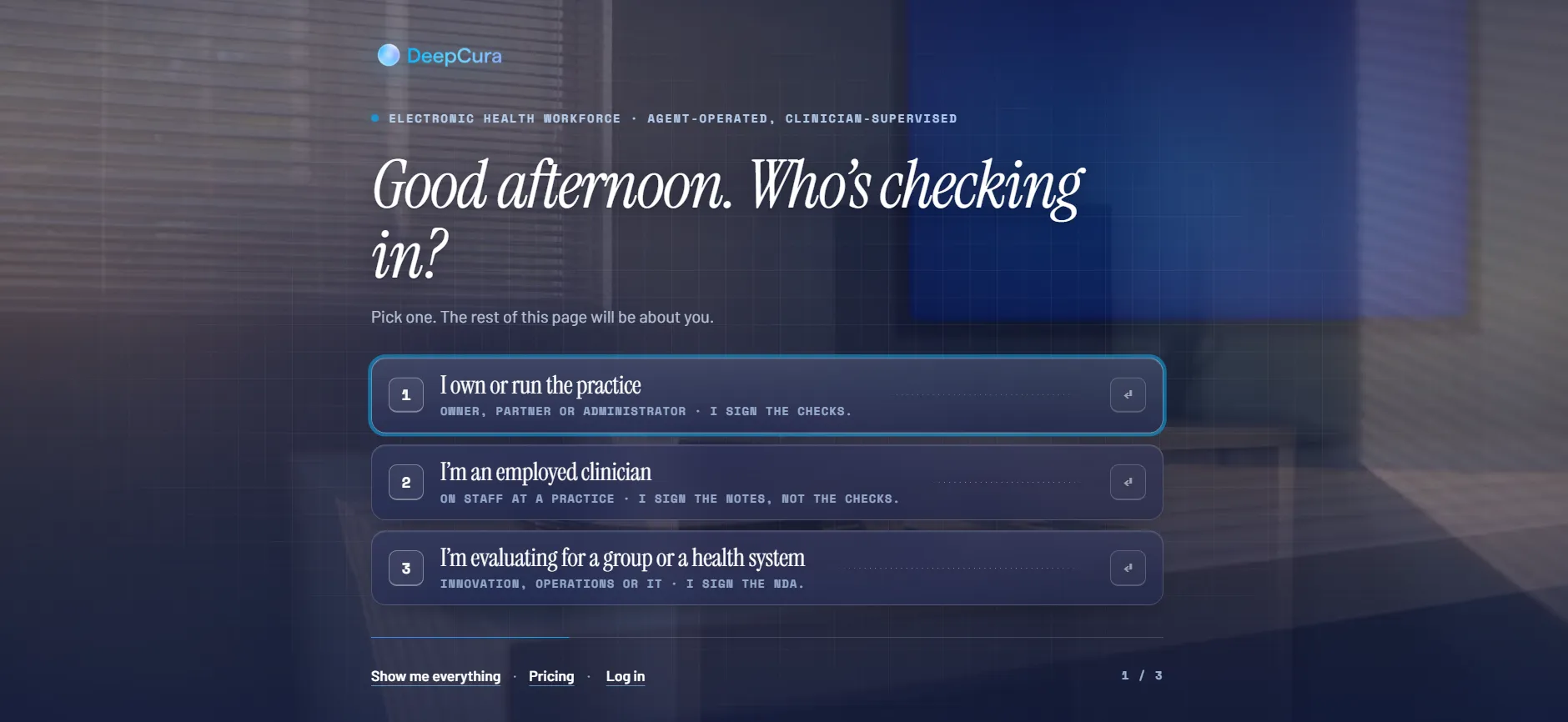
A posted monthly price and a self-serve start make DeepCura the easiest entry point for small practices. One subscription covers its AI agents, including the receptionist, an ambient scribe, billing checks, intake and fax management.
| Team size | Price per provider per month |
| 1 to 2 providers | $129 |
| 3 to 5 providers | $116 |
| 6 to 10 providers | $110 |
| 11+ providers | $101 |
| Annual billing | $999 per seat per year |
What it covers
- Call answering, scheduling, triage and payments around the clock
- Bidirectional write-back with 7+ EHRs, including athenahealth, eClinicalWorks and DrChrono
- A choice of GPT, Claude or Gemini for clinical notes
- Self-serve signup to test every agent before committing
Where it falls short
- Each seat includes 1,000 credits a month shared across every agent, with one credit per call, so busy practices may need the $59 add-on for 1,000 more
- DeepCura’s CEO has written that the company runs with two human employees and seven AI agents, so ask how human support works
A clinic that expects a dedicated human account team may prefer a larger vendor.
DeepCura bundles AI for the small clinic, while Notable bundles it for hospitals buried in referrals and authorizations.
6. Notable
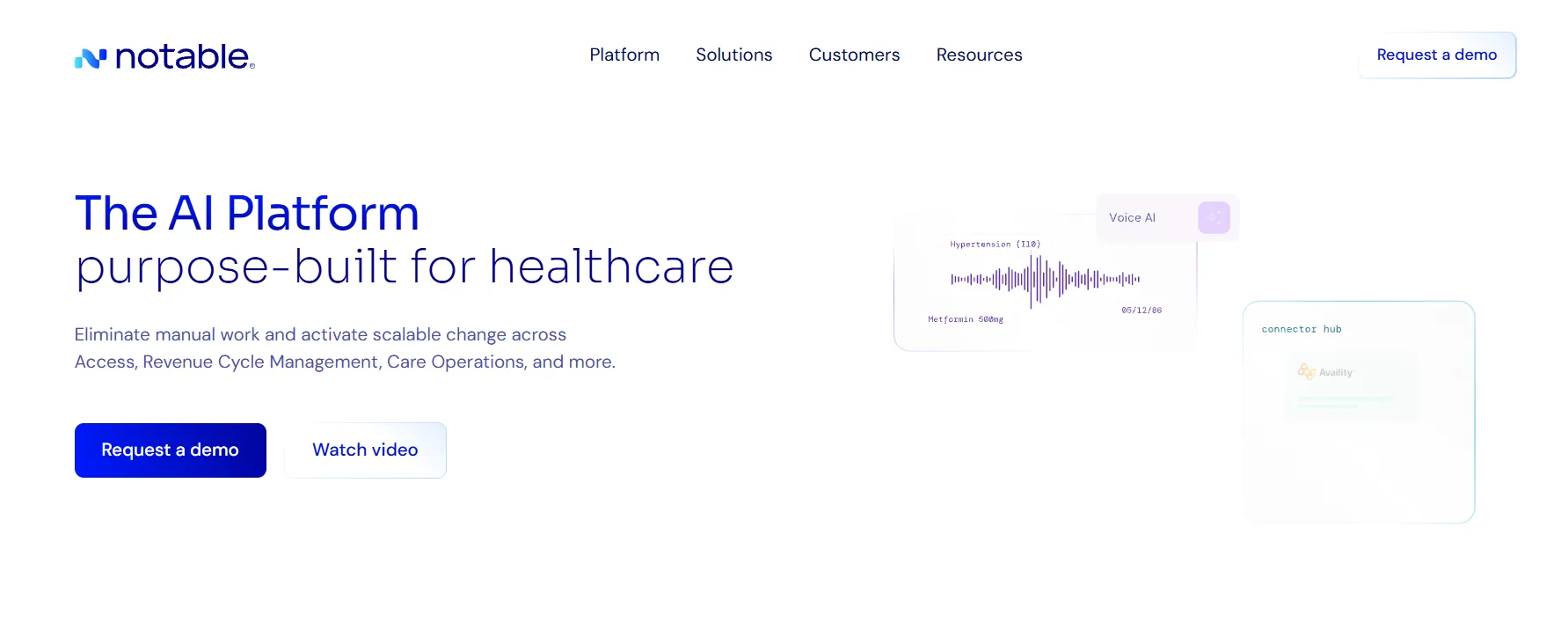
Hospitals with large referral backlogs get the most from Notable, whose AI agents work inside the EHR across patient access, revenue cycle and care operations, with AI voice agents on the phones.
| Founded | Pricing | EHR connection | Named customer |
| 2017 | Custom enterprise contract | Runs inside the EHR | Inova Health |
What it covers
- AI voice agents for patient calls, plus scheduling and registration agents
- Referral intake and processing
- Authorization support and care gap outreach
Inova Health picked Notable in January for AI agents across revenue cycle, patient access and referral management.
Where it falls short
- Built for health systems, so little of it is sized for a small practice
- Independent practices are better served by the smaller platforms on this list.
Notable asks you to commit to a big platform, and Sully.ai lets you commit one AI role at a time.
7. Sully.ai
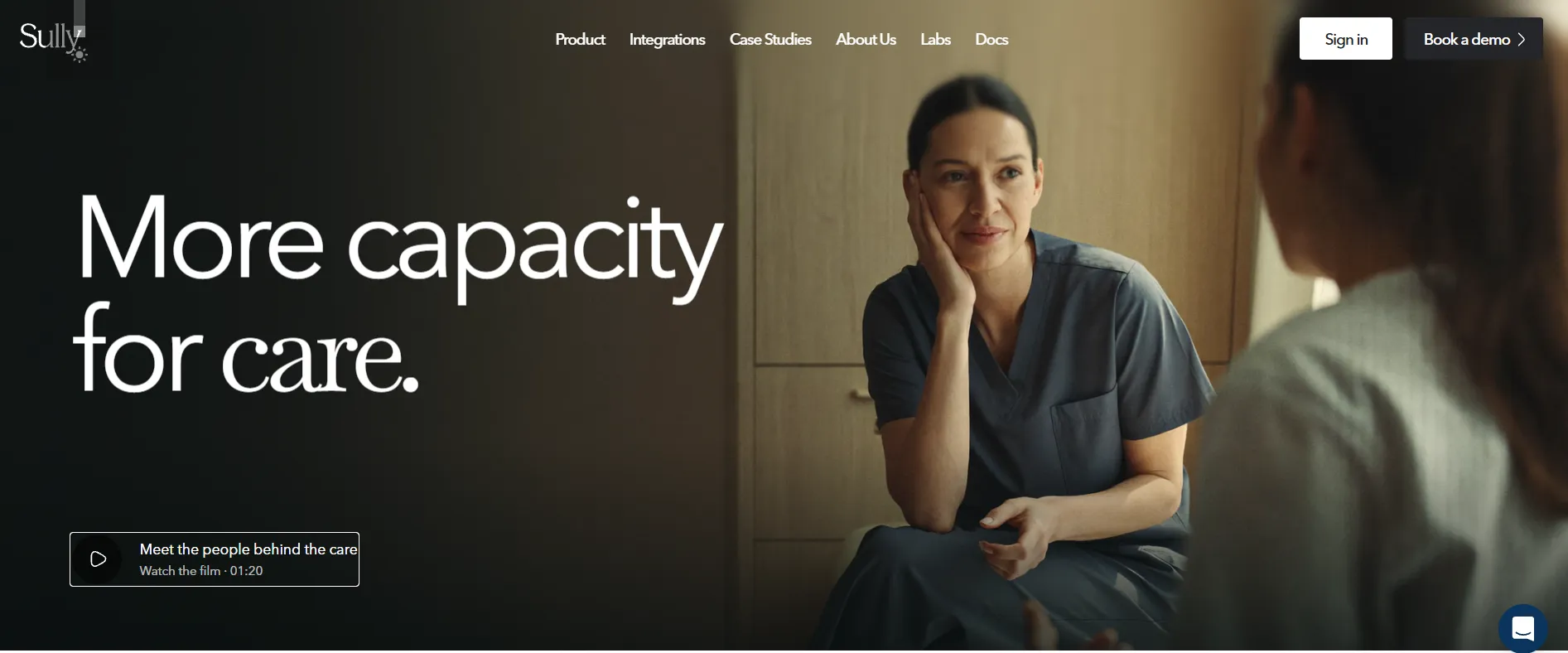
Practices nervous about a big-bang rollout tend to like Sully.ai, which sells AI “employees” you add one at a time, starting with a receptionist and expanding to a scribe, medical coder, triage nurse or interpreter.
| Pricing | EHR connection | Channels |
| Custom quote | 50+ EHRs incl. Epic, Cerner, MEDITECH, athenahealth | Phone, web, chat |
What it covers
- New-patient intake with insurance capture
- Scheduling, rescheduling and reminders
- Safety escalation when a caller describes concerning symptoms
Where it falls short
- Total cost gets harder to forecast as you add agents
Clinics that want one product at a single price for the whole front desk should compare a bundled option first.
Sully’s 50+ integrations cover most mainstream EHRs, and DoctorConnect pushes that coverage further into regional and specialty systems.
8. DoctorConnect ARIA
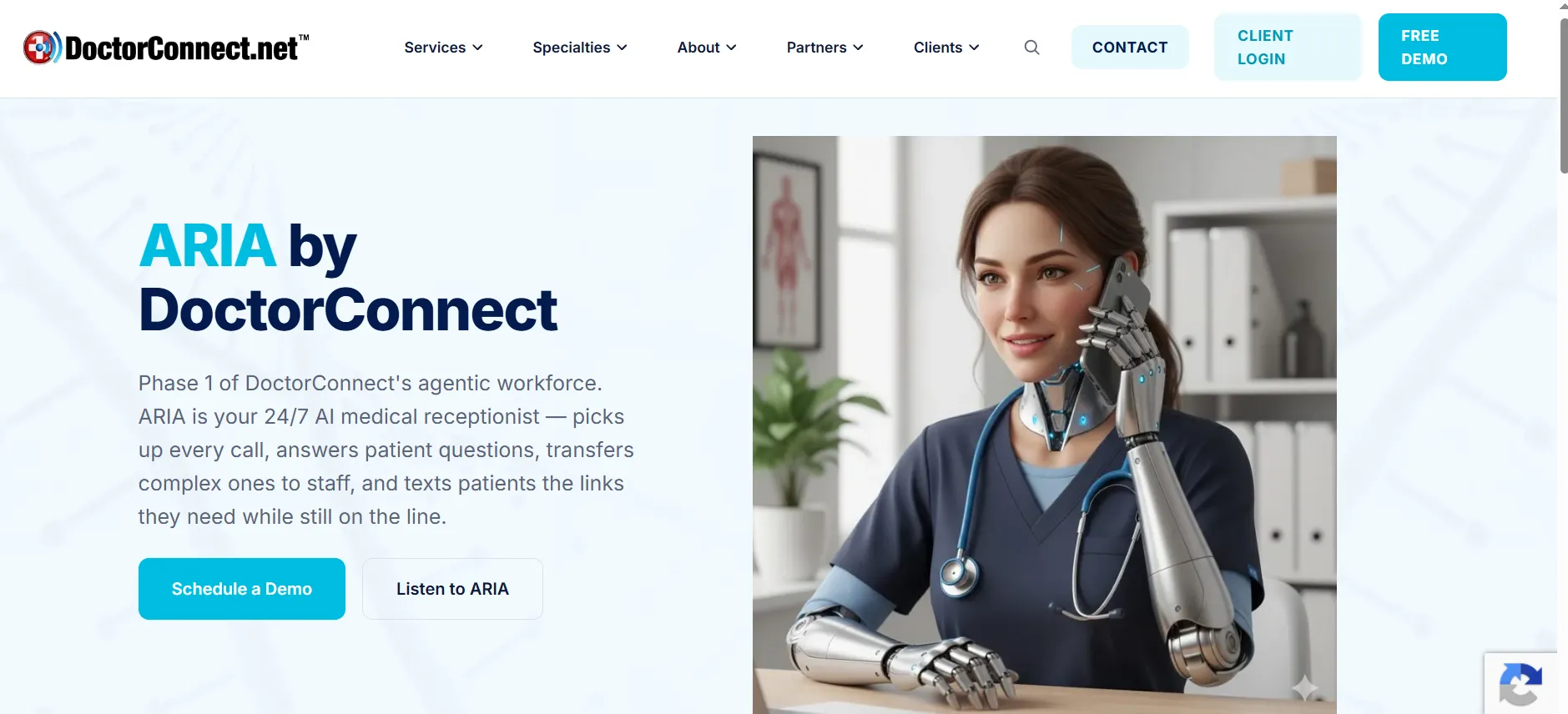
Clinics on a regional or specialty EHR should look at DoctorConnect, which has run patient communication software since 1992 and lists 150+ EHR and PM integrations, far more than most AI-first startups name.
| Founded | Pricing | EHR connection | Scale |
| 1992 | Quote, with one DoctorConnect page listing ARIA at $150 per location per month for non-customers plus usage fees | 150+ EHR and PM systems | 500+ practices |
What it covers
- ARIA, an AI receptionist that answers calls day or night
- Text-while-talking, which sends forms, instructions or payment links during a call
- MIRA for autonomous scheduling and KIRA for digital intake
- Reminders, recall, eligibility checks and RCM on the wider platform
Where it falls short
- Scheduling and intake are separate modules, so confirm which ones your quote covers
- Its own pages describe pricing differently, so get the number in writing
Offices whose EHR is well covered by the platforms above gain little from its integration breadth.
DoctorConnect solves breadth of EHR coverage, and Hello Patient solves the rollout itself by tailoring the AI for you.
9. Hello Patient
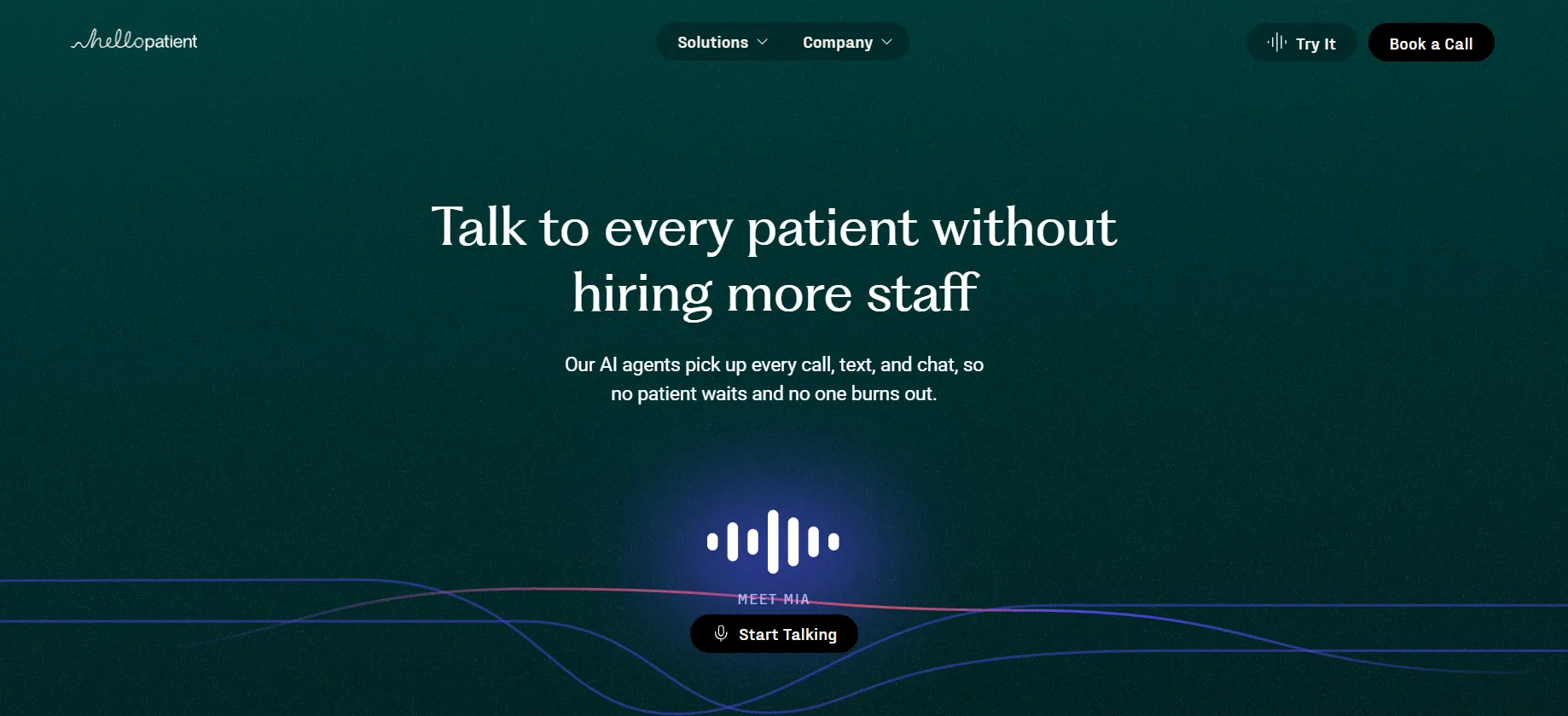
Medical groups that want a hands-on rollout use Hello Patient, whose AI assistant Mia handles calls, texts and chat after the team tailors it to each practice’s workflows.
| Funding | Pricing | Channels | Volume |
| $22.5M Series A led by Scale Venture Partners | Custom quote | Voice, text, chat | 100,000+ calls in its first year |
What it covers
- Booking, rescheduling and patient questions
- Follow-up with patients who have fallen out of care
- Insurance verification and onboarding support
Where it falls short
- Its public materials focus on calls and texts, so confirm EHR write-back for your system during the demo
Teams that prefer to configure the AI themselves should ask how much control the managed model leaves them.
Hello Patient is built around a managed setup for groups, while Weave is built for the small office that wants phones and texting in one familiar app.
10. Weave
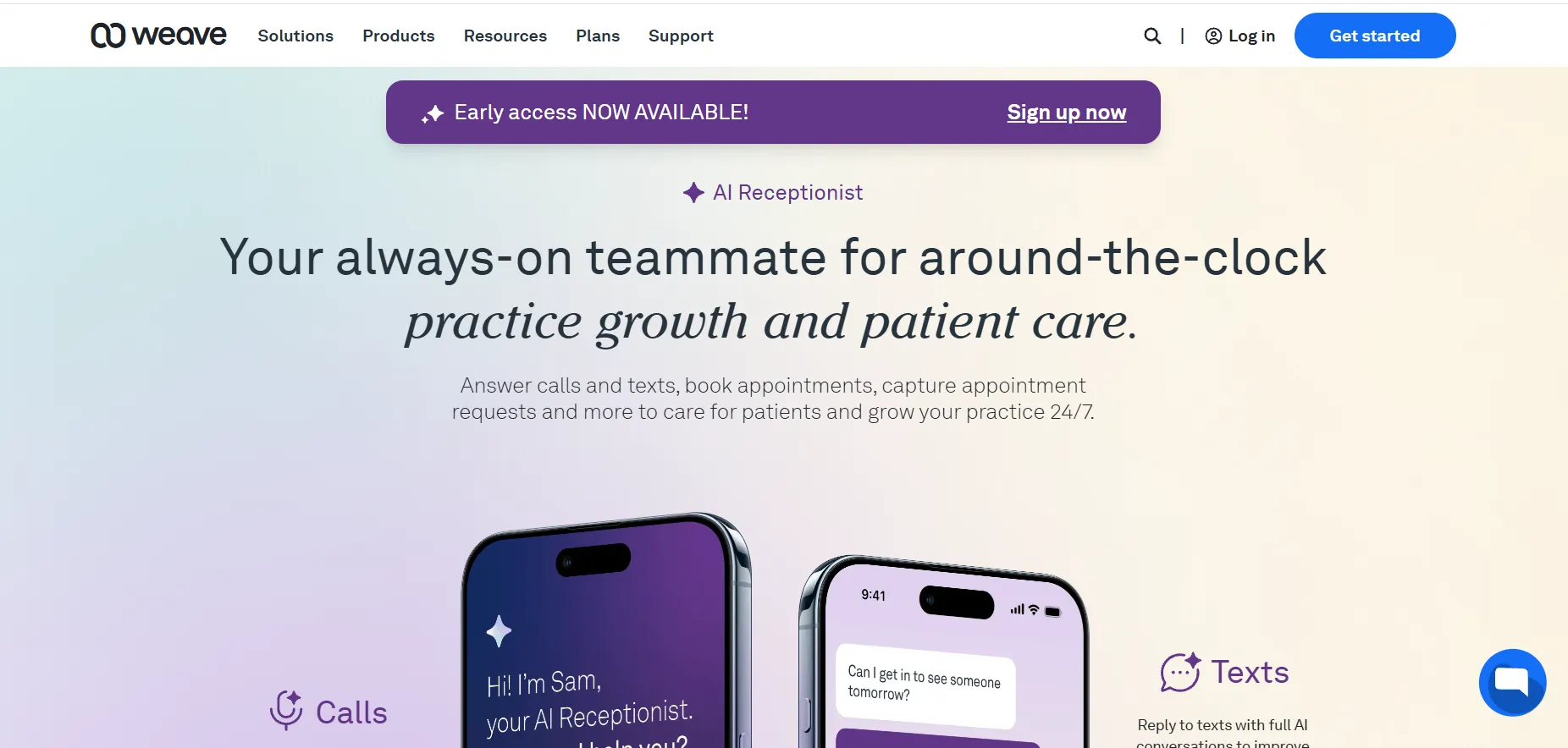
Small offices already on Weave phones can add its AI Receptionist without switching systems. Weave launched the omnichannel version in its second quarter, built on Google Cloud’s Gemini Enterprise Agent Platform, with conversation context kept across voice and text.
| Founded | Pricing | Integrations | Scale |
| 2008, NYSE WEAV | Add-on module or higher-tier bundle | PM systems incl. athenaOne | Nearly 40,000 customer locations |
What it covers
- Booking, confirming, canceling and rescheduling across calls and texts
- Intelligent call routing and FAQ answers 24/7
- Payments, reminders and automated insurance eligibility
Its Q2 results also noted a deeper athenaOne integration, which matters if that is your EHR.
Where it falls short
- AI features cost extra as add-on modules or higher-priced bundles
- Voice capability entered early access in May, so long-run performance data is limited
- Anyone who wants the receptionist tied to coding and claims will need a second system.
Ten strong platforms can still feel like too many, so the next step sorts them by the kind of practice you run.
Best AI Medical Receptionist by Practice Type
Sorting by practice type works because the size of your front desk decides how much configuration you can absorb. A solo practice with one receptionist needs something live in days, while a 30-site group can afford a quarter-long rollout if it gets one protocol everywhere.
| Your practice | First pick | Runner-up | Why it fits |
| Solo or small independent clinic | OmniMD AI Front Desk | DeepCura | Calls, intake and claims without extra vendors |
| Small office on a tight budget | DeepCura | Weave | Posted per-provider price, self-serve signup |
| Specialty group (ortho, derm, cardiology) | Assort Health | OmniMD AI Front Desk | Specialty-trained call flows |
| Multi-specialty clinic | OmniMD AI Front Desk | Sully.ai | 20+ specialties on one platform |
| Multi-location medical group | OmniMD AI Front Desk | Hello Patient | Vendor-managed setup across voice, text and chat |
| Health system | Luma Health | Hyro | EHR-deep orchestration at scale |
| Hospital call center | Hyro | Notable | Built to deflect high inbound volume |
| Referral-heavy hospital department | Notable | Luma Health | Referral and authorization automation inside the EHR |
| Practice on a niche or legacy EHR | DoctorConnect ARIA | OmniMD AI Front Desk | 150+ systems, or a FHIR and HL7 connection |
| Office already on Weave phones | Weave | DeepCura | AI added to the phone system you already run |
Practice type gets you to a shortlist of two or three. The name of the EHR on your login screen usually breaks the tie.
AI Medical Receptionist EHR Compatibility Matrix
EHR fit matters more than most features, because an AI receptionist that cannot write to your schedule turns every booked call into a task someone retypes. The matrix shows integrations each vendor names publicly. “Confirm” means the vendor has not named that EHR, which is a reason to ask during the demo.
| AI receptionist | Epic | athenahealth | eClinicalWorks | AI receptionist | Epic | athenahealth |
| OmniMD AI Front Desk | Via FHIR and HL7 | ✓ | Via FHIR and HL7 | OmniMD AI Front Desk | Via FHIR and HL7 | ✓ |
| Assort Health | ✓ | ✓ | Confirm | Assort Health | ✓ | ✓ |
| Luma Health | ✓ | ✓ | ✓ | Luma Health | ✓ | ✓ |
| Hyro | ✓ | Confirm | Confirm | Hyro | ✓ | Confirm |
| DeepCura | Confirm | ✓ | ✓ | DeepCura | Confirm | ✓ |
| Sully.ai | ✓ | ✓ | Confirm | Sully.ai | ✓ | ✓ |
| DoctorConnect ARIA | Confirm | Confirm | Confirm | DoctorConnect ARIA | Confirm | Confirm |
| Hello Patient | Confirm | Confirm | Confirm | Hello Patient | Confirm | Confirm |
| Weave | Confirm | ✓ | Confirm | Weave | Confirm | ✓ |
A check mark still leaves two questions open, since integrations come in very different depths.
- Read-only lets the AI see open slots but forces staff to book the visit
- One-way write books the visit but misses changes your staff make later, which leads to double-booking
- Bidirectional write-back keeps both sides in sync in real time, and this is the version to insist on
Your clinic rarely builds the connection itself, because the vendor’s team does that work, and your share of the job sits in the launch checklist further down.
Write-back depth also shapes the bill, since deeper integrations often sit on higher tiers or carry setup fees.
How Much Does an AI Medical Receptionist Cost?
That bill follows one of five pricing models. Among the platforms here, only DeepCura and DoctorConnect post numbers, and the rest quote after a demo.
| Pricing model | You pay for | Fits best when | Watch for |
| Per provider per month | Each billing clinician | Call volume swings month to month | Cost climbs with every new hire |
| Per minute | Talk time | Calls are short and predictable | Long insurance calls add up |
| Per call | Each answered call | Many short FAQ calls | Spam and wrong numbers count |
| Flat monthly | A fixed plan | You want one predictable bill | Overage rules above the cap |
| Custom enterprise | Locations, volume, integrations | Health systems and large groups | Multi-year minimums |
Comparing a per-provider plan with a per-minute plan takes one line of math. A four-provider clinic on DeepCura’s 3-to-5 tier pays 4 × $116, or $464 a month, before any extra credits. At 2,000 calls a month averaging three minutes each, that clinic uses 6,000 minutes, so a per-minute plan beats $464 only below about 7.7 cents a minute.
Break-even rate = Monthly flat or per-provider cost ÷ (Monthly calls × Average minutes per call)
The quote rarely tells the full story, so ask about each of these before you sign.
- One-time setup or onboarding fees
- SMS and text-message charges billed separately
- Per-location fees for multi-site groups
- Minimum contract length and cancellation terms
- Charges for live human backup or after-hours transfers
Price only tells you what goes out each month, and the case for buying rests on what comes back in. Read more about true cost of hiring medical receptionist
AI Medical Receptionist ROI for Your Clinic
The return on an AI medical receptionist comes from three places you can measure in your own practice, which are recovered appointments, staff hours freed up and no-shows avoided. No-shows deserve extra attention this year, since an August MGMA Stat poll found about one in three medical groups seeing higher no-show rates than last year as patients face higher costs.
Gather these numbers from your phone system and EHR before any demo.
- Monthly inbound calls and the share that go unanswered or to voicemail
- Share of missed callers who book elsewhere or never call back
- Average revenue per new and returning visit
- Front-desk hours spent on the phone each week and the loaded hourly wage
- Monthly no-show count
- Monthly AI receptionist cost from the pricing section above
Then run the same formula on every vendor you shortlist.
Monthly impact = (Recovered visits × Revenue per visit) + (Staff hours freed × Hourly wage) + (No-shows avoided × Revenue per visit) − AI cost
MGMA warns that an automation unable to point to the workflow change replacing the labor it removes is rarely cutting cost, and is often shifting it into overtime. So pick one baseline number, such as call abandonment rate, measure it before go-live, then measure it again at 30 and 90 days.
Every dollar in that formula assumes the AI handles patient data lawfully, which makes the compliance check the next gate. Calculate the ROI here
Is an AI Medical Receptionist HIPAA Compliant?
An AI medical receptionist can be HIPAA compliant, and the proof sits in a signed contract plus the way the vendor handles your data. Any vendor that hears, records or stores patient information acts as your business associate, so you need a signed Business Associate Agreement before the first live call.
Read the BAA for these five points.
- Recordings and transcripts are named as covered data
- Subcontractors, including the AI model provider behind the voice, sit under their own BAA chain
- Model training on your patients’ calls is off unless you opt in
- Retention periods for recordings are stated, along with how you delete them
- Breach notice to your practice comes without unreasonable delay and no later than the 60 days HIPAA allows
State law adds a layer some clinics miss. California’s AB 3030 requires practices using generative AI for patient messages about clinical information to include a disclaimer and instructions for reaching a human, spoken at the start and end of audio interactions. Scheduling and billing calls fall outside it, and messages a licensed clinician reads and reviews are exempt.
Outbound calls carry their own rule. The FCC ruled in 2024 that AI-generated voices count as artificial voices under the Telephone Consumer Protection Act, so recall and reminder campaigns need the right patient consent on file.
Compliance rules out risky vendors, and there are also practices where even a compliant AI receptionist is the wrong purchase for now.
When an AI Medical Receptionist Is the Wrong Fit
An AI medical receptionist pays off when routine, repeatable calls fill your lines, and it struggles when your phone traffic looks different. Hold off for now if one of these describes your practice.
- Call volume is low enough that one person answers everything without hold times
- Most calls need clinical judgment, such as a nurse line handling symptoms all day
- Your EHR offers no write-back path and no vendor on your shortlist supports it
- Nobody owns escalation rules, so the AI has no clear person to hand calls to
- Scheduling rules live only in staff heads, with no written templates
- No one on your team will review call logs and tune the AI after launch
Patient frustration usually traces back to that last gap, since an AI nobody tunes keeps repeating the same misunderstanding until the caller gives up.
Every item on that list can be fixed, and the fastest way to see whether a vendor will help you fix it is the set of questions you bring to the demo.
Questions to Ask an AI Medical Receptionist Vendor
The best demo question asks the vendor to book a visit live in your own EHR while you watch, since a sandbox hides every integration gap. Bring these too.
On the call itself
- How does the AI tell a new patient from a returning one?
- What happens when it misunderstands a caller twice in a row?
- Which languages and accents has it been tested on with your customers?
- When it transfers a call, what does my staff see on screen?
- How does it confirm a caller’s identity before discussing their chart?
On your workflows
- Can it follow different rules per provider, location and visit type?
- How do I update accepted insurance plans or office hours myself?
- What does it do when the EHR goes down mid-call?
- How are configuration changes tested before they go live?
On accountability
- Who reviews call recordings for errors, and how often?
- Can I export all call logs and transcripts if I leave?
- What happens contractually when the AI books a visit wrong?
A vendor that answers all twelve cleanly is ready for a pilot, and that pilot runs smoother when your team prepares a few things first. Read more FAQs here
How to Launch an AI Medical Receptionist
That preparation follows the same order at most clinics, with the vendor handling the technical connection while your team supplies the practice knowledge.
- File the signed BAA with your compliance lead
- Export last month’s call report from your phone system
- Write down appointment types, durations and provider rules
- List your top 20 call reasons from the last month of call logs
- Name escalation contacts for clinical, billing and urgent calls
- Approve EHR access and test with a dummy patient
- Start with after-hours or overflow calls only
- Review a sample of recorded calls every week for the first month
- Expand to daytime calls once error rates hold steady
Starting with after-hours calls limits the risk, since those calls would otherwise reach voicemail anyway. The questions patients and staff raise in those first weeks tend to repeat across practices.
Choosing Your AI Medical Receptionist
Pick the platform whose biggest strength matches your biggest phone problem. When the pain is staff retyping calls into the EHR, chasing eligibility and then fixing claims, the connected workflow in OmniMD AI Front Desk removes those handoffs.
Book a specialty-specific OmniMD demo and ask us to schedule a test patient inside your own EHR during the call. Run the same test with your second choice the same week, and the gap between the two will show up on the screen.

Kamal Sharma is a distinguished healthcare technology leader and CTO at OmniMD, renowned for driving transformation at the nexus of clinical excellence and digital innovation. Over a career spanning advanced EHR platforms, revenue cycle management, and Digital Health ecosystems including RPM, Telehealth, and Patient Portals, he has consistently architected patient-centric, outcome-oriented systems.