
AI Medical Scribe for Behavioral Health
Turn every behavioral health encounter into a structured, review-ready draft (progress notes, treatment plan updates and assessments) for each clinician on your team. Nothing is final until the clinician approves it.
Built for Behavioral Health Documentation
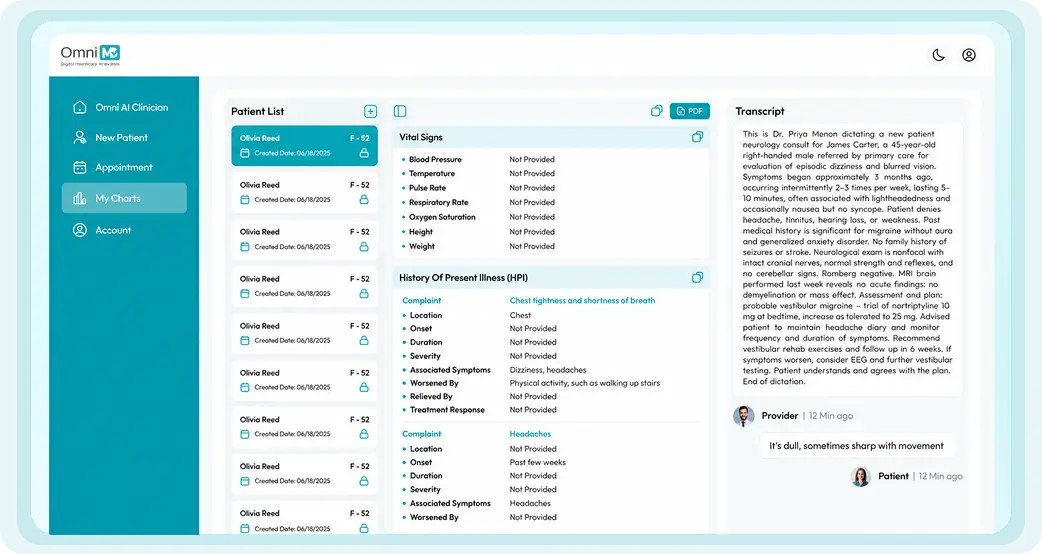
A behavioral health record isn’t one visit at a time. It’s a treatment plan that changes over months, progress notes written by several people, and assessments that have to line up with the goals they support. A scribe that treats every encounter as a standalone office visit leaves your team to stitch that story together by hand.
Narrative-heavy encounters
Much of what matters clinically is what the person says and how they say it. Speaker separation keeps each statement attributed to the right person.
Treatment plans that keep changing
Goals, objectives and interventions shift from session to session. Drafts capture the changes discussed, so the plan and the notes don’t drift apart.
Progress measured against goals
Progress notes have to point back to the plan they report on: what was addressed, what the clinician did and how the person responded.
Behavioral assessments
Intake and periodic assessments combine structured findings with the narrative context behind them. Both belong in the draft.
Many provider types, one record
Prescribers, therapists, counselors and case managers document the same person differently. Each gets the note format their role calls for.
Care that spans months or years
Current documentation is compared with earlier records, so progress and documentation gaps are easier to see.
How AI Medical Scribe Works in Behavioral Health

Capture the encounter
Once the patient or client agrees to recording, start the scribe in a browser or on the iOS or Android app. Speakers are separated from the first minute, and if the connection drops, audio keeps buffering on the device.

Structured draft generation
The conversation becomes a structured draft rather than a raw transcript: presenting concerns, interventions, risk statements and plan changes, organized as a progress note, SOAP, DAP, BIRP or your own template.

Clinician review and approval
The clinician reads the draft, corrects anything wrong or missing, and approves it. Nothing becomes part of the record until they do, and encounters with poor audio are flagged for closer review.

Privacy controls in the workflow
Encryption in transit and in storage, role-based permissions and audit logs apply across OmniMD modules. In OmniMD EHR, 42 CFR Part 2 consent tracking and disclosure logging cover substance use disorder records.

Coding support for your billing team
When the scribe syncs with OmniMD’s behavioral health EHR, ICD-10 diagnoses and CPT codes are populated from the documented encounter for the clinician and billing team to confirm.

Patient context next to the draft
Know Your Patient (KYP) brings history, medications, allergies, prior encounters and risk indicators into the same view as the draft, so nobody has to switch screens to check what changed.

Approved notes go to the chart
After approval, the note is pushed to OmniMD EHR or a connected EHR such as Epic, Cerner, athenahealth, eClinicalWorks or Allscripts. No exporting and no copy and paste.

Continuity across the care team
Session summaries and prior encounters stay with the chart, so the next clinician on the case can see what was addressed last time and what has changed since.
Behavioral Health Notes and Documentation
Start from the formats your clinicians already use, or configure your own at the practice level. Coding still follows your usual process, and our reference of behavioral health CPT and ICD-10 codes can help.
Behavioral health progress notes
Session-by-session notes that tie back to treatment goals: what was addressed, what the clinician did, how the person responded and what happens next.
SOAP, DAP and BIRP notes
All three formats are supported. Our guide to DAP notes for CBT, DBT and trauma care shows what a strong one contains, and you can try the free AI SOAP note generator.
Treatment plan updates
When goals, objectives or interventions change in a session, the draft records the change so the clinician can confirm it in the plan.
Behavioral assessments
Intake and follow-up assessments are drafted with their structured findings and the narrative context behind them.
Risk assessment documentation
Risk statements raised in the session, such as self-harm, suicidal ideation or substance use disclosures, are organized into a clearly labeled section. The scribe documents; the clinician assesses and completes it.
Care coordination and program-specific notes
Case management, care coordination and program notes can be set up as custom templates, adjustable per provider without IT involvement.
Individual counseling, follow-up visit
- Behavior
- Client reports two craving episodes this week and used the breathing technique both times.
- Intervention
- Reviewed the coping plan; reinforced the breathing technique; discussed triggers at work.
- Response
- Client engaged and identified one new trigger to add to the plan.
- Plan
- Update treatment goal 2. Case manager to follow up on the housing referral. Next session in one week.
- Progress note
- SOAP
- DAP
- BIRP
- Treatment plan
- Custom
Behavioral Health AI Scribe vs Traditional Documentation
| Step | Traditional documentation | ✓With OmniMD AI Scribe |
|---|---|---|
| When the note is written | After the session, or at the end of the day | Drafted from the encounter, ready to review shortly after |
| Where the details come from | The clinician’s memory and handwritten notes | The recorded conversation, with speakers attributed |
| Note structure | Depends on who writes it | Your organization’s chosen template |
| Across the team | Formats vary by clinician and site | Shared templates across roles and locations |
| Review | The clinician writes and checks their own note | The clinician reviews, edits and approves every draft |
| Getting it into the EHR | Retyped or copied and pasted into the chart | Pushed to the chart after approval |
AI Scribe for Behavioral Health Clinics
An outpatient clinic’s day mixes very different encounters, often in the same hour, and each needs a different kind of note.
- Intake. History, presenting concerns and the initial assessment in one draft.
- Follow-ups and therapy sessions. Progress against the plan, with prior encounters visible through KYP.
- Medication management. Changes, side effects and adherence captured for the prescriber to review.
- Assessments and care plan updates. Reassessments drafted for comparison with earlier ones.
Drafts are typically ready for review within about 90 seconds of the visit ending.
AI Scribe for Community Behavioral Health Organizations
Community programs document at a volume most private practices never see: large care teams, several provider types in one record, and people who stay in services for years.
- One documentation standard. Shared templates make notes consistent from site to site.
- Attribution in team encounters. Speakers separated across patients, providers, nurses and care team members.
- Care coordination. Handoffs between clinicians, case managers and prescribers written up in one place.
- Multi-location rollout. Typically live in 5 to 7 business days. Plan it with the 30-day AI medical scribe launch playbook.
Using OmniMD EHR? Supervised clinicians and interns can route notes for supervisor co-signature.
AI Scribe for Substance Use and Addiction Treatment
Substance use treatment runs on frequent follow-up, counseling and plans that change as a person moves through care. The scribe drafts; your clinicians decide what goes in the record.
- Counseling notes. Individual sessions structured into your program’s note format.
- Follow-up encounters. Frequent check-ins documented without a backlog building up.
- Treatment planning and progress. Changes captured as they’re discussed, tied back to the plan.
- Multidisciplinary care. Counselors, prescribers and case managers each document in their own format.
With OmniMD EHR, programs also get MAT workflows, ASAM criteria documentation support and 42 CFR Part 2 consent tracking.
Designed for Multidisciplinary Behavioral Health Teams
One scribe across the whole team, with each role documenting the way its work requires.
Prescribers
Psychiatrists and psychiatric nurse practitioners get medication management encounters drafted for review.
Therapists and counselors
Session notes in the format the program requires, from individual counseling to structured therapy.
Social workers and case managers
Care coordination and case notes set up as custom templates.
Psychologists
Assessment narratives drafted alongside their structured findings.
Clinical supervisors and medical directors
Consistent, structured notes that are faster to review, with co-signature available in OmniMD EHR.
Practice administrators
One documentation tool across locations and roles, with setup handled by OmniMD’s technical team.
Behavioral Health AI Scribe Features
The documentation capabilities of OmniMD AI Medical Scribe, set up for how behavioral health teams work.
Ambient documentation
Listens during the encounter; no dictation afterward.
Speaker differentiation
Voices separated and attributed, even with several clinicians present.
Structured clinical notes
Drafts arrive in sections, not as a raw transcript.
Behavioral health note formats
Progress notes, SOAP, DAP and BIRP.
Custom note templates
Per practice, adjustable per provider without IT.
Know Your Patient (KYP)
History, medications, allergies and prior encounters beside the draft.
Longitudinal comparison
Today’s note read against the history of the case.
Session summaries
A short recap for the next clinician who picks up the case.
Multilingual support
Conversations in more than one language, clinical context intact.
Push to EHR
Approved notes sync to the chart in one step.
Web and mobile
Browser plus iOS and Android apps. No hardware.
Confidence flagging
Poor-audio encounters flagged for review instead of drafted.
Longitudinal Documentation Across Months of Care
Behavioral health care often runs for months or years. Longitudinal record comparison sets today’s note against the history of the case, so progress, medication response and documentation gaps are easier to see before an audit finds them.
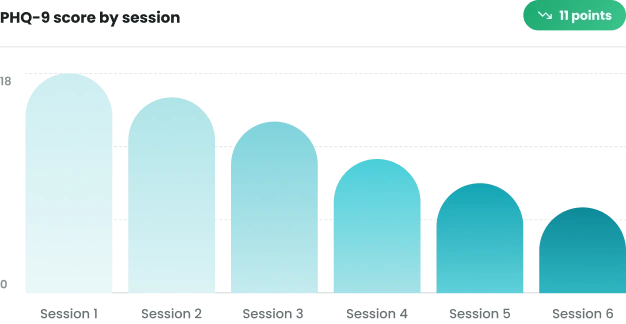
Sample PHQ-9 data for illustration only.
Behavioral Health EHR Integration
The scribe fits into your existing clinical workflow in one of two ways.
Inside OmniMD EHR
Pair the scribe with OmniMD’s behavioral health EHR and documentation, scheduling, telehealth, e-prescribing, billing and 42 CFR Part 2 controls sit in one system. The scribe pulls in patient history and updates the chart directly. If you’d rather outsource claims, see our mental health billing services.
Alongside your current EHR
OmniMD AI Scribe connects through SMART on FHIR, HL7 and secure APIs (see our approach to healthcare interoperability) and pushes approved notes into the patient chart:
- Epic
- Cerner
- athenahealth
- eClinicalWorks
- Allscripts
If your EHR isn’t listed, the standalone scribe still produces the note and your team moves it into the chart. Your EHR credentials are not shared with OmniMD during setup.
Weighing a therapy-focused EHR instead? Compare TherapyNotes and OmniMD side by side.
Privacy and Security for Behavioral Health Documentation
Behavioral health records hold some of the most sensitive things a person ever shares. Here is what applies to an AI scribe, and what to check with any vendor, including us.
HIPAA and your Business Associate Agreement
A vendor that processes protected health information on your behalf is a business associate under HIPAA. Make a signed BAA a condition of go-live, with us or with anyone else.
Encryption and access controls
OmniMD encrypts data in transit and in storage, and applies role-based permissions, audit logs and access controls across its modules.
Clinician review
Every draft is reviewed and approved by a clinician before it’s finalized. The signature, and the accountability, stay with the clinician.
Patient and client consent
Tell people the session is being recorded and get their agreement first. Our guide to consent and PHI handling for AI scribes in behavioral health covers consent scripts, minors and couples sessions.
42 CFR Part 2 for substance use disorder records
Programs covered by 42 CFR Part 2 hold SUD records to protections beyond HIPAA, and compliance with HHS’s 2024 final rule has been required since February 16, 2026 (HHS fact sheet). OmniMD EHR includes patient-level consent tracking, role-based isolation of SUD records, break-the-glass audit trails and disclosure logging. With a different EHR, those controls depend on that system. Read more about 42 CFR Part 2 compliance in a behavioral health EHR.
Why Behavioral Health Teams Use AI Medical Scribes
Practical reasons, not promises. Use the estimator below to model your own numbers.
- Less manual documentationThe first draft comes from the encounter, not a blank template.
- Less charting after hoursNotes get finished between appointments instead of in the evening.
- Consistently structured notesShared templates keep notes consistent across clinicians and sites.
- More attention in the roomClinicians can listen instead of typing while the person talks.
- Easier handoffs across the teamCare coordination is written up in the same place and format.
- Faster supervisory reviewStructured drafts are quicker to read, correct and co-sign.
Estimate the Documentation Time Your Team Could Get Back
See It With Your Own Note Types
Tell us the encounters your team documents most (intakes, counseling follow-ups, medication management, care coordination) and we'll walk through the drafts the scribe produces for them, in your formats and your EHR.