
Key Takeaways
- Addiction Treatment EHR Software Comparison Table
| Platform | Best fit | Methadone dispensing | Capterra rating | Standout |
| Kipu | Residential, detox, OTP | Yes, pumps and robots | 4.7 | Dispensing plus residential tools |
| Sunwave | Billing-heavy centers | Confirm in demo | 4.5 | One login for admissions, records, billing |
| OmniMD | Outpatient MAT, combined care | Confirm in demo | 4.5 | SUD inside a multi-specialty EHR |
| athenahealth | Outpatient behavioral health | Confirm in demo | 3.8 | Best in KLAS |
| Qualifacts | OTPs, agencies | Yes, MethodOne | 3.9 | Three EHR sizes |
| Alleva | Centers billing in-house | Confirm in demo | 4.5 | Billing inside the record |
| BestNotes | Small programs | Confirm in demo | 4.6 | Full price list |
| Netsmart | Large agencies | Yes, Methasoft and SMART | 2.3 | MAT, OTP and residential in one vendor |
The table shows a trade-off for methadone programs. Netsmart and Qualifacts offer built-in dispensing and have the lowest user scores on the list. Kipu is the only platform here that pairs built-in dispensing with a rating above 4.5.
Ratings also mix different users. athenaOne’s score includes patients rating the portal, and Sunwave’s includes Lightning Step customers. Filter reviews by reviewer role and date before you weigh them.
- Rehab Center EHR Software by Program Type
| Your program | Look at first | Also consider |
| Residential or detox with dosing | Kipu | Qualifacts |
| Center with heavy group schedules billing in-house | Alleva | Sunwave, Kipu |
| Methadone OTP at one site | Kipu | Qualifacts |
| Methadone OTPs across several counties | Netsmart | Qualifacts |
| Office-based buprenorphine practice | OmniMD | athenahealth |
| SUD care inside psychiatry or primary care | OmniMD | Athenahealth, OmniMD |
| Billing-heavy center with several programs | Sunwave | Alleva |
| Small program on a tight budget | BestNotes | OmniMD |
Addiction treatment programs face three federal deadlines within one year.
- Enforcement of the stricter privacy rule for substance use disorder (SUD) records began on February 16, 2026.
- Federal permission to prescribe controlled medicines by telehealth to patients never seen in person ends December 31, 2026.
- Medicaid work requirements begin January 1, 2027.
All three land on your EHR, because the EHR holds the consents, prescriptions and treatment records these rules check. The eight platforms below cover the main types of SUD programs.
- Kipu fits residential and detox centers that also dispense methadone.
- Sunwave fits centers where billing and insurance reviews take the most staff time.
- OmniMD fits outpatient SUD care and practices that treat addiction along with primary care or psychiatry.
- athenahealth fits outpatient behavioral health groups and holds this year’s KLAS award for ambulatory behavioral health.
- Qualifacts fits opioid treatment programs (OTPs) and community agencies.
- Alleva fits treatment centers that bill in-house.
- BestNotes fits small programs that want a published price.
- Netsmart fits large agencies running OTPs in several locations.
Where Addiction Treatment EHRs Differ From Medical and Therapy EHRs
Three kinds of software compete for addiction treatment programs, and each one stops at a different point.
- General medical EHR: Handles doctor visits, lab orders and prescriptions, including buprenorphine. It has no level-of-care assessments, bed tracking or SUD consent tools.
- Behavioral health EHR: Handles therapy notes, treatment plans and group scheduling. Most can’t run methadone dosing or detox check-ins.
- Addiction treatment EHR: Covers the full SUD episode, from admission and withdrawal checks through level-of-care changes, methadone dosing, discharge and alumni follow-up.
The latest federal data, in an April 2026 ONC brief from the Office of the National Coordinator for Health IT (ONC), shows how far these facilities have come. About 68% of substance use and mental health treatment facilities use only an EHR, and another 25% still mix an EHR with paper charts.
The same brief shows what those systems still struggle with.
- Only 19% of these facilities belong to a health information exchange (HIE), the networks that let clinics and hospitals share patient records.
- Facilities that use only an EHR send prescriptions electronically 82% of the time.
- Facilities still mixing in paper do so 62% of the time.
Two jobs separate a true addiction treatment EHR from the rest.
- Dispensing methadone: Sending a buprenorphine prescription to a pharmacy is prescribing. Running a dosing window, the counter where OTP patients receive daily methadone, is dispensing. It needs dose calculations, pump connections and bottle tracking.
- Splitting group notes: One IOP group with 12 patients should produce 12 separate patient notes, each showing that person’s participation, without the counselor rewriting the session 12 times.
Both jobs now come with federal rules attached.
Federal Rules Your Substance Abuse EMR Has to Support
A substance abuse EMR has to support five sets of federal changes. Each one gives you a specific feature to test in a demo.
- Stricter privacy rules for SUD records
The federal privacy rule for SUD records is 42 Code of Federal Regulations (CFR) Part 2. Its updated version became mandatory on February 16, 2026. On that date, the Office for Civil Rights (OCR) at the U.S. Department of Health and Human Services (HHS) began accepting complaints and breach reports. Penalties now match those under the Health Insurance Portability and Accountability Act (HIPAA).
The updated rule changes five things for your software.
- One consent can cover routine care: A patient can sign a single consent that covers treatment, payment and health care operations (TPO).
- Counseling notes need their own consent: SUD counseling notes kept apart from the main record still require a separate consent.
- Court protection stays: Records can’t be used against a patient in court without written consent or a court order.
- Separate storage isn’t required: HHS says SUD records don’t have to sit in a walled-off section of the EHR. What counts is control over who sees and shares them.
- One section is paused: The requirement to list every disclosure is on hold. Patients can already ask you to limit who sees their records, so your system needs a way to log and honor those requests.
On September 29, 2026, OCR issued guidance on when state Medicaid agencies can use Part 2 records to confirm that a patient is excused from the new work requirements. Records already shared under a valid consent can be used. Otherwise, the patient has to agree first.
HIPAA’s own security rule update is on a slower track. OCR has moved its final version to at least July 2027, so the current security rule still applies.
- Take-home methadone limits based on time in treatment
The federal opioid treatment program rules, known as Part 8, come from the Substance Abuse and Mental Health Services Administration (SAMHSA). They link take-home methadone to how long a patient has been in treatment.
| Days in treatment | Take-home doses allowed |
| Days 1 to 14 | Up to 7 |
| Days 15 to 30 | Up to 14 |
| Day 31 onward | Up to 28 |
These limits do not automatically qualify patients for take-home doses. An OTP medical practitioner or medical director must assess each patient’s circumstances, determine whether unsupervised medication is appropriate, and document the clinical justification. The regulations also provide separate allowances for doses covering OTP closures, weekends, and holidays.
Part 8 also establishes different telehealth requirements for patients entering treatment with methadone and buprenorphine:
- Methadone: The initial evaluation must generally use audio-visual telehealth. If video is unavailable to the patient, an audio-only evaluation is permitted when the patient is physically present with a licensed practitioner registered to prescribe and dispense controlled medications.
- Buprenorphine: The initial evaluation may use either audio-visual or audio-only telehealth, provided the practitioner determines that an adequate evaluation can be completed through that method.
Your EHR should help OTPs track each patient’s treatment start date, display the applicable federal take-home limits, and document practitioner-approved take-home decisions. It should also support the different telehealth requirements for methadone and buprenorphine, including the specific exception for audio-only methadone evaluations.
- DEA telehealth prescribing rules change December 31, 2026
The Drug Enforcement Administration (DEA) currently allows clinicians to prescribe Schedule II–V controlled medicines by telehealth to patients they’ve never seen in person. That permission ends December 31, 2026, under the current DEA extension. The DEA’s permanent replacement rule has been under White House review since August 25, 2026, and the federal regulatory agenda targets November for final action. As of November 6, 2026, it had not been published.
A separate DEA rule for buprenorphine is already in effect.
- A clinician can prescribe up to six months of buprenorphine by telehealth to a new patient.
- After six months, the patient needs an in-person visit, or the clinician needs another valid authorization, to keep prescribing remotely.
- The pharmacist has to verify the patient’s identity.
- The prescriber has to document a prescription drug monitoring program (PDMP) check.
Until December 31, 2026, buprenorphine prescriptions can still be written under the broader telehealth rules. After that date, the six-month limit applies to new telehealth buprenorphine patients. Your EHR should track each patient’s six-month window and flag when an in-person visit is due.
- Medicaid work requirements start January 1, 2027
The Centers for Medicare & Medicaid Services (CMS) interim rule requires states to start Medicaid work requirements by January 1, 2027. People with an SUD, and people in a qualifying treatment program, are excused.
When a state can’t confirm a patient’s exclusion from records it already has, the patient may need to bring proof. Your EHR should produce that proof and release it only under the right Part 2 consent.
- ASAM’s fourth edition, adopted state by state
The American Society of Addiction Medicine (ASAM) publishes the criteria programs use to decide each patient’s level of care. Its widely used assessment software, CONTINUUM, still runs on the third edition, while states move to the fourth edition on their own schedules.
- Washington switched in January 2026.
- Louisiana required full compliance by July 1, 2026.
- Oregon plans to finish by January 1, 2028.
Programs that bill Medicaid in more than one state may need both editions running side by side.
These five rules are the yardstick for the platform profiles that follow.
The 8 Best Addiction Treatment EHR Software Platforms
1. Kipu
Kipu combines methadone dispensing with residential and detox charting, admissions and billing from a single vendor.
- Kipu snapshot
| Detail | Kipu |
| Best for | Residential and detox centers, including those with an OTP |
| Care settings | Detox, residential, outpatient, OTP |
| Capterra rating | 4.7 from 218 reviews, 90% likely to recommend |
| Pricing | Quote only |
| Main parts | Patient record (EMR), admissions (customer relationship management, or CRM) and billing (revenue cycle management, or RCM) |
B. Kipu’s biggest strength
- Methadone dispensing: Supports dosing, dispensing pumps and take-home tracking.
- Diversion checks: Callback workflows check in on patients who carry take-home doses, to catch medicine being misused.
- Robotic dose prep: Since August 2026, staff can send approved take-home orders to Opio’s ZING robot. Kipu says this prepares doses up to four times faster.
- ASAM assessments: Connects with ASAM CONTINUUM.
C. Problems users reported this year
Three 2026 reviews on Capterra Canada describe cost and complexity.
- Separate logins and add-ons: An April reviewer said billing, the patient record and CRM each need their own login. They felt pressured to buy add-ons and said support had declined. If you need all three parts, ask whether they share one login, and get every part priced on one quote.
- Slower charting: A second April reviewer liked Kipu’s customization but said charting feels clunky and takes extra time. They said support works best with an assigned support contact, so ask whether your contract includes one.
- Cost for small teams: An October reviewer said integrations take time to learn and that small businesses find Kipu expensive.
Should you pick Kipu?
| Your situation | Pick it? |
| Residential or detox center that also dispenses methadone | Yes |
| Multi-site network wanting records, admissions and billing from one vendor | Yes |
| Small outpatient practice on a tight budget | Probably not |
Separate logins top the list of Kipu complaints. A single login across admissions, records and billing is Sunwave’s core pitch.
2. Sunwave
Sunwave combines the former Sunwave Health and Lightning Step Technologies, which moved under the single Sunwave name in June 2026. It sells admissions, patient records and billing under one login.
- Sunwave snapshot
| Detail | Sunwave |
| Best for | Centers where billing and insurance reviews take the most staff time |
| Who uses it | Substance abuse treatment centers, medication-assisted treatment clinics, behavioral health providers |
| Capterra rating | 4.5 from 37 reviews |
| Pricing | Quote only |
| Products | Two systems, Sunwave Health and Lightning Step, under one name |
B. Sunwave’s biggest strength
- Billing and insurance reviews built in: In-house billing covers benefits checks, claims, payments and utilization review (UR), the regular insurer checks on whether a patient still needs their level of care.
- AI note drafts: Its artificial intelligence (AI) tool, SIA, drafts biopsychosocial (BPS) assessments, group notes, progress notes and discharge summaries for a clinician to review and sign.
- AI certification: Sunwave says SIA is the first behavioral health AI tool certified under ISO 42001, an international standard for managing AI.
C. Problems users reported this year
- Setup and support: A February Capterra review from a chief of staff called their Lightning Step setup a disaster. They reported wrong setup advice, support answers that changed week to week, and billing held back by poor configuration. They also worried the merger would leave Lightning Step underfunded.
- Two systems under one name: Sunwave says existing customers stay on the system they already use. Ask which system you’d run on and how long it will be supported.
- One rating, two products: Many reviews on Sunwave’s Capterra page come from Lightning Step users, so check which product each reviewer used.
D. Should you pick Sunwave?
| Your situation | Pick it? |
| Center losing revenue to denied claims and slow insurance reviews | Yes |
| Program wanting admissions, records and billing in one login | Yes |
| OTP needing pump-connected methadone dosing on day one | Probably not |
Sunwave serves organizations that only do addiction treatment. Much of today’s buprenorphine and naltrexone care happens in practices that also treat diabetes, depression and chronic pain, and that is the setting OmniMD is built for.
3. OmniMD
We built OmniMD to run SUD care inside the same EHR that handles psychiatry, primary care and other specialties. A patient’s buprenorphine follow-up and blood pressure check share one chart and one set of privacy controls.
- OmniMD snapshot
| Detail | OmniMD |
| Best for | Office-based medication-assisted treatment (MAT), outpatient SUD care, combined care |
| Care settings | Outpatient, IOP, psychiatry, primary care, multi-specialty |
| Capterra rating | 4.5 from 51 reviews |
| Pricing | Request a quote |
| Time to go live | Up to 4 weeks for 1 to 3 providers, up to 8 weeks for 4 to 15, up to 3 months for larger groups |
B. OmniMD’s biggest strength
- Part 2 controls. Tracks SUD consents and logs every disclosure. Encryption, role-based access and audit logs cover the whole system.
- MAT and ASAM. Includes MAT workflows and support for documenting ASAM criteria.
- Prior authorization. Handles approvals from behavioral health insurers, including Medicaid plans that manage behavioral health separately, as part of claim submission.
- AI medical scribe. Drafts progress notes, treatment plan updates and assessments, then suggests diagnosis codes (ICD-10) and procedure codes (CPT) for the clinician and billing team to confirm.
- Supervisor sign-off. Routes notes from interns and supervised clinicians to a supervisor for co-signature.
- Note formats and telehealth. Includes SOAP, BIRP and DAP templates and built-in telepsychiatry.
Our Capterra listing carries a 4.5 rating from 51 reviews.
C. Where we fall short
- Methadone dosing windows: If you run your own methadone dosing window, confirm pump and dispensing support with us in the demo, or pair us with a dedicated dispensing system. Kipu, Qualifacts and Netsmart build dispensing in.
- ASAM edition: Ask us to show the ASAM edition your state’s Medicaid program uses.
- SUD references: Ask us to connect you with SUD programs similar to yours.
Should you pick OmniMD?
| Your situation | Pick it? |
| Office-based buprenorphine or naltrexone practice | Yes |
| Practice treating SUD along with psychiatry or primary care | Yes |
| Outpatient or IOP program billing Medicaid managed care | Yes |
| Methadone OTP with its own dosing window | Probably not |
Outpatient care that combines behavioral health with primary care is also what KLAS recognized this year, in athenahealth.
4. athenahealth (athenaOne for Behavioral Health)
athenahealth won the KLAS award for Ambulatory Behavioral Health in February 2026, scoring 75.7 in its first year of eligibility. It is the only platform on this list with a current KLAS category award.
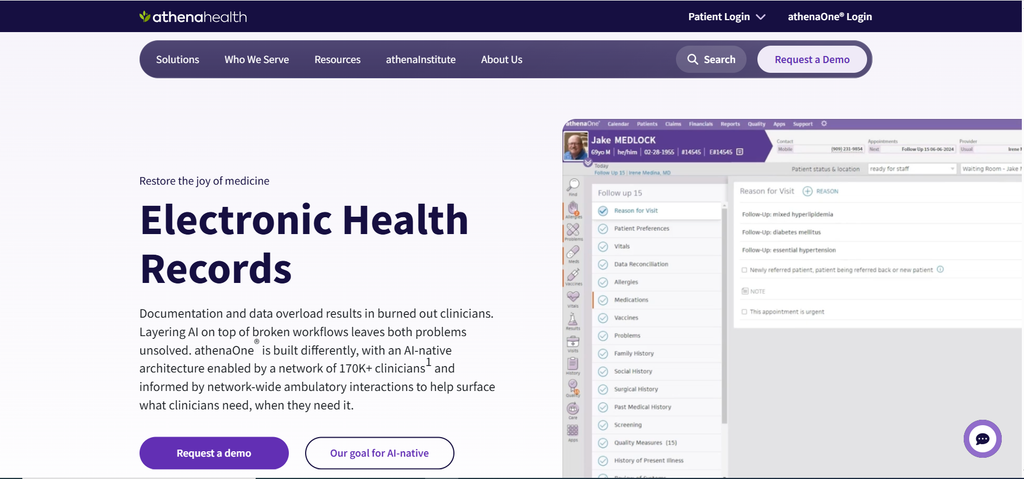
- athenahealth snapshot
| Detail | athenaOne for Behavioral Health |
| Best for | Outpatient behavioral health groups adding SUD care |
| Care settings | Outpatient behavioral health practices |
| Capterra rating | 3.8 from 916 reviews (athenaOne overall) |
| Pricing | Quote |
| Award | Best in KLAS, Ambulatory Behavioral Health |
A. athenahealth’s biggest strength
- Outside validation: KLAS awards are based on interviews with practices that use the product.
- Combined care: Puts behavioral health and primary care in one platform.
B. Weak spots
- Support scores: Customer service is athenaOne’s lowest Capterra score, at 3.6 out of 5.
- Patient reviews in the mix: Many of the 916 reviews come from patients rating the patient portal. Filter by reviewer role before drawing conclusions.
- Ambulatory focus: The KLAS award covers outpatient care. Residential, detox and OTP programs should test those workflows directly.
- Part 2 screens: Ask to see SUD consent screens and the disclosure log during the demo.
Should you pick athenahealth?
| Your situation | Pick it? |
| Outpatient behavioral health group adding MAT | Yes |
| Practice that gives KLAS research heavy weight | Yes |
| Residential, detox or OTP program | Probably not |
athenahealth leaves methadone dispensing to other vendors. Qualifacts made dispensing its largest purchase of the year.
5. Qualifacts
Qualifacts sells three behavioral health EHRs, CareLogic, Credible and InSync. In April 2026 it acquired MethodOne, a dispensing system built for OTPs. Qualifacts says its customers are shifting from office-based opioid treatment (OBOT) to full OTPs because OTP billing is simpler)
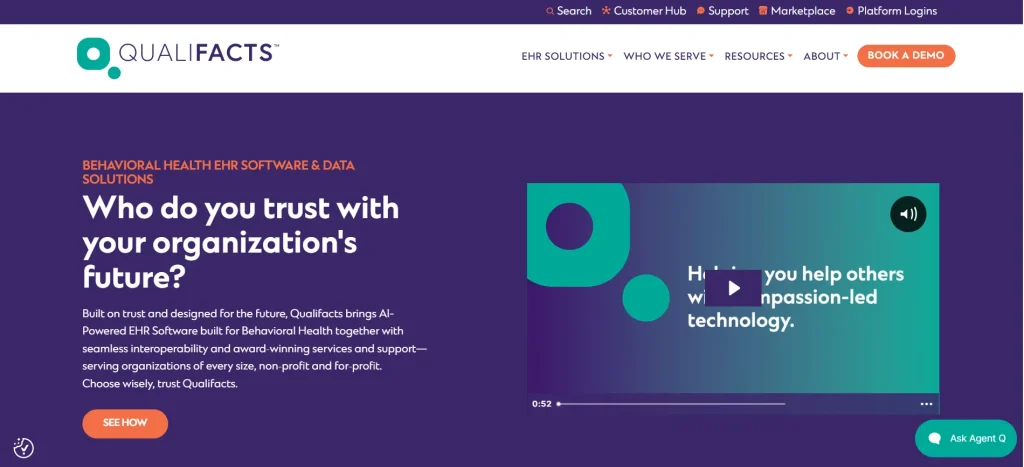
- Qualifacts snapshot
| Detail | Qualifacts |
| Best for | OTPs and community agencies |
| Care settings | OTP, community mental health, residential, inpatient |
| Capterra rating | 3.9 from 73 reviews (Credible) |
| Pricing | Quote, per user |
| Dispensing | MethodOne, acquired April 2026 |
B. Qualifacts’ biggest strength
- Dispensing: MethodOne handles methadone dispensing, inventory and compliance for OTPs regulated by the DEA, SAMHSA and state agencies.
- ASAM tools: Includes ASAM CONTINUUM and CO-Triage assessments.
- Wide care range: Covers medication administration, labs, and inpatient and residential programs.
- Three sizes: Agencies choose the EHR that matches their size and services.
C. Weak spots
- Support and value: On Capterra, Credible scores 3.6 out of 5 for both customer support and value for money, and 70% of reviewers would recommend it.
- New integration: MethodOne joined in April. Ask whether dispensing works inside your EHR today or connects from outside.
- Choosing a product: Ask which of the three EHRs fits your program before the demo.
D. Should you pick Qualifacts?
| Your situation | Pick it? |
| Methadone OTP wanting dispensing and records from one vendor | Yes |
| Community agency running SUD and mental health services | Yes |
| Small private outpatient program wanting a simple setup | Probably not |
Qualifacts sells mainly to agencies. Private treatment centers that want billing inside the patient record often compare Alleva.
6. Alleva
Alleva sells records, admissions and billing tools to addiction treatment and behavioral health programs. It has more Capterra reviews than any other addiction-focused platform on this list.
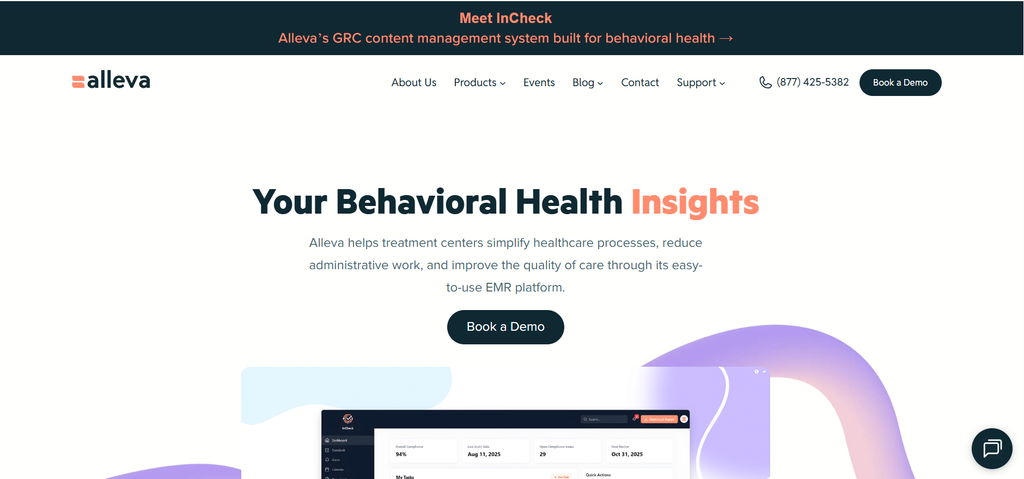
- Alleva snapshot
| Detail | Alleva |
| Best for | Treatment centers that bill in-house |
| Care settings | Residential, inpatient, outpatient, detox, adolescent |
| Capterra rating | 4.5 from 283 reviews, 80% likely to recommend |
| Pricing | Quote only |
| Connects with | CollaborateMD, Dazos CRM, Waystar, eFax |
B. Alleva’s biggest strength
- Billing inside the patient record: Claims run through Waystar, a clearinghouse that checks claims and sends them to insurers.
- Claim checks: Custom billing rules and automatic claim scrubbing catch errors before submission.
- Payment tracking: Shows live claim status and posts insurer payment reports, called electronic remittance advice (ERA), automatically.
- AI notes: A tool called Echo drafts notes from therapy sessions.
B. Weak spots
Features is Alleva’s lowest score on Capterra UK, at 4.4 out of 5. Three areas need a close look in the demo.
- ASAM edition: Ask which ASAM edition it supports.
- Medication workflows: Ask to see controlled-substance prescribing and any methadone tools working live.
- Part 2 consent: Ask for a walkthrough of how it records consents and disclosures.
C. Should you pick Alleva?
| Your situation | Pick it? |
| Treatment center that bills in-house | Yes |
| Center that gives review volume heavy weight | Yes |
| OTP needing dispensing inside the EHR | Probably not |
Alleva shares pricing after a demo. BestNotes publishes its full price list.
7. BestNotes
BestNotes lists a starting price of $59 per user per month on month-to-month terms. Its latest listing on Capterra shows a 4.6 rating from 220 reviews.
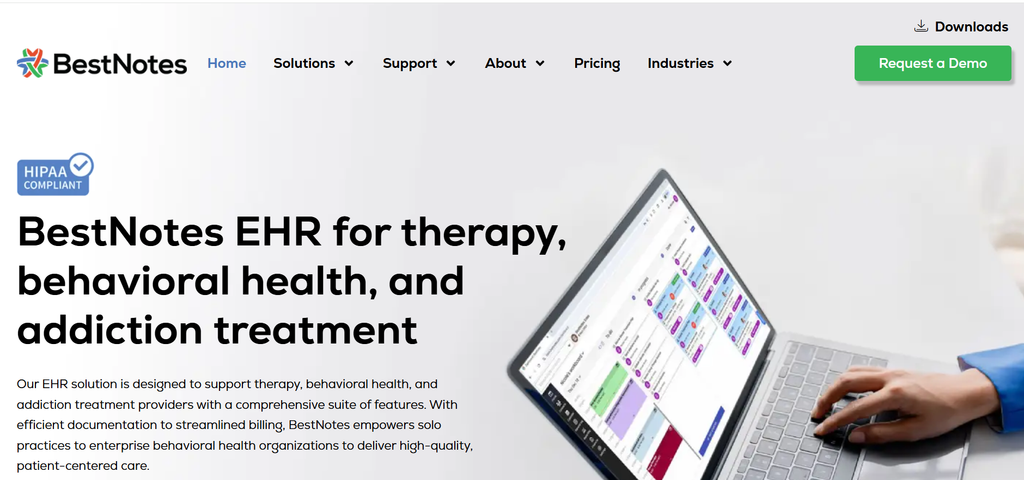
- BestNotes snapshot
| Detail | BestNotes |
| Best for | Small programs that need ASAM’s fourth edition at a known price |
| Care settings | Detox, residential, intensive outpatient, aftercare |
| Capterra rating | 4.6 from 220 reviews |
| Pricing | $59 per user per month for the first 10 users, lower after that |
| Contract | Month to month |
B. BestNotes’ biggest strength
- Published prices: Every add-on has a listed price.
- ASAM fourth edition: An add-on tracks level-of-care changes over time and feeds them into treatment plans.
- Third-edition tools: CONTINUUM costs $504 and CO-Triage $144 per user per year, both paid up front and nonrefundable.
- No long contract: Month-to-month terms.
C. Problems users reported this year
- Dated screens: A September Software Advice reviewer called BestNotes reliable but said the interface looks dated and feels clunky.
- Add-ons nearly double the bill: Ten users on the base price cost 590amonth.AddingASAM’sfourthedition(40) and AI notes ($490) brings the total to $1,120 a month.
- Billing through a partner: Claims run through CollaborateMD, adding a step between a signed note and a paid claim.
D. Should you pick BestNotes?
| Your situation | Pick it? |
| Small program needing ASAM’s fourth edition now | Yes |
| Team wanting month-to-month terms | Yes |
| Multi-site center needing built-in billing and dispensing | Probably not |
BestNotes serves the smallest programs on this list. Netsmart serves the largest.
8. Netsmart
Netsmart sells to large behavioral health and human services agencies. It owns Methasoft and SMART, two methadone dispensing systems, and covers office-based MAT, OTPs and residential care.
A. Netsmart snapshot
| Detail | Netsmart |
| Best for | Large agencies with OTPs in several locations |
| Care settings | OTP, office-based MAT, residential |
| Capterra rating | 2.3 from 37 reviews (myAvatar) |
| Pricing | Quote only |
| Dispensing | Methasoft and SMART |
B. Netsmart’s biggest strength
- Dispensing: Methasoft and SMART handle dosing, inventory and case management for OTPs.
- Range of care: One vendor covers office-based MAT, OTPs and residential programs.
C. Weak spots
- Lowest user scores on this list: The myAvatar listing shows 62% negative reviews, with ease of use at 2.2 and customer service at 2.3.
- Enterprise fit: Ask for a setup timeline and pricing for a program your size before committing.
- References: Ask to speak with a Netsmart customer running SUD treatment at a similar scale.
Should you pick Netsmart?
| Your situation | Pick it? |
| Agency running OTPs across several counties | Yes |
| Organization running MAT, OTP and residential programs under one vendor | Yes |
| Independent 30-bed residential center | Probably not |
How to Switch Your Addiction Treatment EMR Without Losing Patients or Payments
A switch has to carry over records that a general medical practice never holds. Confirm the new system brings across each of these before go-live.
- Every active Part 2 consent, with its scope and expiration date
- Each OTP patient’s admission date, so take-home limits keep calculating correctly
- Open insurance approvals and UR due dates
- Every treatment plan, with the patient’s current ASAM level of care
- Full medication histories, including each dose change
- Unpaid claims, which should stay in the old system until they close
Keep the old system running through one full billing cycle so claims and authorizations opened there can close there.
Frequently Asked Questions
Can a primary care EHR run a buprenorphine practice?
Yes, if it supports electronic prescribing of controlled substances (EPCS), documents PDMP checks and tracks Part 2 consents. Methadone is different, because it has to be dispensed at an OTP using dosing tools that primary care systems usually lack.
Is a HIPAA-compliant EHR enough for SUD records?
No. Part 2 adds rules HIPAA doesn’t have, including a separate consent for SUD counseling notes and protection against records being used in court. Ask any vendor that claims Part 2 support to show a TPO consent, a patient restriction request and a disclosure record on screen.
Does KLAS rank addiction treatment EHRs?
KLAS doesn’t have a separate addiction treatment category. Its closest award this year went to athenahealth for ambulatory behavioral health, so residential and OTP buyers should rely on user reviews and reference calls with similar programs.
Can I use an AI scribe with SUD records?
Yes. Sunwave, Alleva and OmniMD all offer AI note tools. Before recording sessions, check how long the vendor keeps the audio and make sure that matches what your consent forms tell patients.
Choosing Your Addiction Treatment EHR
Three answers narrow the field.
- Whether you dispense methadone or only prescribe buprenorphine
- Whether you treat addiction on its own or alongside other care
- Which ASAM edition and Medicaid rules your state applies in 2027
Programs that treat addiction as part of whole-person outpatient care need Part 2 consent tracking, MAT workflows and prior authorization in the same chart as primary care and psychiatry. We built OmniMD to deliver that combination.
Disclaimer: This comparison is based on publicly available information, product documentation, user reviews, and regulatory guidance available as of November 6, 2026. Features, pricing, ratings, and regulatory requirements may change. The analysis is intended for informational purposes only and does not constitute legal, regulatory, or purchasing advice. Practices should independently verify vendor capabilities and consult qualified professionals before making compliance or software decisions.

Dr. Giriraj Tosh Purohit is an experienced Product Manager and Security officer with a strong background in healthcare technology and management consulting. With expertise spanning clinical workflows, EHR, RCM, Digital Health, and AI-driven products, he has been instrumental in shaping innovative healthcare solutions.