
Healthcare Ransomware Hit 67% of Practices in 2026: How to Protect Your EHR in 2027?
Healthcare ransomware attacks rose nearly 14 percent in the first half of 2026. Comparitech’s ransomware tracker counted 410 attacks on healthcare organizations from January through June, up from 360 in the second half of 2025. That works out to 2.3 attacks every day.
The 14 percent compares two back-to-back six-month periods, and the split underneath it tells your clinic far more than the headline does.
What the 14% Healthcare Ransomware Rise Means for Your Clinic
For your clinic, that split shows attackers shifting toward the healthcare businesses around you.
- Clinics and hospitals. Attacks on direct care providers grew just over 3 percent.
- Healthcare businesses. Attacks on medical billing providers, health tech companies, and similar firms grew nearly 35 percent.
- In the U.S. Provider attacks fell more than 7 percent, while attacks on healthcare businesses climbed from 71 to 79.
Vendors also hand attackers bigger prizes. Comparitech’s first-quarter data shows gangs claimed 29 TB of stolen data from 81 healthcare businesses, more than twice the 13 TB they claimed from 120 providers. One billing firm or software company holds records for many clinics, so every connection on the map below is a door into your patient records.
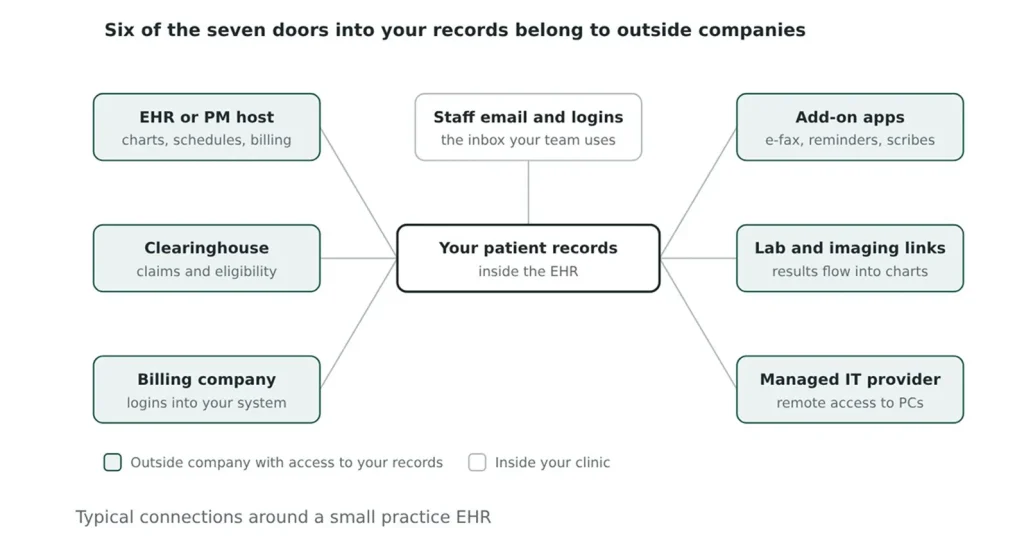
Behind those doors, the type of clinic attackers reached in 2026 followed a clear pattern.
Which Clinics Are Most at Risk From 2026 Ransomware Attacks
That pattern puts small clinics most at risk from 2026 ransomware attacks. We sorted the 13 confirmed U.S. provider victims that Comparitech names across its first-quarter and first-half 2026 reports by type of practice, and 12 of them were clinics or community providers.
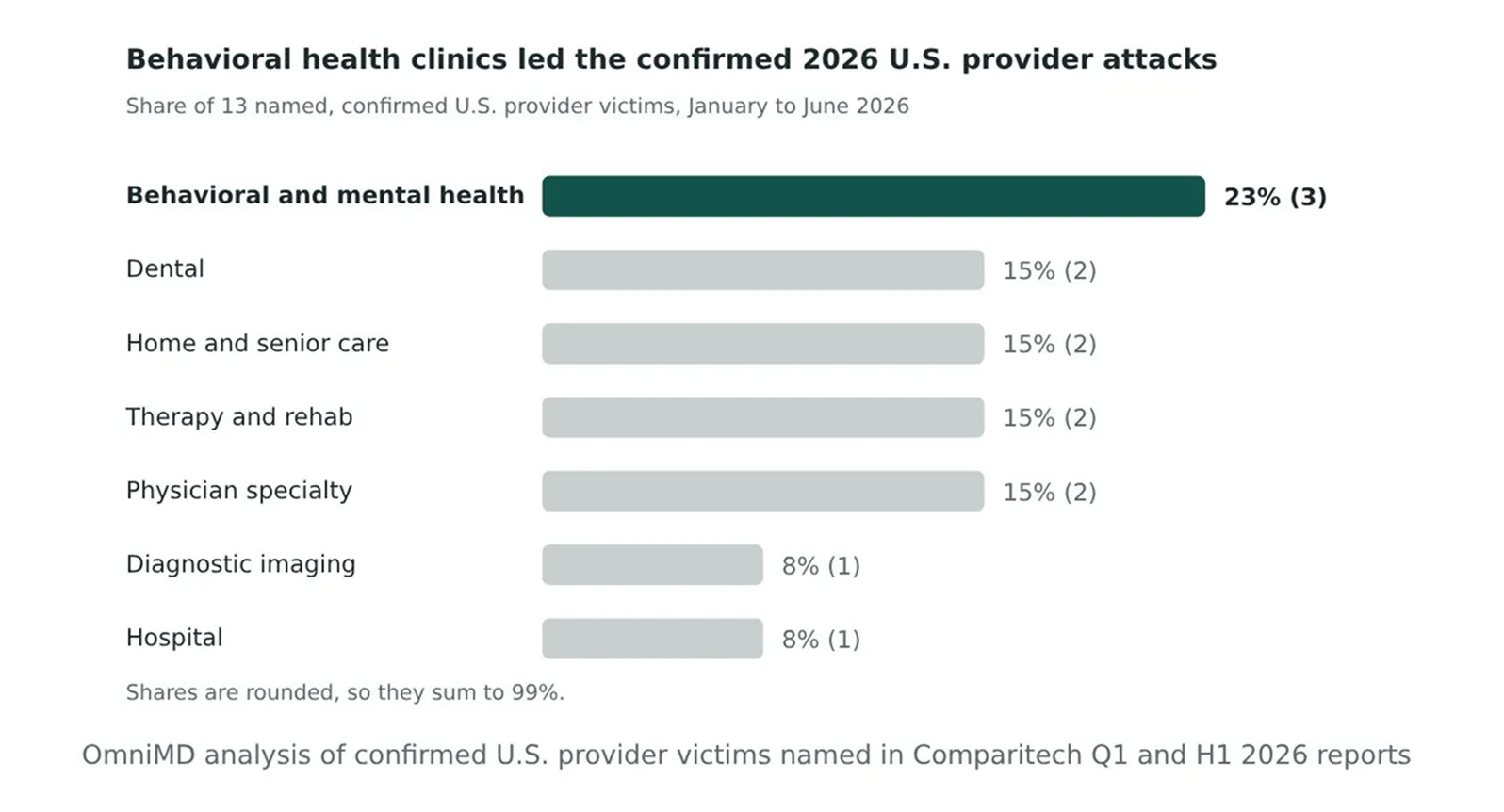
Each clinic type has one move that closes its most exposed door first.
| Clinic type | Named 2026 victims | Your first move |
|---|---|---|
| Behavioral and mental health | Aroostook Mental Health Services, FMRS Health Systems, Community Connections | Limit therapy-note access by role |
| Dental | Pecan Tree Dental (13,300 people), Bayside Dental | Keep an offline copy of patient files |
| Home and senior care | Rocky Mountain Care, Elmwood Healthcare | Lock down laptops and tablets used in homes |
| Therapy and rehab | Lymphedema Therapy Specialists, Texas Hearing Institute | Remove old staff and contractor logins monthly |
| Physician specialty | Mt. Spokane Pediatrics (32,021 people), Orthopaedic Specialists of Massachusetts | Print tomorrow’s schedule daily |
| Diagnostic imaging | AdvancedHEALTH | Keep imaging systems off front-desk networks |
Whatever type of clinic you run, knowing the price of a breach in advance shapes how much protection makes sense.
What a Healthcare Ransomware Breach Costs in 2026
The price of a healthcare ransomware breach comes from three places at once, the breach response, the ransom demand, and federal penalties. Healthcare has posted the highest average breach cost of any industry for 13 straight years, according to IBM’s 2026 breach report.
| Cost measure | Amount | Period |
|---|---|---|
| Average healthcare data breach | $6.64 million | IBM 2026 report |
| Average healthcare data breach | $7.42 million | IBM 2025 report, as cited in 2026 |
| Average U.S. breach, all industries | $11.5 million | IBM 2026 report |
| Breach contained within 200 days | $4.32 million | IBM 2026 report |
| Breach lasting over 200 days | $5.65 million | IBM 2026 report |
| Median ransom demand on providers | $300,000 | January to March 2026 |
| Median ransom demand on providers | $310,000 | January to June 2026 |
| OCR penalties, four ransomware cases | $1,165,000 total | Announced April 2026 |
IBM’s averages span organizations of every size, so your own total will differ. The pattern still holds for a small clinic, because across all industries a breach caught and contained within 200 days averaged $1.33 million less than a slow one.
The penalty line deserves a closer look. HHS announced the four settlements in April 2026, and every one of them involved a failure to complete an accurate and thorough risk analysis. That same law also decides who sends patient letters when your vendor is the one that gets hit.
Who Sends HIPAA Breach Notices When Your EHR Vendor Is Hit
HIPAA breach notification stays your clinic’s legal duty even when ransomware hits your EHR vendor, because HHS treats you as the covered entity and the vendor as your business associate. OCR guidance splits the work this way.
- Your vendor must alert you without unreasonable delay and no later than 60 calendar days after it discovers the breach.
- Either of you can mail the patient letters, and only one of you needs to send them.
- Your clinic still answers for whether they go out on time.
- Your next step is to log the date and time your vendor first alerts you, because your own notice clock generally starts when your clinic learns of the breach.
HHS’s ransomware fact sheet presumes a breach whenever ransomware encrypts patient data. You avoid notification only by documenting a low probability of compromise across four factors.
- The type of data involved
- Who got it
- Whether it was taken or viewed
- How far you reduced the risk
Two more rules catch clinics off guard.
- Outages count. HHS notes that a high risk to data availability can point toward compromise by itself, so a long vendor outage can trigger HIPAA duties even when no files leave.
- Smaller breaches. Breaches affecting fewer than 500 patients can be reported to HHS within 60 days after the end of the calendar year in which you found them.
Those timelines could tighten sharply, depending on what HHS does with its pending Security Rule overhaul.
How the Proposed HIPAA Update Would Change Ransomware Response in 2027
Those timelines would tighten under the proposed HIPAA Security Rule update. Three points frame the table that follows.
- No new ransomware definition. HHS’s proposed rule updates several definitions to match current technology, and none of them defines a ransomware attack.
- New duties instead. Its biggest ransomware changes sit in what you and your vendors must do once an attack starts.
- Timing. The 2026 federal regulatory agenda lists July 2027 as the projected final action date, and the current rule stays in force until a final rule replaces it.
| Requirement | Current rule | Proposed rule |
|---|---|---|
| Vendor alert | No contingency-plan alert | Added alert within 24 hours of activating its contingency plan |
| System restore | No set deadline | Written procedures to restore critical systems within 72 hours |
| Multi-factor login | Not named | Required, limited exceptions |
| Data encryption | Addressable | Required at rest and in transit, limited exceptions |
| Security testing | No fixed schedule | Scans every 6 months, penetration test every 12 months |
| Asset inventory and network map | Not required | Updated at least every 12 months |
| Vendor safeguard proof | BAA assurances | Written verification every 12 months |
You can build most of these habits with a 30-day plan, long before any final rule arrives.
Healthcare Ransomware Protection Strategies for Your Clinic in 30 Days
That 30-day plan for healthcare ransomware protection comes down to seven actions, each with an owner and proof to keep on file. OCR’s April 2026 recommendations start where week one does, by identifying where patient data enters, moves through, and leaves your systems.
| Week | Action | Owner | Proof to keep |
|---|---|---|---|
| 1 | List every vendor on the map above with a 24/7 incident contact | Practice manager | One-page vendor sheet |
| 1 | Run the free HHS security risk assessment tool | Owner and IT | Saved risk report |
| 2 | Turn on multi-factor login for email, EHR, and remote access | IT provider | Settings screenshot |
| 2 | Ask each vendor for its BAA notice window, last restore-test date, and subcontractor list | Owner | Written vendor answers |
| 3 | Build a paper downtime kit with forms, med and allergy lists, and a contact sheet | Front desk lead | Kit location on file |
| 3 | Open a backup clearinghouse account for claims | Billing lead | Active login |
| 4 | Run a one-hour drill checking patients in on paper | Clinical lead | Drill notes and fixes |
Week four’s drill pays off on the one morning you hope never comes.
What to Do in the First 24 Hours of an EHR Ransomware Attack
On that morning, the first 24 hours of an EHR ransomware attack decide how fast patient care resumes and how strong your HIPAA position looks later. Every step in this workflow follows HHS ransomware guidance, so print it and tape it inside your downtime kit.
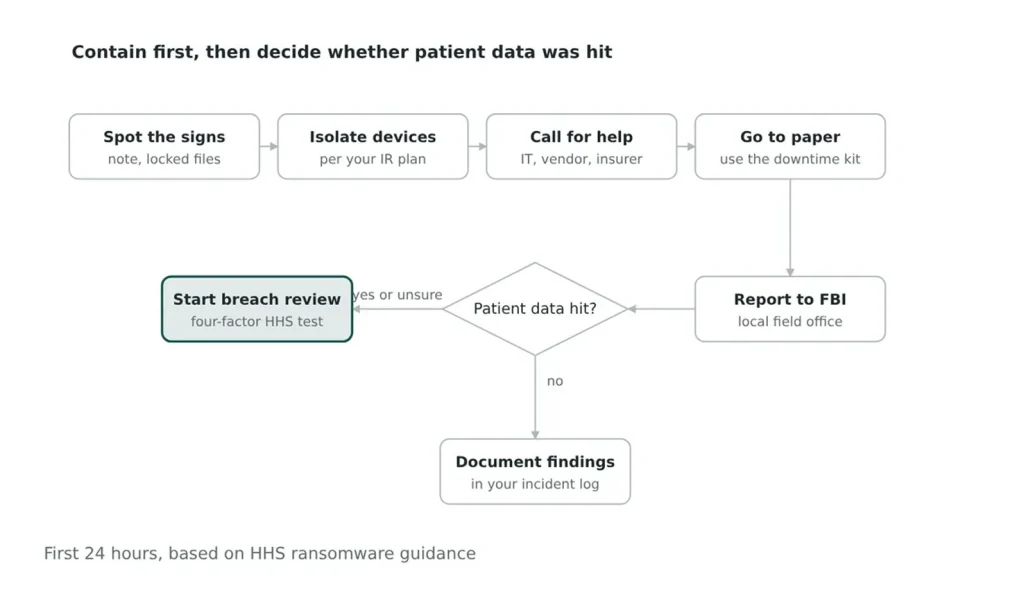
The ransom note itself raises the questions clinic owners ask most often.
FAQs
Should my clinic pay the ransom?
No ransom payment to a healthcare victim was officially confirmed in the first half of 2026, and six victims stated they refused to pay. A payment buys only the attackers’ promise to delete stolen data. Decide now who in your clinic can authorize any response, together with your insurer and attorney.
Is a cloud-based EHR safe from ransomware?
Cloud hosting moves servers out of your office, yet a stolen staff login still reaches the same records. In April 2026, attackers failed to encrypt the systems of Unimed, a German billing provider, and still stole enough data that about 135,000 patients have been notified so far.
Will my vendor tell me if it was attacked?
It should, within the window your BAA sets, though public disclosure often lags. Of 225 healthcare ransomware attacks recorded in the U.S. in the first half of 2026, only 31 were confirmed by the victims. Nine of the ten biggest healthcare ransomware breaches of that period happened between January and March, a sign of how far reporting can trail an attack.

Dr. Giriraj Tosh Purohit is an experienced Product Manager and Security officer with a strong background in healthcare technology and management consulting. With expertise spanning clinical workflows, EHR, RCM, Digital Health, and AI-driven products, he has been instrumental in shaping innovative healthcare solutions.