
How to Implement AI Medical Scribes in Urgent Care Clinics: A Step By Step Guide
Urgent care clinics run in a very fast paced and high patient volume environment where efficiency and accuracy are critical. Often within limited time, providers have to balance patient care, documentation, compliance and operational requirements. This is where AI medical scribe urgent care solutions stand out by transforming workflows and redefining clinical efficiency.
We have given our years supporting urgent care here at OmniMD with innovative healthcare technologies. Relying on our experience, this guide walks you through how to implement AI medical scribes in urgent care clinics, step by step, ensuring a smooth and measurable ROI.
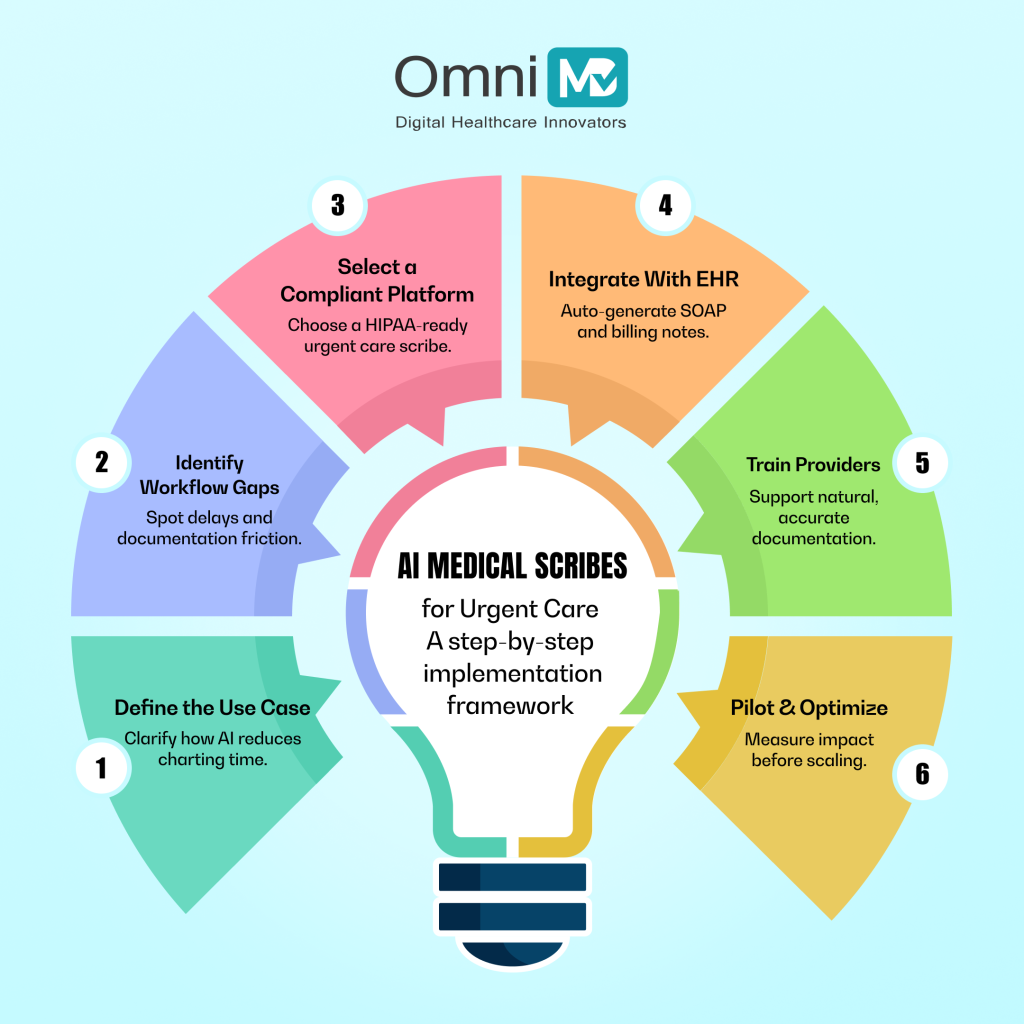
A rushed rollout is one of the most common reasons an otherwise good AI scribe underdelivers. Clinics that skip straight to picking a vendor, without first mapping their own workflow or setting a way to measure results, often end up with a tool providers tolerate rather than one they actually rely on. The seven steps below are sequenced deliberately: understanding the technology and your own pain points comes before choosing a platform, and piloting comes before any full-site rollout.
1. Understand the Role of AI Medical Scribes in Urgent Care
An AI medical scribe is an advanced, voice enabled solution that automatically captures conversations between providers and patients and converts them into structured clinical documentation in real time. In urgent care organisations, AI scribes:
- Minimise documentation burden for clinicians
- Enhance chart accuracy and completeness
- Enables faster patient throughput
- Reduce after hour charting chaos
- Support regulatory and billing compliance
Implementing an AI medical scribe urgent care platform allows providers to focus on patient care rather than data entry.
Unlike a human scribe or traditional dictation software, an AI medical scribe listens passively during the visit and doesn’t require the provider to dictate in a rigid format. This ambient approach matters most in urgent care, where visits are short and unpredictable, one moment a provider is examining a laceration, the next they’re discussing follow-up care with a worried parent. A scribe built for this setting needs to keep up with that back-and-forth without asking the provider to slow down or restate anything for the record.
2. Assess Your Urgent Care Workflow and Pain Points
Evaluate your current clinical workflow thoroughly before implementation. Recognise the areas where documentation slows the operations down, such as:
- Long waiting times for patients
- Provider burnout due to excessive charting
- Incomplete or delayed notes
- Coding and billing inefficiencies
To get an understanding about these challenges ensures that your AI medical scribes urgent care solution is aligned with real operational requirements.
A useful way to run this assessment is to shadow a few providers for a full shift and log where time actually goes: how many minutes are spent per chart, how much documentation carries over into personal time, and which visit types (minor injuries, respiratory complaints, lacerations) generate the most back-and-forth with billing or coding. This baseline gives you something concrete to compare against once the AI scribe is live, rather than relying on a general sense that things have improved.
3. Choose A HIPAA Compliant AI Medical Scribe Platform
Not all AI scribes are created equally. For urgent care clinics, the solution must be:
- HIPAA compliant and secure
- Designed for high volume, visit based care
- Compatible with existing EHR
- Capable of real time or near real time documentation
Here at OmniMD, our AI powered medical scribe solutions are purpose built for urgent care workflows, ensuring seamless integration with leading EHR platforms and compliance with industry regulations.
Beyond the basics of HIPAA compliance, ask vendors specific questions before signing: where is patient audio and text stored, is a signed Business Associate Agreement included by default, and what happens to voice data after a note is finalized. For multi-location urgent care groups, also confirm the platform can be licensed and rolled out consistently across sites rather than configured separately at each one.
4. Integrate the AI Medical Scribe with Your EHR
Successful implementation relies on seamless EHR integration. Your AI medical scribe urgent care system should:
- Automatically populate clinical notes
- Support SOAP notes, assessments, and plans
- Reduce manual copy paste workflows
- Improve coding and billing accuracy
A well integrated system eliminates redundant tasks and accelerates chart completion without disrupting provider workflows.
Integration depth varies a lot between vendors. Some AI scribes only generate a note you copy and paste manually, while others write directly into the correct fields of your EHR through an API or HL7/FHIR connection. Before committing, run a short technical test with your own EHR instance and IT team to confirm the scribe populates notes where they’re supposed to land, not just that it produces readable text.
For a full breakdown of AI scribe options by specialty, see our guide to AI medical scribes by specialty covering cardiology, orthopedics, behavioral health, and more.
5. Train Providers and Clinical Staff
Even the most advanced AI solution requires proper guidance for implementation. Focus training on:
- How the AI medical scribe captures and structures notes
- Best practices for natural clinical conversations
- Reviewing and finalising AI generated documentation
- Ensuring documentation accuracy and compliance
We at OmniMD recommend short, role based training sessions to ensure rapid adoption and provider confidence.
Training works best in two stages. First, a short session covering how the tool listens, what it does and doesn’t capture automatically, and how to review a note before signing it. Second, a follow-up check-in two to three weeks after go-live, once providers have real notes to discuss, to address specific phrasing issues or missed details rather than hypothetical ones. Identifying one or two ‘super-user’ providers per shift to answer quick questions also speeds up adoption for everyone else.
6. Pilot the AI Medical Scribe in a Controlled Environment
Conduct a pilot program in one or two urgent care locations before a full rollout. Monitor key metrics such as:
- Provider documentation time
- Patient visit duration
- Notes completion rates
- Provider satisfaction
A pilot lets you fine tune the workflows and optimize the AI medical scribe urgent care implementation before scaling.
Give the pilot enough time to be meaningful, typically four to six weeks, so you capture both fast learning-curve improvements and any recurring issues that only show up after providers stop paying close attention. Set a simple threshold in advance for what “ready to expand” looks like, for example, most notes needing only minor edits and no unresolved compliance concerns, so the decision to scale doesn’t come down to general impressions alone.
7. Measure Performance and Optimize Continuously
After the implementation, track performance indicators to measure success, including:
- Reduction in after hour charting
- Improved patient throughput
- Increased provider productivity
- Enhanced documentation quality
Ongoing optimization ensures your AI medical scribe urgent care solution delivers long term value and adapts to evolving clinical needs.
Review these metrics on a set cadence, monthly in the first quarter and quarterly after that, rather than only checking in when something feels off. Share the results with the providers using the tool daily; seeing the actual time saved or the drop in after-hours charting tends to reinforce adoption far more than being told the rollout was a success.
Why Urgent Care Clinics Choose OmniMD for AI Medical Scribes
With an experience of over a decade supporting urgent care organisations, OmniMD delivers AI powered solutions designed for real world clinical environments. Our AI medical scribe urgent care platform is:
- Built specifically for fast paced urgent care workflows
- Fully HIPAA compliant and secure
- Seamlessly integrated with major EHR platforms
- Backed by expert onboarding and ongoing support
That combination matters most in the first ninety days after go-live, when providers are still forming an opinion of the tool. Clinics that pair OmniMD’s platform with the assessment, pilot, and training steps above tend to reach steady, confident daily use faster than those that treat implementation as a single flip-the-switch event.
Key Takeaways
Implementing an AI medical scribe urgent care solution is no longer a future concept, it is a practical, proven strategy to improve efficiency, reduce burnout, and improve patient care. By following this guide’s approach, urgent care clinicians can adopt AI technology confidently and successfully.
Here at OmniMD, we stay committed to helping urgent care providers leverage intelligent healthcare technology to deliver better outcomes, faster workflows, and sustainable growth.

Dr. Giriraj Tosh Purohit is an experienced Product Manager and Security officer with a strong background in healthcare technology and management consulting. With expertise spanning clinical workflows, EHR, RCM, Digital Health, and AI-driven products, he has been instrumental in shaping innovative healthcare solutions.