
Insurance Eligibility Integration Options for Urgent Care EHRs
Insurance eligibility integration models decide two things for your urgent care EHR.
- The first is the road a coverage check takes to reach the payer.
- The second is the moment that check fires.
Each layer carries its own costs and failure points, so comparing real-time and batch alone leaves half the decision unmade.
Walk-in care feels that gap at the front desk, because a check that stalls or reads the wrong benefit lands on a patient standing there. Picking the right model starts with seeing both layers on their own.
How Insurance Eligibility Integration Models Work in Two Layers
- The first layer is the route: It covers every system your check passes through after someone clicks verify in the EHR. That might be a clearinghouse, a direct government connection, or a separate intake tool. The route decides which payers you can reach, who bills you per transaction, and who you call when answers stop coming back.
- The second layer is timing: It covers the events that fire a check, such as a patient registering, insurance details changing, or a scheduled visit coming up tomorrow.
Keeping the two apart helps you read sales demos clearly. Two vendors can both say ‘real-time’ and still send your eligibility checks down very different routes, with very different results when a payer’s system slows down. That’s why the route deserves your attention first: it sets limits that no timing layer can work around.
Choose the Route Your Urgent Care EHR Uses to Reach Payers
Those limits become visible once you lay out the five routes urgent care clinics use today.
- Built-in EHR eligibility: Your EHR sends the check through a clearinghouse it already partners with. You sign one agreement, and the vendor manages the payer connections.
- Your own clearinghouse account: You hold the contract and connect it to the EHR. You get more say over which payers are enrolled, and you also own the fees and the support calls.
- Direct Medicare connection: Original Medicare checks run through the CMS HIPAA Eligibility Transaction System, known as HETS. A CMS notice from April of this year requires every provider that uses a third-party vendor for these checks to enroll that vendor and link it to the provider’s NPI. CMS warns that checks can fail with error code 41 when that link is missing. Medicare Advantage members are different, since they belong to private plans that answer through their own payer connections.
- A separate intake platform: A front-end tool runs the check and writes the result back into your EHR. Patients may like the experience, but you now troubleshoot two systems when something breaks.
- Portal, phone, or AI agent fallback: Some payers return thin answers electronically, so staff or software finish the job by hand. The CAQH Index released in February found that over half of health plans and a quarter of provider organizations now use AI tools in administrative workflows.
The Medicare enrollment rule also hands you a free audit tool. Once a vendor is enrolled, CMS sends you a monthly transaction volume report for it, which gives you an independent count of how many Medicare checks your system runs. The route you choose also decides how fast any answer can come back to the desk, and that speed is where timing takes over.
Match Real-Time, Batch, or Hybrid Timing to Walk-In Volume
Speed has a written ceiling. The CAQH CORE eligibility operating rules adopted under HIPAA give a real-time check up to 20 seconds round trip. A payer meets the rule when 90 percent of its answers arrive inside that window in a calendar month, and the rule suggests no more than 4 seconds at each stop along the way.
That 90 percent leaves one patient in ten who can wait past 20 seconds at a fully compliant payer. Uptime has a gap too. The version HHS still requires lets a plan’s eligibility system run at 86 percent weekly availability, which allows up to about 23 hours of downtime each week. CAQH raised that floor to 90 percent in a 2022 update, and the government’s federal standards listing still shows that update as voluntary.
Your real-time setup therefore needs a planned path for slow or missing answers. The cleanest version lets registration continue under a pending status, retries in the background, and moves anything still unresolved into a work queue before the patient reaches checkout.
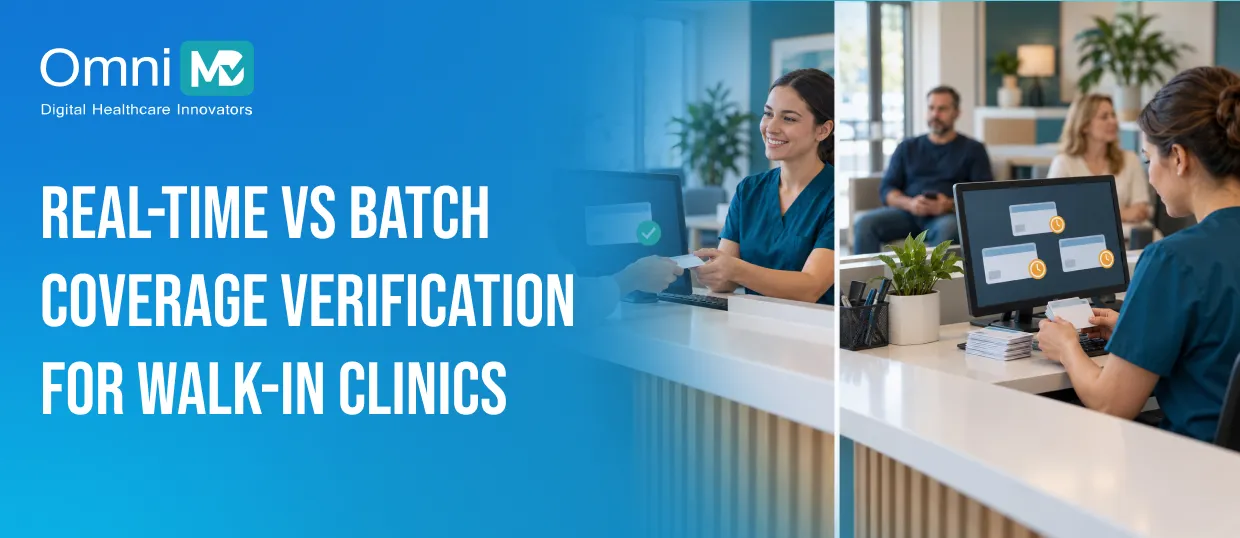
- Real-time fires the check at registration. It fits walk-in traffic, and it’s the only mode open on the direct Medicare route, since the HETS system accepts real-time requests only and refuses batch files. CMS says it’s typically available around the clock, though its help desk works weekdays from 7 a.m. to 7 p.m. Eastern. A Saturday problem at your clinic waits until Monday for CMS support.
- Batch sends a list of upcoming visits together, and CORE rules allow payers to answer by the next day. It fits scheduled work like employer physicals and drug screens booked days ahead.
- Hybrid runs batch for the schedule and real-time at the door. It fits clinics that blend walk-ins with booked occupational health visits.
A fast answer still has to describe the visit you’re running, and urgent care is where standard checks often describe the wrong one.
Fix the Urgent Care Gaps Standard Eligibility Checks Miss
The wrong-visit problem starts with a two-letter code. Every eligibility request names a service type. Code 30 asks for general plan coverage, while X12, the group that maintains these codes, keeps a separate code UC for urgent care. That split matters because the federal Summary of Benefits and Coverage template, which group and individual health plans use to explain costs to members, gives urgent care its own row, separate from primary care and specialist visits. If your system asks only with code 30, the front desk can quote an office visit copay and collect the wrong amount.
The second gap shows up with injured workers. Per HHS guidance, workers’ compensation and auto insurance that pays medical bills are not health plans under HIPAA. That means those carriers have no duty to answer a standard eligibility check at all. Your integration needs its own path for these visits, where staff capture the employer authorization, claim number, and adjuster contact at registration and flag the visit so the claim never goes to the patient’s health plan.
The third gap is other coverage. A payer’s response can list a second plan or name a different primary payer. If your EHR only shows an active or inactive badge, that detail never reaches the person collecting the copay.
Each of these gaps calls for a slightly different setup, so the next step is fitting the setup to the clinic you run.
Pick an Eligibility Integration Model for Your Clinic Type
Your patient mix, more than your size, points to the right pairing of route and timing. Find the row that sounds most like your clinic.
| Your clinic | Route to favor | Timing |
| Single site, mostly walk-ins | Built-in EHR eligibility | Real-time |
| Large employer or occ-med book | Built-in EHR plus a comp intake path | Hybrid |
| High Original Medicare share | Vendor enrolled for HETS | Real-time |
| Several locations | One route for every site | Hybrid |
| Many payers with thin answers | Clearinghouse plus AI or portal fallback | Real-time with follow-up |
Most clinics fit more than one row. When that happens, let the row with the most money at risk decide the route, then add the timing the other rows need.
No matter which row fits, every model will eventually send back a rejection, and the code inside it tells your staff what to fix.
Read Eligibility Rejection Codes Before Calling the Payer
Those codes sit in a part of the response called the AAA segment, and these five are the ones registration staff run into at check-in.
| Code | What the payer is saying | Front desk move |
| 42 | Can’t respond right now | Hold and retry later |
| 72 | Member ID invalid or not on file | Rescan the card, check the prefix |
| 73 | Name doesn’t match | Enter it exactly as printed |
| 58 | Birth date missing or wrong | Confirm with the patient |
| 75 | Subscriber not found | Check subscriber versus dependent |
Code 72 deserves a second look. X12’s own official interpretation says a payer should send 72 when a member doesn’t exist in its system at all. So when a returning patient gets a 72 on an ID that worked before, a plan change is a likely cause, and asking for the current card comes before retyping the old number.
The most useful setup turns each code into a plain-language next step right on the check-in screen, so nobody has to look it up while a patient waits. Whether your system can do that is one of several things worth confirming before you sign anything.
Ask Your EHR Vendor These Eligibility Questions Before You Sign
Your vendor builds and maintains the connection, so your part is making sure it fits the way your clinic runs. Bring these questions to the demo and ask to see each answer working on screen.
- Which route does the check take, and are our ten highest-volume payers live on it today?
- Does the system send code UC on urgent care visits and show the UC copay when several come back?
- Is your company enrolled for HETS and linked to our NPI?
- What does the check-in screen show when an answer runs past 20 seconds, and where do unresolved checks go?
- Which reports come standard, such as the share of checks with a usable answer, manual reviews per day, and median response time?
Final Thoughts: Cut Denials With Your Insurance Eligibility Integration
Insurance eligibility integration pays off when fewer claims bounce back. Watch two denial codes. CARC 27 means coverage had ended, and CARC 31 means the payer couldn’t find the patient. Compare those counts for two months before and after go-live, and you’ll see if your setup works.
OmniMD’s urgent care EHR keeps eligibility, registration, and billing in one place, so a check at the front desk carries through to the claim. Bring the questions above to an OmniMD demo and see how they work with your own payers.

Divan Dave is the Founder and CEO of OmniMD, a pioneering healthcare IT company he established in 2002. With over two decades of leadership, Mr. Dave has been instrumental in transforming traditional care delivery into modern, data-driven digital health systems.