

Medicaid work requirements start on January 1, 2027 in most states. Once they begin, some adults on Medicaid will need to show every month that they’re working, in school, volunteering or in a job program. If they can’t show it, and they don’t qualify to be excused, they could lose their coverage. You might also hear this called ‘community engagement.’ That’s the official name, and it’s what patients will see on government letters.
Your practice won’t do the checking. The state handles that. But you’ll still feel it in three big ways.
- At your front desk: This is often where patients first find out their Medicaid has stopped.
- With your doctors: Many states will ask doctors to confirm which patients are too sick to work.
- In your billing. If a patient’s coverage has a gap, those visits might not get paid.
Key Takeaways
- Only adults ages 19 to 64 in certain Medicaid groups have to follow this rule.
- Starting January 1, 2027, these adults will renew Medicaid every six months instead of once a year. Medicaid will also pay for less of their past care.
- The diagnosis codes and notes your practice writes can decide whether a sick patient gets excused.
- In Nebraska, the first state to start (May 1, 2026), most people who lost coverage hadn’t sent the state what it asked for.
- People who lose Medicaid this way won’t be able to get Marketplace tax credits, the government help that makes other insurance cheaper.
Dates to remember
| Date | What happens |
| 31-Jul-26 | The federal rule took effect, so it’s already in force |
| 31-Aug-26 | States had to tell members about the rule by this date |
| 1-Jan-27 | The work rule and six-month renewals begin, and Medicaid starts paying for less past care |
| 1-Jan-28 | Sick patients have to show more proof to stay excused |
| 31-Dec-28 | No state can delay past this date |
A lot of your patients probably have no idea this is coming. In an April 2026 survey of 1,974 Medicaid members by the Health Management Academy, about 55% had never heard of the work rules.
Another 27% had heard something but didn’t know the details. And about 85% didn’t know Medicaid will start checking eligibility twice a year. Healthcare Dive reported these findings.
With January 2027 this close, plan on explaining the basics to many of your patients. So let’s start with what the rule asks them to do.
What Medicaid Work Requirements Ask Patients to Do
On June 1, 2026, the Centers for Medicare & Medicaid Services (CMS), the federal agency that runs Medicaid, released the new rule. It says certain adults have to show 80 hours a month of approved activities to keep their Medicaid. You can read the full rule, published on June 3, in the federal rule record. It’s the rule every state follows today.
Your patient meets the rule for the month if they do any one of these four things.
| Way to qualify | What it means |
| Hours | 80 hours of work, volunteering or a job program |
| School | Going to school at least half-time |
| Mix | Adding up different activities to reach 80 hours |
| Pay | Earning at least $580 a month in 2026 |
- But where does $580 come from?
It’s 80 hours at the federal minimum wage of $7.25, so it stays the same unless that wage goes up. This pay option is great news for working patients. If someone has a steady part-time job, their paycheck alone can be enough, and they don’t have to count hours at all.
There’s more good news. States have to check the records they already have before they ask your patient for any paperwork. CMS also built a free online tool called Emmy that patients can use to report their work or school if they want to. Ask your state Medicaid office whether your state uses it.
- How many months count?
People applying for the first time usually have to show at least one month before they apply. People already on Medicaid show one or more months between renewals. Each state decides the exact number.
- Who gets excused?
Some people don’t have to follow the rule at all. You’ll find the full list in the CMS summary. For several of these groups, the proof comes from your practice’s records.
| Who gets excused | What your practice may be asked for |
| Pregnant people and new mothers | Proof of pregnancy |
| People who are “medically frail” (very sick or disabled) | Medical notes |
| People in drug or alcohol treatment | A treatment letter |
| Parents or caregivers of a child 13 or younger, or of a disabled person | Proof of the disability |
| Veterans with a total disability rating | Usually nothing |
| People meeting work rules for TANF (cash aid) or SNAP (food aid) | Usually nothing |
| American Indians and Alaska Natives | Usually nothing |
| Former foster youth | Usually nothing |
| People in jail or prison | Usually nothing |
- What are short breaks?
States can also give people a short break from the rule if they’re in the hospital or a nursing home, or if they have to travel far for treatment of a serious illness. People who live in a disaster area or a county with lots of unemployment can qualify too.
All of this only matters for patients in the right Medicaid group. So your next job is figuring out who they are.
Which Medicaid Patients Are Covered by the Work Requirements?
Eligibility depends on the type of Medicaid coverage a patient has, not just their age or health condition.
- Who is covered: Adults ages 19–64 who are not pregnant, are not enrolled in Medicare, and receive Medicaid through the ACA expansion group or certain state programs. About 21 million people receive coverage through the expansion group.
- Which states are affected: The requirements apply in 43 states and Washington, D.C. U.S. territories are excluded.
- What about states that didn’t expand Medicaid: They may still have to apply the requirements to some patients. CMS identified programs in Georgia, Tennessee, and Wisconsin that cover adults subject to the rule.
- Who is exempt: People covered through other Medicaid eligibility groups, such as those who qualify based on disability, generally fall outside these requirements. However, an adult enrolled in the expansion group may still need to meet them even with a chronic illness, unless they qualify for an exemption and the state recognizes it.
How to Identify Patients Who May Be Affected
- Confirm the eligibility code: Contact your state Medicaid agency or Medicaid health plans to find out which code in an eligibility check identifies patients covered under the expansion adult group.
- Filter your patient records: Use that code to identify patients ages 19 to 64 who may be subject to the work requirements.
- Save the list for follow-up: Keep this list as your starting point for checking exemptions, tracking compliance, and identifying patients who may need help maintaining coverage.
Important: Treat this as a preliminary list, not a final determination of who must meet the requirements. Verify each patient’s eligibility and any applicable exemptions with the state or health plan.
Why This Patient List Matters
Medicaid work requirements could affect your practice’s revenue by reducing the number of patients who remain enrolled and able to use their coverage.
- Expected enrollment decline in 2027. CMS estimates that Medicaid enrollment will be about 2.3 million lower during fiscal year 2027 (October 2026–September 2027) because of the new requirements. This estimate assumes most states begin implementing them in January 2027.
- A larger impact in later years. CMS projects that the reduction could grow to 3.1–3.3 million people in subsequent years.
- When your practice may feel the impact. The timing will depend on when your state implements the requirements and how many of your patients are affected.
Identifying potentially affected patients now can help your practice prepare for possible coverage losses, changes in appointment volume, and disruptions to reimbursement.
Check When Your State’s Medicaid Work Requirements Begin
Most states are scheduled to begin enforcing Medicaid work requirements on January 1, 2027, but some states are implementing them earlier or using a phased rollout. Your practice needs to know its state’s timeline to identify patients who may already be at risk of losing coverage and those who will be affected next.
| State | Implementation timeline |
| Nebraska | Enforcement began May 1, 2026. |
| Montana | A practice period began in July 2026, followed by enforcement on October 1, 2026. |
| Arkansas | A practice period began July 1, 2026. Coverage removals are not scheduled to begin before January 1, 2027. |
| Iowa | Requirements begin for new applicants on December 1, 2026, and for existing members at renewals starting in February 2027. |
| Georgia | Its existing state program runs through December 31, 2026, before the federal requirements take effect. |
| Most other states | Scheduled to begin January 1, 2027. |
These dates are based on the KFF state tracker and, for Iowa, information from the state’s Medicaid agency. Because implementation plans can change, confirm the current timeline with your state Medicaid agency before making decisions about individual patients.
- What Nebraska’s Early Results Show
Nebraska’s initial results highlight how missing paperwork can lead to Medicaid coverage losses, even when patients may qualify for coverage.
According to figures presented at the state’s September 2026 Medicaid Advisory Committee meeting:
- New applicants: Nearly 560 applications were denied, and 84% of those denials were attributed to applicants failing to provide the required information.
- Existing members: About 530 people lost coverage during renewal, and 92% had not responded to the state’s request for information.
These figures cover only the initial months of implementation. Check the latest advisory committee updates for newer data.
What this means for your practice: Help potentially affected patients understand notices, respond to requests for documentation, and complete renewal steps on time. Missing information can put coverage at risk.
- Prepare Your Staff for Patient Questions About Notices
States were required to notify Medicaid members about the new requirements by August 31, 2026. Patients may already have received these notices but may not have opened them or understood what they need to do.
Montana provides an example of this communication challenge. In September 2026, concerns were raised that the state’s notices were confusing, prompting officials to revise them. NPR reported on the issue.
Prepare your front-desk staff to:
- Recognize the state’s Medicaid work-requirement notices.
- Direct patients to the appropriate Medicaid agency or health plan for eligibility questions.
- Remind patients to read notices carefully and respond by the stated deadlines.
Staff should avoid interpreting a notice as proof that a patient has lost coverage. Patients should confirm their individual status with the state or health plan.
- Can States Delay Implementation?
States may request a limited delay, but an extension is not automatic. CMS can end an approved delay early if a state fails to submit required progress reports. No delay can extend beyond December 31, 2028, and extensions cannot be renewed.
In early October 2026, the governors of Oregon, California, Maine, New Mexico, and Virginia asked the U.S. Department of Health and Human Services (HHS) for additional time. However, requesting a delay does not mean it has been approved.
For planning purposes, use your state’s announced implementation date unless the state Medicaid agency confirms an approved delay.
- Two More Changes That Could Affect Practice Payments
Medicaid work requirements are not the only changes practices need to prepare for. Two additional changes scheduled to begin on January 1, 2027, could directly affect Medicaid reimbursement. The next section explains what they are and how they may affect your practice.
Prepare for Six-Month Medicaid Renewals and Shorter Back Coverage
First, a term you’ll need. “Back coverage” (the official name is retroactive coverage) means Medicaid pays for care someone got shortly before they applied. Both of these changes affect the expansion of adults on your list.
| What’s changing | Until December 31, 2026 | Starting January 1, 2027 |
| How often expansion adults renew | Once a year | Every six months |
| Back coverage for expansion adults | Up to three months | One month |
| Back coverage for other Medicaid members | Up to three months | Two months |
Virginia’s factsheet explains both changes in detail.
What this means for your billing team
- Help eligible uninsured patients apply before January: The shorter retroactive coverage period applies only to applications filed on or after January 1, 2027. Patients who apply in 2026 may still qualify for up to three months of retroactive coverage, depending on their eligibility and state rules. Help them apply before the deadline so they don’t miss out on coverage for past care.
- Check eligibility more often: Work requirements will add another condition to Medicaid eligibility for affected adults. Your team will need to check whether patients still qualify at renewal, because failing to meet these requirements could lead to a loss of coverage.
- Expect less coverage for past visits: Starting in January 2027, eligible expansion adults applying for Medicaid will generally be able to get retroactive coverage for only one month before the month they apply, rather than up to three months. If a patient applies in April, for example, Medicaid may cover eligible care from March, but not care from February or earlier under the new limit.
- Encourage patients who lose coverage to reapply promptly: Losing Medicaid doesn’t prevent someone from applying again. If a patient without coverage applies in the same month as their visit and meets the eligibility requirements, that visit may qualify for coverage. Encourage patients to apply as soon as possible rather than waiting until they have accumulated more medical bills.
For patients with serious health conditions, documentation from their doctor may also be important in establishing an exemption from work requirements. Your billing team can help identify patients who may qualify and coordinate with clinical staff to ensure the necessary documentation is available.
Handle Requests to Excuse Sick Patients
To be excused as ‘medically frail,’ a patient needs two things. First, they need a qualifying health condition. Second, that condition has to make it hard for them to meet the work rule. The qualifying conditions fall into five groups.
- Blindness or disability
- Substance use disorder
- A disabling mental illness
- A physical, intellectual or developmental disability that makes at least one daily activity much harder
- A serious or complex medical condition
- How do states decide?
In September 2026, CMS gave states an optional three-step method in its CMS guidance.
| Step | What the state looks at | What it means for you |
| 1 | Diagnosis codes alone, when they clearly show the patient qualifies | Code accurately |
| 2 | Other claims that show how serious the illness is, like medicines, equipment or rehab | Send complete claims |
| 3 | A person reviews records like visit notes, hospital discharge papers, medicine lists, test results or a provider’s signed statement | Answer records requests |
- CMS gives an example of a step 3 case: For example, a patient’s diabetes isn’t well controlled and they have early nerve damage, but they handle daily tasks on their own and haven’t been to the hospital or emergency room lately. The data alone can’t settle it, so a person has to review the case. For patients like this, your notes about what they can and can’t do matter a lot.
- Your codes come first: States look back at the past 12 months of claims when checking for frailty. That means the diagnoses your practice billed over the past year are often the first thing a state sees, and visits you code between now and January will be part of that history too. So at every visit, code each documented condition in full detail using ICD-10 (the standard system for diagnosis codes). Only code what the medical record supports.
- What will states ask you for?
In a KFF survey, 29 states said they plan to ask the patient’s doctor to confirm frailty, and 11 plan to use health questionnaires. That survey was done in March, before the final rule came out, so your state’s plan may have changed. Nebraska uses a list of diagnosis and procedure codes, and its form asks new applicants for their doctor’s contact information. You can see each state’s early plan in the KFF analysis. In North Carolina, the doctor who signs the form has to already know and treat the patient. Check whether your state has a rule like that before you sign for a new patient.
- What the paperwork looks like in one state.
When it’s time to renew, Montana confirms frailty using a provider’s records, then checks them against later claims. It also asks for provider letters showing someone is in addiction treatment, and for records showing a family member’s disability when a caregiver asks to be excused. The full list is in Montana’s checklist. Your state may ask for different papers, so check its forms.
- Expect more requests in 2028.
In 2027, states can choose to accept a patient’s own written statement every time their status is checked. Starting in 2028, that’s only allowed once per stretch of coverage, and frailty has to be checked again at least once a year. So next year, in states that allow it, a patient’s own word might be enough. From January 2028 on, more of these requests will land on your doctors’ desks.
- The courts could still change things.
- In late June 2026, 25 states and the District of Columbia sued in federal court in Massachusetts. They argue CMS went too far by making sick people prove their illness makes it hard to work. In late July, a judge refused to pause the rule while the case moves forward. The court heard arguments in October.
- On September 18, doctor groups, including the American College of Physicians, filed a second case in Maryland, together with Medicaid members and a city government. They want the frailty rules stopped.
- Until a court says otherwise, the current rules stand. Check for court news once a month.
- Write a clear letter policy.
This part can confuse doctors too. One doctor with 25 years of experience told KFF Health News she doesn’t know what ‘medically frail’ means when a form asks her to decide. A written policy means no doctor has to guess.
- Who signs: Usually the doctor who treats the condition.
- Visit first? Decide whether the patient needs a recent visit before anyone signs.
- How fast: Set a number of days, since patients usually only get 30 days to respond to the state.
- What goes in the letter: The diagnosis, the last visit date, how the condition limits work or school, and how long it’s expected to last.
- Who makes the call? Your doctor describes the facts, and the state makes the decision.
- Keep patient records private.
Addiction treatment records get extra federal protection. Under a federal rule called 42 CFR Part 2, a treatment program usually needs the patient’s written permission before sending these records to the state Medicaid office, and that permission form has to meet federal requirements. The OCR guidance from the HHS Office for Civil Rights walks through common situations. For all other records, ask your compliance lead to set one simple rule, like only sending records when the patient asks in writing.
These requests look a little different depending on what kind of practice you run.
Match the Rule to Your Specialty
| Type of practice | What you’ll be asked for most | What to get ready |
| Primary care | Frailty letters for long-term illness | Notes on daily limits at each chronic care visit |
| Behavioral health | Frailty letters for serious mental illness | Notes on how the illness affects work and daily life |
| Addiction treatment | Proof of treatment | A permission form that meets Part 2 rules |
| OB/GYN | Proof of pregnancy or recent birth | A same-day letter template |
| Specialists | Proof of serious illness or hospital stays | Discharge and travel-for-treatment records ready to send |
| Pediatrics | Parents asking whether they’re excused as caregivers | Letting parents of kids 13 or younger know they may be excused |
No matter what kind of practice you run, your front desk usually hears about these needs first.
Build a Front Desk Plan for Unclear Coverage
Every visit with an expansion adult should follow the same path, from the first coverage check to the last note in the chart.
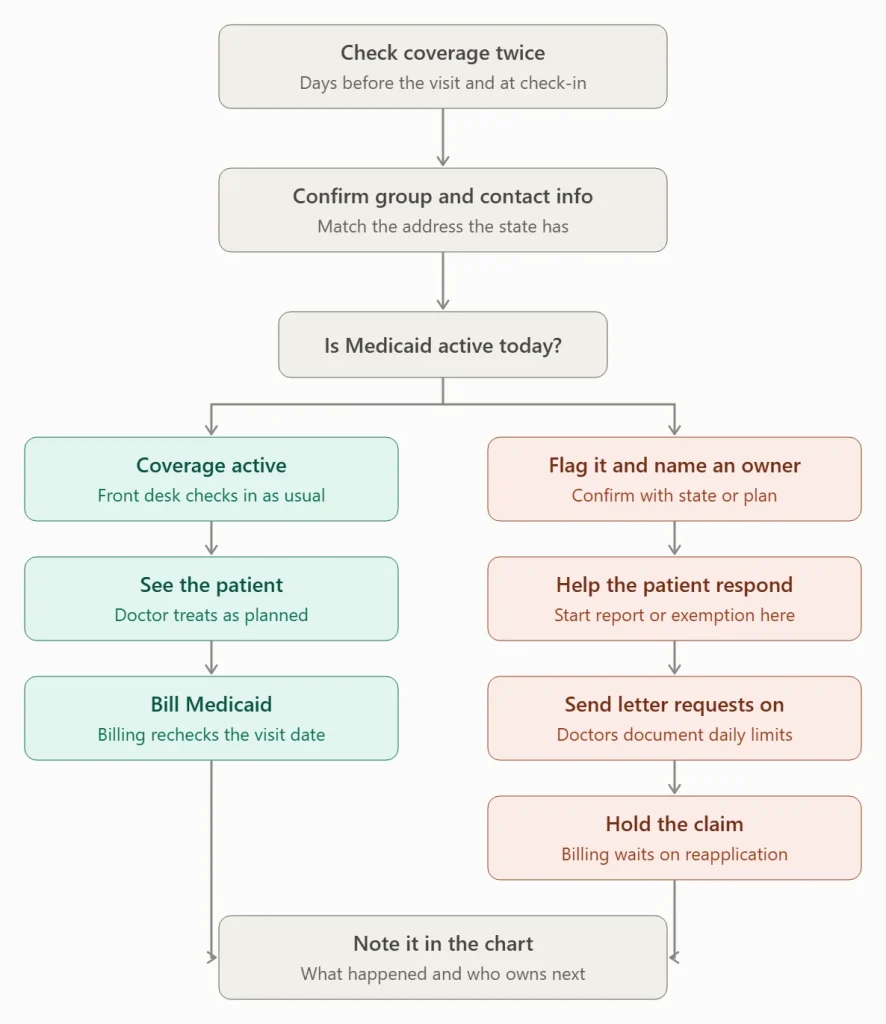
A. What to do for every expansion adult on the schedule
- Check coverage twice: Check two or three business days before the visit, then again at check-in. Confirm the patient’s Medicaid group both times.
- Double-check contact info: Make sure you have the right address and phone number, and ask whether the state has the same details. If not, show the patient how to update them, because a letter sent to an old address can mean a missed deadline.
- Flag anything unclear: If coverage shows as inactive or unclear, flag the record and pick one person to follow up by a set date. Confirm with the state or the health plan before you treat the coverage as ended.
- Ask about state letters: If the state can’t confirm someone meets the rule, it sends a notice, and the patient gets 30 days to respond. If they don’t respond, they can lose Medicaid.
- Help them respond right there: Help the patient start their online report or exemption request before they leave your office.
- Hand off letter requests: Send any request for a doctor’s letter to your clinical team.
- Write it all down: Note in the chart what happened, what you told the patient, and who’s handling the next step.
B. Why does step 5 matter so much?
State help lines can be hard to get through. Federal data from March 2026 showed Montana took longer than the 45-day limit on 35% of Medicaid applications. About 40% of callers hung up before reaching anyone, the second-worst rate in the country. That was months before Montana even started enforcing the work rule. A patient has a much better chance of finishing their report in your office than on hold with the state.
Messages you can use
What your front desk can say
“The new Medicaid work rules apply to some adults, and your state Medicaid office decides who. If you got a letter from them, it has a deadline, so let’s find where you can respond today. If your doctor’s records can help, we can send them once you give us permission.”
Patient portal message
“Medicaid rules are changing on January 1, 2027. Some adults will need to report work, school or volunteer hours to keep their coverage. Make sure the state has your current address, and answer any Medicaid letter before its deadline. If a health problem makes it hard for you to work, let us know at your next visit.”
Waiting-room sign
“Got a letter from Medicaid about work hours? Bring it to the front desk and we’ll help you figure out what to do next.”
C. Make sure everyone understands.
Translate these messages into the languages your patients speak, and use interpreters for these conversations. It also helps to ask your Medicaid health plan contacts whether they’re reaching out to their members, so your messages match theirs.
All of this goes much more smoothly when each step has one person in charge.
Give Each Team a Clear Job
| Team | Their job |
| Front desk | Coverage checks, address updates, flags, patient conversations |
| Doctors and clinicians | Frailty letters, problem lists, notes on daily limits |
| Billing | Rechecking coverage before billing, holding claims, tracking denials |
| Care coordinator | Helping patients reapply, following up on exemptions, working with health plans |
| Practice manager | Watching for state updates, training staff, reviewing monthly numbers |
If you run a smaller practice, it’s fine for one person to cover more than one job. Just make sure every task has a name next to it. Train each team on its own part first. Then walk through one example case together from start to finish, so everyone can see how the work gets handed off, all the way to billing.
Protect Your Payments When Coverage Changes
Denied claims were already a big headache for practices before any of this started. In a January 2026 poll by the Medical Group Management Association (MGMA), 48% of medical practice leaders said denials and appeals were where they lost the most money. Another 23% said front-desk problems. The poll had 288 responses. You can see the full results on the MGMA site. That poll came before any state enforced the new federal rule, and six-month renewals will add even more pressure on both fronts starting in January.
- Check one more time before billing. Make sure the patient had Medicaid on the exact day of the visit before you send the claim.
- Hold claims during reapplication. If the patient has reapplied and the visit falls inside the back-coverage window, hold the claim until the state decides. Let the patient know what happens if they’re turned down, and note that conversation in the chart.
- Keep an eye on coverage denials. Every denial comes with a code that explains why. Code 26 means the care happened before coverage started, and code 27 means it happened after coverage ended. Code 200 means the care happened during a break in coverage. Track these three codes separately for expansion adults, or let our revenue cycle team dig into the root cause for you.
- Track these numbers every month. Write down each one for October, November and December 2026. That gives you a “before” picture from before the rules start. Then compare each month after that to those numbers.
| Number to track | What it tells you |
| Coverage still unclear at visit time | Your checks are happening too late |
| Open follow-up tasks | Cases are getting forgotten |
| Code 26, 27 and 200 denials for expansion adults | Coverage gaps are reaching your claims |
| Days to fix a coverage question | Work is moving slowly between teams |
| Reapplications started within the back-coverage window | Payments you saved |
| Number to track | What it tells you |
Even with all of this in place, some patients will still lose coverage. They’ll need your help with what comes next.
Help Patients After Medicaid Ends
Help with other insurance won’t be there. People who lose Medicaid for not meeting the work rules can’t get Marketplace tax credits, the government help that lowers the cost of insurance bought on HealthCare.gov or a state exchange. King County’s public health department in Washington state says this rule starts January 1, 2028. Check how it works in your state before advising patients.
What you can tell patients
- Apply again. They can reapply as soon as they meet the rule or qualify to be excused.
- Appeal. If they think the state made a mistake, they can ask for a fair hearing. The state’s letter explains how.
- Get help paying. Offer your practice’s payment plan or financial help, or point them to a nearby community health center that charges based on income.
Keeping track of all this across your teams is a lot easier with the right system.
Set Up Your EHR to Track Medicaid Coverage
The state makes every decision about the work rule. What an electronic health record (EHR) and practice management system like OmniMD can do is keep every open coverage question in front of your team until someone solves it. Set yours up to do these things.
- Save every coverage check with its date and Medicaid group
- Flag your expansion adult patients
- Create a follow-up task with an owner and a due date whenever coverage is unclear
- Keep a log of each problem with the check date, problem type, owner, due date and status, instead of juggling shared spreadsheets
- Store frailty letters, permission forms and patient messages in the chart
- Run reports on open tasks, coverage denials and how fast letters go out, by location and provider
- Remind doctors to update problem lists and note daily limits for flagged patients
Keeping everything in one place gives you a clear record of who did what, and it keeps every location on the same page. If your front desk is already stretched thin, our eligibility verification team can check coverage before each appointment. With January 1 about nine weeks out, now’s the time to start setting things up and training your team.
Follow a Simple Readiness Timeline
Want this on paper for your team? Grab our printable checklist and hang it by the front desk.
Now through December 31, 2026
- Build your list of affected patients
- Help uninsured patients who might qualify apply before January 1, while back coverage still reaches three months
- Give each team its job and train everyone
- Finish your front desk script, portal message and waiting-room sign, including translations
- Set your frailty letter policy, letter template and records permission process
- Set up EHR flags, tasks, the problem log and reports
- Write down your “before” numbers for October through December
January through June 2027
- Check coverage twice and confirm contact info at every expansion adult visit
- Help patients who lost coverage reapply in the same month as their visit
- Review flagged accounts every week and fix anything that isn’t working
- Watch for six-month renewal notices, which will follow your state’s schedule
July through December 2027
- Look at how well your codes and letters helped patients get excused
- Plan doctor time for more letter requests starting January 2028
- Compare your numbers to your “before” picture and set goals
If you’re in Nebraska or Montana, the rule is already in effect where you are. Start with the second phase, and use the first as a checklist to catch anything you missed. In Iowa, try to finish the first phase before December 1, when new applicants start facing the rule. Georgia practices switch from the state’s own program to the federal rules in January, so the first phase is your to-do list right now. Wherever you are, check your state Medicaid office’s provider page every month, because the court cases and new CMS guidance could still change forms and dates.

Dr. Giriraj Tosh Purohit is an experienced Product Manager and Security officer with a strong background in healthcare technology and management consulting. With expertise spanning clinical workflows, EHR, RCM, Digital Health, and AI-driven products, he has been instrumental in shaping innovative healthcare solutions.