
AI Medical Scribe for Pain Management
Payers want to see conservative therapy, functional change, and how the patient responded. OmniMD’s AI medical scribe for pain management builds every note around exactly those things, so you’re not resubmitting the same prior authorization twice. It runs on OmniMD AI Medical Scribe, tuned for interventional and medication management visits.
9.5 min
saved per note
100%
risk discussion captured
0
prior-auth gaps
5
checks per visit
See How OmniMD AI Medical Scribe for Pain Management Writes the Note
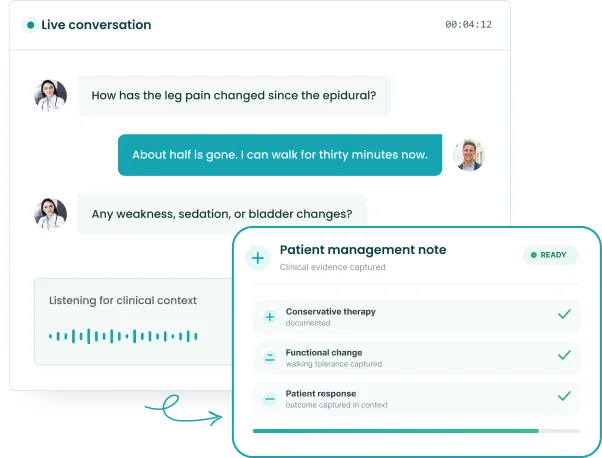
This is what a real epidural follow-up sounds like in the room, next to the note OmniMD drafts from that same conversation before the patient leaves.
Explore OmniMD’s AI Medical Scribe for Pain Management Features
Ten capabilities, built for how pain management actually gets charted.

Capture every word
Every refill needs the risk talk and the agreement on record, in your words. OmniMD catches the real conversation, not a reused paragraph.

Clear procedure days
Notes proportional to the visit, drafted as it happens. A full injection list closes with the day, not after it.

Prove prior authorization
Conservative therapy, function, and response, structured into every visit. The approval clock only runs once.

Withstand board review
Built from the real conversation, so it still reads clearly eight months later, whoever opens the chart.

Align every specialist
PT, behavioral health, primary care, pharmacy. One structured chart, so nobody calls to ask what happened.

Pull labs into the chart
UDS results, imaging, and lab values sit next to the note instead of a separate tab. No second login to piece the visit together.

Connect with every system you use
OmniMD writes back into OmniMD’s pain management EHR or the EHR you already use, plus e-prescribing and referral systems. No export file, no manual re-entry.

Compare every visit automatically
Pain scores, function, and medication changes carry forward on their own, so the trend is visible the moment the chart opens.

Surface practice-wide patterns
See prescribing patterns, documentation completeness, and audit-readiness across every provider, not just one chart at a time.

Suggest what the note still needs
If a risk discussion or a prior-auth element is missing, OmniMD flags it before you sign, not after a denial.
What payers check in a pain management note
Medicare contractors publish exactly what an interventional pain note has to show. One missing element, such as a baseline score on a different scale, conservative care with no duration, or relief written as “better” instead of a percentage, is enough to put a claim or a prior authorization at risk. OmniMD drafts the note from the conversation, so these details reach the chart as the patient says them.
| Procedure or visit | What the record has to show | What OmniMD drafts from the visit |
|---|---|---|
| Epidural steroid injectionMedicare LCD L39240 | Pain for at least 4 weeks, with failure of (or inability to tolerate) 4 weeks of noninvasive conservative care. An objective pain or functional scale at baseline, repeated on the same scale at every follow-up. A repeat injection needs at least 50% sustained improvement for at least 3 months. | Conservative therapy tried and for how long, the score the patient gives in the room, and the relief they report since the last injection, in their own words. |
| Facet joint interventions and RFAMedicare LCD L38773 | Pain for at least 3 months with failed noninvasive conservative care, scored on the same scale at baseline and after each diagnostic block. Two diagnostic medial branch blocks, each giving at least 80% relief of the index pain, before radiofrequency ablation. A repeat RFA at the same site needs at least 50% improvement lasting at least 6 months, and no more than 2 RFA sessions per spinal region are paid in a rolling 12 months. | Block-by-block relief percentages, the index pain location and how long relief lasted, so the RFA request carries its own evidence. |
| Long-term opioid therapyCDC 2022 guideline | A discussion of benefits and risks with the patient, a review of state PDMP data, and consideration of toxicology testing, before starting and periodically during treatment. | The risk discussion as it actually happened, plus the PDMP review, urine drug screen result and dose changes you mention. See PDMP requirements by state. |
Sources: CGS Medicare spinal pain management fact sheet (LCDs L39240 and L38773) and CDC Clinical Practice Guideline for Prescribing Opioids for Pain, 2022. Rules vary by Medicare contractor and commercial payer, so check the current policy for your region. For the codes behind these procedures, see the pain management CPT and ICD-10 code reference and our pain management billing and coding guide.
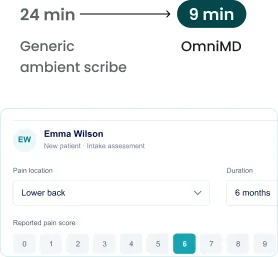
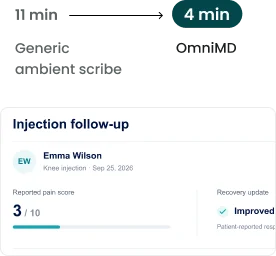
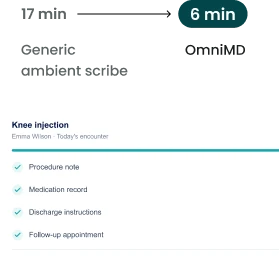
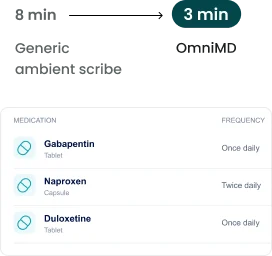
Compare pain management documentation minutes by visit type
The four visit types that fill most pain management schedules, and how long each note takes to finalize.
New chronic pain intake
Injection follow-up
Procedure-day close-out
Medication management
Meet the pain management practices OmniMD fits
See how the same scribe adapts to four very different practice setups.

Solo interventional practice
One physician running a full procedure schedule needs every follow-up note done by the time the next patient sits down, without a scribe on payroll.

Multi-provider pain group
Different physicians, one standard. Every provider’s notes come out structured the same way, so nothing depends on who happened to chart it.

ASC-affiliated pain clinic
Cases move between clinic and surgery center. OmniMD keeps the same note structure on both sides, so the chart reads as one continuous record. See the AI scribe for ambulatory surgery centers.

Telehealth-heavy practice
Medication management visits running mostly over video still get the same structured template, risk agreement and all, as an in-person visit.
Measure the value OmniMD adds to pain management
Six numbers that matter more than a feature list.
48–72 hrs
From signing to live for most practices, including EHR connection. Multi-location setups can take longer.
92%
Of prior-authorization requests approved on the first submission, no back-and-forth with the payer.
0 hrs
Spent training OmniMD on pain management vocabulary. It already knows PQRST, MME, and ESI levels.
1 note
Holds up for the payer, the board, and the pharmacy program at once, no separate version for each.
24/7
Drafted the moment a visit ends, whenever that is, with no overnight queue to wait behind.
50%
Sustained improvement on the same scale as baseline that Medicare looks for before a repeat epidural or facet procedure. OmniMD captures the score at every follow-up.
Calculate hours reclaimed from a pain management schedule
Enter your practice’s numbers to see what a full week of visits is really costing in charting time.
Book a pain management scribe demo
A new chronic pain intake, an epidural follow-up, a medication management visit, anything on your schedule. See exactly what OmniMD AI Medical Scribe for pain management writes for it, live.