
PDMP Requirements by State and What Pain Management Must Log
A PDMP, short for prescription drug monitoring program, is the state database that records every controlled substance prescription filled in that state. PDMP requirements change from state to state, and pain management practices run into them at almost every visit, since so many of your scripts are controlled substances. This guide walks you through what your state expects, drug by drug, and how the same check can count toward your MIPS score.
Let’s start with the word that confuses most pain teams, which is “log.” The PDMP gets its data from pharmacies and dispensing practitioners, who send in every fill, and your prescribers pull that data out to review it. That’s how Florida’s PDMP law describes it too.
So what are you logging? Three things, and each one lives somewhere different.
- The check. The PDMP lookup your prescriber runs before a controlled pain script
- The note. The chart entry that proves the check happened, or explains why it couldn’t
- The dispensing report. Only if your clinic sends medication home from the office
It all starts with the check.
When to Check the PDMP for Pain Medications
When you have to check the PDMP depends on the drug’s class and schedule, so one script in a visit can need a check while the next one doesn’t.
- Tramadol is a Schedule IV opioid. New York’s I-STOP rule says you check the PMP Registry every time you prescribe a Schedule II, III, or IV drug, so tramadol’s in.
- Carisoprodol gets called out by name in Texas, right alongside opioids, benzodiazepines, and barbiturates.
- Pregabalin is a nonopioid Schedule V drug, and Florida lets that group skip the check. A pregabalin-only visit in Florida can go without one, while an oxycodone visit needs one.
- Gabapentin has no federal schedule at all. Oregon still tracks it, though, so you may see it on the report.
- Benzodiazepines count too, even when the patient’s psychiatrist writes them. New Jersey wants a check the first time you prescribe one, plus the first time you prescribe a new patient a Schedule II drug or any opioid for acute or chronic pain.
Getting that first check right is the easy part. The trickier question, especially with patients you see every month, is how often you have to do it again.
How Often to Check the PDMP for Chronic Pain Patients
How often you check the PDMP depends on your state.
States with a set interval
- California wants a CURES check the first time you prescribe a Schedule II to IV drug, then at least once every six months while it stays part of treatment.
- New Jersey wants a fresh check every quarter for new patients who keep receiving those prescriptions.
States that tie it to every script
- Texas wants a PMP review before every prescription in those four drug classes.
- Florida lets refills go without a check and requires one before every new prescription. Schedule II scripts can’t be refilled, so if your patient’s on monthly oxycodone, you’re checking every month.
Morning batch pulls need a second look, too. California wants the report reviewed no earlier than 24 hours, or the previous business day, before you prescribe. New York’s rule is similar, since the registry search has to happen no more than 24 hours before you prescribe. Florida’s statute is silent on timing, and its Board of Medicine says the law gives no guidance on how far ahead you can check.
Here is how the states covered in this guide compare at a glance.
| State | When a check is required | How often | Worth knowing |
|---|---|---|---|
| California (CURES) | First Schedule II, III, or IV prescription | At least every six months while the drug stays part of treatment | Review within 24 hours or the previous business day before prescribing |
| Florida | Every new Schedule II to V prescription for patients 16 and older | Every new prescription; refills don’t need a check | Nonopioid Schedule V drugs and hospice patients are outside the rule |
| New Jersey | First Schedule II drug or opioid for pain to a new patient, and first benzodiazepine | Every quarter for new patients who stay on those drugs | Separate triggers apply to suspected drug-seeking |
| New York (I-STOP) | Every Schedule II, III, or IV prescription | Every time, no more than 24 hours before prescribing | Designees must be employed by or contracted with the practice |
| Texas | Every opioid, benzodiazepine, barbiturate, or carisoprodol prescription | Every time | Full history report required; cancer, sickle cell, and hospice exemptions need a note |
The CDC’s opioid prescribing guidelines land in about the same spot. For long-term opioid therapy, they say to check before the first opioid prescription and at least every three months after, and they call checking before every opioid script the ideal.
If your patients come in every 28 or 30 days, the simplest move is to check at every prescribing visit. That one habit covers every state schedule above and the CDC’s ideal. It also keeps you fair, since the CDC asks you to check all your patients when you can instead of picking and choosing based on what you expect to find.
Of course, checking every visit only protects you if the check shows up in your note.
PDMP Documentation Requirements for Pain Management
Your PDMP documentation has to prove two things, and the Texas PMP spells out both.
- The check happened. The Texas Medical Board wants a chart entry every time someone opens a patient’s PMP history.
- Someone read the full report. Glancing at the patient’s risk score doesn’t count. You have to review the full controlled substance history report, every patient, every time.
Skipped checks need a note too.
- Texas lets you skip the check for patients with cancer, sickle cell disease, or hospice care, which covers some of your cancer pain patients, as long as you clearly note the reason in the prescription record.
- Florida is stricter. Its check covers patients 16 and older, and hospice patients and nonopioid Schedule V drugs fall outside it. If the PDMP is down or can’t be reached because of a technology or power failure, you have to document why you didn’t check, and you can’t prescribe more than a three-day supply.
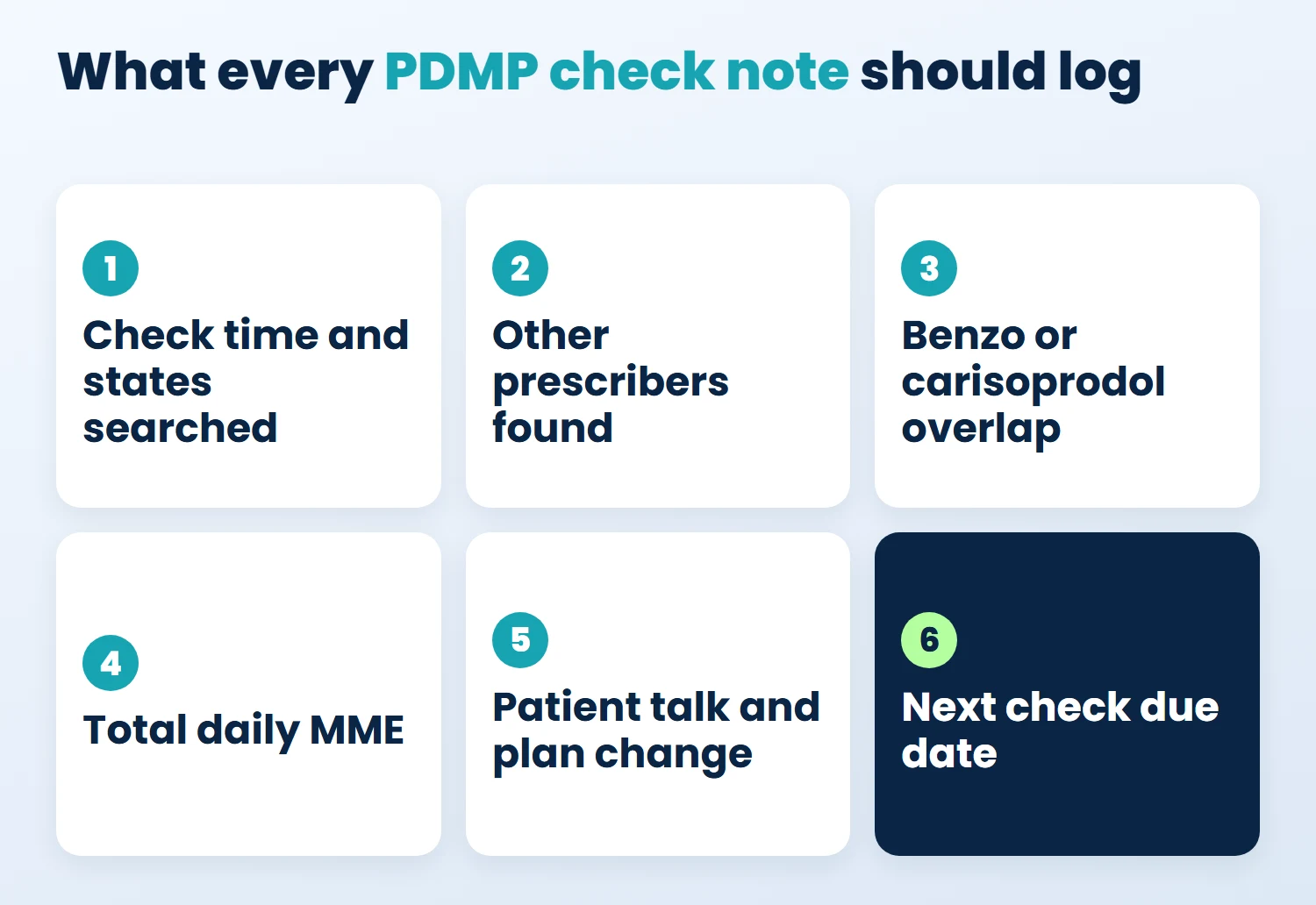
When you do check, a solid pain note gives an auditor or a covering doctor everything they’d want to see.
- When you ran the check and which states’ data it pulled
- Any other prescribers who showed up, like a surgeon’s post-op script or a dentist’s
- Any overlap with a benzodiazepine or carisoprodol
- The patient’s total daily MME, leaving buprenorphine out of the math like the CDC says
- What you talked about with the patient and how the report changed your plan
- When the next check is due
That conversation line matters more than it looks. The CDC wants you to go over PDMP findings with the patient and not drop anyone from care because of the report. If the report makes you think a patient might be sharing or selling, the CDC suggests toxicology testing to help you decide whether opioids can stop without causing withdrawal.
In most pain clinics, though, an MA or nurse pulls the report before the visit.
PDMP Delegate Rules for Pain Clinic Staff
PDMP delegate rules decide whether they’re allowed to, and each state sets its own limits.
- New York lets licensed or unlicensed staff search the registry for you as designees, as long as they’re employed by or under contract with your practice.
- Colorado dropped its old three-delegate limit in 2022, so a prescriber can authorize as many trained delegates as needed.
- Florida lets a designee handle the check too.
Your prescriber still reads the report and makes the call, so set up your template to show who ran the check and who reviewed it.
There’s one step nobody can do for your prescribers, and that’s registering in the first place. In a November 2025 Georgia case, a state administrative law judge found that a physician broke medical board rules by failing to enroll in the PDMP by the state’s 2018 deadline. He admitted he hadn’t checked his email in three years and didn’t enroll until March 2023. His license was suspended indefinitely, though that order also rested on separate findings about his fitness to practice.
Georgia doesn’t stop at registration, either. If your practice counts as a pain clinic there, you’ve got more on your plate.
Pain Clinic Regulations That Expand PDMP Requirements
Pain clinic regulations can stack extra PDMP duties on top of your state’s general rules. Georgia’s rule for licensed pain clinics covers three of them.
- Registration and checks: Every physician who owns or works in the clinic has to register with the PDMP and check it regularly on all new and existing patients.
- Location licensing: Each clinic location needs its own license, and running a pain clinic without one is a felony.
- Dispensing: Clinics that dispense controlled substances have to register with the state Board of Pharmacy.
Whether your practice counts as a pain clinic can surprise you, too. Tennessee counts buprenorphine and tramadol prescribed for pain when it decides who needs a pain clinic license. Buprenorphine used only in a bona fide medication-assisted treatment program for opioid dependence doesn’t count, so the reason you document for that script matters.
And if your clinic keeps meds on the shelf, that dispensing piece comes with its own PDMP homework.
PDMP Reporting Requirements for In-Office Dispensing
PDMP reporting requirements start the day your clinic begins dispensing, because you become one of the places sending data into the PDMP. Florida’s rules for dispensing practitioners, which include physicians, APRNs, and PAs, show what that looks like.
- Deadline: Every Schedule II to V dispense has to reach the PDMP by the close of the next business day.
- Zero reports: You file one by the close of the next business day for any day you don’t dispense, weekends included.
- Extra fields: The report asks for the patient’s phone number, whether it’s a new fill or a refill, the name of whoever picks it up along with the type and issuer of their ID, and your state license number.
- Penalty: Skipping a report on purpose is a first-degree misdemeanor.
Florida also bars dispensing practitioners from dispensing most Schedule II and III drugs, with narrow exceptions such as limited post-surgical supplies, so check which schedules you can keep on the shelf at all.
If you do injections, there’s a helpful exception. Florida leaves drugs you administer to patients out of reporting, so something you give during a procedure in your office is handled differently from pills that go home in a bottle.
Arizona also requires providers who dispense from their office to report Schedule II to V dispenses to its PMP within one business day, with limited exceptions such as drugs given directly to the patient and samples, so check your own state’s submitter rules before the first bottle goes out.
All of that goes to the state. Medicare, meanwhile, keeps score on the other half of your log, the check itself.
The MIPS Query of PDMP Measure for Pain Practices
If you’re in MIPS, Query of PDMP is a required Promoting Interoperability measure worth 10 points. Skip any required measure without claiming an exclusion and your whole Promoting Interoperability score drops to zero, which is a big hit since the category makes up 25 percent of your MIPS final score. Our guide to MIPS scoring and penalties shows how that flows through to payment.
The measure comes with a few rules of its own, and you’ll find them on the CMS rule that created the measure.
- You have to run the check before you e-send the Schedule II opioid, Schedule III, or Schedule IV script.
- It has to use data from your certified EHR technology.
- You can run it any way your state law allows.
- There are two optional exclusions if you qualify.
For pain practices, this comes up all day long. Every tramadol or carisoprodol script you send electronically is a Schedule IV prescription, so it counts. And since the timing lines up with most state rules, one check inside your EHR can cover your state requirement and your MIPS attestation at once. If your team checks a separate portal in another browser tab, someone has to connect that check back to the chart and the e-prescription by hand.
Keeping the check, the note, and the script connected is the job your EHR should be doing for you.
How OmniMD Logs PDMP Review in the Pain Management Note
That’s the job we built OmniMD’s pain management documentation to do. When your prescriber goes over PDMP findings with a patient, OmniMD’s AI medical scribe picks up the conversation and puts it in the visit note, right next to the MME, the prescribing decision, and the next check date your prescriber enters.
Your MA’s report pull, your prescriber’s review, and the e-prescription all live in one record, so a covering doctor can see what the last check found. Want to see it with your own pain patients?
PDMP Requirements FAQs
What does PDMP stand for in medical terms?
PDMP stands for prescription drug monitoring program. It’s a state database that records controlled substance prescriptions filled by pharmacies and dispensing practitioners, so prescribers can review a patient’s controlled medication history before writing a new script.
How often do you have to check the PDMP?
It depends on the state. New York and Texas require a check before every covered prescription, New Jersey requires quarterly checks for continuing new patients, and California requires one at least every six months. Checking at every prescribing visit meets all of them.
Can a medical assistant check the PDMP for a prescriber?
In many states, yes. New York, Colorado, and Florida let delegates or designees run the search, but the prescriber still has to review the report and make the prescribing decision.
Does a PDMP check count toward MIPS?
It can. The Query of PDMP measure is a required, 10-point Promoting Interoperability measure that counts when you use certified EHR technology to query the PDMP before electronically sending at least one Schedule II opioid or Schedule III or IV prescription.
This article is general information, not legal or compliance advice. PDMP laws and board rules change, so confirm current requirements with your state PDMP, licensing board, and counsel before you rely on them.

Dr. Giriraj Tosh Purohit is an experienced Product Manager and Security officer with a strong background in healthcare technology and management consulting. With expertise spanning clinical workflows, EHR, RCM, Digital Health, and AI-driven products, he has been instrumental in shaping innovative healthcare solutions.