
How AI Medical Scribes Integrate Seamlessly With EHR Systems
Electronic Healthcare Records (EHRs) are the backbone of modern healthcare delivery. Even so, many clinicians find the documentation within EHRs one of the biggest contributors to the administrative burden. AI scribe EHR integration has emerged as a game changing solution as healthcare organisations seek advanced and smarter ways to improve efficiency without compromising the quality of care.
With the help of intelligent automation, OmniMD stands out with years of experience in helping healthcare organisations and providers by streamlining their clinical documentation, improving workflow efficiency, and enabling clinicians to focus more on patient care.
For most practices, the value shows up in the small moments rather than a single dramatic change: a provider finishing a note before the patient leaves the room instead of after the last visit of the day, or a chart that reads clearly to the next clinician who opens it months later. Those moments add up across a clinic’s entire patient volume, which is why integration quality, not just the AI itself, ends up shaping how much time and stress a practice actually saves.
The Growing Challenge of EHR Documentation
EHR systems have improved data accessibility, care coordination and compliance and on the other hand, they have also introduced complex documentation requirements. Physicians often have to spend more time on the desk, entering data and a lot less time on the patient interactions where they are actually needed, leading to burnout and reduction in productivity.
This challenge has led to a greater adoption of AI-powered scribes that automate documentation during patient encounters and fit seamlessly into existing EHR workflows.
The problem rarely comes from the EHR itself. Most systems were built to store structured data reliably, not to keep pace with a live conversation. That gap is what turns a 15-minute visit into 25 minutes of work once charting, coding fields, and template navigation are added on top of the actual exam. Closing that gap is less about replacing the EHR and more about giving it a faster, more accurate way to receive information in the first place.
What Is AI Scribe EHR Integration?
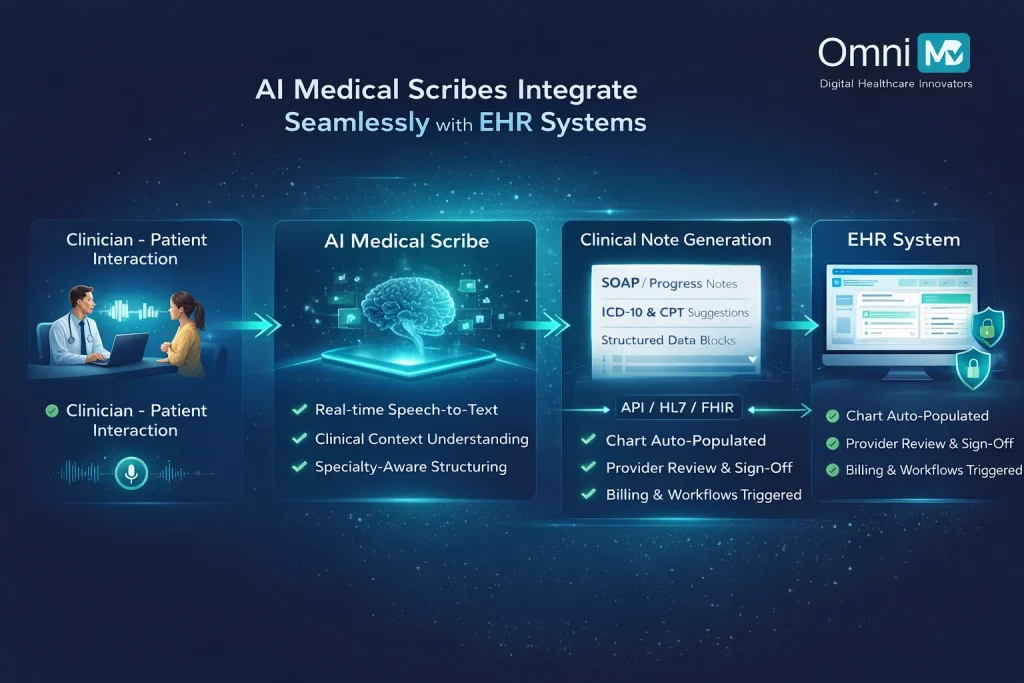
AI medical scribes use advanced speech recognition and natural language processing to capture the clinical conversations in real time. These clinical conversations are transformed into well structured clinical notes that align with EHR documentation standards.
This kind of integration ensures notes are automatically placed into the appropriate sections of the EHR, eliminating manual data entry, minimising errors, and enhancing documentation consistency.
The difference between a scribe that simply transcribes and one that truly integrates comes down to where the output lands. A transcript that a clinician has to copy into the right fields still leaves most of the administrative work in place. A properly connected system recognizes what belongs in the history of present illness, what belongs in the assessment, and what belongs in the plan, and routes each piece there directly.
How AI Medical Scribes Seamlessly Integrate With EHR Systems
- Secure and Interoperable Connectivity
Modern EHR platforms support secure integrations through APIs. OmniMD uses these capabilities to enable a frictionless, reliable connection between the two, ensuring accurate data exchange without disrupting existing workflows.
In practice, that connection relies on standard data exchange formats such as HL7 and FHIR, the same protocols most EHR vendors already support for interoperability. Building on standards that IT teams already trust makes onboarding faster and reduces the risk of the kind of custom integration work that can stall a rollout for months.
This secure connectivity allows documentation to flow directly into patient charts while maintaining compliance with healthcare data standards.
- Real Time Clinical Documentation
It captures conversations and generates structured notes in real time during patient encounters. These notes are created to match EHR templates, allowing clinicians to review, edit and approve documentation before final submission.
This approach enhances chart completion times while preserving clinical oversight.
Keeping a clinician in the review step matters as much as the speed gain itself. A note that’s drafted instantly but signed without a second look creates its own risk. The workflow is built so the provider still confirms what was captured before it becomes part of the permanent record, which keeps accountability where it belongs.
- Intelligent Data Structuring
The ability to convert conversational data into structured EHR fields is one of the key strengths of this approach. OmniMD’s AI accurately recognizes diagnoses, medications, symptoms, and care plans, mapping them into the appropriate sections of the EHR.
This structured documentation supports accuracy in coding, billing, reporting and downstream analytics.
That structure is also what makes a note usable after the visit ends. Billing teams can pull the exact diagnosis and procedure detail they need without re-reading a full narrative, and quality reporting programs can pull the same structured fields without a separate manual abstraction step. A note that reads well to a clinician and a note that’s usable downstream are not always the same thing, and this is where getting the structure right matters most.
- Specialty Specific Documentation Support
Clinical documentation varies specifically across specialities. It adapts to specialty specific workflows, terminology, and note formats, ensuring relevance and accuracy.
This flexibility allows providers across multiple care settings to adopt AI-driven documentation with confidence.
A cardiology note and a pediatric well-visit note don’t share the same shape, vocabulary, or level of detail, and a scribe that treats every visit the same way tends to produce notes that need heavy editing regardless of specialty. Matching format and terminology to the visit type is what keeps that editing burden low across a multi-specialty practice rather than just a single department.
- Built In Security and Compliance
Patient data security is essential. OmniMD’s platform is built to meet HIPAA requirements through encrypted data transmission, role based access controls, and a secure authentication process.
Healthcare organisations can adopt AI documentation technology without compromising compliance or data integrity.
This matters most during audits and payer reviews, when an organisation needs to show not just that a note exists, but who accessed it, when it was edited, and what was changed. Built-in access controls and an auditable trail turn that from a scramble into a straightforward records request.
Benefits of AI Scribe EHR Integration For Healthcare Organisations
Healthcare organisations that implement this kind of AI-assisted documentation experience meaningful improvements, including:
- Reduced documentation time for clinicians
- Improved accuracy and consistency of clinical notes
- Faster chart completion and turnaround
- Decreased clinician burnout
- Enhanced patient provider interactions
These benefits contribute to a better operational efficiency and improved patient satisfaction.
Reduced clinician burnout in particular tends to show up in retention numbers before it shows up in any formal survey. Documentation load is consistently cited as one of the top reasons clinicians leave a practice or reduce their hours, so even a modest, measurable drop in after-hours charting can influence staffing stability over time, not just day-to-day satisfaction.
Why OmniMD Leads In AI Scribe EHR Integration
OmniMD brings deep expertise in healthcare technology and EHR interoperability. The AI scribe solution is made to integrate smoothly with existing EHR systems, ensuring quick adoption and long term success.
Key differentiation includes:
- Proven EHR integration expertise
- Intelligent automation tailored to clinical workflows
- Scalable solutions for practices and health systems
- A strong focus on usability, security and performance
OmniMD’s commitment to seamless EHR integration helps healthcare organisations achieve measurable improvements without disrupting care delivery.
That focus on fit over features is deliberate. A scribe that produces excellent notes but requires clinicians to change how they work, or forces IT teams into a lengthy custom build, tends to stall during rollout regardless of how good the underlying AI is. Prioritizing integration effort as much as documentation quality is what keeps adoption realistic for practices that can’t afford a long transition period.
The Future of AI Scribe EHR Integration
As the world of Healthcare continues to evolve, this kind of integration will play a leading role in minimising administrative burden and empowering value based care. AI-driven solutions will increasingly support analytics, quality reporting and clinical decision making, even beyond documentation.
The next stage of this shift is less about writing the note faster and more about what a clinic can do with the structured data once it exists. Consistent, well-tagged documentation across an entire patient population makes it easier to spot care gaps, track outcomes for chronic conditions, and prepare for value-based contracts that reward measurable results rather than visit volume alone.
To see how OmniMD’s EHR integration compares against the other top AI scribes on the market, explore our full 2026 AI medical scribe comparison.
OmniMD stays focused on advancing intelligent documentation solutions that empower providers and strengthen healthcare delivery.
Discover how OmniMD’s AI medical scribe solutions can seamlessly integrate with your EHR and transform your documentation workflow.

Dr. Giriraj Tosh Purohit is an experienced Product Manager and Security officer with a strong background in healthcare technology and management consulting. With expertise spanning clinical workflows, EHR, RCM, Digital Health, and AI-driven products, he has been instrumental in shaping innovative healthcare solutions.