
The 5 Patient Engagement Companies Worth Your Time in 2026
I went through G2, Capterra, Software Advice, KLAS’s live vendor pages, company newsrooms, and the messier, more candid corners of Trustpilot to figure out which patient engagement platforms are actually worth a practice’s money right now, reading current review text, current complaint patterns, and current 2026 product releases rather than old press clippings.
Here are the five that came out on top, why they rank, and exactly what their own users say is good and bad about them today.
How I Ranked These Five Companies
I weighed three things together:
- Independent review scores: current G2 and Capterra ratings, since these have the largest audited pools of healthcare software reviews
- KLAS Research standing: what the healthcare industry’s most trusted independent analyst firm currently says about each vendor, checked against KLAS’s own live vendor pages rather than old award announcements
- 2026 momentum: what each company has shipped, launched, or reported financially this year
A note on the numbers: Review counts on G2 for healthcare software are often small compared to categories like CRM or project management. I am giving you the actual review counts alongside every rating so a 4.8 built on 15 reviews doesn’t get mistaken for the same thing as a 4.3 built on 200.
G2 and Capterra Ratings Compared
| Company | G2 Rating | Capterra Rating | 2026 Scale |
|---|---|---|---|
| Luma Health | 4.8 (84 reviews) | 4.6 (82 reviews) | 1,000+ organizations, 100M+ patients across the US, UK, Canada, Caribbean |
| Klara (ModMed) | 4.6 (111 reviews) | 4.6 (211 reviews) | About 80% of patients reached, per ModMed’s own Jan-May 2026 data |
| Phreesia | 4.1 (43 reviews) | 4.3 (166 reviews) | 4,658 clients in fiscal Q4 2026, 180M+ patient visits in 2025 |
| Solutionreach | 4.3 (168 reviews) | 3.8 (236 reviews) | 1B+ interactions/ |
| OmniMD | 4.2 (11 reviews) | 4.5 (51 reviews) | 12,000+ providers across 20+ specialties |
Patient Engagement Capabilities Compared Across All Five
| Feature | Luma Health | Klara | Phreesia | Solutionreach | OmniMD |
|---|---|---|---|---|---|
| Self-scheduling | Yes, rule-based, EHR-aware | Yes | Yes | Yes | Yes |
| Two-way secure messaging | Yes, multi-language | Yes, core strength | Limited, intake-focused | Yes, via mobile app | Yes |
| Native EHR/ | No, integrates with 80+ EHRs | Part of ModMed suite | No, integrates with 16+ systems | No, integrates with 400+ systems | Yes, fully built in. Also, third-party EHR integration is available. |
| Payment collection | Yes, in-chat | Not a core focus | Yes, core strength | Not a core focus | Yes, online bill pay |
| Telehealth/ | Yes | Yes | Not a primary focus | Not a primary focus | Yes |
| AI voice/ | Yes, Navigator and Spark | Not a core focus | Yes, Phreesia VoiceAI | Yes, AI scheduling, in beta | Yes, AI Scribe, Front Desk, Clinician, Biller, Coder |
| New patient acquisition tools | Yes, Patient Pipeline | Not a core focus | Yes, HCP marketing tools | Not a core focus | Yes, through clinical marketing services |
| Reputation/ | Not a core focus | Not a core focus | Not a core focus | Yes, core strength | Yes, through clinical marketing services |
| Best suited for | Health systems, multi-location groups | Specialty practices on ModMed | Large practices, health systems | Practices wanting reminders/ | Small, mid-size, and enterprise-level practices wanting one platform |
1. Luma Health: Best for Large Health Systems
Company Snapshot
- Founded 2015 in San Mateo, CA
- Scale: 1,000+ healthcare organizations, 100M+ patients
- Mostly serves health systems and multi-location groups
- Small single-location practice? Confirm you’re actually its target customer
- Integrates with 80+ EHRs, including Epic, Oracle Health, MEDITECH, athenahealth
- Check your own EHR against that list first
- Includes: self-scheduling, smart waitlist, referral management, two-way secure messaging, video visits, mobile-first intake, insurance eligibility checks, in-chat payments
- Deployment: Cloud/SaaS
- Pricing: quote-based, not published
- Ratings: 4.6/5 Capterra (82 reviews, 90% recommend), 4.8/5 G2 (84 reviews)
2026 Product Updates
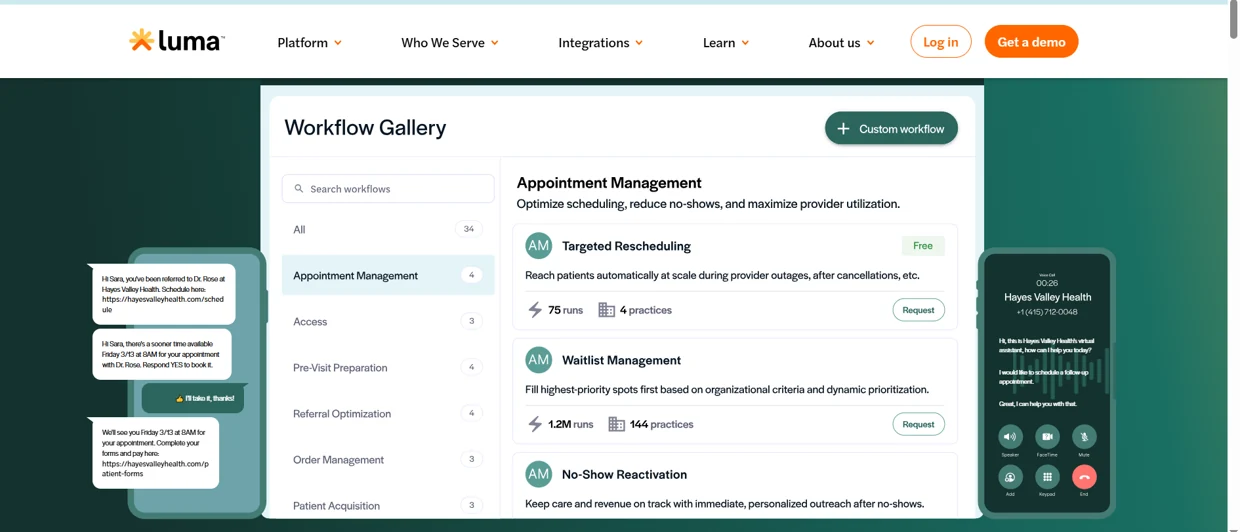
- Spring 2026 release: Workflow Builder, a no-code orchestration engine; AI workflows across this release saved a combined 2.5 million hours and handled 350,000+ care-related next steps across health systems
- Navigator, Luma’s conversational AI agent, now handles proactive outbound follow-up in addition to inbound requests, automating 95% of after-hours calls at the University of Arkansas for Medical Sciences and cutting call abandonment by 40% at Sun River Health
- Fax Transform, an AI tool that reads incoming faxes and extracts clinical findings automatically instead of requiring manual data entry
- Summer 2026 release: features connecting pre-visit preparation, check-in, and in-clinic flow
- July 2026: launched Patient Pipeline, which builds Google Ads around a health system’s real-time open schedule slots and traces bookings back to the ad spend that drove them. Currently available only for health systems on Epic
- Won a Gold Stevie Award in the Artificial Intelligence/Machine Learning Solution, Healthcare category, at the 2026 American Business Awards
- Announced a partnership with PCC, an eight-time Best in KLAS pediatric EHR, to bring AI-enabled communications to 300+ pediatric practices
Patient Engagement Capabilities
- Rule-based, EHR-aware self-scheduling
- Smart waitlist that auto-matches open slots to appropriate patients
- Referral management
- Two-way secure messaging in multiple languages
- Video visits
- Mobile-first intake forms and health screenings delivered inside chat, with no app download or portal login needed
- Real-time insurance eligibility checks and in-chat payment collection
G2 and Capterra Ratings
- G2: 4.8/5 from 84 reviews
- Capterra: 4.6/5 from 82 reviews, 90% recommendation rate
Strengths (per users)
- Customer support and implementation team called out as unusually responsive
- Intuitive enough that new staff need very little training
- A real, measurable drop in no-show rates, with cited cases as high as 79% reduction
Weaknesses (per users)
- Implementation, integration, and premium support often sit outside the base subscription, pushing year-one cost above the quote.
- Per-message and per-minute fees can scale faster than patient volume, so busy months raise the bill unexpectedly.
- Discount levels and module packaging stay unclear until you get a formal quote.
- Support is ticket-based, and users report slow response on urgent issues.
Pricing: Not published, quote-based
Best Fit: Health systems and multi-location groups that want AI to run entire operational workflows, not just send reminders
My Advice: A lot of Luma’s newest capabilities, Navigator, Fax Transform, Workflow Builder, Patient Pipeline, are being rolled out EHR by EHR rather than across the whole platform at once, and Patient Pipeline specifically is Epic-only today. Before you weigh any of the 2026 releases in your decision, get a straight answer on which of them are actually live on your specific EHR right now versus still on the roadmap for it. And since the KLAS survey gap means independent data on mid-size deployments is thin, ask for a reference customer close to your own size and location count, not just Luma’s flagship health-system logos.
2. Klara (Acquired by ModMed): Best for ModMed Specialty Practices
Company Snapshot
- Founded 2013 in Boca Raton, FL
- Acquired by ModMed in Feb 2022 after raising $32M+
- Sold as “ModMed Patient Engagement, powered by Klara,” packaged with ModMed’s EMA EHR and PM software
- Not on EMA? EHR interface sold as a separate add-on
- Includes: two-way texting, call-to-text, voicemail transcription, website messenger, digital intake with e-signature, telemedicine, broadcast messaging, reminders, pre/post-visit outreach, internal chat
- Strongest in: dermatology, plastic surgery, OBGYN, ENT, ophthalmology, orthopedics
- Used across 40+ specialties
- Deployment: Cloud/SaaS
- Support: email, phone, chat, knowledge base
- Pricing: quote-based, not published
- Ratings: 4.6/5 Capterra (211 reviews), 4.6/5 G2 (111 reviews)
2026 Product Updates
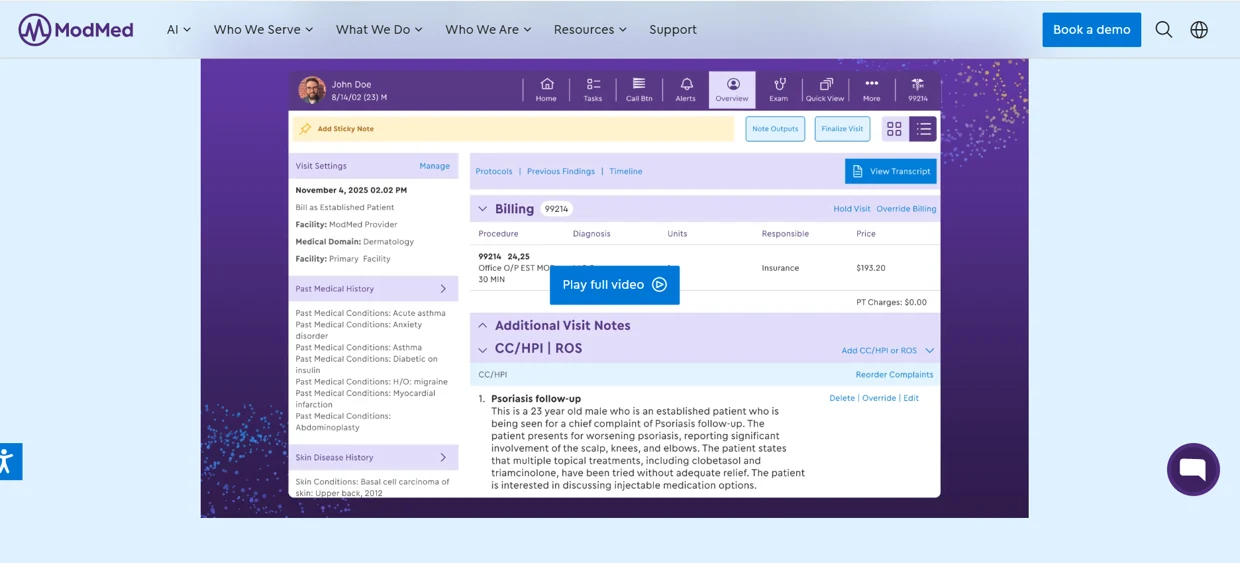
- Continued integration of billing: practices now send statements, payment links, and bill reminders directly through Klara when paired with ModMed’s EMA EMR
- Ongoing rollout of self-scheduling, though recent Capterra reviews describe bugs in the self-scheduling module and slow support communication during a rollout delay
- AI-powered message routing continues to expand across departments and satellite locations
Patient Engagement Capabilities
- Turns phone calls into text messages: patient texting, web chat, and voicemail auto-transcription into one thread
- Call-to-text conversion so staff aren’t stuck on routine phone questions
- Self-scheduling, automated pre-visit instructions, digital forms before arrival
- Post-visit follow-up messaging replacing paper handouts
- Intelligent message routing to the right staff member or department
- Klara’s own case studies report practices seeing a 30-60% reduction in inbound phone call volume within 90 days of adoption
G2 and Capterra Ratings
- G2: 4.6/5 from 111 reviews
- Capterra:4.6/5, 211 reviews, page last updated March 2026
Strengths (per users)
- ‘Communication’ is the most repeated word in reviews, describing an end to phone tag and voicemail
- Smooth transitions reported by practices switching from other systems like Relatient, especially if already on ModMed
- Multi-department message triage improves response time even across satellite office locations
Weaknesses (per users)
- Recent Capterra reviews describe self-scheduling glitches during rollout, including one reviewer noting a missed go-live date and sparse communication from the Klara team afterward
- Duplicate patient charts occasionally created during self-scheduling, along with friction combining multiple charts for the same patient
- Some patients avoid opening message links because they resemble spam or junk text, per reviewers on Capterra
- Patient portal side lags behind competitors even though messaging is strong
Pricing: Enterprise/ModMed-bundled pricing available on request; not published
Best Fit: Specialty practices already on or adopting ModMed’s EMA EHR that want to eliminate phone tag with patients
My Advice: The real question here isn’t whether Klara is good, the reviews already answer that. It’s how much of Klara you actually get if you’re not on ModMed’s EMA EHR. Ask for a written feature-parity sheet comparing the standalone product to the ModMed-bundled version before you sign anything. And get a firm date on when the self-scheduling bugs multiple 2026 reviewers flagged will be resolved. Intermittent self-scheduling is exactly the kind of defect that quietly kills staff trust in a rollout, long before anyone escalates it formally.
3. Phreesia: Best for Large-Scale Intake and Collections
Company Snapshot
- Founded 2005, HQ in Wilmington, DE (ops HQ Raleigh, NC)
- IPO’d on NYSE in 2019 (ticker: PHR) after raising $100M+; remains independent
- Sold as the Phreesia Platform, connects to a practice’s existing EHR rather than replacing one
- Integration depth varies by EHR; confirm yours before buying
- Includes: PhreesiaPad, PhreesiaMobile, insurance verification, scheduling, copay/payment collection, Appointment Accelerator, clinical assessments, post-visit surveys
- Strongest in: high-volume ambulatory practices and health systems, not tied to one specialty
- Used across 4,300+ provider organizations in all 50 states
- Deployment: Cloud/SaaS, plus on-site hardware (PhreesiaPad, Arrivals Kiosks)
- Support: phone, email, chat
- Pricing: quote-based, not published
- Ratings: 4.3/5 Capterra (167 reviews), 3.9/5 G2 (45 reviews)

2026 Product Updates
- Launched Phreesia VoiceAI, an AI phone agent handling scheduling, refill requests, and payment calls, which the company says is driving new opportunities in its Network Solutions business
- Launched new healthcare provider marketing offerings in fiscal Q1 2027
- Continues integrating AccessOne’s payment financing tools into its core platform, a deal that officially closed November 12, 2025
Patient Engagement Capabilities
- Tablet or phone-based self-check-in with insurance/demographic verification
- Clinical screening questionnaires completed before the visit
- Copay/balance payment collected at check-in
- Phreesia VoiceAI, an AI phone agent for scheduling, refills, and payment calls
- HITRUST CSF, SOC 2 Type 2, PCI Level 1 certified
- Native integration with 16+ practice management/EHR systems
G2 and Capterra Ratings
- G2: 4.1/5 from 43 reviews
- Capterra:4.3/5, 166 reviews, multi-year Capterra Shortlist honoree
Strengths (per users)
- Major time savings at the front desk: less paper, faster check-in, smoother eligibility verification
- Credited with improving collections and cutting manual payment-chasing
- Core patient activation business kept growing through fiscal 2026 and into fiscal Q1 2027, even as the Network Solutions side hit a rough patch
Weaknesses (per users), the most important section to read
- A real, recurring pattern of angry patient-side reviews on Trustpilot about:
- Repetitive intake questions asked at every single visit
- Unwanted sponsored/advertising content shown during check-in based on diagnosis or prescriptions
- High frequency of text/email reminders some patients describe as excessive
- Phreesia has responded publicly on Trustpilot, saying sponsored content is optional and opt-outable via support. Even so, the volume and consistency of these complaints is something any buyer should know before rollout
- A few practice-side reviewers mention slower-than-expected implementation and occasional EHR field-sync friction
Pricing: Not published, quote-based
Best Fit: Large practices and health systems where intake efficiency and collections are the biggest pain points
My Advice: Keep the two purchasing decisions separate in your head. You’re buying a patient intake and payment product, not investing in the stock, so the March 2026 guidance cut and the lawsuit tied to it shouldn’t move your evaluation much on their own, since both concern the pharma-funded Network Solutions unit and not the tools your front desk would actually touch. What should move your evaluation: ask Phreesia directly which sponsored-content settings you can turn off by default for your patient population, and get the opt-out mechanics written into the contract rather than left to a support email process, since that’s the complaint that shows up again and again in patient reviews.
4. Solutionreach: Best for Reminders and Reputation Management
Company Snapshot
- Founded 2000 in Lehi, UT, by Jim Higgins
- Sold as a standalone patient communication platform, not bundled with any EHR or PM system
- Includes: appointment reminders, two-way texting, online scheduling, patient review/reputation management, secure messaging, insurance eligibility checks, Revenue Cycle Messaging
- Strongest in: dental and vision practices, plus DSOs, vision groups, and general medical practices
- Serves 50,000+ practices; integrates with 400+ PM/EHR systems
- Deployment: Cloud/SaaS
- Support: email, phone, chat
- Pricing: starts at $329/month flat rate
- Ratings: 3.8/5 Capterra (236 reviews), 4.3/5 G2 (167 reviews)
2026 Product Updates
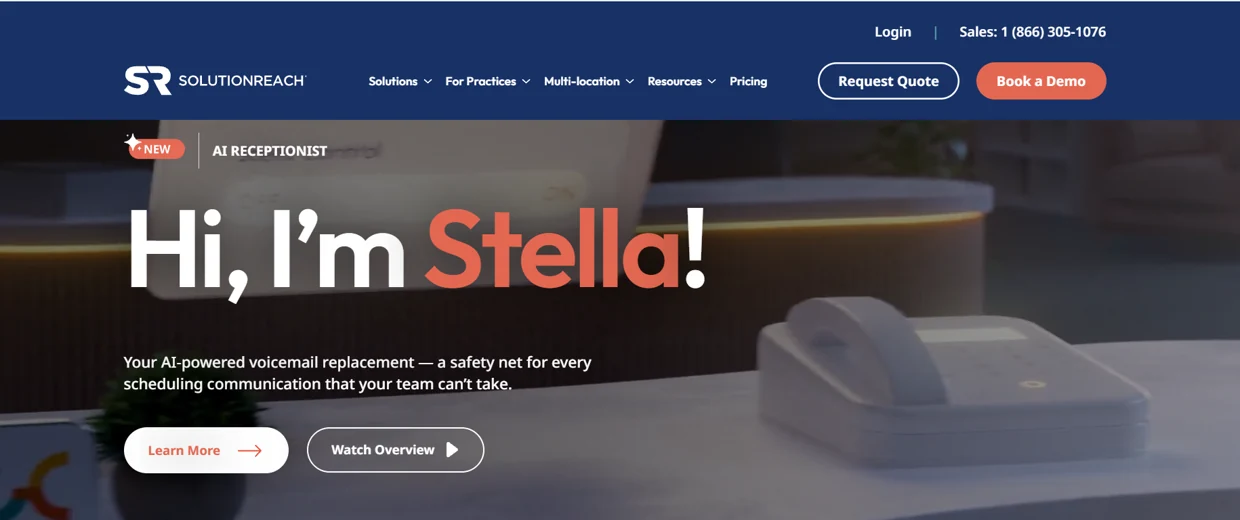
- 2026 release notes show a new AI Virtual Assistant (Scheduling), a conversational AI tool currently in beta that answers calls the office can’t and books appointments automatically
- Website iframe embedding for SR Schedule, currently in beta, letting practices embed scheduling directly on their own site with customizable configuration
- Intake improvements: table-type questions for easier patient responses and a save-as-draft option so patients can finish intake packets later
- Marketing tracking phone numbers added to SR Schedule, with improved phone number validation across the platform
- Patient Profile page UI refreshed to reduce dead clicks
Patient Engagement Capabilities
- Automated appointment reminders and recalls across text, email, and voice
- Two-way texting via a mobile app
- Online scheduling
- Patient surveys and reputation management tied to review generation
- Broadcast messaging for practice announcements or health campaigns
G2 and Capterra Ratings
- G2: 4.3/5 from 168 reviews
- Capterra:3.8/5, 236 reviews, 70% recommendation rate, 3.5/5 on both support and value for money, page last updated January 2026
Strengths (per users)
- Daily time savings from automated reminders/recalls, with several long-term users saying it eliminated manual phone reminders entirely
- Reputation management and review-generation tools remain a differentiator versus competitors that don’t prioritize this
- Mature, stable feature set from two decades in the category, now expanding into AI-powered scheduling
Weaknesses (per users), the one real red flag on this list
- A genuine, recurring pattern of contract and sales complaints running alongside the usual product complaints:
- Reviewers describing feeling misled by sales reps about contract terms
- Difficulty exiting agreements even after being told otherwise
- Support described as hard to reach outside a self-serve FAQ
- Rigid appointment-type templates that can cause patients to self-schedule into the wrong visit type
Pricing: Flat-rate subscription, not published; third-party pricing trackers cite a starting point near $329/month
Best Fit: Practices that want mature, proven reminders, recalls, and reputation management, and are comfortable negotiating contract terms carefully upfront
My Advice: This is the one vendor on this list where I’d slow the procurement process down on purpose. Get the full contract, including auto-renewal terms and the early-termination clause, reviewed by whoever handles vendor agreements at your organization before a demo call turns into a signature. When you talk to reference customers, don’t just ask how onboarding went, ask specifically how the exit process went for anyone who left, since that’s where the recurring complaints in the reviews actually sit.
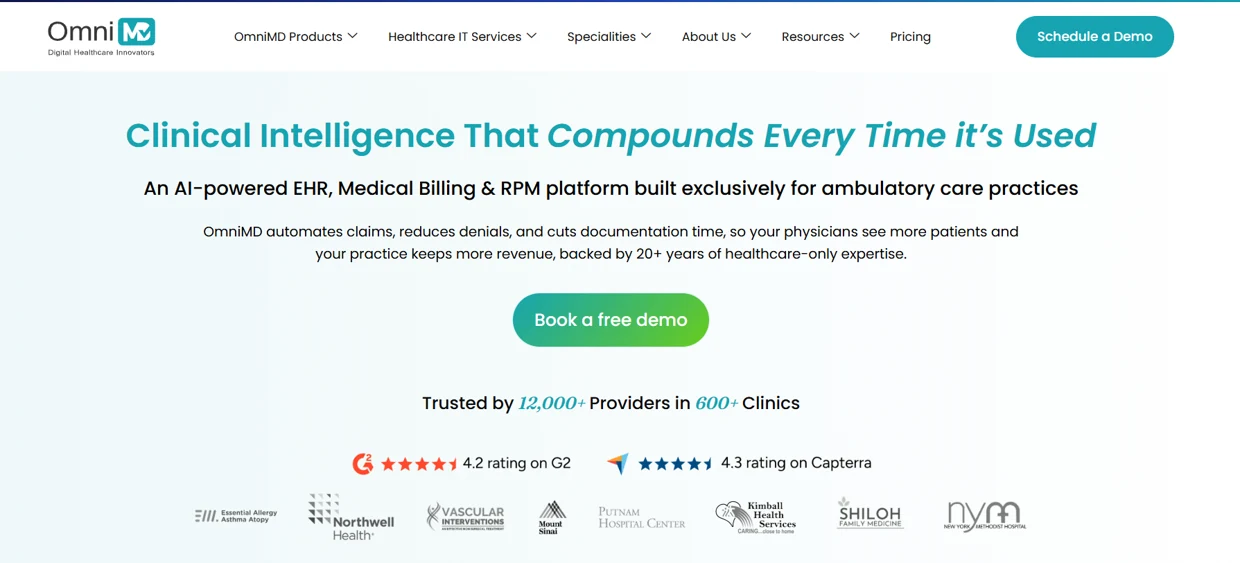
5. OmniMD: Best for All-in-One EHR and Engagement
Company Snapshot
- Founded 2002 in New York City; started with 5 people in a single room
- Privately held and self-funded; no venture capital, no acquisitions made
- Sold as a single integrated platform, though standalone modules are also available: EHR, practice management, revenue cycle management, and patient engagement all under one roof, not stitched together from separate vendors
- Includes: EHR/EMR, practice management, billing/RCM, patient portal, telehealth, remote patient monitoring, AI Frontdesk, AI Clinician, AI Medical Biller and Coder (added May 2026)
- Strongest in: small-to-mid independent practices and specialty clinics, not built for large multi-site health systems
- Serves 12,000+ providers across 20+ specialties
- Deployment: Cloud/SaaS, with desktop and mobile apps
- Support: email, phone, chat, 24/7 live rep
- Pricing: custom
- Ratings: 4.5/5 on Capterra (51-52 reviews)
2026 Product Updates
- OmniMD launched AI Medical Biller and AI Medical Coder on May 28, 2026, both integrated with our existing ONC-certified EHR and Practice Management system, and both available via a 3-day free trial that runs against a practice’s own live claim history instead of sample data.
- AI Medical Biller applies machine learning to a practice’s own historical claims to identify denial patterns, missed codes, and uncaptured revenue tied to that specific payer mix and specialty. It generates a pre-submission risk score for each claim, flags documentation gaps before the claim goes out, and routes exception cases to human billers rather than letting errors reach the payer.
- AI Medical Coder is built to cut coding time by roughly 50%, improve coding accuracy, and speed up reimbursement, working alongside AI Medical Biller rather than as a separate step.
- The two products round out the AI portfolio: AI Medical Scribe handles clinical documentation, AI Front Desk handles front-office operations, AI Clinician supports clinical decision-making, and AI Biller and AI Coder now cover the revenue cycle.
- Our AI Front Desk maintains 99.7% accuracy across 60-plus automated tasks, including answering calls, scheduling, insurance updates, and prescription refill requests.
- We updated our billing software for the 2026 AI-related CPT codes. The system now automatically captures the five documentation elements payers require for AI-assisted services: which AI tool was used, any physician modifications, the final clinical decision, the AI vendor, and the algorithm version, and flags gaps in any of these before the claim goes out.
Patient Engagement Capabilities
- Real-time patient portal access to labs, e-prescribing history, and clinical documentation, synced continuously
- Patients can self-update demographics, insurance, allergies, and history, which removes manual data entry from front desk
- Online scheduling/rescheduling, secure two-way messaging, prescription refill requests, digital bill payment
- Stored follow-up/educational instructions patients can revisit any time
- AI medical scribe, AI-assisted front-desk automation, AI clinical decision support, and AI billing/coding tools, all built into the same platform as the EHR
G2 and Capterra Ratings
- G2:4.2/5, 11 reviews, page last modified July 2026, a small sample worth noting
- Capterra: 4.5/5, 51 reviews, page last updated February 2026, a larger and stronger sample
Strengths (per users)
- We hear it in review after review, from family medicine to psychiatry: when something breaks, a real person picks up. Support responsiveness is the theme reviewers return to most, on both G2 and Capterra.
- Teams get up and running fast. Reviewers consistently describe the workflow as easy to learn, with little to no training required.
- We built our 2026 AI rollout around a real, quantified problem. Kodiak Solutions found claim denials drove a 25% year-over-year jump in net revenue leakage, over $48 billion in losses across 2,300 facilities, up from $38.6 billion in 2024. AI Biller and AI Coder go straight at that gap.
- One platform, five AI tools. Scribe, Front Desk, Clinician, Biller, and Coder all run inside the same EHR, so practices aren’t stitching together point solutions to get AI coverage across the visit.
- Ratings back up the reviews: 4.5/5 on Capterra across 51 reviews, with support and ease of use as the recurring callouts.
Weaknesses (per users)
- Reviews on G2 mention occasional slower load times during peak or maintenance windows and a brief adjustment period for new staff learning the interface, both fairly typical for practice-management software and generally described as easing once teams settle in
- G2’s review sample for OmniMD is smaller than the other four vendors here, so read the rating as a useful signal rather than a large-sample verdict
Pricing: Subscription-based, per-provider per-month; custom quotes provided based on organization size
Best Fit: Small, mid-size, and enterprise-level practices that want engagement, EHR, scheduling, and billing running on one connected platform instead of stitching together separate vendors, and that value being able to call and reach a real person
My Advice: Since I know this platform closely, here’s where I’d focus your evaluation to get the clearest read on it. Take the 3-day free trial on the new AI Medical Biller and AI Medical Coder seriously, and run it against a real batch of your own claims rather than a clean sample, since that’s the fastest way to see the denial-reduction impact these tools were built for. And ask for a single, connected walkthrough covering the patient portal, scheduling, and billing together rather than separate feature demos, because the real advantage here is how well those pieces work as one system, and that’s much easier to appreciate live than on a feature list.
Which of These Five Should You Choose
- Choose Luma Health if: you’re a large health system or multi-location group with the budget and IT team for a serious rollout. Its 2026 Operational AI releases and 4.8 G2 score are hard to ignore, even though it currently sits outside a formal KLAS ranking.
- Choose Klara if: you’re on ModMed already, or you specifically want to kill phone tag with patients. Its 80% patient-reach figure from ModMed’s own 2026 data speaks for itself, though watch for the self-scheduling bugs recent reviewers flagged.
- Choose Phreesia if: you’re at real scale and collections are your biggest pain point. Its core patient activation business kept growing in 2026, but its Network Solutions unit and the resulting shareholder lawsuits are worth watching.
- Choose Solutionreach if: you want a long-established reminder, recall, and reputation-management system now adding AI scheduling. Read every line of the contract first.
- Choose OmniMD if: you’re a smaller, mid-size, or enterprise-level practice that doesn’t want another vendor bolted onto your EHR, and you value being able to call someone and get a real answer. With hospitals losing $48 billion to claim denials in 2024 alone, per Kodiak Solutions, it’s worth running OmniMD’s AI Medical Biller and AI Medical Coder against your own claim history during the 3-day free trial to see what it catches before those claims go out.
Frequently Asked Questions
What are patient engagement solutions?
Patient engagement solutions are the tools a practice uses to reach patients outside the exam room: appointment reminders, two-way texting, online scheduling, digital intake forms, secure messaging, bill pay, and review requests. Some are standalone platforms that connect to your EHR, and others are modules inside the EHR itself. That distinction matters more than the feature list, because a standalone platform adds a second vendor, a second contract, and an integration that has to keep working after both products ship updates.
What patient engagement tools should a small practice start with?
Start with the two that pay for themselves fastest: automated appointment reminders and online self-scheduling. Reminders cut no-shows directly, and self-scheduling takes phone volume off the front desk without adding headcount. Digital intake is usually the third step. Broadcast messaging, reputation management, and campaign tools are worth adding once those first three run reliably, not before.
How much does patient engagement software cost?
None of the five vendors compared here publish standard pricing, so any figure quoted online is secondhand. Pricing is typically structured per provider per month, per location, or as a percentage of collections for payment modules, and it moves with practice size, module count, and contract length. Ask every vendor for the all-in number including implementation, EHR interface fees, and per-message or per-transaction charges. Interface fees in particular are a common line item that does not show up in the first quote.
Does patient engagement software integrate with my EHR?
Most do, but “integrates” covers a wide range. A read-only feed that pulls your appointment schedule is a very different thing from a bidirectional interface that writes intake responses back into the chart. Ask which specific EHR versions are supported, whether the interface is included or billed separately, and who owns the connection when it breaks. Our EHR integration guide covers the questions worth asking before you sign.
What is the difference between a patient portal and a patient engagement platform?
A patient portal is one destination, a logged-in area where patients view results, message the practice, and pay a bill. A patient engagement platform is the outbound layer that reaches patients where they already are, usually by text, before they ever think to log in. Most practices need both, and portal adoption tends to rise once an engagement layer is actively driving traffic to it.
Which patient engagement platform is best for a small practice?
Of the five compared here, Solutionreach and Klara are the most common fits for smaller practices, with Klara making the most sense if you are already on ModMed. Luma Health and Phreesia are built for health-system and enterprise scale, and their pricing reflects that. If you would rather not run a second vendor alongside your EHR at all, an all-in-one system is the other route worth pricing before you decide.
Disclaimer
Ratings, review counts, and product details reflect publicly available data as of September 2026 and are subject to change as vendors ship updates and new reviews are added.

Dr. Giriraj Tosh Purohit is an experienced Product Manager and Security officer with a strong background in healthcare technology and management consulting. With expertise spanning clinical workflows, EHR, RCM, Digital Health, and AI-driven products, he has been instrumental in shaping innovative healthcare solutions.