

Telehealth Billing Guidelines 2026 and How to Keep Claims Paid Through 2027
Medicare telehealth finally has an end date far enough away to plan around. The Consolidated Appropriations Act, 2026 keeps home visits, audio-only care, and the expanded practitioner list in place until December 31, 2027. That means your team can stop rebuilding its workflows every few months and start building ones that will last.
That stability settles whether a visit can happen by telehealth, but a lot is still changing on the claim itself.
- Two coding tracks: Medicare still won’t pay the AMA’s 98000 series telehealth codes, while many commercial plans accept them.
- Two new modifiers: CMS has proposed BB and BC for platform arrangements.
- In-house monitoring staff: A separate proposal could require your remote monitoring staff to be your own employees.
- A prescribing deadline: The DEA’s permission to prescribe controlled medications by telehealth ends December 31, 2026, unless a permanent rule replaces it.
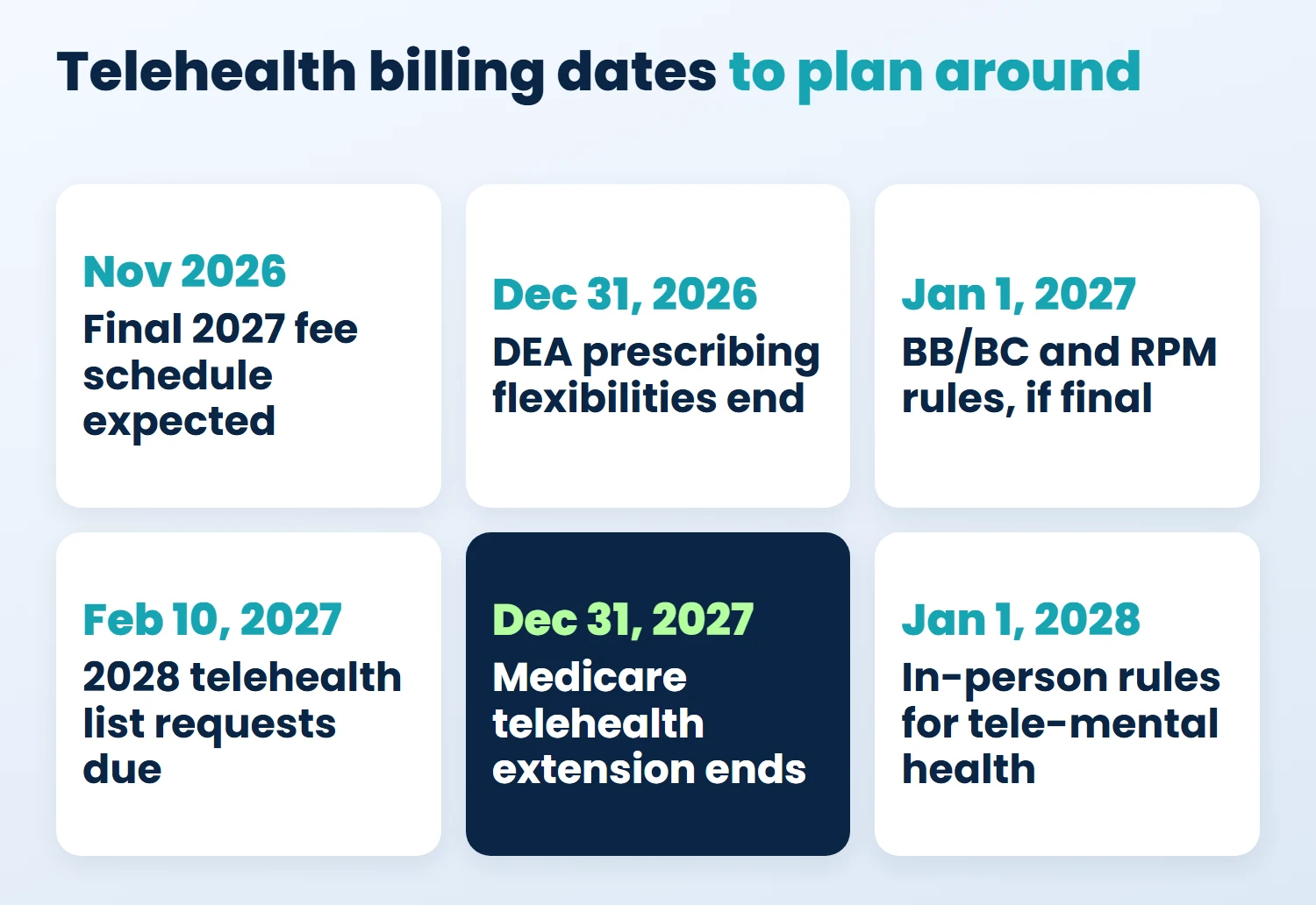
Each of those changes comes with a date, and the start of 2026 showed how disruptive a missed one can be. When the flexibilities lapsed on January 31, visits from those days sat in limbo until Congress restored them on February 3. Before we walk through the 2026 telehealth billing guidelines rule by rule, it helps to line up every date in one place, in the order it reaches your claims.
| Date | What changes | Who it affects |
|---|---|---|
| Early November 2026 | Final 2027 fee schedule expected | All Medicare billing |
| November 2026 | DEA special registration rule expected | Controlled medication prescribers |
| December 31, 2026 | DEA tele-prescribing flexibilities end | Controlled medication prescribers |
| January 1, 2027 | BB and BC modifiers and RPM staffing rules, if finalized | Platform, incident-to, and RPM billing |
| February 10, 2027 | Last day to request telehealth list changes for 2028 | Specialty practices |
| December 31, 2027 | Medicare home, audio-only, and practitioner flexibilities end | Non-behavioral telehealth |
| January 1, 2028 | In-person visit rules begin | Tele-mental health |
Most of your everyday visit volume depends on the December 2027 date, which is why the Medicare telehealth extension is the right place to start.
What the Medicare Telehealth Extension Covers Until 2027
According to the latest CMS FAQ, a Medicare patient can receive telehealth from anywhere in the United States and its territories until the extension ends. A patient at home qualifies without living in a rural area or traveling to a clinic.
The extension protects five groups of services and clinicians.
- Expanded practitioners: Physical therapists, occupational therapists, speech-language pathologists, and audiologists keep furnishing Medicare telehealth.
- Phone visits: Patients at home keep receiving audio-only telehealth for non-behavioral care.
- Tele-mental health: The in-person visit requirement stays paused, so a new behavioral patient can start care by video or phone without an office visit first.
- FQHCs and RHCs: Health centers keep billing non-behavioral telehealth with HCPCS G2025. The patient’s home counts as both a distant site and an originating site. Behavioral visits are paid under the center’s all-inclusive rate or prospective payment system.
- Hospital services at home: Hospitals keep billing outpatient therapy, diabetes self-management training, and medical nutrition therapy that their staff deliver remotely to patients at home.
A few rules will outlast the extension because CMS made them permanent in the current fee schedule.
| Permanent rule | What it means for you |
|---|---|
| No telehealth frequency limits | Subsequent inpatient, nursing facility, and critical care consultation visits are unlimited |
| Virtual direct supervision | Live audio-video counts for services without a 010 or 090 global indicator |
| Teaching physician virtual presence | Allowed through live audio-video in every residency training location, but only when the service itself is furnished as Medicare telehealth |
| Supervision scope | Covers most incident-to services, many diagnostic tests, and cardiac and pulmonary rehab |
All of this decides whether a visit may happen by telehealth. What your billers need to know next is how to write that visit on a claim, and the answer depends on which payer receives it.
Telehealth CPT Codes, POS, and Modifiers for Medicare and Commercial Payers
The AMA’s telehealth E/M family, the newest set of telehealth CPT codes, remains in effect in 2026. Codes 98000 through 98007 cover audio-video visits, and 98008 through 98015 cover audio-only visits. Medicare treats every code in that range as invalid. The one exception is 98016, the brief virtual check-in, which Medicare pays.
For a Medicare patient, you bill the same office E/M code you’d use in person, 99202 through 99215. Then two fields tell Medicare the visit happened by telehealth.
Place of service decides the rate.
- POS 10 means the patient is at home. Medicare pays the non-facility rate, which is the higher one.
- POS 02 means the patient is anywhere else, such as a clinic or an office. Medicare pays the facility rate.
Because the rate follows the patient’s location, someone on your team should confirm where the patient is sitting at the start of every visit.
The modifier tells Medicare the technology. Billing guides disagree about this field more than any other. Several say Medicare no longer needs modifier 95 because POS already signals telehealth. The place-of-service section of CMS’s Claims Processing Manual (Chapter 26, section 10.5) still instructs billers to pair POS 02 or POS 10 with modifier 95 for audio-video or 93 for audio-only, and says neither modifier changes the payment.
- Modifier 95: Adding it costs you nothing, and leaving it off gives your Medicare contractor a reason to reject. Append it on every Medicare video visit unless your contractor tells you otherwise in writing.
- Modifier 93: Every source agrees here. Every audio-only Medicare claim carries it.
- Modifier GT: It’s no longer used on Medicare professional claims (since 2018) and is still required only on Critical Access Hospital Method II claims.
Commercial plans are where the 98000 codes come into play, since many of them accept those codes directly. Because the code itself describes the modality, modifier 95 isn’t needed when a plan accepts them. The audio-only codes also require more than 10 minutes of medical discussion. For Medicare Advantage, check each plan’s telehealth policy before you assume it follows traditional Medicare.
To see how far apart the tracks run, take one established patient with a moderate-complexity problem who joins from home.
| Payer | Visit type | Code | POS | Modifier |
|---|---|---|---|---|
| Traditional Medicare | Video | 99214 | 10 | 95 |
| Traditional Medicare | Phone | 99214 | 10 | 93 |
| Commercial plan on 98000 series | Video | 98006 | Per payer | Not needed |
| Commercial plan on 98000 series | Phone | 98014 | Per payer | Not needed |
| Commercial plan on office E/M | Video | 99214 | 02 or 10 per payer | 95 |
| Medicare Advantage | Video or phone | Per plan | Per plan | Per plan |
Because one visit can land on a claim this many ways, the most common telehealth denial comes from sending one payer’s format to another. You can prevent most of those denials once, at setup.
- Tag every payer in your practice management system with the code set it accepts.
- Record location and modality in every note, meaning where the patient was and whether the visit ran on video or phone.
- Support the level with time or medical decision making.
- Explain phone visits by noting why video wasn’t used.
Even a perfectly coded claim fails if the service itself isn’t allowed by telehealth, which makes the Medicare telehealth list the next thing to check.
How to Check the Medicare Telehealth Services List
Medicare pays a service as telehealth only when its code appears on the Medicare Telehealth Services List for the date of service. The list currently holds more than 250 codes, according to HHS guidance. If your schedulers book a service that isn’t on it, the visit won’t pay as telehealth, so the list check belongs at scheduling instead of coding.
CMS updates the list once a year through the fee schedule, and every change takes effect on January 1. For 2027, CMS has proposed five additions.
| Proposed code | What it covers |
|---|---|
| GACP1 and GACP2 | Advance care planning by clinical staff under practitioner direction |
| GSMAS | Group medical sessions for 2 to 10 patients |
| GSLPP | Pediatric speech, language, voice, and communication treatment |
| GADV1 | E/M for vaccine adverse effects |
CMS originated every one of those additions itself, since it received no outside requests for this cycle. If your specialty relies on a service that’s missing, a request with supporting evidence by the February 10, 2027 deadline is how it reaches the next fee schedule.
The list tells you which services may be billed. A related question comes up in almost every group that went hybrid, which is where the clinician can be sitting when they deliver those services.
How to Bill Telehealth When Clinicians Work From Home
Clinicians can furnish Medicare telehealth from their own homes. How they enroll depends on whether they also have a clinic.
| Clinician type | What to enroll | Privacy option |
|---|---|---|
| Has a physical practice location | Practice location only | Home address not required |
| Virtual-only | Must enroll home address as a practice location | Mark it “Home office for administrative/telehealth use only” to hide the street address on Care Compare |
Getting this right protects your clinicians’ privacy and keeps enrollment consistent with the address on your claims. The claim may soon carry one more detail about how a visit was delivered, and that detail concerns the platform itself.
What the BB and BC Telehealth Modifiers Mean for Your Claims
The same law that extended telehealth directed CMS to create modifiers for certain virtual platform arrangements. The proposed rule for 2027 names them BB and BC. According to Nixon Law, they would apply starting January 1, 2027, in three situations.
- The billing clinician contracts with the company that owns the virtual platform.
- The billing clinician has a payment arrangement with a company for use of the platform.
- The service is furnished incident to a physician’s or practitioner’s professional service.
What changes and what stays the same. Your payment stays the same under both modifiers. The difference is visibility, since platform-affiliated visits will appear in Medicare claims data for the first time. CMS says usage guidance will be posted on its website, and that guidance hasn’t been published yet.
Groundwork you can finish now.
- List every video platform your clinicians use and the company that owns each one.
- Pull those contracts and note whether you pay a flat license, a per-visit fee, or a revenue share.
- Flag every telehealth service your staff bill incident to a physician.
The proposed rule applies a similar test to remote patient monitoring. There the question shifts from who owns the platform to who employs the people reviewing the patient’s readings.
How to Update Remote Patient Monitoring Billing
The employment question lands on a monitoring program that already changed in 2026. On January 1, 2026, CMS began paying for shorter monitoring months on both the physiologic and therapeutic sides.
| Code | What it covers | Billing note |
|---|---|---|
| 99445 | RPM device supply, 2 to 15 days | Same rate as 99454 |
| 99454 | RPM device supply, 16+ days | Bill one or the other per period |
| 99470 | RPM management, 10 to 19 minutes | Never billed with 99457 |
| 99457 | RPM management, first 20 minutes | Replaces 99470 at 20 minutes |
| 98984 to 98986 | RTM data, 2 to 15 days | RTM version of 99445 |
| 98979 | RTM management, 10 to 19 minutes | RTM version of 99470 |
| 99453 | Setup and education | Needs at least 2 days of monitoring |
Under CPT guidance, codes 99470 and 99457 both require a live, interactive conversation with the patient or caregiver, so make sure your staff log that call.
What the proposed rule would change.
- Employed staff only: Medicare would pay RPM and RTM only when clinical staff employed by the practice perform them. Services delivered by contractors wouldn’t qualify.
- An initiating visit: The billing practitioner would furnish a separately reportable initiating visit, where the practitioner discusses remote monitoring with the patient. A visit where monitoring never comes up wouldn’t count.
- Established patients for RTM: RTM would follow the same patient-relationship rule RPM already follows.
- Lower valuation: CMS proposes updating how these services are valued, because it believes devices may cost less than its original estimates.
CMS is also seeking comments on bundling the current RPM and RTM codes into four new G-codes. That idea is still under discussion, so keep billing the current codes until the final rule arrives, which CMS typically issues in early November.
If a vendor runs your monitoring today, start pricing an in-house model now (our RPM software comparison is a good starting point), since the staffing rule could apply on January 1, 2027. Count your enrolled patients, the minutes your vendor logs each month, and the staff you’d need to cover that time yourself.
One piece of RPM planning is simpler than the rest. CMS classifies remote patient monitoring as a non-face-to-face service outside Medicare’s telehealth rules, so the location limits that return in 2028 won’t touch it.
Every fee schedule change in this section points to January 1. Controlled medication prescribing follows the DEA’s own calendar, and its deadline arrives one day earlier.
How to Plan Telehealth Prescribing Before the DEA Deadline
That December 31 deadline comes from the DEA’s fourth extension of its pandemic-era telemedicine rules. Until then, any DEA-registered clinician can prescribe Schedule II through V medications over audio-video telehealth without a prior in-person exam, which covers patients such as those who started ADHD stimulants online. Audio-only visits also qualify for Schedule III through V narcotic medications approved by the FDA to treat opioid use disorder. The basic rules still apply, so every prescription needs
- a legitimate medical purpose
- a licensed prescriber
- compliance with federal and state law
Two permanent DEA and HHS rules took effect on December 31, 2025, and they run alongside the extension. According to the DEA announcement, clinicians covered by either rule can keep using the looser extension through December 31, so the requirements below become the working pathway once the extension ends.
Buprenorphine for opioid use disorder. The buprenorphine rule, which SAMHSA walks through in its Q&A page, asks you to
- check the prescription drug monitoring program for the state where the patient is located during the visit, reviewing the prior 12 months of history before each prescription or refill
- document when you checked, or tried to check, for every prescription
- prescribe for up to six calendar months from the first prescription, by audio-only or video visit, to a patient you’ve never evaluated in person
- limit each prescription to seven days when the state database can’t be accessed, and document the attempt, since those seven-day prescriptions count toward the six-month total
- continue past six months only with an in-person exam or under one of the narrow telemedicine exceptions in the Ryan Haight Act
- expect the pharmacy to verify the patient’s identity before dispensing
Veterans Affairs continuity of care. The VA rule lets VA practitioners prescribe Schedule II through V medications by telemedicine without an initial in-person visit, as long as another VA practitioner previously conducted one. It comes with its own safeguards.
- Before each prescription, the practitioner reviews the patient’s VA health record and the monitoring program for the state where the patient is located.
- If either one is unavailable, the prescription is limited to seven days.
- Contracted practitioners outside VA facilities who care for veterans through the Community Care Network, or who conduct disability compensation evaluations, fall outside the rule.
For every other controlled medication, a permanent answer may arrive before the deadline. The DEA sent its final special registration rule to White House review on August 25, 2026, and the Justice Department’s regulatory agenda targets November for final action. That review typically takes up to 90 days, with one 30-day extension possible, so publication could land close to December 31. The text isn’t public yet, so you can’t build the final workflow, but you can measure how many patients it might affect.
- Run a report of everyone on a controlled medication who has never seen one of your prescribers in person.
- Decide which clinicians and locations could absorb in-person visits early in 2027 if the final rule requires them.
- Create those appointments as their own slot type, since one office visit may keep a prescription valid while the rest of that patient’s care stays virtual.
Federal prescribing rules set a nationwide floor, and states can add stricter requirements on top of it. Payment for your commercial telehealth visits leans on geography even more, because it depends on the laws of the state where the patient is sitting during the call.
How State Parity Laws Shape Commercial Telehealth Payment
State rules matter more each quarter because commercial telehealth use keeps rising. Here is what FAIR Health found in 2026.
| Measure | Latest figure |
|---|---|
| Share of commercial medical claim lines | 5.6% in Q2, up from 5.5% in Q1 |
| Telehealth patients with a mental health claim | 53.7% in Q2 |
| Same share for adults aged 19 to 30 | 70.9% in Q2 |
| Overweight and obesity diagnostic ranking | Moved from third to second in Q2 |
| Top telehealth procedure category | Established patient office visits in Q1 |
| Urban vs. rural patients with a telehealth claim | 18.6% vs. 10.3% in Q1, with rural growing faster |
What those visits pay depends on which kind of parity your state requires, and our telehealth reimbursement guide covers how payers set those rates.
- Coverage parity means a plan must cover a service by telehealth if it covers the same service in person. The plan can still pay less.
- Payment parity also requires the in-person rate, and fewer states have it.
The CCHP tracker shows which kind your state has. It counts payment parity only when the law explicitly requires the in-person rate. Medicare Advantage plans must cover what Part B covers through telehealth. Plans that offer additional telehealth benefits can set different cost sharing for those virtual services.
Questions to bring to every commercial plan before renewal.
- Do you pay telehealth visits at the in-person rate?
- Do you accept the 98000 series, or do you want office E/M codes with modifier 95?
- Do you pay phone visits outside behavioral health?
- Which POS do you want when the patient is at home?
The answers matter for longer than one year, since most payer contracts run a year or more. The terms you sign for 2027 will likely still be in force when Medicare’s extension ends.
How to Prepare for the 2028 Medicare Telehealth Changes
When the extension ends, and unless Congress acts again, every temporary flexibility from the first section expires. For non-behavioral care, CMS says patients will generally need to be in a rural area and at a medical facility to receive Medicare telehealth.
One path around those limits already exists for some ACOs. Clinicians in applicable Medicare Shared Savings Program ACOs can furnish covered telehealth to prospectively assigned beneficiaries in their homes, without geographic limits.
- Applicable ACOs have prospective assignment in the ENHANCED track or BASIC track levels C, D, or E.
- The service must be billed through the TIN of an ACO participant.
- No separate application is needed.
Behavioral health keeps home access permanently, though its rules change.
| Patient type | Rule starting 2028 |
|---|---|
| New to tele-mental health after 2027 | In-person visit within 6 months before the first session, then every 12 months, with limited exceptions |
| Started on or before December 31, 2027 | Counts as established and needs only the yearly in-person visit |
| Phone-only visits | Allowed when you can offer video and the patient can’t use it or doesn’t consent |
| Treating clinician unavailable | A clinician of the same specialty in the same group can do the in-person visit |
| FQHC and RHC virtual behavioral visits | In-person rules start no earlier than January 1, 2028 |
Because the established-patient rule turns on a single date, start recording each tele-mental health patient’s first telehealth visit now. That one field decides which rule applies to them.
Payment pressure adds urgency. CMS proposes cutting the 2027 conversion factor by 1.68 percent for clinicians outside qualifying alternative payment models and 1.19 percent for qualifying participants, because the one-time 2.5 percent increase for 2026 expires and small statutory updates only partly offset it. Smaller payments leave less room to absorb a denied or downcoded telehealth claim, which is why these rules belong inside the system your team bills from.
How OmniMD Keeps Telehealth Claims Aligned With Payer Rules
OmniMD runs telehealth, the EHR, practice management, and billing in one system. Its telehealth platform is updated as Medicare’s telehealth billing guidelines and CPT codes change, so your claim templates don’t need manual edits every time CMS issues new guidance.
A visit moves through that one system from booking to payment.
- Booking. AI Front Desk books the virtual visit and checks eligibility against live payer databases, so the plan on the claim is confirmed before the patient joins.
- The visit. AI Clinician listens and writes a structured note into the chart, placing location, modality, and time where your coder can find them.
- Coding. AI Medical Coder suggests codes while that note takes shape.
- Claim checks. AI RCM scrubs each claim and catches a wrong POS or a missing modifier before a payer sees it.
- Follow-up. RPA for billers pulls claim status and EOBs back into the system after the payer responds.
See how OmniMD would handle your telehealth claims across Medicare and commercial plans.
Telehealth Billing FAQs for 2026 and 2027
Is Medicare telehealth extended through 2027?
Yes. The Consolidated Appropriations Act, 2026 extends Medicare’s telehealth flexibilities through December 31, 2027, including visits from the patient’s home, audio-only care, and the expanded list of practitioners who can bill telehealth.
Did Congress pass the telehealth extension?
Yes. The flexibilities briefly lapsed on January 31, 2026, and Congress restored them on February 3, 2026, through the Consolidated Appropriations Act, 2026, which extends them through December 31, 2027.
What happens to Medicare telehealth after 2027?
Unless Congress acts again, non-behavioral telehealth will generally require the patient to be in a rural area and at a medical facility starting January 1, 2028. Behavioral and mental health visits can still take place at home, with in-person visit requirements.
What does Medicare pay the originating site for a telehealth visit?
When the patient is in a facility, that facility bills HCPCS Q3014, which pays $31.85 in 2026. CMS has proposed raising it by 2.5 percent, to $32.65, for 2027.
Can I use POS 11 for a Medicare telehealth visit?
No. POS 02 and POS 10 are the only valid place-of-service codes for Medicare telehealth. POS 11 means an in-person office visit.
Will audio-only behavioral visits work for new patients after 2027?
Yes. Once the extension ends, audio-only behavioral care can be used for both new and established patients, as long as the video conditions in the 2028 table are met.
This article is general information, not legal, compliance, or billing advice. Proposed rules can change before they are finalized, so confirm current requirements with CMS, the DEA, your Medicare contractor, and each payer before you bill.

Divan Dave is the Founder and CEO of OmniMD, a pioneering healthcare IT company he established in 2002. With over two decades of leadership, Mr. Dave has been instrumental in transforming traditional care delivery into modern, data-driven digital health systems.